
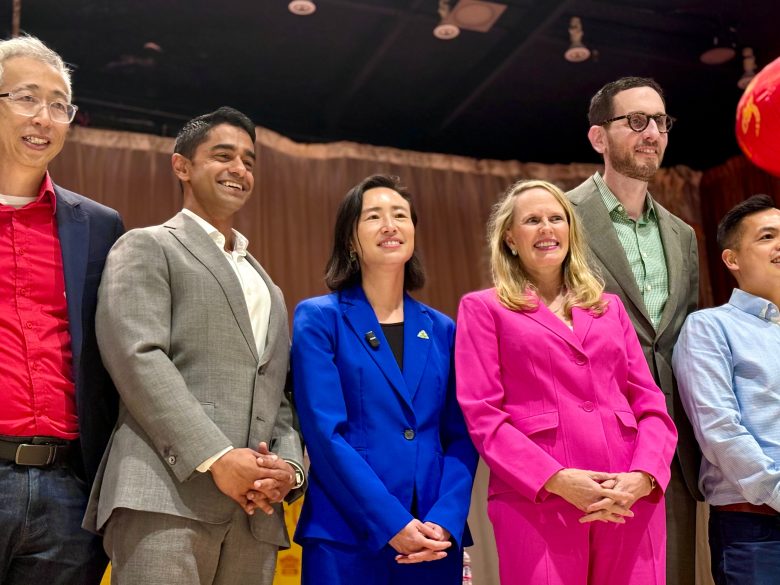

Supervisor Connie Chan, a self-described “Chinatown daughter” and the only major Chinese American candidate, leaned into identity politics at Saturday night’s Congressional forum in front of more than 200 residents at Chinatown’s Victory Hall.
“This is a historical moment for us, for our community to take our voice from San Francisco to Washington, D.C,” said Chan who talked about immigrating with her single mother and a brother to San Francisco’s Chinatown without knowing a single word of English. “I understand our pain and I understand our voices.”
Although there have been two earlier forums, Saturday was the first time the three leading candidates shared a stage since Jan. 7. In that forum, State Senator Scott Wiener’s failure to clearly answer a question about genocide in Gaza created a backlash. Wiener now uses the word genocide in regard to Gaza.
It was Taiwan, not Gaza, however, that got top billing on Saturday night and the audience listened closely with Chinese-speaking grandpas taking meticulous notes on slips of paper throughout the evening.
Taiwan is the foreign policy issue that figures most prominently among Chinese American voters who account for more than 16 percent of the electorate. Whoever wins this race will replace Representative Nancy Pelosi, who in 2022 became the highest-ranking U.S. official to visit the island in 25 years. That visit aggravated mainland China’s government, which subsequently encircled the island with unprecedented military exercises.
“I do not agree with her decision,” said Saikat Chakrabarti, a centimillionaire candidate, who received the loudest applause and cheers of the evening in response to the question on Pelosi’s visit to Taiwan.
Chinese American voters here saw the visit as inflammatory. They rank maintaining peace with China around Taiwan as a top priority.
“That was a provocative action, and the absolute worst thing that could happen right now is a full-on war with China,” Chakrabarti added.
He continued to say that he sees a bipartisan hawkishness towards China in Washington, which has resulted in a Cold War that led to an increase in anti-Asian hate within the United States. “In Congress, I will fight to stop the Cold War with China,” he said. The audience burst into applause.
Wiener got booed a little when he said he supports Pelosi’s decisions.
Chan, who needs both the Chinese votes and Pelosi’s endorsement, avoided directly answering the question, simply emphasizing that the Taiwan issue “is deeply personal” given her years in Hong Kong and Taiwan, and said the United States should be an agent for peace. “I advocate for us to really make sure that we encourage Taiwan and China that direct dialogue is important.”
For much of the evening, the candidates stressed their bona fides. As the only Cantonese speaker, Chan had an apparent advantage, doubling her speaking time by deftly interpreting her own answers into Cantonese. The other candidates relied on interpreters.
Wiener emphasized his contributions to the Chinese community, citing work on affordable housing, expanding access to healthcare, acupuncture benefits, protecting funding for Muni and BART, reinstating eighth-grade algebra, pushing back against anti-AAPI hate, fighting against vehicle break-ins, and delivering resources for the Chinese Hospital, the Chinese Cultural Center, Wah Mei School, and Portsmouth Square. The list he wanted to present was so long that the time-up alert rang before he finished.
Chakrabarti, who has spent less time courting Chinese American voters and only finalized his Chinese name months ago, tried to dazzle the audience by spotlighting his resume: a Harvard University graduate, a main contributor to Bernie Sanders’ 2016 presidential campaign, Alexandria Ocasio-Cortez’s 2018 Congressional campaign, and the Green New Deal.
An unexpected participant was Marie Hurabiell, whose resume is in a league of its own compared to the other three. Hurabiel was a Trump appointee to the Presidio Trust board, remained a registered Republican until 2022 and wrote in a June 2025 social media post that “Trans women are NOT women.”
“For one end of the spectrum, there are three people in the race. The entire rest of the spectrum … there’s no one,” Hurabiell said in an interview. She said she entered the race two weeks ago because she felt compelled to “give people a choice.”
During the forum, Hurabiell was often the lone candidate who didn’t blame Trump for the current conditions. Hurabiell also runs Connected SF, and previously ran unsuccessfully twice for the City College Board of Trustees. Just as Chakrabarti frequently invokes Sanders and Ocasio-Cortez, Hurabiell’s campaign messages are about President Donald Trump and Mayor Daniel Lurie — her campaign website claims Connected SF played a key role in electing Lurie.
Hurabiell believes a significant portion of the Chinese American community belongs to the spectrum that she represents, so at Victory Hall she pointed to the ideological similarities. “We have stood shoulder to shoulder in these fights,” she said at her first forum, referring to the recall of former District Attorney Chesa Boudin, the recall of the school board, and the fights for algebra in school and to keep merit at Lowell.
The forum was co-hosted by San Francisco’s three Chinese political clubs, the Chinese American Democratic club, the Edwin M. Lee Asian Pacific Democratic Club, and Rose Pak Asian American Club. “All three clubs have worked very hard over the past several weeks to make this event possible,” said Jeremy Lee, president of Rose Pak Asian American Club.
After the Jan. 7 debate where Wiener failed to clearly answer a yes/no question on Gaza and in advance of Saturday night, his campaign sent debate guidelines to organizers, suggesting rules such as “No lighting rounds, yes/no, or speed rounds, where candidates only get a few words to respond to questions.”
“Any suggestion Senator Wiener is avoiding candidate forums is literally made up,” said Wiener’s campaign spokesperson Joe Arellano, adding that Wiener is scheduled to participate in “an additional eight and counting” forums before the June primary.
To protect the monolingual Chinese-speaking audience and non-Chinese speaking candidates, moderators warned all interpreters that they would be replaced if their interpretation was materially different from the candidate’s statement three times. It worked.
On several occasions, the bilingual organizers and campaign staff pointed out inaccuracies in the nuanced political translation, and interpreters corrected them immediately.
Throughout the forum, Chakrabarti emphasized cutting the military budget and ending corruption in Congress, including banning members of Congress from doing insider stock trading and ending corporate money in politics. “I’m also the only one willing to take on not just Republicans, but a corrupt Democratic establishment,” he said. He also committed to doing town halls multiple times a year when he becomes San Francisco’s representative.
Chan pledged to fight for working families and a future that has free city college for all. “We will take our working people’s agenda, our immigrant agenda from Chinatown, from San Francisco, and all the way to Washington, D.C.,” she said.
Wiener, who recently unveiled an ambitious Congressional housing platform to build eight million homes over the next decade, returned repeatedly to housing policy.
After being led for four decades by a leader “who has moved mountains for San Francisco,” said Wiener, who does the city need next?
Wiener’s answer: “We need someone who wakes up every morning thinking, what am I going to do for San Francisco today? That is what I do.”
Forget about Wiener or the leftist carpetbagger from New York Chakrabarti.
Connie Chan stands above both of them.