


Of all the recent dings against historic preservation — and there have been a heap — perhaps none is as ironic as the near demolition of 2229 Webster St. in the Fillmore District. The Italianate Victorian was for decades home to Anne Bloomfield, a dedicated preservationist who was president of the Northern California Chapter of the Society of Architectural Historians when she died.
While her research led to many landmark and historic neighborhood designations — and it was the backbone of a survey discussed later in this piece — she couldn’t protect her own house. The renovation of her longtime home, built in the 1870s, far exceeded its permits.
Yet overzealous construction projects are nothing new in San Francisco’s real estate market, where home values are worth exponentially more than the penalty fees associated with violating the rules around constructing them.
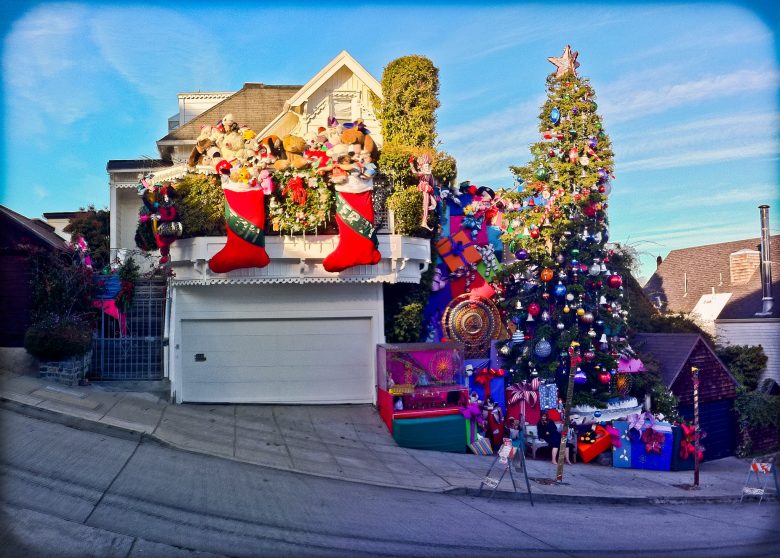
“We have seen a number of so-called renovations that have been functional demolitions,” said District 8 Supervisor Rafael Mandelman. Mandelman, who sees historic preservation as a key part of his legacy, said that while that kind of activity has been going on for decades, what’s different now is that state laws are being used to destroy particularly beloved buildings. He cited the Tom and Jerry house on 21st Street, slated to be torn down, but long famous for its elaborate Christmas decorations.
A raft of other pressures — most notably the state-mandated Family Zoning Plan, which requires San Francisco to create 82,062 additional housing units by 2031 — have historic preservation advocates increasingly concerned.
“The city has not been kind to preservation in 2025,” wrote Woody LaBounty, president of SF Heritage, in protest of the southward turn of affairs.
Preservation advocates’ concerns continue to mount, given the loosening of discretionary reviews, the unprecedented planned demolition of a historic landmark at 447 Battery St., the demolition of the McCroskey Mattress Building in a historic designated district and proposed changes to the Historic Preservation Commission to lessen its power.
“It’s a legitimate concern,” said District 3 Supervisor Danny Sauter when asked if the push for development could threaten historic resources. “There’s a balance we need to find here.”
North Beach Historic District: Land Grab or Political Play?
Sauter’s district became the focus of one of the most controversial preservation showdowns when a North Beach Historic Designation proposal — pursued at the federal instead of local level — turned into the subject of hot debate.
While Sauter said he supports a historic designation for North Beach — and claimed his office is close to finishing a local version of such a proposal — he is against the federal version that was first proposed in June 2024, yet has been mysteriously stymied since, dropping off the state’s agenda for technicalities or without any explanation at all.
“The proposal that was put forward is really expansive and includes parking lots,” Sauter said. “It includes sites that I don’t think anyone would tell you with a straight face are actually historic.”
Yet Katherine Petrin, the architectural historian who was hired by the Northeast San Francisco Conservancy to put together the survey for the North Beach Historic District proposal, said the survey has been misrepresented.
“The word is out that we want to landmark every garage in North Beach,” she said, noting that 99 sites — including vacant lots and garages — were identified as prime options for redevelopment as part of the survey. The only garage included in the historic designation is a clinker brick structure and Hildebrand stable built for former San Francisco political kingpin Abe Ruef. “Not all garages are the same,” she said.
Some, including Sauter, speculate that the pursuit of historic designation is in direct response to the housing mandate — that securing such protection will limit the amount of housing that can be built. Yet Petrin claims this survey work began long before the Family Zoning Plan was enacted.
“People who are in opposition think that this was just dreamed up overnight to thwart development efforts,” she said. “The truth is that this started decades ago, and it was work that just kept being built upon.”
Many people assume North Beach is not already designated a historic district, Petrin said, and so she was surprised by the amount of controversy the proposed designation generated—including what appears to be political interference with the process of the designation, which was first submitted two years ago but has never gotten on the agenda of the state’s Historic Resources Commission.
“It’s a mystery why,” LaBounty said. “There are signs that there’s opposition from people who don’t understand what it means.”
LaBounty said that after decades of unsuccessfully trying for historic designation at the local level, the federal path was pursued because it was less onerous. But now, that process appears to be compromised. “If you can just not hear an item and it can be killed at the state level after […] going through all the work, then you can’t trust the process anymore,” he said. “In the preservation world, we’re sort of left in this funny situation where we’re like, what are the rules?”
A Tale of Two Buildings
When the developer Related California created a new iteration of its Financial District development to create office and hotel space that swallowed up a historic landmark last summer, there was nothing the Historic Preservation Commission could do to stop it. The commission voted against rescinding the landmark status of the three-story brick Jones-Tierbach coffee building landmarked in 2022, but it didn’t make a difference.
“Why are we bending over backwards to let this developer get what it wants, so that we lose the landmark?” LaBounty asked. “We’re so focused on economic revitalization and getting what we want, especially downtown, that we will start giving up things.”
The developer of 447 Battery St., Related California, did not respond to a request for comment.
While it’s easy to overlook the Jones-Tierbach coffee building as a historic landmark — and some question its special-ness — the opposite holds true for the recently demolished McCroskey Mattress Building, which many presumed was already a historic landmark, given its facade. Yet it’s simply within a historic zone, the Market Street Landmark Historic District.
That means it did not face any additional review when it was demolished to make way for an artist incubator at 1687 Market St. spearheaded by SFJAZZ founder Randall Kline. Preservationist advocates like Mandelman, Petrin and LaBounty see it as yet another example of a changing tide.
Yet the Market Street project differs from Battery Street in important ways — it’s creating housing rather than more office space and hotel space at a time when retail vacancies and hotel recovery are still sluggish. The Market Street corridor also does not have the historic clout that North Beach does; no tourist is clamoring to make that the first stop on their itinerary.
The Artists Hub on Market will create 94 units of affordable housing with priority for artists, along with two additional floors of performing arts community space. The original design for 1687 Market St. included keeping the original facade of the mattress company.
“We knew that people love it and there was a real attachment to it,” said Fiona Ruddy, senior project manager at Mercy Housing California that’s partnering with the Artists Hub on Market.
But when they learned that they would be able to increase the unit count from 77 to 94 units, they decided, after much internal discussion about the tradeoffs, that the priority should be adding more affordable housing. “We felt what was really important was delivering the largest number of units we could, understanding that we’re in a housing crisis,” she said. Other nods to the building’s history, like an old spring making machine and some historic signs, will be incorporated into the building’s design and the mattress company’s integral role after the 1906 earthquake is highlighted on the project’s website.
At a time when so many artists are being priced out of the city, no one can be faulted for wanting to welcome them back in. But only time will tell if the addition of 17 units was worth the loss of an iconic facade, especially when there’s evidence that increasing affordable housing stock alone will not solve the housing crisis. One thing is for certain — when something is destroyed, it’s gone forever.
“It’s a hard moment in the sense that it’s hard all over the country,” LaBounty said. “Donald Trump tore down part of the White House without any talk about it, just did what he wanted.”