

The Mission District is getting 30 new treatment beds for those fresh out of a recovery program.
The project is by Friendship House, a social services nonprofit specializing in American Indian issues, and subsidized with financing from a Behavioral Health Bridge Housing grant that the city began receiving from the state in 2023.
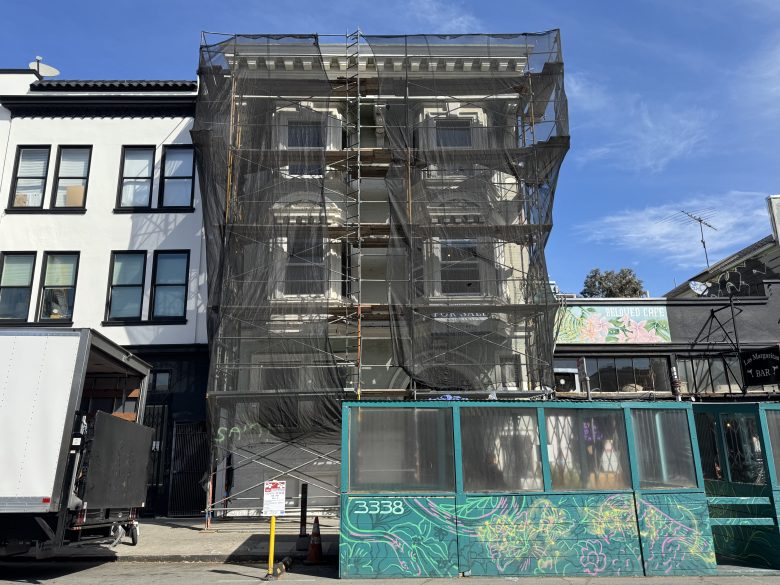
The beds will be housed at the New Path Forward Recovery Lodge at 3340 24th St. near Bartlett Street, which is owned by Friendship House.
Clayton Dumont, chief operating officer at Friendship House, said the funding will allow New Path Forward to offer up to two years of housing to eligible patients, who must be a graduate of any recovery program, and at least 90 days sober.
Friendship House currently runs an 80-bed substance recovery and prevention program at 56 Julian Ave. between 14th and 15th streets. Patients, who are mostly American Indian, can stay up to one year at the facility, which combines American Indian and Western practices.
The nonprofit submitted an application to the Planning Department on Feb. 19 to change the use of the 24th Street building from residential — it was an apartment building — to affordable group housing. The three-story Victorian, which was built in 1908, has 17 rooms and will accommodate 30 beds of supportive housing.
Dumont said that between 80 and 85 percent of Friendship House’s patients are American Indian and come from across California for treatment.
About half of them choose to stay in San Francisco once they’ve completed the group’s program, but they often face difficulty finding beds at a subsequent sober-living facility or finding “culturally competent facilities.”
“They’re oriented toward different spiritualities than ours. They’re not targeting American Indians like we want to,” said Dumont, of other sober living programs. “Our founder, Helen Waukazoo, always had the dream that we’d be able to offer that next stage of care.”
Friendship House moved closer to fulfilling Waukazoo’s dream by purchasing the 24th Street property in November, which at the time was empty. The property sold for an estimated $2.1 million, according to the real estate site Redfin.
When Mayor Daniel Lurie took office in January of 2025, he promised adding 1,500 treatment beds in his first six months in office to end homelessness.
Lurie later pushed his deadline from June to September and later dropped the numerical goal entirely when it became clear he was going to miss the target, even after broadening the definitions of “treatment bed” to meet his goals.
Facilities like New Path Forward illustrate a shift in focus citywide toward funding smaller facilities with more comprehensive programs.
Friendships House’s chance of use permit is considered administrative and does not require a vote by planning commissioners or a public hearing. A spokesperson for the planning department said it will likely approve the permit by the end of the month.
Once the permit is approved, New Path Forward Recovery Lodge would start interviewing patients, and the first residents could start moving in within a week or two, Dumont said.
Friendship House plans to offer counseling sessions, individual treatment planning, workforce development, resume building and outpatient groups, a necessary and important component of recovery, according to Dumont.
“The main thing that really promotes long-term recovery are groups — outpatient groups,” he said. Outpatient groups are recovery services offered to people at their place of residence.
“We’ll offer those several times a day. We’re having counselors scheduled to be there from 8 a.m. to midnight so it can cover different people’s shifts, depending when they’re working.”
Friendship House won’t start offering counseling until it secures the required state licensing, which can take between four and seven months.
In the meantime, the New Path Forward Recovery Lodge will have a house manager supervising the facilities, and it will offer talking circles, “Red Road” groups — an American Indian 12-step program — and peer to help residents with various tasks, like filling out DMV forms or refilling medication.
Residents may also be invited to sweatlodge ceremonies at Friendship House’s facility at 56 Julian Ave.
Meanwhile over on Julian, the fentanyl fold and squalor spill over from the fentanyl addict magnet of the Gubbio Project laps up onto Friendship House and Centro Latino senior center to the north, and people’s homes to the south.
Gubbio doesn’t care about the impact they have on the neighborhood, only that the government cash keeps flowing in.
recovery house on 24th st. 2 doors away from a BAR!!! WTH!!!!????
It’s a really bad idea to put a sober house steps away from active drug abuse in a city that loves booze and drugs.
SMH. who thought this was a good idea.
Makes little sense. We have to import out of area addicts to a major city and place them directly on a street with lots of temptations as opposed to Modesto, or Ukiah or something less big city?
“ Dumond said that between 80 to 85 percent of Friendship House’s patients are American Indian and come from across California for treatment. About half of them choose to stay in San Francisco once they’ve completed the group’s program”
Why are we intentionally importing more homeless people?
Ka-ching!
I have to comment,you people are awesome! The reporting you do not only educates the public about what’s going on in San Franciscos less.afluent communities,you get the real ” skinny” on where the taxpayers dollars are going,( or not going) timelines and updating previous stories. I realize it’s not an easy job, but your engagement and enthusiasm are highly appreciated,GREAT. JOB ,And Thank You.
Campers, (pun intended)
It took me a year or so of picking up trash with Skippy in ever roving tough yet fragile and both scary and pitiful people around our Trash Route (see our QR for news) to realize that the Tent People had never left.
While the tents were gone …
We’d actually been doing Porter Janitor work (that’s when you clean while the business around you continues) inside of Homeless Encampments for, like, maybe 3 years.
So, there are just over 8,000 counted Homeless.
3,200 of them are heavily addicted.
1,000 of these will die annually.
But, as times get harder as the Rich squeeze tighter through the President and now, our Mayor, people will get more desperate and more will turn to drugs and be forced into Homelessness.
Did I really pick this thread ?
go Niners !!
h.