



Is there a path to transit salvation through … Hunky Jesus? Signature-gatherers for a five-county BART rescue measure are praying for it.
Last week, we wrote about the terrible, awful, very bad consequences for BART if voters spurn that potential November revenue measure: Dirtier trains, crappier service, station closures, higher fares — human sacrifice, dogs and cats living together, mass hysteria.
But, as we disclosed, it’s actually worse than that: All of these privations assume BART continues to exist. Without a transfusion of revenue, there’s no reason to believe it will:
At long last, the BART tunnels will be free to film the sequel to “THX 1138.” And in transit, misery loves company: The November measure would also provide revenue for Muni, Caltrain and AC Transit. Without it, Muni will slash service deeply and Caltrain and AC Transit are in danger of shuttering — especially Caltrain.
We regret to inform you that it gets even worse. In order to pass with a simple majority instead of a two-thirds vote, this five-county measure is being signature-gathered. That remains a significant challenge: The requirement is 186,000 valid signatures by early June.
“We are feeling good about where we are, but it’s definitely a steep hill to climb,” says Jeff Cretan, the spokesperson for Connect Bay Area, the committee that formed to signature-gather this measure and, if things work out, campaign for it.
Lousy weather in February didn’t help. A ton of signature-gatherers for other measures doesn’t help, either. That includes a measure to fight the so-called billionaire tax, funded by billionaires.
This is driving up the price of paid signature gathering and, naturally, the paid gatherers are going to be working harder to push the measure for which billionaires are paying $20 a signature.
It remains to be seen if enough signatures can be gleaned from farmers markets and transit stops across five counties.
“We’ll be at Giants games,” Cretan notes. We get a sinking feeling that this may be the highlight of many Giants games this year.
And, yes, “we’ll be at Hunky Jesus.”
If the signature-gatherers are forsaken and don’t meet their goal, the measure won’t even appear on November’s ballot. And all the dire outcomes will come to pass — dogs and cats living together — without voters even having a chance to weigh in.
BART is a system that was, literally, created to ferry workers and shoppers from the outer suburbs to Downtown San Francisco.
BART employees in 2019 were worried about too many people taking the train. While transit systems, on average, make back about 17 percent of their operating budget from “farebox recovery,” BART was pulling about four-and-a-half times that.
And then 2020 happened. In inflation-adjusted dollars, BART’s revenues decreased around $371 million in 2024 vs. 2019. And BART’s operating deficit stands at $376 million. Transit funding is complicated, but this isn’t that complicated.
BART’s robust farebox recovery immediately flipped from being a strength to being a weakness. Same goes for Caltrain. But, long before the pandemic, not everyone was thrilled.
“I remember getting into an argument with the Caltrain people, who were bragging about 70 to 75 percent farebox recovery,” said Sen. Scott Wiener.
“No, no, no! That is not something to be proud of! It means your only option to raise revenue is raising fares. We’ve known since before the pandemic that they need more stable tax revenue.”
But that’s hard. In 2023, Wiener proposed funding transit through raising bridge tolls. That didn’t work out. In 2024, he tried to engineer a nine-county transit revenue measure. That, too, failed to launch.
And in 2025, along with Sen. Jesse Arreguín, he engineered the five-county measure presently taking the Hunky Jesus and Giants game signature-gathering path to (potentially) appearing on November’s ballot.
One of the complaints leveled against this measure is that it’s a sales tax — meaning the panhandler outside Oracle Park pays the extra penny for every dollar spent to support transit same as the millionaire ballpayers inside the park. Whatever complaints there are, Wiener has heard them, and thought about them, and tried to mitigate them.
A gross receipts tax on big businesses, he says, probably wouldn’t have advanced off the Assembly floor. This sales tax barely did.
It also likely would have resulted in Santa Clara and San Mateo counties leaving the five-county group. It would’ve resulted in an opposition campaign from big business interests. And it didn’t poll high enough to necessarily survive that. And, to top it off, it’s hardly clear that Gov. Gavin Newsom wouldn’t have vetoed a tax on business.
“Senator Arreguín and I made an assessment after a lot of work that the only viable path forward was a sales tax,” Wiener says. “In the end, to me, job No. 1 was making sure BART doesn’t collapse, Muni doesn’t cut service by one-half and AC Transit and Caltrain don’t unravel.”
Our article last week elicited a good deal of chatter and feedback. Mission Local can’t tell you how to vote, but it can tell you when your arguments don’t add up. Most of them don’t.
Complaints that BART could just cut its way into right-sizing without additional revenue are nonsensical; recall the revenue numbers vs. deficit listed above. They’re pretty much one-to-one.
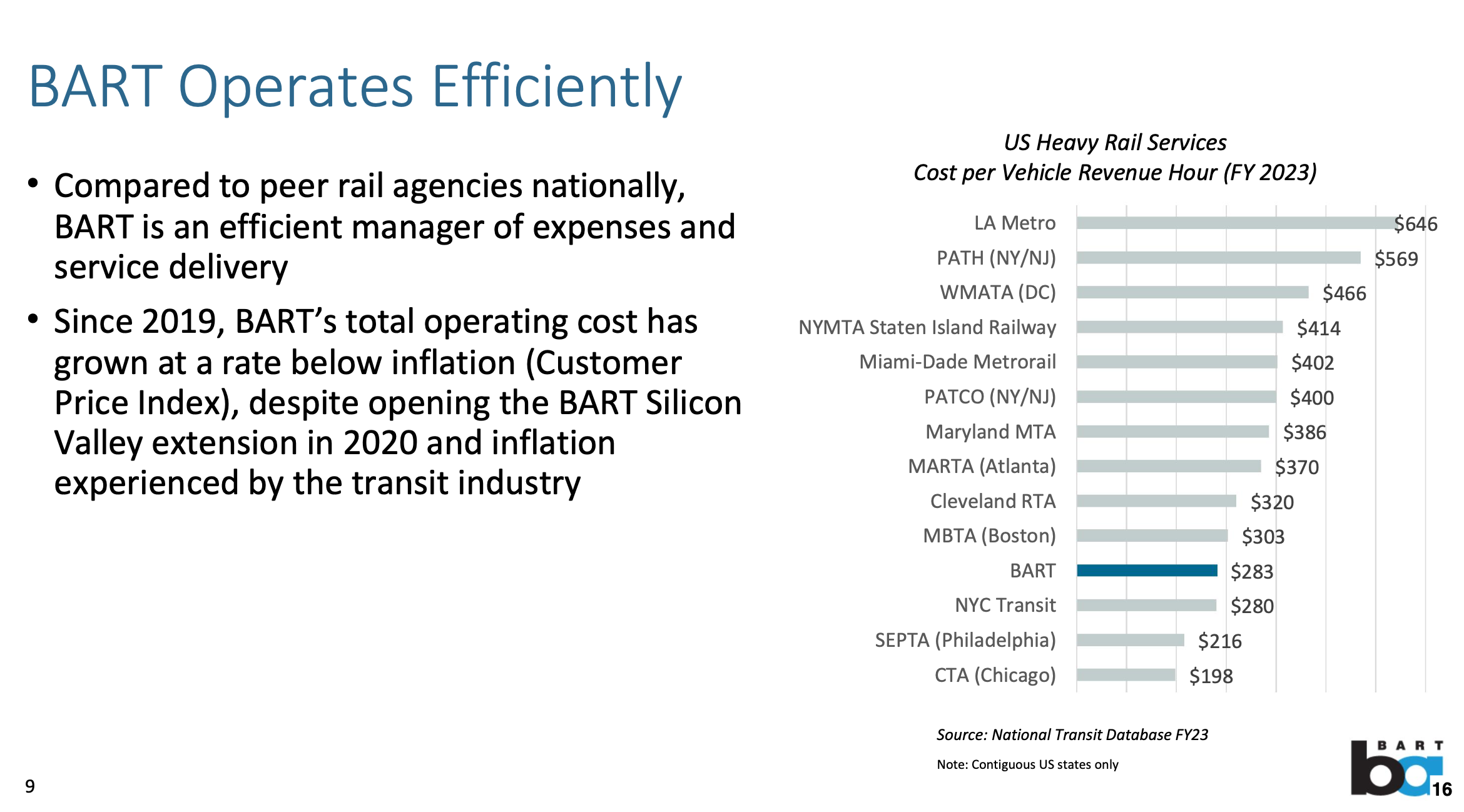
Complaints that BART has been profligate with its spending also do not add up: On almost any metric, it remains one of the more efficient transit systems in the nation, even in its weakened state.
Complaints that the present management will be left in place assumes that there is someone else who could do better. Say what you will about BART, it is not run uniquely poorly.
Complaints that BART is being held hostage by its drivers’ union are not relevant to the budget deficit on hand. Drivers’ salaries, including overtime, account for between 7.77 and 7.96 percent of BART’s preliminary fiscal 2027 budget of $1.05 billion.
That’s a ceiling of around $83.5 million, which is a lot of money, especially if placed in two piles, but a small fraction of the operating deficit.
Complaints that BART is overextended and built unnecessary infrastructure are valid — but, again, irrelevant to the budget crisis of the moment.
Transit systems run on capital budgets — building stuff, procuring stuff — and operating budgets — day-to-day stuff, paying people’s wages and the electricity bill. The sources for these two budgets are separate and very rarely commingled.
Anyone complaining that, if only BART had stuck to core service it wouldn’t be in this predicament, does not understand the most rudimentary elements of transit funding.
Complaints that sales taxes are regressive ignore the fact that transit fares are regressive — you pay the same $2.55 to travel from Embarcadero to Balboa Park that Mark Zuckerberg does. Alas.
Complaints that BART is unaccountable in its budgeting and spending somehow ignore that BART is the rare transit system with an independent inspector general mandated to root out waste, fraud and abuse.
The IG is appointed by the governor, meaning she does not answer to BART’s management or its board. To date, the inspector general has, per its own accounting, recovered more than $2 million. That’s great, but it’s budget dust in government terms. BART could run better but it is, evidently, not rife with waste, fraud and abuse.
What’s more, the legislation earmarking sales-tax money for transit would mandate BART (as well as Muni, Caltrain and AC Transit) to be subjected to independent financial efficiency reviews by a third-party.
They’d be made to prove efficiency measures they’d taken, come up with a plan to implement more, and their money could be withheld if they don’t enact that plan.
Hey, guess what? BART’s revenues in the first two quarters of fiscal 2026 were 10 percent higher than expected. Expenses, meanwhile, were 9 percent lower than expected. That’s kind of what you’d want with a public agency desperately trying to squeeze the most out of every dollar.
We can’t tell people gleefully cheerleading BART’s demise how to vote. But we can tell them that there is no downtown recovery without BART. Anyone happy to let BART fail has to be happy to let Downtown San Francisco fail. There is no daylight here.
Perhaps, in the end, gasoline prices approaching the per-ounce cost of Simpler Times beer will play into BART’s favor. That, along with Hunky Jesus, could be a formidable one-two punch.
And, hey, if the transit system collapses, there’s always that “THX 1138” sequel. As they say, always look on the bright side of life.
Until the Wall Street crash of 2008, The State of California provided Muni with nine figures per year in operating subsidy. Roll those figures forward with inflation and those nine figures would basically plug the Muni gap entirely. I am not sure what kind of operating subsidy BART got, if any.
State operating subsidies are the way to go, not sales taxes, to have a government with a $350b budget spare a billion or two to subsidize public transit ops statewide to the point where transit is virtually fare free at the point of use.
Why can’t Scott Wiener get back for us now that which was ours in the first instance?
I think it’s a tough sell to ask legislators — and their voters — from SoCal and the Central Valley to pay for our transit.
Transit is a regional service. It makes sense for it to be paid for primarily with regional revenues.
There are transit systems in SoCal and in most counties, few as intensive as Muni, BART, AC Transit and LA.
The subsidies were relatively large, but about 1/4 of operations costs.
In general, public transit signficantly increases economic efficiencies, and in the end pays for itself. In that sense it is an investment, not an expense.
At what point in time, all things considered, would you envision CAHSR “paying for itself”?
I am talking about county and city public transit operations budgets, not new construction.
HSR is your typical CA Democrat contracting corruption where projects are slow walked to maximize take by connected contractors.
The topic of this article is transit operations budgets for systems that are already in place, not capital budgets for HSR.
Those economic benefits are, again, primarily to the benefit of people here in the region the system serves. They’re a good argument for supporting the ballot measure! But I don’t see how they really help in convincing a skeptical voter in Fresno that their taxes should fund BART or AC Transit.
Then why isn’t it a tough sell to ask SoCal and Central Valley voters to pay for our highways (and us to pay for theirs)?
Because that happens. And at a much larger scale than the funding BART needs. The BART deficit is less than 9 days’ worth of Caltrans’ annual budget (want to check my math? it’s $376M vs $16B).
Well, I’d sure like to see more public funding go to transit, and not quite as much go to car infrastructure.
But I think you pointed already at an answer to your own question: the highway funding is mutual. We pay for the Central Valley’s highways just like they pay for ours; highways are something a typical voter most anywhere in the state sees their own area as benefitting from. We don’t so much pay for the Central Valley’s transit, because it has a lot less transit.
A key difference is that everyone benefits from roads. Because even if you don’t drive, everything you buy has traveled to you by road.
So a taxpayer in SF benefits from the freeway and highway system across the state. But voters in Fresno do not benefit from BART.
Marcos, there is no appetite in the majority of California for centrally funding a transit system for the SF Bay Area. Heck the State is even struggling to find money for a High-Speed rail system that would benefit the entire State.
That ship has sailed and if locally we want a Rolls Royce transit system (and BART is the only one in the State – even LA has only a light rail system) then we locally are going to have to pay for it.
Where is the voracious appetite – outside Sacramento – for continuing to fund the HSR boondoggle? It’s essentially an opportunity-cost or mission-creep at this point.
If BART is the Rolls-Royce of transit systems, I shiver to think what the Chevy equivalent might be.
Thanks Joe, this is by far the best summary I’ve read about the current budget situations facing our mass transit systems. One question, does the sales tax increase sunset at a specific date or does it go on in perpetuity.
Ian —
Thank you kindly. I believe it is a 14-year sunset.
Best,
JE
I am truly confused about what people who are happy to see BART go want commuters to do. Do they really want and estimated 80,000+ more people driving over the Bay Bridge every day? Because that’s the number of people using BART to cross the bay every day. What am I missing?
This could be a slam dunk class action lawsuit for disabled Californians. This article outlines how little appetite at the statehouse there was to spend existing income & sales tax dollars on transit, so now everyone wants to shift that burden to vulnerable low-income Californians too? I can’t think of a better federal court to rebuke California. I dare everyone to sign & vote yes.
If the anti-bart people could read, this article would make them really mad
Here’s how to get away from the politics:
Take a piece of paper, draw a circle on it. Then think about how you think our tax dollars shoud be spent in proportion. Add things like: Roads, Water, Sewage, Police, Fire, Social Services, Public Transport.
(Assume that they are covered 100% by public taxes, trying to include “fare recovery” is one step from insisting that the police pay for their own existance by traffic tickets and that is just political minefield)
So, once you draw your little pie chart showing how you believe, in your dream set up, the money should be spent to best invest in a solid, functioning city, go pull the real numbers and you’ll see where we need to move.
Seriously. The first step is to assume that the fare you pay for a bus or train doesn’t exist any more than assuming parking pays for roads or traffic tickets pay for cops. OF COURSE it isn’t the same, but for the purpose of this exercise, it makes is a LOT easier to get to a legitamate answer without debate.
I actually learned this during a project management seminar where you were to do it with one circle where you break up how you think your work/life balance should be with family/work/education/etc… and then break it down about how it acutally is in another circle and THAT will show you where you need to do some work. It’s a great way to find a *direction* that you need to go without politics
I’m starting to wonder if you care who this endeavor hurts. Every argument and even misinformation will be resorted to to make sure these systems aren’t compromised further.
I don’t pay the same as Mark Zuckerberg for BART, etc (e.g. Clipper Access) & Muni is free for disabled residents in San Francisco. The sales tax would hurt people who can’t mitigate what your asking of us. smh
I would think that the problem getting signatures in SF supporting BART, as opposed to supporting Muni, is clear enough. Muni in SF provides an entire transit network. But BART is not a network at all but rather a single line connecting downtown, the Mission, the 280 corridor and SFO.
So if you live in the north or west parts of SF, BART does little for you. So why vote for more tax to bail out BART?
Of course BART is a true network in the East Bay. There are four lines. You can take it from Richmond to Dublin, or from Antioch to Fremont. But why would a SF voter care about that?
Well, do you ever use that Muni network to go downtown, or to SoMa?
Everything downtown that you take Muni to (or drive to) — an employer, shops, restaurants, theaters, etc. — has lots of other people getting there by BART. If BART gets left to die, then all those places will suddenly have a lot harder time pulling in workers, customers, visitors, etc. Many of them in turn will go under, or leave the city. That would be a real hit to the advantages of living in a city in the first place.
Living in the Mission, I take BART all the time from 16th through Embarcadero. Almost daily. There’s a Muni line but it’s not as convenient.
Sure, BART is great if you live in the Mission. But what if you live in out in the Avenues?
Like I said, BART is a single line. It is not a transit network or city-wide service. Heck, it only has 8 stops within the city limits.
I am supportive of the sales tax measure because there is no alternative. But I disagree with the argument presented that, although the BART inspector general is powerful and independent, they have not been able to find much fraud and waste in the system. The implication being that this is because there is not a lot of fraud to uncover.
In fact, the BART inspector general is very weak, and their investigations are routinely obstructed by the BART management and the unions. An Alameda County grand jury confirmed this obstructionism in a 2022 verdict, and the BART inspector general, Harriet Richardson, went so far as to resign in protest of this in 2023!
I am disappointed that this sales tax measure did not have additional riders strengthening the role of the inspector general and their ability to conduct investigations. It is also disappointing that there was no discussion of merging agencies, as one of the reasons for inefficiencies is how many transit agencies the Bay Area has. A rare opportunity for major reform and consolidation of the Bay Area transit agencies has been missed in this moment of maximum leverage.
The thing that blows my mind is that Muni’s farebox recovery is around 25% … so when I take a trip on MUNI, I pay $2.85 and taxpayers pay $8.55 for a total cost of $11.40 … when I could have just taken an Uber for $10. Muni is so grossly inefficient it’s mind boggling
Yes, and I’m sure if every rider of muni decided to book an uber, the price would stay $10.
Love that the article completely glosses over where revenue stands to be gained – the homes and businesses (especially in SF) along the BART line. No value assessment tax there means cheap taxes but extremely valuable property. It’s insane how much BART relies on fare. Maybe these transit user-owners should chip in too instead of stealing from the rest of us.
Is it possible for me to sign somewhere online? Or do I have to find a canvasser in person?
You have to find a canvasser in person. They’re legally required to witness you signing the petition, and attest that they did so. If you go to the Connect Bay Area website and click on Events, you can find a list of times and places signature gatherers will be!
Jeff Cretan – Solid politico, unfortunate name
BART farebox recovery was a “suburban commuter” fare structure on a subway system enabled by long distance commutes to high salary offices. Now that WFH has taken over, that pattern is unlikely to return. In future a flat fare with full free transfers to first/last mile buses would be more equitable. Insisting on that fare structure in return for the greater funding should be the deal.
Great article. Thanks for writing it. If the annual overtime for drivers is $83.5M, what about the overtime costs for the other major groups of employees? $8M? Another $80M? It’s often claimed that labor costs including OT are too high; I’d love to be able to refute this with numbers.
Sir or madam —
The drivers earn up to $83.5M in wages *and* overtime.
JE
“ Mission Local can’t tell you how to vote but it can tell you when your arguments don’t add up. Most of them don’t. ”
^^ Any pretense about non-biased objective reporting has left the room. At least the Mission Local room. It’s sad actually, because the media push is well orchestrated and well funded.
Jake —
This is a column, like it says on the top. News organizations have been running reported columns going back more than a century. This would be clear to anyone who read a newspaper at any point going back that time. Thank you for noticing.
Best,
JE
Redirect a third of our bloated, ineffective homelessness spending to transit and the deficit disappears. Problem solved.
24 billion dollars for losers, is central to California’s religion of ‘compassion’. Without it, we would just be normal rational people. Not zealots on a mission to subvert human nature and invent a new way of collective failure.