
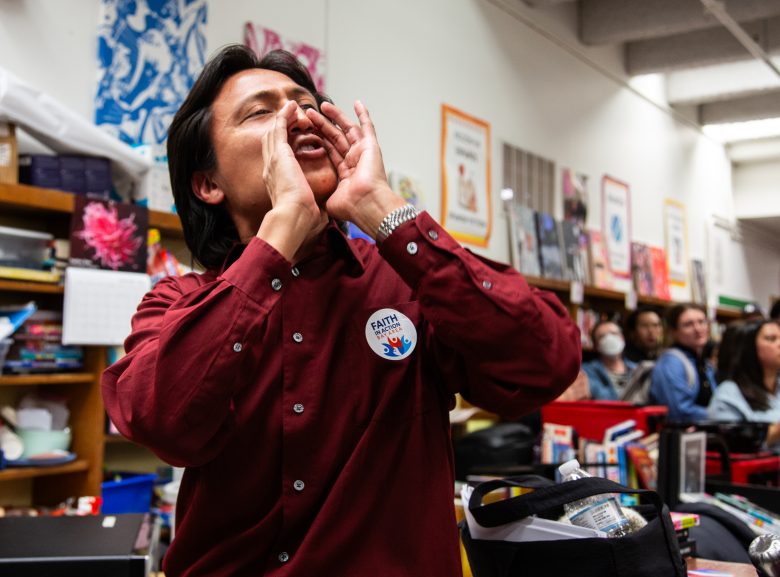

Last week, San Francisco Unified School District Superintendent Maria Su stood before a large crowd of students, parents and educators and offered her explanation for a decline in the number of students entering San Francisco public school “newcomer” pathways.
These are programs specifically earmarked for recent immigrants with limited English proficiency — as well as potential ongoing strife, trauma and poverty. It’s a great deal more than just classes in a specific language.
The reduction, Su said, was because more and more recent immigrants don’t want to be in these programs. Specifically, they’re scared of being publicly identified as immigrants in Donald Trump’s America.
“A lot of our students, a lot of our families are not choosing to go into the newcomer programs,” she said. “For a lot of reasons. A lot of our families are scared.”
It is hard to overstate how badly this went over with the assembled crowd. In your humble narrator’s own personal life, the moment rekindled distant memories of the time that neighborhood mortician Ed Newberry had the brilliant idea of creating beer ice cream and offering it to everyone on the block.
It tasted so awful that even Suzy Q, Ed’s doberman pinscher, wouldn’t eat it. So it was a bit like that, but without snacks.
Su was given the Showtime at the Apollo treatment, and then everyone went home and moved on to worrying about the looming teacher strike and all the other things people are afraid of in Donald Trump’s America.
But it’s not just partisan audience members who are objecting to Su’s claim that San Francisco’s immigrants are too fearful to take advantage of the very programs created to serve them.
Numerous veteran district employees are pushing back, hard, against the notion that demand for newcomer programs is dropping largely because those newcomers are scared. Rather, they allege that declining enrollment is, in part, manufactured by the district’s own actions.
Mission Local has obtained written communiqués from the district, mandating that enrollment in several schools, including at least one with programs specifically designed for newcomer immigrant children, either be restricted or require onerous extra steps for anyone seeking placement there.
These schools, in the words of district employees, are no longer “sold” to prospective parents and students, who might not otherwise be aware of their existence.
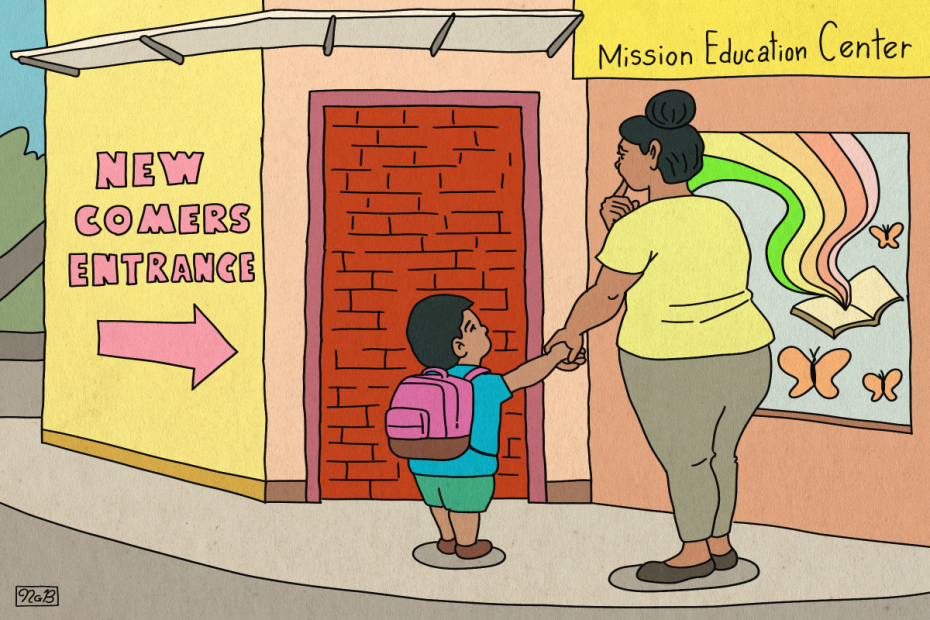
Quite the opposite: Multiple individuals have told us of either being given the runaround or dissuaded by district staffers when they attempted to enroll children in schools on this shadow list. That includes Mission Education Center, once the district’s flagship school for newcomer elementary students.
Also, despite this reported campaign of dissuasion, immigrant enrollment numbers obtained by Mission Local do not jibe with Su’s claim. They do, however, induce one to question how the hell the district is tallying immigrant students.
While the social payoff on helping a young person ramp up their English skills, orient themselves culturally and thrive academically is high, the tangible payoff for newcomer programs is also high — as in, they’re expensive.
That’s something to consider when immigrants’ purported organic lack of demand for costly, labor-intensive newcomer programs is cited as the rationale to swing the budget axe, as the district would clearly desire.
“Our office,” said one SFUSD central-office administrator, “affected that demand.”
In January, an email sent to school leaders from San Francisco Unified School District associate superintendent Theresa Shipp described a precipitous drop in newcomer students.
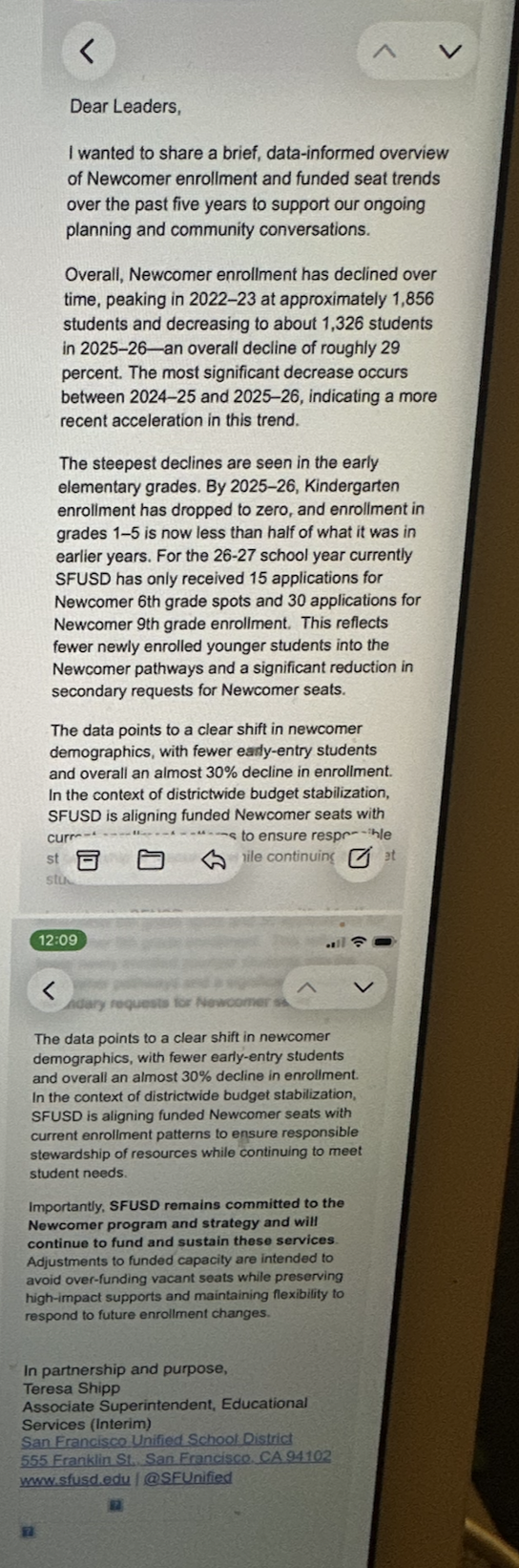
While the district had 1,856 newcomers in 2022-23, the email stated, it only had 1,326 in 2025-26. That’s a nearly 30 percent decline.
That seemed plausible. The second Trump administration, like the first, was marked by an almost bombastic level of cruelty to immigrants — or anyone who looks like an immigrant. People intercepted crossing the border can no longer easily make asylum claims.
But still, the cited numbers seemed jarringly low. The district’s claim that there are now zero newcomers in the city’s kindergartens — as in, not even one — strained credulity.
It is not clear how these numbers were tabulated. Our queries of the district, some now more than a week old and still unanswered, will probably remain that way while the district is focusing on its combustible labor situation.
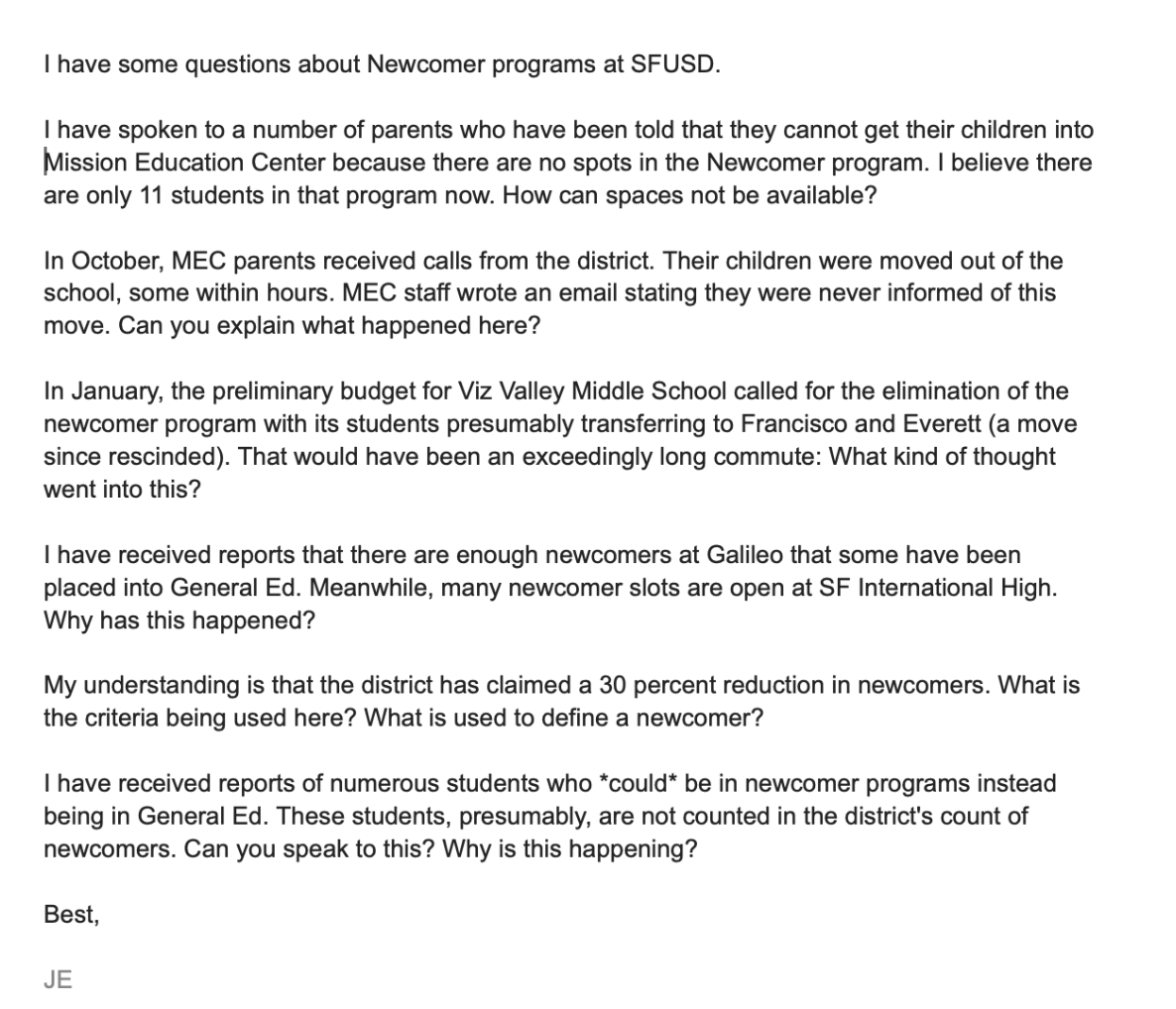
It’s also clear that, while people may assume every newcomer is undocumented, that’s not the case. A “newcomer” is a student who has been in the U.S. for zero to three years. The claim that not a single family with a toddler has immigrated to the United States since 2023 and enrolled that child in a San Francisco public school beggars belief.
The district has not answered direct questions on the matter. Yet it seems likely that the figures in Shipp’s email might be counting the number of newcomers enrolled in newcomer programs, and leaving out the public school students who arrived in the U.S. within the last three years and would qualify to be in such a program — but aren’t.
Those are two very different numbers. And the district plays no small role in how many newcomers actually find their way into its newcomer programs.
Mission Local, in fact, obtained a more comprehensive tally of total newcomers enrolled in San Francisco public schools. It does not reveal any mass exodus from newcomer programs, just a rebalancing and a moderate decline.
There are presently a shade fewer than 1,500 students in district newcomer programs, and just over 1,500 newcomer students who are not in these programs. In 2018-19, there were just about 1,900 students in newcomer programs, and some 1,600 newcomers who weren’t enrolled in the programs.
Crucially, documents obtained by Mission Local show there were district-imposed capacity reductions at newcomer sites dating back prior to Trump’s election.
The significance of this data is that it’s hard to argue that it indicates a diaspora of newcomers from district programs due to fear of rampaging federal agents or any other real or perceived threat. Rather, it prompts questions about how diligently the district is now enrolling newcomers in newcomer programs.
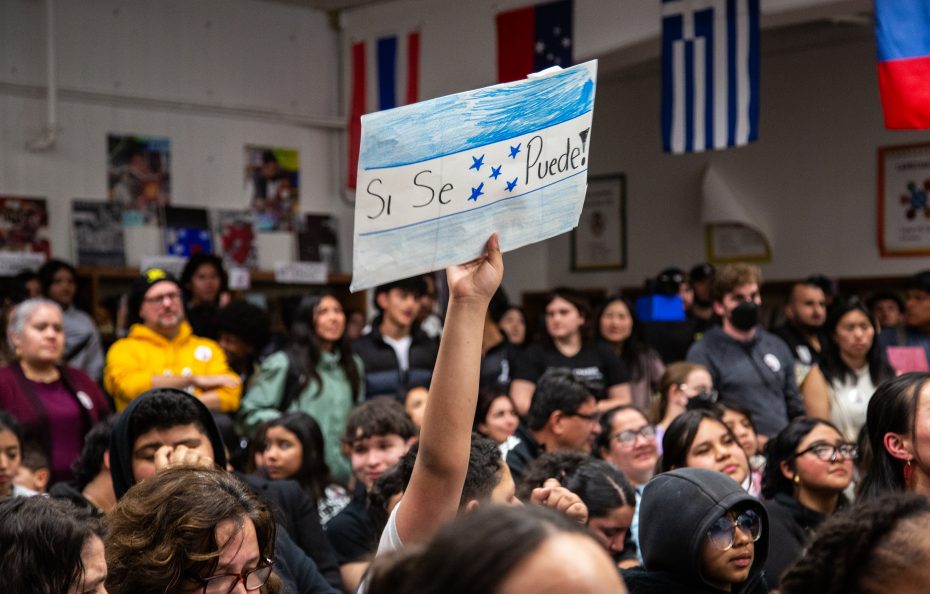
Speaking of questions, a newcomer student hoping to be placed in general education, English-only instruction, now must answer up to 10 or so of them, orally.
These are not existential queries. Instead, they’re more like What’s your name? and Describe what you see around you and What city are you in?
These are the kinds of questions you’d ask a woozy boxer who’s been knocked to the canvas. They do not exactly guarantee that a student can hold their own in Mr. Parker’s advanced-placement U.S. History class and discuss the Gadsen Purchase.
It is now far easier than it used to be for newcomers to opt into English-only general education classes.
Until recently, doing this required passing the standardized English Language Proficiency Assessments for California (ELPAC) test, with the tabulated score landing an applicant into brackets determining their suitability for general education.
Now, that’s been replaced with an unofficial oral screener: What is the last thing you watched on TV?
At the same time, it’s not clear how effectively newcomer families are being informed of their options, and kids may just want to go to their friends’ schools and parents may just want their kids to go to nearby schools.
A concise cover page listing all the programs at every school was not universally included in application materials this school year, leaving less-informed families to guess.
The public-school application process is notoriously tedious, even for the well-educated and affluent. Monolingual Spanish-speaking newcomer families, meanwhile, are now tasked with deciphering these difficult and jargon-laden forms.
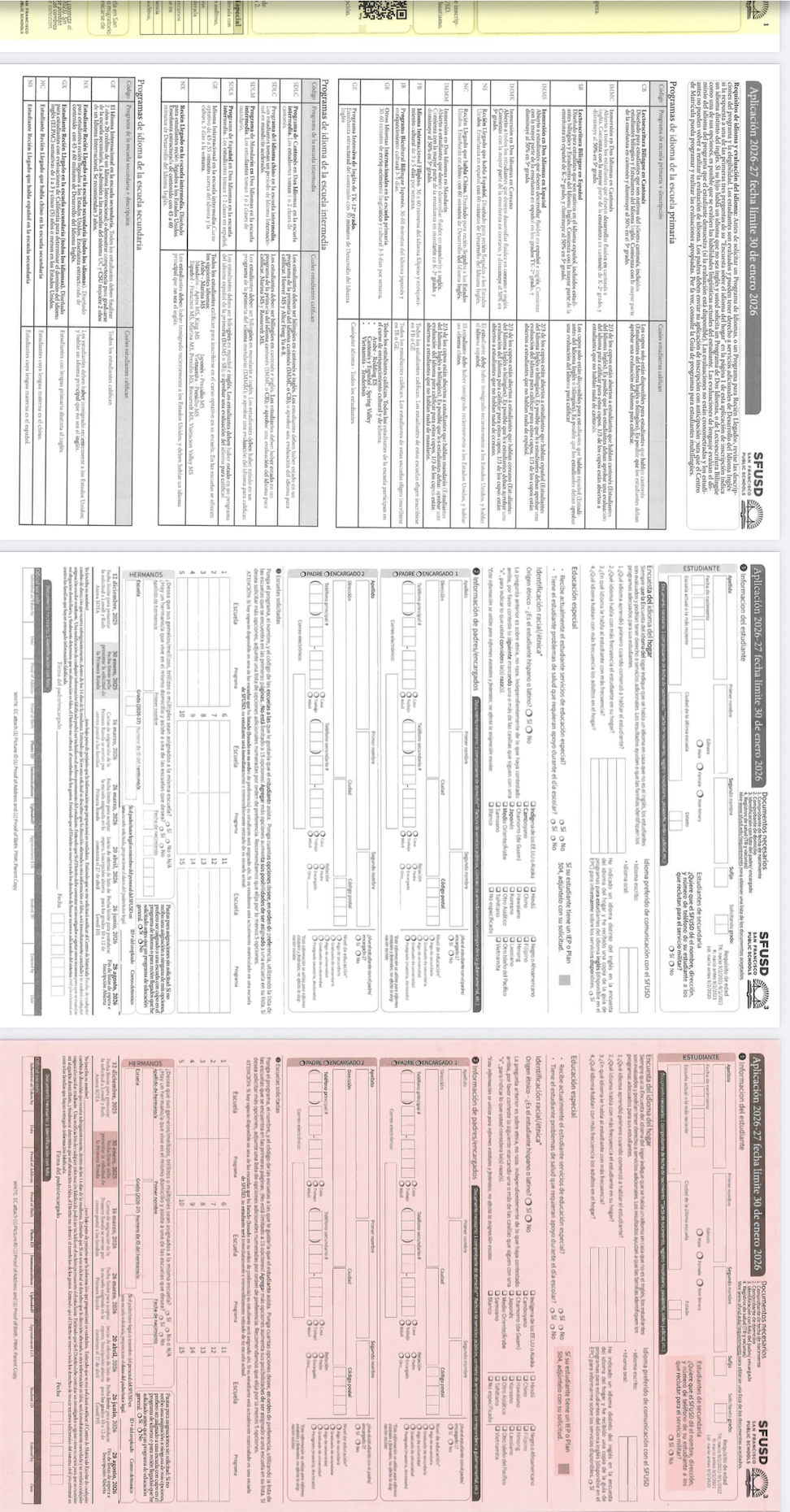
That’s a problem for everyone, but especially for newcomers; a decent number of Spanish-speaking newcomer parents are not proficient in written Spanish.
Mission Local has learned that befuddled families not infrequently select elementary schools for their teenage students. That’s a hell of a mistake to make. It is not an indicator of excessive guidance and hand-holding from the district.
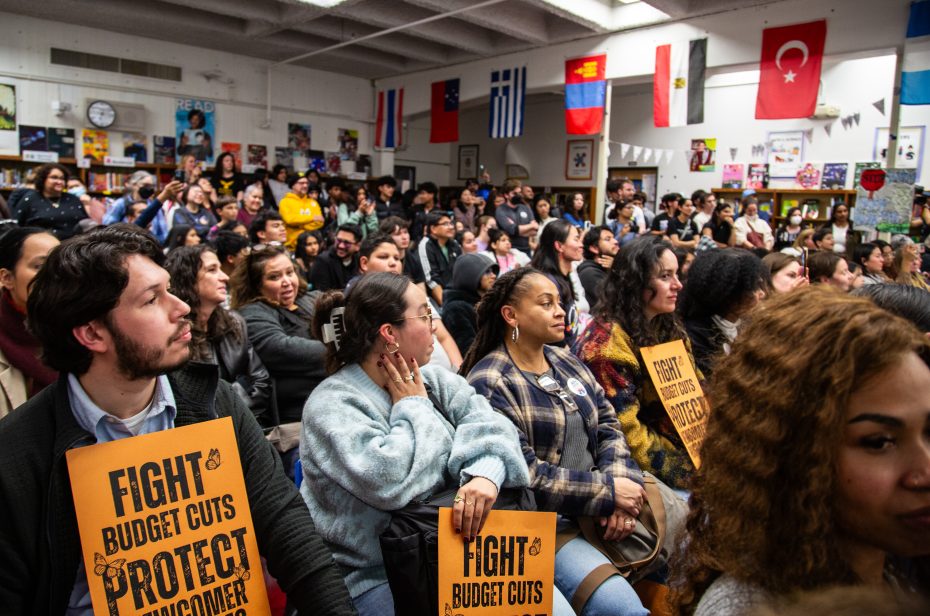
Multiple SFUSD central-office administrators tell us that, during in-person meetings, higher-ups have curtailed enrollment at several small schools, including Mission Education Center.
Frontline staff know well enough not to suggest these schools to would-be students, and anyone insisting on placement there is either referred to a manager or made to undertake a tour with school site staff or other onerous steps.
The district didn’t answer our questions about this. But SFUSD sources surmise that the district would simply wish to hasten the demise of schools with small and/or dwindling enrollments.
Mission Local obtained written memos prescribing such steps for the since-merged Academy at McAteer, the June Jordan School for Equity and MEC. Until recently, it was the district’s elementary-level newcomer pathway school, but it’s now a husk with fewer than a dozen newcomers.
These practices purportedly go back years, preceding the tenure of the present superintendent.
The experiences of parents attempting to enroll kids into MEC squares with this. Last week, we wrote about a mother given the runaround when trying to place her child into the school.
This week Mission Local spoke to an MEC staffer who, on two occasions, accompanied parents as they attempted to enroll their children at the school. Both times, the staffer says, district employees attempted to denigrate MEC and push other schools. The staffer recalls being told there was no space at MEC.
“I work there,” the staffer recalls saying at the time. “I know there’s space.”
Incidentally, this was in mid-2024 — before Trump’s election.
Last year, the district unilaterally yanked the few remaining newcomers out of MEC, claiming it was for their own good in the event of an immigration raid. Most of the immigrant parents complained and undid this move.
“Among the parents, we came to the conclusion that it was a pretext they used,” said Carlos, the father of a former MEC student. “They took advantage of it to intimidate us so we would all leave that school.”
So, that’s a big part of why the district’s claims regarding diminishing newcomer programs are going down worse than beer ice cream. The data presented strains credulity as do the district’s rationales.
Even among district employees sympathetic to “right-sizing” newcomer programs, the claim that declining enrollment is an organic process undertaken by scared immigrants falls flat. Rather, it seems like a palatable excuse and justification for making cost-cutting moves to solve problems that the district helped to propagate.
If reductions to newcomer programs are truly needed, sums up a veteran district employee, “just tell the truth.”
Excellent investigative reporting. For many years, parents, educators, and administrators involved with Cantonese immersion and Cantonese newcomer programs in SFUSD have said that enrollment in these programs was declining — not because families didn’t want them, but because the district’s enrollment and assignment processes has diluted access and not prioritized sending families to them.
Several schools with Cantonese biliteracy and immersion programs — including Sutro Elementary and Jean Parker Elementary (the school that triggered the landmark SCOTUS case Lau v. Nichols on language access) — were placed on the district’s chopping block. The district’s narrative has largely focused on low enrollment as evidence that families no longer need or want these programs, but now, digging deeper, we can see how enrollment policies set by the district can impact the choice of newcomer and other families.
Thanks for bringing this up, I was unaware of Cantonese programs at sfusd.
It’s untrue that parents do not choose the newcomer schools. The district has been limiting enrollment at these school since 1981 and probably before that. I say 1981 because that’s the year I began teaching and I have been told by EPC people that parents were not encouraged to go to newcomer schools and they were told to fill other schools before sending any children there. The superintendent was hired as budget slasher, she has no educational background. As a sanctuary city, we need to provide these programs who are very needy students and cut funds elsewhere such as hiring consultants to the district.
Thank you Joe! Journalism at its best!
my foster daughter was abused and abandoned. A judge issued her a special juvenile status document that is basically saying, “you can stay until your request for citizenship goes through” (and adoption made it worse, so we are stuck). She’s been with us for years and is part of the family. Everything was fine and dandy, but now I can’t send her to any programs like this because there’s literally zero chance anyone from ICE wouldn’t drag her into one of their unmarked cars and disappear her.
I am utterly and completely disgusted that millions upon millions of “christians” voted for this man. Just disgusted. If I didn’t live in SF, I’d probably have left the country and gone back to stay with relatives in Italy. (relatives who actually wanted to move HERE just a few years ago, yet now talk about us like we’re living in a 3rd world country on the verge of collapse)