

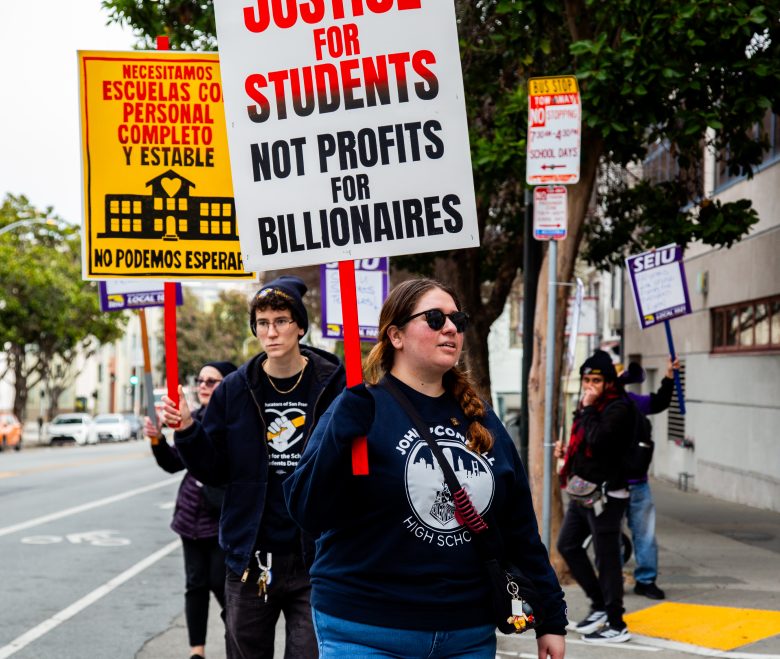

Public schools across San Francisco will be closed on Monday as teachers are readying to hit the picket lines in the city’s first educator walkout in nearly half a century.
Negotiations between the San Francisco Unified School District and the United Educators of San Francisco started in March, but reached an impasse by October. The two sides only returned to the bargaining table last week after teachers voted overwhelmingly to authorize a strike.
Talks continued over the weekend, when roughly 100 teachers met with the district’s four-person bargaining team and Superintendent Maria Su at the War Memorial Veterans Building on Saturday.
After hours of back and forth, the district agreed to strengthen its sanctuary-school policy, but the two sides failed to come to an agreement on anything else.
The union and district are scheduled to return to the bargaining table on Monday at noon.
Schools will not open until there is agreement, but there’s little telling how long that will take. The last time teachers walked out, in 1979, it was more than six weeks before classes resumed.
On Sunday, Mayor Daniel Lurie and Rep. Nancy Pelosi made last-minute appeals urging teachers to postpone the strike for three days. “Frankly, I’m frustrated,” Lurie said on Sunday evening when no agreement was reached.
“We have made it very clear that our demands … do not come at the cost of concessions or takeaways,” read a statement published by the union on Sunday afternoon.
What are the sticking points in negotiations?
The union is asking for a 9-percent salary increase over the course of two years, in addition to fully funded healthcare for dependents, changing the workload for special education teachers and increasing staffing to reduce class size.
Other asks include strengthening the district’s sanctuary-school policy, which the district conceded to on Saturday, and support for unhoused students.
Over the course of 11 months and 12 bargaining sessions, the district has maintained that it does not have the money to cover these demands.
It says it is staring down a projected $102 million deficit. The union contends there is money to spare.
The union is asking for the district to dip into its $429 million reserve, which the district has, in part, agreed to by toying with the idea of funding increased salaries and benefits with a local parcel tax.
But much of this money is restricted, and cannot be used for ongoing costs. The district argues that doing so would put it in a precarious financial position.
A state-mandated neutral third party released its report on Jan. 23 and largely sided with the district.
The report argued that a wage increase of 9 percent is well above the state average, and would exceed the city’s cost-of-living adjustment. Fully funded family health benefits, it argued, would likely not be approved by the state, which retains oversight over the district.
Those benefits, it said, were “simply not an option.”
But the fact-finders also found that the district could offer more. It proposed a 6-percent increase over the course of two years, instead of the district’s offer of a 2-percent increase over three years. Its plan, the report said, would be “more likely to pass state scrutiny.”
On Thursday, the district’s bargaining team presented an updated offer to the union: partially funded dependent healthcare and a 6-percent wage increase over the course of two years in exchange for educators forgoing sabbatical leaves and limits on class sizes.
Class sizes in San Francisco are an average of 21 students per teacher, slightly higher than the state average at 20 students per teacher.
On special-education caseloads and support for unhoused students, the district refused to change the contract language, but offered some committees and working groups to better support students. That offer was promptly rejected.
The union presented a counteroffer on Saturday with minor concessions, but maintained its ask for fully funded dependent health care and a 9-percent raise. The district made some concessions as well: A partially funded healthcare program, a pilot program at five schools testing the union’s proposed work model for special education, and a 6-percent raise.
On non-compensated requests, like support for unhoused students, the district says it’s “close.”
Maybe Kaiser should be part of the negotiating teams. It’s absurd that $24,000/year can’t cover dependent care.
Kaiser’s 2025 cost for dependent care was $26,993. So $24,000 is pretty close to the cost, and teachers would have to pay around $3000 per year ($250 per month) to cover the shortfall.
See https://www.kff.org/health-costs/premiums-worker-contributions-among-workers-covered-by-employer-sponsored-coverage/
Perhaps a compromise could be that teachers contribute something per month per dependent with a cap.
As much as I support teachers, it really isn’t sustainable for the district to fully pay for dependent health care. It’s understandable why teachers with dependents don’t like this idea ─ most of their raise, whatever they end up getting, would go to pay for dependent health care.
More than 30% of kids in SF go to private schools. That is up substantially since the progressive school board trashed the district. Combo of killing off advance math and aggressive mainstreaming, race based admissions, and then keeping the schools closed for over a year so teachers did not have to work.
And all of these bad ideas were pushed by the head of …the teachers union.
The district is under state supervision as “united un-educators” caused wellheeled parrents to flee, and the district gets money from the state for each attendee.
Falling enrollment (as people flee the crappy education and shutdowns pushed by the “progressive” union) combined with a refusal by the union to closing schools that lost enroellment (raising costs)are what drove the district to state oversight.
And oh, not only does the district not have the money (and the state will refuse to approve the contract, even if the school board caved) but the union’s demands are based upon really bad math (union leadership is after all anti advanced math) when they failed to include money from the parcel tax into what teachers are paid compaired to other districts….
It’s strike based upon bad math and the end result of the horrible damage the education unions horrible leadership has inflicted on San Francisco’s kids over the last 10 years.
Why are we villainizing teachers when we live in a city with 50+ Billionaires? Rich people send their kids to private school so they don’t have to mix with us normies has nothing to do with the union. Teachers worked tirelessly to switch to online teaching and did have to work during covid while their children were also at home. Let’s be kind to the workers of our city and stop scratching out the eyeballs of each other while we fight for the leftover scraps from the billionaires.
You don’t seem to understand why parents, including middle and lower income, are opting for private school.
My family is looking into them because of the lack of support for gifted/accelerated learning (cut over a decade ago) and the delayed teaching of algebra. Plenty of other public school districts nationally offer it in 6th or 7th grade (for students who are ready)!!
The district doesn’t focus on achievement, so people interested in it will leave.
The deeply flawed school place allocation scheme, AKA “bussing”, is a solid reason why parents send their kids to private schools.
Nobody is villainizing teachers, but unless you have a workable idea how to make the 50+ billionaires pay for the public school system, the point is rather moot.
Billionaire’s tax
Boy I can see that you did not take advanced math.
There may be 50 billionaires in sf, do they have 24,000 kids?
And oh, those billionaires are mobile. While I believe they can be taxed at the national level (and should be) no way to do it locally w/o destroying the tax base,
Reality is that real people, with real kids flee the SFUSD due to very bad decisions by progressive who have (along with the union) put ideology over learning,
Parrents want the best for their kids, while there are some, good public k-5, and a few k-8 schools that are good, the vast bulk of schools are not great, and all of the junior high and most of the high schools suck, Not surprising that the bail out rate goes up substantially after 5th grade…
The money-per-student from the State doesn’t cover all the costs, so technically the school district is better off with fewer students since parcel taxes are paid by even by parents sending their children to private schools, and spread less thinly when there are fewer students.
With the market value of real estate in San Francisco, the district should really be Basic Aid instead of LCFF but property taxes are based on assessed value, not market value.
What’s really needed is to make Prop 13 apply solely to owner-occupied housing, not to market-rate investor-owned housing and not to commercial property. Some exception for rent-controlled housing would be appropriate.
It’s frustrating to see all these teachers, administrators, and even parents – with good intentions of course – rally around talking points that are simply not grounded in facts. It’s not super complicated – either there is money to pay for the demands or there isn’t. An independent fact-finding report concluded that there isn’t – and the Union tries to convince everybody that there is. Even if the district agrees to dip into its reserves, it needs to do so responsibly, or the reserves quickly turn into a deep hole in no time. The idea that the district is quietly running a massive profit while claiming to run a deficit makes for a nice conspiracy theory, but it’s not like the numbers are a secret.
Missing from all the reportage and analysis is the hard fact that, becasue of Prop 13 (dating from 1979!), 70% of SFUSD funding comes from the state. So, assuming some additional funds are needed, especially the big bucks to pay for full family heathcare in perpituity, it’s not “simply” a matter of more City and County of SF general fund $. It’s the state that would have to pony up. That’s not something that can happen overnight.
Former SFUSD para and teacher here siding with school district.
The demands of UESF show that the union is not living in reality. The district has been under the threat of state control because it has been spending too much. Fully funded healthcare is simply not possible given the district’s dire fiscal situation. Any demands to tap into reserves is simply shows poor grasp of budgeting principles that landed the district in this situation in the first place.
A lot of the focus as been about adding X% COLA. Do people forget that teachers have FWEA added to their paychecks from the parcel tax or that they get a step increase yearly? They do no simply get a measly 2-3% raise each year. They are civil servants which means their salary increases along with their years of service.
Also it is not unreasonable for the district to get rid of sabbaticals and AP prep periods as these only benefit a small fraction of teachers. Talk about inequity…let’s raise wages for all teachers and distribute the benefits for all.
There are tradeoffs for every decision. The district should revisit shutting under-enrolled schools.
Disclaimer, my child is a teacher in San Francisco.
1. The 6% over two years is insulting. It should be a minimum of 4% per year.
2. The Special Education teachers are desperately needed, this should non-negotiable.
3. Fully funded dependent health care is not possible, the State oversight would never agree to this. The district’s offer of $24,000 per year is generous, considering what private employers offer for dependent health care. Also, teachers with no dependents are really subsidizing teachers with dependents, so it’s not really fair.
4. The City and County of San Francisco should be fully funding the “Stay Over Program,” the School District should not be burdened with funding that program. The affordable housing crisis is not the school district’s fault, it’s developers, real estate investors, and YIMBYs at the state and local level, like Scott Wiener, that kowtow to market-rate developers and prevent additional affordable housing from being built.
Oh PLEASE. Tell us, oichumgomez, how many units of affordable housing did ‘affordable or nothing’ former Supervisor Preston get built? Please tell us. I believe the answer is ‘zero,’ but I could be wrong. But it’s close to that. Do you know how few units of housing have been built in the past FORTY years? And this is exactly why California is in a crisis and why so many childbearing people left our state and why our state is aging (even if it’s technically still growing), and why schools are now in a tailspin. Just please, stick to what you understand and stop trying to smear politicians who understand economics.
It’s too bad because I agree with you on your other points. Although I don’t think the state Fiscal Crisis Management Team is going to allow more than a 3% raise for the next two years. I guess we’ll have to see.
I do know, well at least for San Francisco.
San Francisco Population and Housing Units
1950
Population: 775,357
Legal Housing Units: 310,559
Unpermitted Housing Unit Estimate: 15,000
Total Housing Units: 325,559
Persons per Housing Unit (permitted units only): 2.50
Persons per Housing Unit (including unpermitted units): 2.38
2020
Population: 870,014
Legal Housing Units: 346,527
Unpermitted Housing Unit Estimate: 35,000
Total Housing Units: 381,527
Persons per Housing Unit (permitted units only): 2.51
Persons per Housing Unit (including unpermitted units): 2.28
2024
Population: 810,202
Legal Housing Units: 361,044
Unpermitted Housing Unit Estimate: 37,000
Total Housing Units: 398,044
Persons per Housing Unit (permitted units only): 2.24
Persons per Housing Unit (including unpermitted units): 2.04
The issue isn’t that housing isn’t being built, the issue is that developers and real estate investors obviously only want to build the most profitable housing and they lobby legislators to weaken affordable housing requirements. There should be a non-negotiable requirement for 15% of new rental units to be BMR, and 20% of for-sale units to be BMR, and it should not be diluted by Density Bonus.
You also have faux affordable housing groups insisting that rents are too low, i.e. the executive director of San Francisco’s Housing Action Coalition explained: “One of the challenges we face in San Francisco is we need the rent to go back up,” a startling, but accurate, admission by an organization that purports to be in favor of affordable housing. He’s not really wrong, for market-rate housing to move forward rents need to back up since there is currently a backlog of about 70,000 approved, but unbuilt housing units, which isn’t that much lower than San Francisco’s RHNA of 82,069. Where he’s wrong is that he expects the market to solve the affordable housing crisis, but the market can’t solve it. Perhaps he really believes in the “trickle-down theory” of housing, where renters leave their lower-cost, often rent-controlled, apartments in order to move into much more expensive newly-built housing.
Don’t blame NIMBYs for the affordable housing crisis, the blame rests squarely with YIMBY groups and the entities that fund them. One of the biggest YIMBY groups, Up for Growth, had the following statement in their initial trademark application: “Political action committee services, namely, promoting the interests of real estate developers, real estate owners, construction companies, real estate investors, and property management companies in the field of housing policy legislation.” Spot-on!
Regarding Item 4: Blaming housing developers for the housing shortage is akin to blaming farmers for a (government-induced) famine.
YIMBYs are pro-housing — at all income levels and have made it substantially easier to create affordable/taxpayer-subsidized housing (for example SB-330, SB-35, AB-130 and the list goes on) .
Whereas, local NIMBY’s — who have been in control of housing policy over the course of 5+ decades; leading to chronic housing scarcity inevitably resulting in runaway housing costs — are manifestly anti-housing.
Your critique is entirely misplaced, utterly idiotic, and demonstrably false.
The fiscal gutting of public education from the top down at every turn has permeated our society (and SFUSD) for decades… public education is THE most important factor to keeping a nation united, aware, and critical of its ‘government.’ Bloated bureaucracy year after year, overpaid ‘administrators’ who fled the classroom ASAP, middle managers who do nothing, paper pushers by the dozens and SFUSD *still* finds a way to blow 40 million on a payroll system that never worked. Blah blah blah blame the teachers’ union progressive radicals etc and demonstrate all of your ignorance. This strike is just another symptom of the class war that has ruined the USA and SF.
Well I asked my adult child, who is an SF public school teacher, what he/she was doing today. After picketing he/she went home to grade papers and work on lesson plans. Unpaid of course.
It appears that the San Francisco School District is looking to place a parcel tax on the November 2026 ballot. SFMTA is looking forward to a parcel tax on the 11/2026 ballot to save MUNI. With San Francisco’s residence already paying tax for the air they breath, (LOL), it is a definite fail for a SFUSD and SFMTA ballot measure.
Anthony, you ought to look at what an incredible windfall our city’s Boomers enjoy. It’s all public record—look up the tax assessment for properties in your neighborhood occupied by people who’ve owned those homes for decades. The last time SFUSD teachers went on strike it was because Proposition 13 passed in November 1978 and it immediately launched every school district in the state into fiscal crisis. So it’s somewhat surprising that there haven’t been more labor stoppages since then, but here we are. Stuff costs money, inflation has been a thing, and thus the formula to cover those costs is due for a revision.
Voters rejected Split Roll (Prop 15) in 2020 after massive campaign spending by commercial office property owners.
Prop 15 didn’t even go far enough, it should have made Prop 13 apply solely to owner-occupied housing, not to rental housing (at least not market-rate rental housing, there could have been some exception for rent-controlled housing). But at least Prop 15 would have been a start in reforming Prop 13.
Now you have self-serving people trying to repeal Prop 19, which finally brought at least a little sanity to the Prop 13 mess by ending the inheriting of artificially low assessments. There is no reason that artificially low assessments should be inherited, and in fact that was never part of Prop 13, it was Props 58 and 193 that added the inherited assessed value.
There are always edge cases that need to be addressed. An adult child caregiver that inherits a house should be protected against huge increases in property taxes, but there are already deferral options available.
Lay all of them off! Let’s parent have the funding for their kids to private schools. Better grade and high system than public schools.
Certainly any pay rises should be linked to job cuts, so that the dal is cost neutral.