

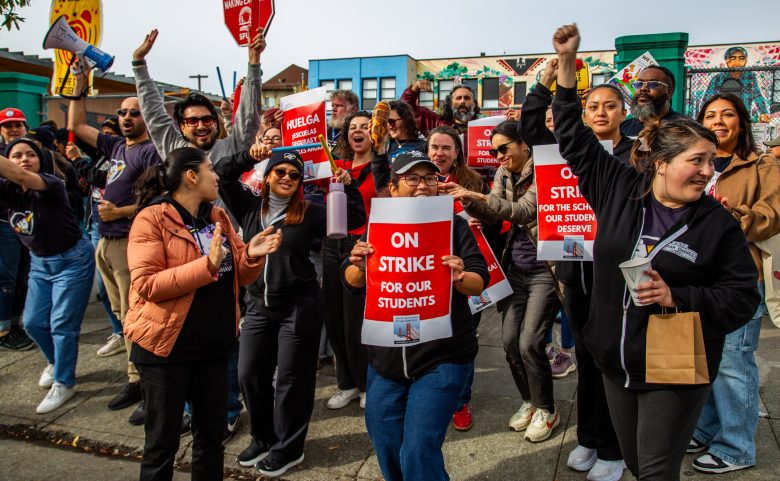

This month’s four-day teacher strike, which mercifully concluded this morning, should not have caught anyone off guard.
The San Francisco Unified School District and its teachers had been at loggerheads since March of last year. On Oct. 10, the two sides formally declared an impasse and ceased negotiating.
In November, teachers held “practice pickets” at more than 100 schools. In early December they voted to authorize a strike by a 99-percent clip and then, in January, did so again by a nearly 98-percent clip.
So, this was brewing. For many months. Yet, Mayor Daniel Lurie told reporters this week that it wasn’t until Feb. 2 that he first called the teachers union president, just eight days before her members walked off the job.
The district, also, was caught flat-footed by things it should have seen coming. It waited so long to resolve teacher concerns over non-monetary issues, like sanctuary campuses and AI, that these issues ended up consuming valuable time during strike bargaining.
And the district’s contingency plans for the strike seemed to lean heavily on the ability to run some manner of programming out of school sites during a work stoppage, as the Oakland Unified School District has done during its recent barrage of educator walkouts.
But this was rendered impossible in San Francisco when the principals and administrators voted last week to sympathy strike alongside the teachers, as did SEIU-covered custodians, clerks, secretaries and food service workers.
This, too, shouldn’t have come as a shock to the district. The United Administrators of San Francisco purportedly informed the superintendent in mid-January that such a move was likely.
By late January, Mission Local reported that principals would vote on whether to strike in solidarity once teachers set a walkout date. The outcome of that vote was not in question, and it should’ve been clear that school facilities would be shut.
And yet, on Feb. 3, a preliminary emergency resolution gave Superintendent Maria Su the authority to call for the “use of volunteers at any school facility during an emergency.”
The resolution also would’ve allowed her to hire “substitute employees” at the princely sum of up to $600 a day. The sympathy strikes, which were forewarned, imploded this contingency.
The union is celebrating this as a big win. It received fully covered family healthcare, which was the United Educators of San Francisco’s marquee demand. This does away with healthcare payments of up to $1,500 a month for teachers with families.
But that led to a smaller wage bump for most teachers than the union was demanding: 5 percent. That’s less than the 6 percent that was on the table prior to the fully funded healthcare offer, but more than the four percent the district subsequently countered with.
The district’s monetary issues are real: Cheryl Stevens, the primary author of the state-mandated Feb. 4 “fact-finding report” — which largely backed the district’s fiscal claims — is respected as a true neutral by both labor and management figures.
If, as the district is wont to shout from the rooftops, untenable payouts lead to layoffs and contractions a few years down the road, then nobody wins.
On Friday, after a grueling week, everybody is exhausted and relieved and only saying the nicest things. But it’s clear that the district’s lack of preparation and write-the-term-paper-in-the-hallway responses put it on the back foot from the get-go.

Earlier this month, when thousands of out-of-towners descended upon the Bay Area for the Bad Bunny concert and adjunct football game, scads of chronically online people posted the same revelation: San Francisco isn’t a dystopian shithole! It’s really quite beautiful!
It turns out there is a notable gap between real life and the ramblings of angry people on the internet. Those who substitute ramblings of angry people on the internet for real life are, in fact, often taken aback when confronted with real life. Something like this appears to have happened to the San Francisco Unified School District.
On the internet, angry people were grousing about greedy teachers and the teachers’ strike. There were completely untenable calls to open the schools during the multi-union strikes, despite the fact that this was as plausible as whatever Elon Musk is going on about with AI satellite factories on the moon.
If you visited the actual school picket sites, however — and Mission Local reporters criss-crossed the city all week, covering protests at schools, large rallies, and even giant human messages at Ocean Beach — they were high-energy, positive and well-attended, with many families and students present and drivers honking loudly in support.
Of course, not every public-school family supported an agonizing work stoppage, but the people who were backing the teachers were a lot more active and visible than the people who weren’t.
That could, no doubt, have changed if this strike dragged on for aeons. Blessedly, it didn’t, and it’s hard to say the district anticipated families’ largely positive initial reaction.
But that’s what happens when you substitute the internet for real life and parents groups for parents.
The district should not have misread the solid initial support for its teachers. Take a minute and think: Can you name your teachers from kindergarten to seventh grade? I can’t tell you where I left my overdue library books, but I can rattle that one off.
I can name all of my kids’ teachers, too (I had three public-school kids home this week, exhausting their supply of “Wings of Fire” books). Parents know and, generally, like their kids’ teachers. But can you name two people who work in the district office?
There are, of course, exceptions. Maybe you hated your teachers. Maybe you still do.
But, at least for the one week, most parents were ready to back educators— whom they know and whom they trust with their children every day — and reserve their animus for the SFUSD, which they only hear from when it sends out simultaneous texts, emails and robocalls but, somehow, never seems to tell you the things you really need to know.
Here’s what parents do know about the district: It failed to pay its employees, driving them out of the district or to despair; it ran an abortive and chaotic school-closure process; and it has generally made hiring teachers and deploying them promptly to school sites a process more lengthy and convoluted than an Icelandic saga.
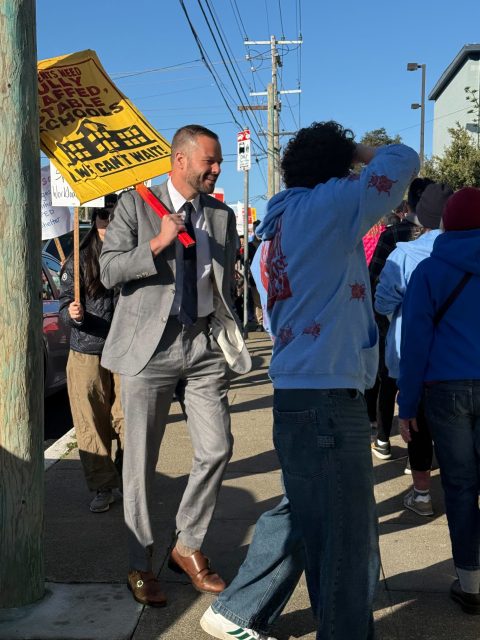
So, the district missed that. It missed months of opportunities to call for bargaining, even during the mediation period. It missed the significance of the union’s “practice pickets” in November — a move that should’ve raised red flags.
It, critically, was caught off-guard by the sympathy strikes, which appear to have obliterated whatever contingency plans the district had in place with “substitute employees” and volunteers at school sites.
The teachers and district had been deadlocked for 11 months, and have met sparsely until recently, so the last-minute, hair-on-fire nature of so much of February’s action and inaction has been bizarre.
Mayor Lurie told assembled reporters that he only reached out to the union on the cusp of its strike. Better late than never, but his call for a 72-hour cooling-off period on a Sunday afternoon for a strike set to commence Monday morning came off as facile.
Prior to the Thursday-night breakthrough of a fully funded family healthcare offer, much of the progress made between the teachers and the district was focused on non-monetary issues: The district’s sanctuary policy, provisions for homeless students, and an AI policy.
It was, and is, mind-boggling that these issues were left unresolved until after teachers walked out.
Su has stated that the district stood to lose between $7 million and $10 million for every day of a work stoppage. So it is astounding that the early part of this week was spent hemming and hawing about these low-hanging, non-monetary issues while teachers marched on picket lines.
That the district then caved on them adds insult to injury — and gave the striking teachers succor.
Dealing with these issues ahead of time would’ve mollified the communities that served as part of the striking teachers’ coalition. But the opposite happened.
During the run-up to the strike and in its early days, it felt almost as if the district was going out of its way to antagonize a workforce that needed no additional aggravation.
On the cusp of the walkout, teachers, principals and others were confused and irritated to receive emails from the SFUSD with Monday “redeployment assignments” to “Staff Centers” on the first day of the walkout. It was unclear who would choose to cross the picket to show up at a “Staff Center,” and what work was to be done there.
Well now we know: District employees at A.P. Giannini Middle School, one of eight “Staff Centers,” were filmed sitting around and watching the Winter Olympics on a classroom movie screen as union members picketed outside. Perhaps they should’ve been redeployed to Dave & Buster’s.
Through it all, organized labor was watching. Police and firefighters are, at present, hammering out their contracts. It remains to be seen how cleanly that process will go, even for some of the most popular and deferred-to city workers. Next year, a multitude of contracts come undone right as the devastating effects of the president’s draconian budget bill come due.
What we saw this week appears to be a coming attraction for next year, with the possibility of coordinated strikes on the statewide level. As this unfolds, there is no one in the mayor’s inner circle with a labor background, or who even seems to be familiar with the ins and outs of public-sector collective bargaining.
There is going to be a lot of bargaining in the coming months and a dearth of money. To crib the words from Genesis: There’s not much love to go ’round.
Thank you for your EXCELLENT coverage throughout the strike!
Throughout the week, SF Chronicle kept trying to downplay support for our strike. They kept claiming we had “several hundred” people in attendance at our rallies, when the aerial photos clearly show many thousands. You did it differently. You came out to school sites. Your staff interviewed educators, parents, and city officials.
And yes: SFUSD had plenty of notice that educators were beyond frustrated with working conditions and compensation, and fully ready to strike.
It was a tough week. I hope we never have to do it again. We gave up some things we wanted. But right now, I’m so very proud of my union: UESF ran an amazing bargaining campaign from start to finish! They you for your comprehensive coverage, Mission Local.
simple answer, pay teachers the same as police
“If, as the district is wont to shout from the rooftops, untenable payouts lead to layoffs and contractions a few years down the road, then nobody wins.”
Exactly this. This deal seems unaffordable in the face of the well documented financial crisis that SFUSD is in. The money is going to have to come from somewhere and the State may require the books to be balanced on the back of job losses and school closures.
So the big question is this. Did the unions chase this deal with the understanding that in the future there will be a smaller number of staff who get to enjoy its fruits? Or in other words has one cohort of teachers been rewarded whilst another class of teachers are to be sacrificed to pay for it?
“The district’s monetary issues are real”
SF is the richest city in one of the richest states on earth. If it can’t afford to fund the essential services, like education, it needs to raise more revenue. It’s not complicated. Tax the f-ing rich.
Of course the district’s monetary issues are real. Rich or not, our city has again been crowned “the worst-run city in America”. “Tax the rich” is simply a slogan, not a policy or platform. The relentless pursuit of revenue for its own sake clouds the reality of outcomes.
Throw money all you like, but it ain’t going to fix it.
You mean progressives should run revenue measures for SFUSD like they’ve been doing for Lurie and Breed?
I guess you think that progs should go to the mat for SFUSD revenues without exacting any concessions in exchange for that support from hostile administrators, just as progs have been relegated to gifting cash unconditionally to successive conservative mayors.
I remember all of my teachers — even the ones I hated — and I would still want to see each and every one get a fair contract that values their work and pays them a living wage. Union power!
While the ‘fully funded health care’ is a win for people with spouses/dependents, it is a loss for single teachers which often are the newer teachers. A lump sum increase for all would have been more equitable and folks could have put it toward their dependent health care costs if they wished.
What you are describing is “equality”, not “equity”, my friend.
Enjoy this helpful visual https://www.diversityresources.com/understanding-the-difference-between-equality-and-equity/
It’s also helpful to think about how we try to make income tax brackets more “equitable” for those who make more money, instead of making the tax brackets more “equal”.
From each according to their ability, to each according to their need.
Nope, it is a job with compensation via salary and benefits. Equity is about erasing inequalities – there is nothing inequitable about dependents as that was a choice of people. Equitable would be fair to everyone and that is not whehat happens when someone makes significant more because their dependents are all covered.
How do I know this? I’ve been a teacher for over 25 years without kids. Teachers with kids want to have their dependents covered at the expense of salary raises themselves.
Good luck out there my friend.
This comment is the divide and conquer method which the District and management will always use to pit union members against each other. UESF stands together; united our struggle is one! And realistically, if the district is actually going to attract and retain its workers, it’s likely that the single person you’re referring to may someday have one or more dependents and will benefit from the healthcare package that we won today! This contract is a historic win for families, students and educators!
Strength in unity!!
I agree, the coverage on the strike in terms of factual, accountable information versus clickbaity slop was really interesting. Some of the articles on websites that operate for clicks had obviously run with whatever copy they could harvest on the topic without any verification and it was laughable how many easily provable inaccuracies were published as legitimate news.
There were a lot of really good conversations happening with people on all sides of this issue, one thing that most everyone agreed on is that public schools can’t be tied to an enrollment formula that doesn’t take into account the regional cost issues. There isn’t a one-size-fits-all funding model that is going to work in a state that’s as varied and diverse as CA. In districts all over the country we are seeing the same thing play out over and over.
Maybe SF or other large urban districts in CA could start the process of developing what the next 100 years of public and community support looks like. Maybe there’s a way to prepare for the challenges that will soon be impacting us all due to climate change, technology disrupting jobs and consolidation of capital by slowly transforming our public schools, libraries and parks into community based organizations so we all can be a part of making it better.
Thank you Mr. Eskenazi for injecting a note of caution into the wave of celebration that is designed to push the teachers’ struggles aside and make it yesterday’s news.
I trust Mission Local to continue to distinguish itself by following the struggles of teachers.
I hope the teachers will have a chance to read and absorb the ballyhooed Tentative Agreement and vote NO to it should it fail to meet their satisfaction.
As a true socialist, I firmly believe that, in our time, union bureaucrats function as a release valve to keep workers in their places, not as true democratic representatives of the rank and file.
I think we are all truly concerned with narratives that come from a dwindling number and variety of sources.
While this is a win for the union it is not necessarily a win for all teachers. It’s unambiguously a win for older, married teachers with kids who have long tenure, and offers the least protection for the younger staff, who are probably the ones who are not partnered and make the lowest wages, and who are going to be the first to be laid off if the district needed to make cuts. Frankly, I would be a lot more supportive if this was a 15% raise for the youngest and lowest-paid folks, and a 3% cost of living increase for those at the top of the pay scale. I also suspect that healthcare is going to be yet another ballooning cost SFUSD will have to pay for that will increase much faster than inflation. There’s a reason the third-party largely sided with the district’s economics; it’ll be interesting to see if the state accepts this deal or if it fuels further layoffs.
Joe, many thanks for the fact-based reporting on this important issue. Especially when The Chron’s only strategy seemed to be to copy and paste incorrect information from SFUSD. I too saw tons of energy and enthusiasm from families at pickets for both my kids’ schools that in no way matched the narrative that the SF Parents Coalition and others were trying to push online. The claim that SF Parents represents “thousands of families” or is genuinely “parent-led” just doesn’t hold up to what many of us saw in our own school communities this week. I wish that parents had a credible, transparent, and inclusive advocacy organization to turn to in these times.
Finally, emergency waivers exist to excuse districts from average daily attendance (ADA) counts and 180-day requirements. Perhaps this could dull the financial impact Dr. Su is talking about? Seems odd to jump to alarmism when potential remedies exist.
I have to wonder if all these fumbles, many seemingly her fault, will shorten her tenure with the district.
Full family health coverage discriminates against LBGT folk. It seems bizarre that San Francisco, of all places would do this. I know some of them have families but not in proportion. Much fairer to negotiate a benefit allowance that is equal for all employees. Make it flexible so that those who don’t need family coverage can fund tax sheltered retirement.
Joe, I would love to see an article with interviews from UESF members who think this as a terrible deal. (See other commenters here). I have seen numerous comments like these across social media.
One of the absolutely worst run school systems anywhere. And has been that way fur decades. The proof is there – if they can, people leave the city after having kids.
Counter point: The bargaining worked out as intended: The parties came to a fair agreement within the confines of the process. There are many ways to get there, and we have seen one version of that, albeit a messy one. This was a win in the sense that we can continue to have trust in institutions and values and that things are going to work out in the end.
Maintaining the autonomy of the bargaining process is a good thing in my view. Which includes keeping elected officials like mayors and governors from injecting themselves in the negotiations. See Gov. Newsom involving himself in the last BART strike.
Besides, I figure it would be a huge time waste, if the standard was that a mayor needed to start getting proactively involved every time a bargaining unit is up for negotiation.
I agree Daniel. Sometimes you have to go to war to get the fairest deal. By allowing a strike to start, the District was holding out for the most concessions. And it succeeded in getting a lower pay award in return for the (admittedly probably too generous) healthcare deal.
Going down to the wire brinkmanship like this is all part and parcel of disputes, labour or otherwise. SFUSD was right to make the unions work for their deal.