
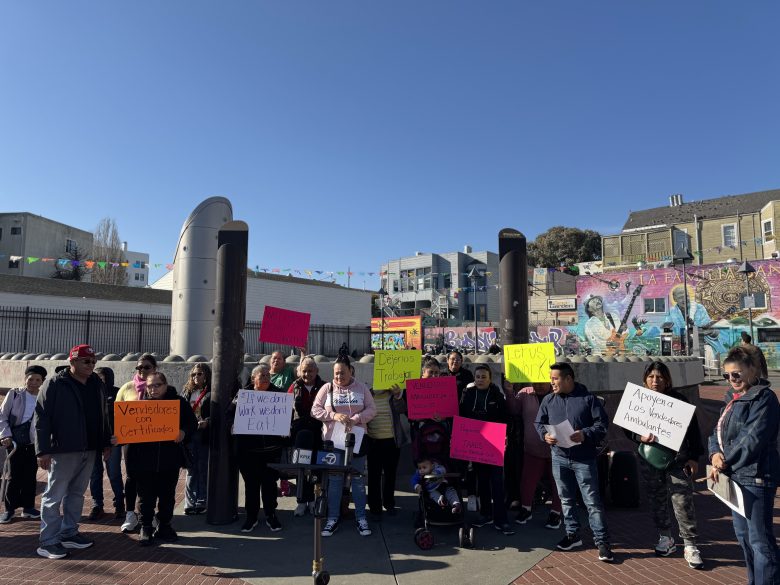

Super Bowl XL was pitched by backers as a means to generate up to $630 million in spending in the Bay Area and as much as $440 million in San Francisco alone — if you believed in the math from a study commissioned by the game’s host committee.
Mission District food vendors hoped those benefits would trickle down to their stands but, instead, a group of vendors ended the week losing hundreds of dollars.
Seven vendors who spoke to Mission Local said city workers and law enforcement officers told them that from Saturday, Jan. 31 to Sunday, Feb. 8, they would not be allowed to set up their stands around the Mission District’s two BART plazas, their customary spots.
The reason? To keep the area at and around the plazas clean to visitors during Super Bowl week.
“I was left with nothing, without the ability to sustain myself or my family,” Dayrys Perez, a street vendor who sells empanadas outside of the McDonald’s at 24th and Mission streets, said in Spanish.
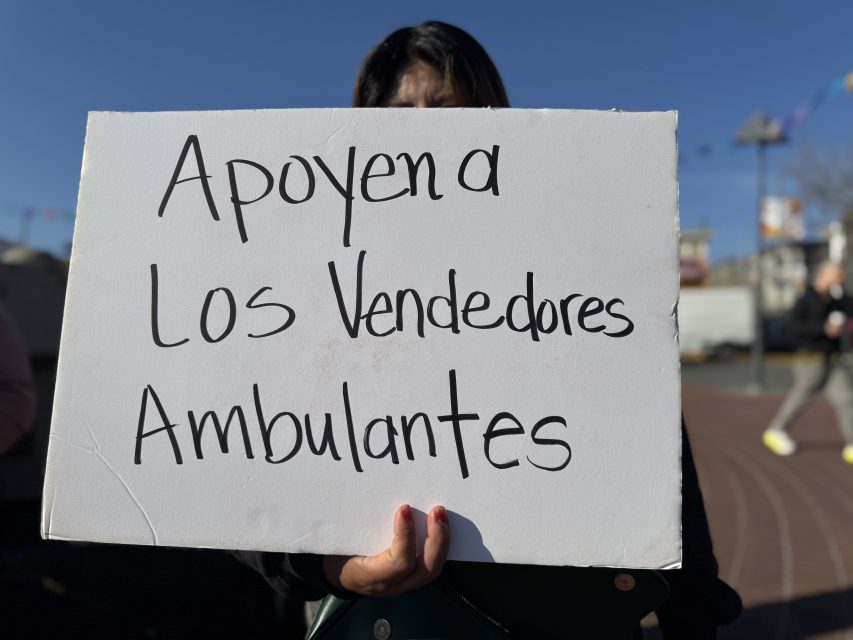
It appears those affected were largely at the 24th Street BART Plaza and that other food vendors were able to sell along Mission Street last week.
Perez said that in a regular week, working just over 20 hours, she makes between $500 to $600. She was excited for the Super Bowl — she thought her sales might be far greater. But three city employees and two police officers came to her stall around 8:30 a.m. and told her not to set up for the upcoming week because the plazas needed to be cleaned for the Super Bowl. Perez’s sales totaled zero last week.
“I didn’t even know how to buy food,” Perez said. She has a four-year-old boy who is autistic, and said her job options are limited — her son gets off school early, and she needs to keep a flexible schedule. “I was depressed and emotionally unstable because I didn’t know where to look [for help].”
Then another blow: The Monday teachers’ strike, which is set to continue at least through Tuesday and perhaps far longer, kept Perez home again — not selling.
Most vendors who spoke to Mission Local said they did not know which city agency had conducted the enforcement but they recalled they wore yellow fluorescent vests.
San Francisco Public Works pointed to the Department of Public Health for comment on enforcement.
“Health inspectors conduct regular food vendor inspections and prioritize education and outreach. This includes providing multilingual resources, explaining why permitting is important, and helping vendors connect with other City resources,” read a statement from the Department of Public Health. “The City regularly conducts unpermitted street vending, inspections, and enforcement in neighborhoods across the city, as well as responds to public complaints.”
Neither the mayor’s office nor BART replied to a requests for comment before the publishing of this article.
Cecilia Contreras sells tamales and warm oatmeal at the northeastern plaza at 24th and Mission for three hours a day, five days a week. She, too, had hoped Super Bowl week could boost business. She took a chance selling food for two short days despite the ban, but still fell hundreds short from her normal sales numbers.
In a regular week, Contreras makes between $700 to $800. Last week, she said she made $300.
“It affected me greatly,” Contreras said in Spanish. “I’m still scrambling to make rent.”
Leila Ovando, director of food access and equity at Nuestra Causa, a Mission District nonprofit that works on political education and civic engagement, lamented the city’s position on street vending during Super Bowl week.
“It was a little scary to see them aggressively attacking them like that,” said Ovando. Multiple city agencies also conducted operations around the Embarcadero, according to El Tecolote, and confiscated fruit and hot dog carts over the weekend.
“The whole city has an opportunity … We’re all catering to this. Why is it that they can’t participate in it?” asked Ovando.
Food street vendors already feel besieged by the city. They have sounded the alarm over a proposed ordinance by the Department of Public Health to comply with state law, saying it could run them out of business.
The state law requires municipalities to draft their own law for enforcement and permitting of mobile food operations, like pushcarts, and the city is considering requesting food vendors to have carts with washing stations and to have them cook their food at a commissary kitchen.
Vendors say they’re not opposed to regulations, but they’re asking the city to help them by providing funds to purchase the carts, and by allowing them to cook at home. Maria Villegas, who usually sells tamales, warm drinks and rice pudding at 24th and Mission for three hours a day, five days a week, said she obeyed last week’s order. The move to another intersection, however, cost her hundreds.
Villegas said she moved her stall last week between two locations, South Van Ness Avenue and Capp Street, at the behest of city workers. On a regular week she makes $550, but last week she made less than half that, she said: $250.
She also fell short by about $300 from merchandise she couldn’t sell because she only sells the food she prepares the same day, she added.
“People who came to this event wanted to see San Francisco’s culture,” Villegas said in Spanish. “We are part of that culture and it was important for people to know that. Unfortunately, we couldn’t fully express that culture.”
Giving tourists food poisoning isn’t the message we want to send
Did these vendors have a permit and were still not allowed to sell? If so, They should be able to sue the city. If they are unpermitted and are not legally allowed to sell, then it’s hard to be sympathetic for the scofflaws. Would be good info to know. Surprised it’s left out of the article…
Point well-taken.
This is very unfortunate because food vendors barely scrape by, so they need every dollar they can get.
“Why is it that they can’t participate in it?”
Because food vending from a sidewalk cart these days sucks on so many levels, and that the only “winners” are the mobster cartels who have taken over the trade.
That’s great ! Crack down on unregulated capitalism, the fragility of rugged individualism and pave the way for the ‘warmth of collectivism’! Spread that ‘warmth’ by “any means necessary”…
SO the crypto swindler Democrats don’t want to deregulate everything that benefits the unrich.
An abundance of hypocrisy.
Lurie has been getting and taking bad advice,
Supervisor Fielder has been as bad as her predecessor with the vendors.
They need what we had under Feinstein which was Cop Kobans at every BART stop and absolutely no DPW because they do some good work when they do DPW work but they are not cops !!
Get some paint from SFMTA cause they have plenty cause they never repaint our crosswalks and bike lanes even in the block where the Mayor goes to school.
Paint out Vendor Stalls with numbers stretching out either way from the Kobans.
Assign the numbers to specific vendors.
Ask Walter Wong if they can buy a couple of the ‘Cop Boxes’ he salvaged and use one of those or retrieve the one at the Powell BART stop.
Set up a small stage in the center of each stop where the preachers stand.
Put a Mariachi band (rotate to spread da bread) there daily.
Open for business.
go Niners !!
h.