
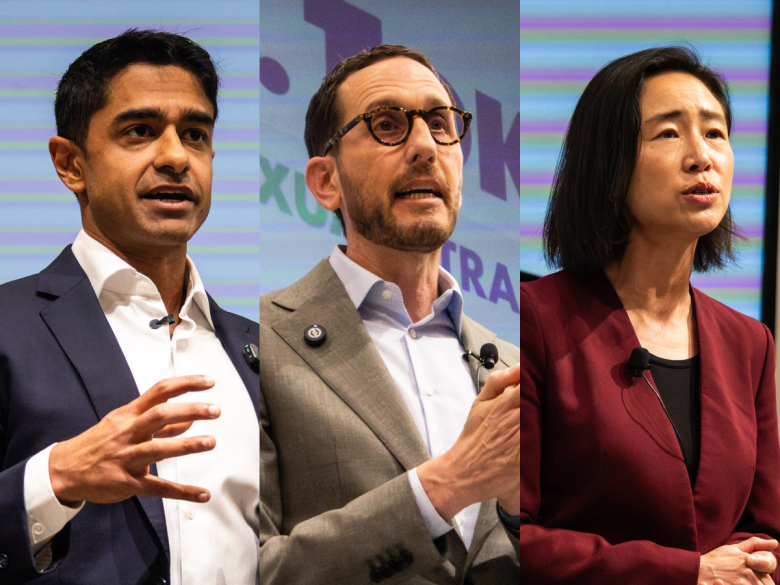

No matter who wins November’s election to succeed Nancy Pelosi in U.S. Congress, it seems that the Congressional Progressive Caucus will be gaining a new member.
At Monday night’s Q&A at the Mission’s Cultura y Arte Nativa de las Americas, State Sen. Scott Wiener, District 1 Supervisor Connie Chan, and former Rep. Alexandria Ocasio-Cortez staffer and tech multi-millionaire Saikat Chakrabarti all worked to establish their progressive bona fides.
All three candidates made it clear they would be most excited to join the Progressive Caucus if elected. They also all called for accountability for fossil fuel companies, abolishing ICE and Medicare for All.
The progressive bent was perhaps unsurprising, given that the three were speaking to members of the Working Families Party, a group critical not just of Republicans but also of corporate Democrats.
The event, open to the public, drew about 100 people, with many more joining online. Organizers chose some questions in advance, and others from audience submissions.
They honed in on the areas where candidates’ progressive credentials were in question.
Chakrabarti defends donations to moderates, explains local record
For Chakrabarti, that meant asking about his election donations in 2024.
Those included $500, the maximum donation, to the unsuccessful campaign of Michael Lai in District 11, and $500 for Bilal Mahmood, who unseated the city’s lone socialist supervisor, Dean Preston, in District 5. Chakrabarti also voted for Daniel Lurie for mayor.
Lai, Mahmood and Lurie are all moderates and ran against local progressives.
Chakrabarti tried to explain. “When it comes to Michael, that was an oversight on my part,” Chakrabarti said — a “former” friend from the Bernie Sanders campaign worked on Lai’s campaign, and recommended that Chakrabarti donate.
As for Mahmood, “he’s, I believe, progressive,” Chakrabarti said (one person in the crowd let out an incredulous laugh). Chakrabarti listed some of the progressive policies Mahmood has supported, including the labor-backed CEO tax on June’s ballot.
“I’d be lying if I didn’t admit I was excited to see the first South Asian supervisor in the city and first Muslim supervisor in the city,” he added.
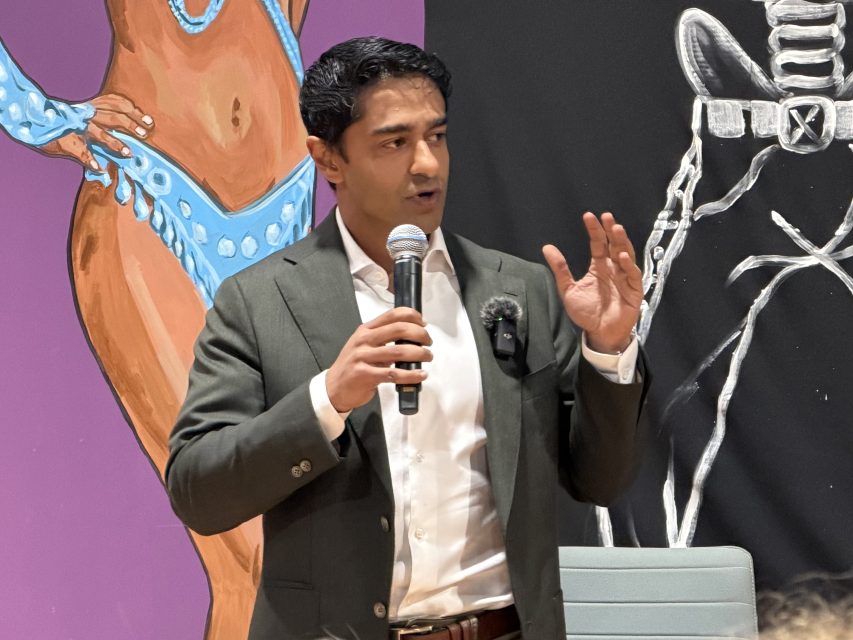
As for Lurie, “I’ll be honest, I was not a fan of any of the people running for mayor,” Chakrabarti said to chuckles from the crowd. He also noted that Aaron Peskin, the consensus progressive candidate in that race, was his second choice.
You’ve been in San Francisco for years, a member asked, so “why didn’t you start engaging in San Francisco progressive communities years ago?” Voting records show Chakrabarti resided here from 2010-11 and from 2020 to the present.
Chakrabarti said he’d been more focused on federal politics in his work with Sanders and Ocasio-Cortez, and with his policy think tank, New Consensus.
“That’s why I’m running for Congress,” he said. “If I wanted to run for supervisor or something else in the city, I’d start by volunteering and working on campaigns here and working my way up, the way I’ve done in national politics.”
Scott Wiener talks Gaza ‘genocide,’ taxes and legislative chops
Wiener, who is not on the progressive “team” in San Francisco because of his stances on issues like housing and taxes, also received a grilling from the Working Families Party.
They pointed out that the last time the group interviewed Wiener, he declined to say whether Israel’s attack on Gaza amounted to genocide, much like he did at the first congressional debate in a clip that went viral. A few days later, though, Wiener posted a video saying that he does think Israel’s actions constitute genocide.
“Can you walk us through your thought process for what the turning point was for you?” organizers asked.
Wiener said that he had always considered what Israel was doing in Gaza an atrocity, but had just “chose to use different words that were, in my view, quite equivalent to genocide.” This included “cratering an entire population,” “absolute destruction,” “a moral stain” and the Yiddish word “shanda,” which means disgrace.
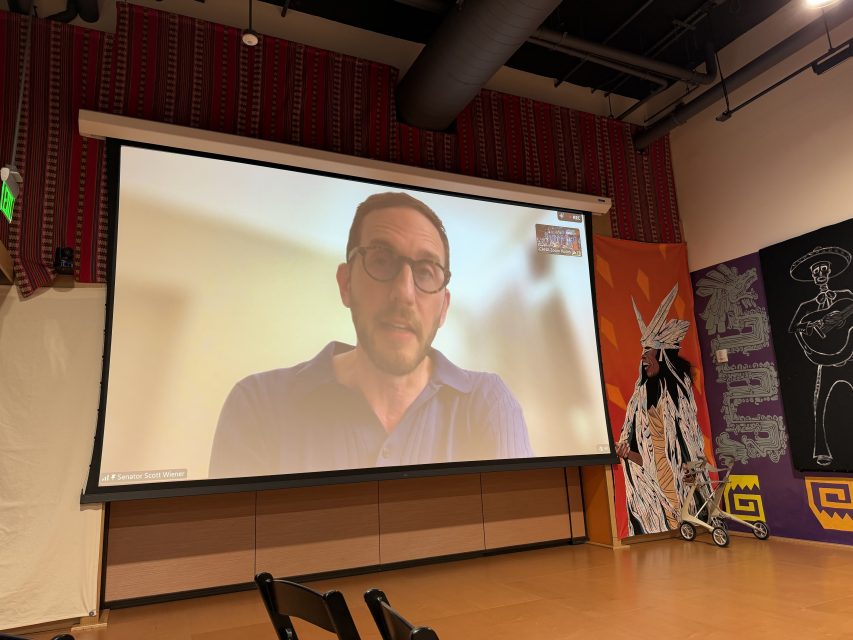
“The word ‘genocide’ is a very sensitive one, and the community is very divided on it, and for a lot of people it is very raw,” he said. “But ultimately I chose to use the word ‘genocide’ and I stand by that.”
Organizers also asked Wiener about his opposition to Prop. 33, a failed November 2024 statewide initiative that would have allowed cities to expand rent control.
“I did not oppose it. So that is not accurate,” Wiener said, explaining that for many years he has supported reforming California’s rent control laws, which in San Francisco only apply to buildings built before 1979.
Wiener also fielded a question about his work on a tax measure that will go before Bay Area voters in November to fund public transit.
Without the funds, BART and Muni service will be decimated. They asked why his tax a sales tax that, like all sales taxes, is regressive and disproportionately affects the poor, rather than a progressive gross receipts tax which hits larger businesses.
A gross receipts tax, Wiener responded, would not have passed the legislature. “We could have fought that fight for a gross receipts tax, and then had no bill, and then had no ballot measure, and have BART, Muni, AC Transit, Caltrain crater or have massive service cuts.”
Near the end, Wiener, who has far more legislative experience than the other candidates, made a pitch for taking his years into account.
“It’s not good enough to have progressive ideas,” he said. “You have to have the ability to turn those progressive ideas into progressive laws.”
Chan on housing and the Great Highway
Chan’s politics and strong union support tend to place her solidly into San Francisco’s progressive camp, but she was still questioned about her stances on urbanist issues, including upzoning to allow taller buildings and closing the Great Highway to cars.
Though building taller, denser housing and pedestrianizing roads tend to be progressive issues in a national context, San Francisco’s progressive establishment often opposes urbanist changes.
Many of the city’s unions and progressive supervisors opposed this year’s upzoning legislation and last year’s Proposition K, which closed the Great Highway.
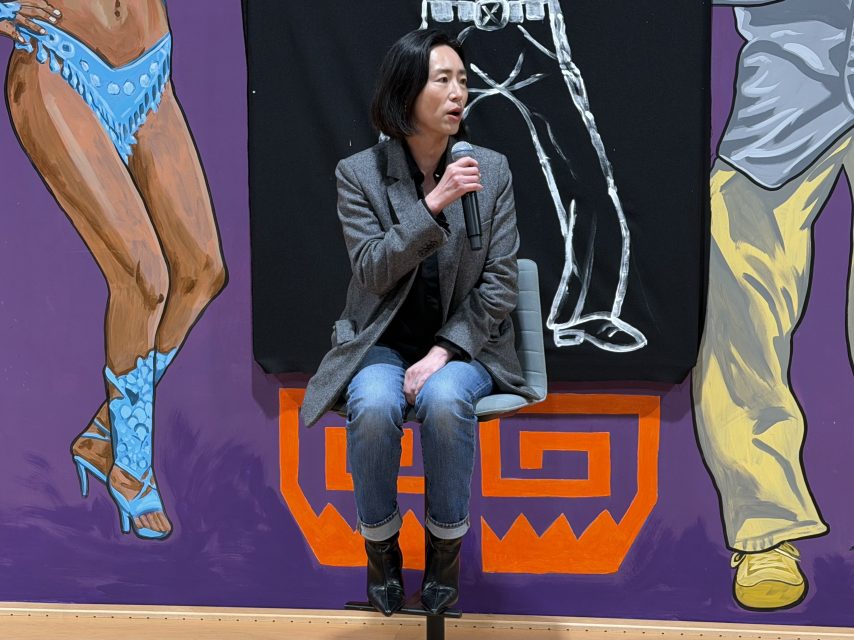
Chan said that lack of protections for small businesses and rent-controlled tenants motivated her opposition to upzoning, which increased the maximum height of buildings on many of San Francisco’s commercial corridors from four stories to six or eight stories.
“That is the reason why I was really hoping that I could get support to amend the zoning plan,” she said, “to fight against real estate, speculative investments and displacement.”
Chan proposed amendments to the upzoning plan that lowered allowable heights on commercial corridors in her district and removed all existing housing — not just rent-controlled housing — from the plan.
These amendments were ultimately not incorporated into the plan because they likely would have put the city out of compliance with state housing law.
As for the Great Highway, Chan said that until there is a better public transit system and people “want to ditch their cars,” the question she will be asking is, “Are there access and routes for people who have to drive their cars?”
An endorsement from the Working Families Party is forthcoming.
The top two vote getters in the June 2 “jungle primary,” regardless of party affiliation, will advance to the Nov. 3 general election.
Scott Weiner is NOT a progressive.
He is not a progressive and, given that he has won every election he has ever run for, it would appear that local voters do not want him to be one. So his job here is to mutter platitudes like “genocide” and “abolish ICE”, which please the lefties but are of course meaningless since Congress will never act on such views anyway. At the same time he must not scare off the silent moderate majority who serially elect and re-elect him
“Though building taller, denser housing and pedestrianizing roads tend to be progressive issues in a national context, San Francisco’s progressive establishment often opposes urbanist changes.”
These people are out of touch and clueless. Progressive and conservative folks alike from other parts of the country and world laugh at this city for this exact reason. Not building enough new housing for existing and new residents alike is exactly why rent is so high in this city.
Wrong. Building market rate housing serves developers and nobody else.
Los Angeles rents are quite a bit lower than San Francisco rents now… BECAUSE THEY BUILD WAY MORE MARKET RATE HOUSING ! Supply and demand, Comrade. It’s real, not ideological.
nix, building new market rate homes also serves the kind of people who clearly want to buy or rent them. Or isn’t that cohort important to you?
“Wiener said, explaining that for many years he has supported reforming California’s rent control laws, which in San Francisco only apply to buildings built before 1979. ”
There should have been a follow-up question, asking for evidence of that support. I don’t believe it exists. Also Wiener saying he “did not oppose” prop 33 is not the same as saying he supported it.
Its interesting how San Francisco cannot get out of its own way. Seriously, giving $500 to a moderate Democrat is a negative thing? So much so that Chakrabarti needs to defend doing so?
This type of in fighting is why Donald Trump is in the White House, and Republicans dominate Congress. Its time to stop these “purity” tests and accept that there are many flavors of Democrat, and they ALL have a seat at the table … even in SF!
in progressive san francisco, the influence of money goes to the centrists because no republicans would win but “centrist” democrats who are ok with taking money from the wealthy (property developers, investment bankers, angel investors, tech CEOs, and Corporations). They may say one thing in public to get elected but once they’re in office, they will vote socially progressive on issues that don’t really affect the bottom line (still important to everyday working people) but when it comes to which side they’re on about projects being funded, they don’t want to upset their donors because they depend on the money to win re-election or for higher office.
Chakrabarti is a carpet-bagging socialist from the East Coast, not a progressive. Vote for Chan.
Let’s be real, Chakrabarti is not part of this community. He should spend the next 10 years getting to understand San Francisco, maybe run for a local election so he can work through local issues and feel what this city is really about, then we can talk.
Progressives such as Senator Elizabeth Warren are self-declared capitalists and none of them are socialists. Chakrabarti has socialist credentials and may be one.
Thanks for doing such a thorough job of reporting on these important issues. It is most important for people around the state to see how San Francisco representatives in Sacramento fail to support a lot of residents who they ignore. This election cycle will be most relevant to our state and could set us on a new trajectory if the public is well-informed and understand how we got where we are now/
another “MAKE SURE TO VOTE IN THE PRIMARIES!!” leads to 3 people who I find very little reason to support.
Sadly, I agree. I think a better story line would be:
Are any of the S.F. congressional candidates ‘progressive’?
Who needs progressives? I want people who will get things done. Not NIMBY up everything.
Hector, why is it even important which of these candidates is the “most progressive”? Progressives rarely win city-wide elections whether it be for mayor, the State Assembly or Congress.
If you want to predict the winner wouldn’t it make more sense to ask which candidate is the most moderat?
All three have embraced the genocide lie, though Wiener did so only half-heartedly when forced to.
As much as I dislike Wiener because of all of his anti-affordable housing legislation, he is the least awful of the three candidates. In Congress, Wiener will not be able to champion bills that negatively affect the Bay Area and California nearly as much as he was able to do so as a State Senator.
Chan and Chakrabarti are completely unacceptable. They are pathological liars that are pandering to the far left voters that usually decide the primary winners.