

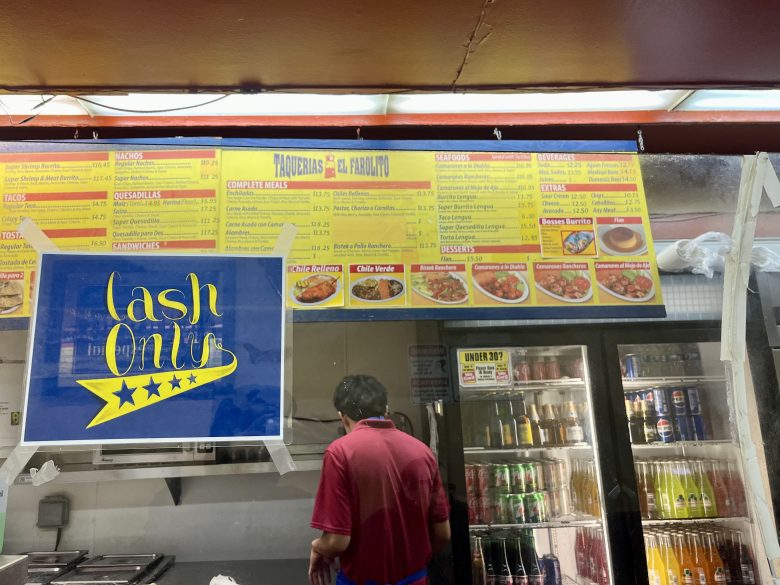

Seven years after San Francisco passed a law requiring brick-and-mortar stores to accept cash from customers, citing an “ethos of inclusivity,” city leaders are seeking to repeal it.
Supervisor Rafael Mandelman, who proposed the repeal, said he was inspired to do so after hearing complaints from business owners that break-ins were “kind of out of control.” Some small business owners, he said, believe the requirement to accept cash makes them a target.
“We burden small businesses in the city to an extraordinary extent,” Mandelman said. “I think this is one area where we should let them decide how best to serve their customers.”
Crime is generally down in San Francisco, with reported burglaries about 27 percent lower in 2025 compared to 2024.
Michael Rotella, the owner of Rocco’s Café in SoMa, said he discovered his restaurant had accepted thousands of dollars in counterfeit bills over the course of six months in 2024.
That same year, his restaurant was also broken into twice. After conferring with nearby business owners, he realized that a neighbor with a sign stating there was no cash on the premises had been spared during a rash of burglaries.
“It was very apparent to me that people were breaking in for cash,” Rotella said. “So that’s when I went completely cashless.”
About 20 percent of his sales came in cash, Rotella said, but he “made the difficult decision” to flout the cash-acceptance rule to protect his business and his staff’s safety.
After a few months, he said, the city came knocking on his door, threatening to fine him.
The cash rule stems from an amendment to the police code, passed in 2019. It requires most businesses to accept cash, with a few businesses (food trucks, pop-ups and service-based businesses such as hair salons) excepted.
The impetus for the rule was accessibility: The “very poor,” as well immigrant communities and the very young and old, the amendment read, “fall outside the non-cash financial system.”
It cited a 2005 study commissioned by the city, which stated as many as 50 percent of African American and Latino households in San Francisco were estimated to have no bank account.
Supervisor Matt Dorsey, another supporter of the police code repeal, said that “equity concerns are less prevalent today” than they were at the time the mandate was first passed, because it’s easier to get EBT cards, and platforms like Zelle and Venmo are more common.
Neither Dorsey or Mandelman had data as to whether — or how much — disparities had improved as far as the city was concerned, but both said that business owners should be permitted to make the choice of whether to accept or reject cash.
Nationwide, those levels are decreasing, but remain significant. A survey conducted by the FDIC found that in 2023, Black and Latino households were overrepresented in the unbanked population, with 10.6 percent of Black and 9.5 percent of Latino households in the U.S. were unbanked, down from 17 and 14 percent in 2017.
Today, approximately 4 percent of San Francisco households are “unbanked,” or do not have a checking or savings account.
Nearly 14 percent are “underbanked,” meaning that they have bank accounts but primarily use cash or use check cashers or money orders, according to Eric Manke, a spokesperson for the Office of Financial Empowerment, a public-private partnership within the Office of the Treasurer & Tax Collector that seeks to connect residents to banking and other financial services.
“These residents are often the most financially vulnerable and can face higher costs and barriers in everyday transactions,” Manke said.
“It’s a matter of retail access for people who don’t have other forms of payment,” city economist Ted Egan said of the original mandate. On the other hand, Egan said, creating a cash infrastructure could be “onerous” for small businesses.
In some areas of the city, cash is still king: Many dive bars and mom-and-pop restaurants only accept cash. Others offer incentives for customers who pay cash, to save the business money on credit card processing fees.
“By and large, most businesses will still conduct business in cash. I don’t think there’ll be a shortage of places in San Francisco where things can be bought in cash,” Dorsey said. And those businesses that refuse to accept cash may “pay a price,” he added.
For some businesses, that price is worth it.
Evan Bloom, the founder of Wise Sons Deli, recently wrote a letter, urging supervisors to pass the repeal, that his business only brought in 2 percent of its sales in cash and that, after “repeated break-ins and armed robberies,” Wise Sons had also decided to go cashless.
“Since doing so, we have experienced zero break-ins,” Bloom wrote.
“It sucks,” Rotella said, of having to turn away customers who want to pay with cash. “But in the city of San Francisco, and specifically SoMa, I already have enough issues to deal with, with trying to keep the business alive.”
The revision will be voted on by the Board of Supervisors’ public safety committee on Thursday.
This story was updated with a crime statistic about burglaries.
How you spend your money is marketable data. Paying in cash deprives the odious data mining industry from snatching more of your data to sell. Perhaps your bank doesn’t sell your data, but your credit card company probably does. Cash is a vehicle for privacy, which used to be a right in America.
Nobody is saying you cannot carry cash and use cash. That is your choice.
As a business I should be able to choose what payment methods I accept. That is my choice.
Correct – as a customer, I will make sure to only shop at places that accepts cash. Not everyone has access to a bank account. Perhaps the rule should apply to high-end shops, but not to places that carry food & drinks.
I don’t want to get to paranoid sounding, but we’ve seen some crazy stuff this past year or so. The ability of a ‘leader’ to just tell a credit card company to “turn off this list of people” isn’t something that is even remotely unlikely anymore. I’ll stick to cash, thank you very much.
This will expand the marginalization of the poorest, the immigrants, the youth, who are all already disadvantaged by the ever-increasingly corporate world we are in. What do you do when not even money, the coin of the realm, “Legal Tender,” cannot buy you a lemonade at the corner store?
So like, what is your plan to address break ins and armed robberies? I don’t think its fair to expect small business owners and employees to be routinely traumatized as part of their job.
Go to the corner store across the street.
Thank you for this eloquent comment. I agree w/ you.
Go to a store near by that does take cash. Even poor, marginalized people can handle that.
not.that.hard
The poorest, the immigrant, the youth can get a bank account just like the rest us, for peet’s sake.
Not everyone can afford a bank account. There is a balance limit to avoid banking fees.
Financial institutions have no incentive in having poor customers. They make $$ off the balances we carry on our cking accts.
“ nearly 14 percent are “underbanked” — have bank accounts but primarily use cash or use check cashers or money orders”
I have sympathy for the unbanked, but we should not be concerned about people being “underbanked”. They have access to a bank account. They can take part in any part of the economy that requires one. They might prefer cash but there’s no reason for the government to intervene to get businesses to honor that preference.
I think there’s significance to what others are saying about cash being akin to a right. If burglary is up, something should be done about it, but the rights of a business, even a small one, should not trump those of the individual, and it could be hard to walk back the effects of repealing the law if it’s done hastily.
The real issue here is not who is banked, un banked or underbanked. The real issue is the swipe fee for the charge and debit cards. If we were to follow Brazil’s lead and mandate a swipe charge less than 1% I could go along with the cashless trend.
Let’s call out the “repeated break-ins” for what they are: anecdotes unsupported by actual data.
Burglary in San Francisco has dropped by more than 50% compared to the same period in 2024. Year-on-year we are down more than 40% in 2026. In fact, it’s the lowest number of burglaries on record in the SFPD Crime Dashboard, which goes back to 2017.
It’s strange that the two biggest supporters of SFPD overtime on the Board of Supervisors are the ones arguing accepting cash is too onerous, when it’s safer than it has been in many years.
Recent disclosures show that on December 23, Visa donated $250,000 to Mayor Lurie’s ballot measure committee for the Muni parcel tax. This legislation was filed on January 6.
The mayor is using the committee as a vehicle for self-promotion, literally titling it: “Stronger Muni for All, Mayor Lurie’s Ballot Measure Committee.”
So that’s interesting. It makes one wonder: Did Visa donate out of pure generosity and support for our public transit system, or for another reason? Is this change really designed to help small businesses… or a very large one?
And if SFPD is so ineffective at preventing crime that the only way to prevent break-ins is to take away our right to buy stuff without corporate tracking, then will the supervisors reallocate some of SFPD’s record-high funding toward public workers like teachers who actually do their jobs? The starting pay in SF for a K-12 teacher is $61k. For a cop, $119k.
Benefits of cash: I bought a coffee and a scone today. I tipped a buck. I know the store pays several people off the books and the baristas split the tips. I know that they spend the money at the bodega and the chinese market across the street. I know that the bodega cooks some of their food (chips and some baklava and cookies). I know the chinese vegie market pays their staff in cash and may even pay their rent in cash.
So… in some respects, you might say, “OH THEY ARE AVOIDING TAXES!!”, but the reality is that, economically, cash is the most effective way of multiplying value locally. Credit/Debit for purchases, in comparison, is horrible for a local economy. It literally removes value from the local economy.
I don’t know if you should make it a law that you need to accept it if you serve the public, but from an economic standpoint, using cash is far far far far better for the local economy.
Some of us prefer to use cash and it has nothing to do with whether we have a bank or not. It’s just how we roll. We don’t want to use credit cards for everything and go into debt or be tempted to buy things that we don’t need.
The city could bridge the equity gap by offering debit cards at their own city-owned bank/credit union. Which is something they’ve talked about doing for ages.
These businesses are the first to complain about unpermitted food vendors, but are choosing to ignore the law themselves.
I’ve reported them before, and I’ll do it again. Next time I’ll place an order and they can choose to refuse my cash.
Cash is King. It’s a right to privacy. The working class, the disabled, the immigrant, blue collar, we all use it. It’s our one thing that is ours without our privacy being invaded and data being sold. I am really sad to see this is even being considered. If you don’t want breakins, put a sign that says “no cash on premises and accept it for your clients. A lot of us are struggling right now financially and in the red. For those of you who are well off with higher paying jobs, that means in the negative balance. Cash does not keep our money in limbo like banks do.
Well, that’s too bad, a business that does NOT accept cash from me will lose my business. 🤷🏼♀️
I like cash.
– I don’t want the bank or my spouse to know what I spend my every cent on. Otherwise I’d have to open another account just for chocolate, coffee, any other frivolous stuff! 🙂
– I was at the airport, a visitor said his card didn’t work and he only had cash, he was relieved to hear from me that all S.F. business are required to take cash.
– Also young people in the store can’t do math!!! Shocking, you hand them $22 (a 20 & 2 singles) for something that’s $11.89 and they are completely stumped, they try to give you the 2 bucks back. I’m worried they can’t do any math in their head, they need the practice.
– Cash teaches people that money is ‘real’ and creates value.
– Always have a stash around for emergencies. They happen.
– people loose their bank cards and they have no cash, they are really stuck.