

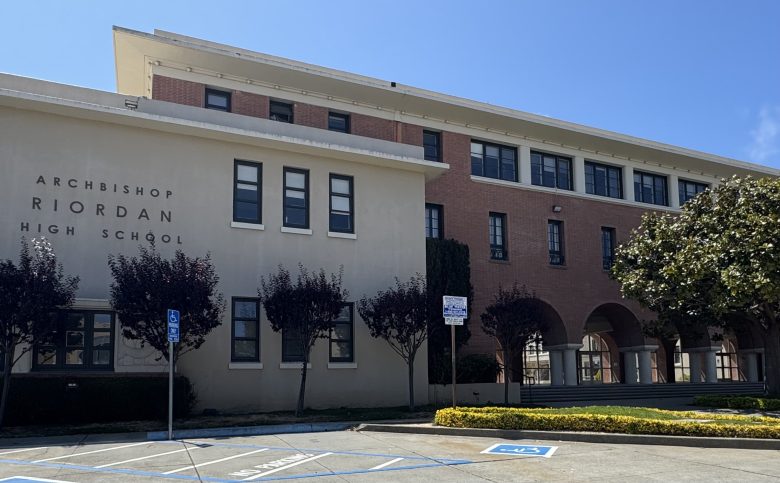

The San Francisco Department of Public Health today announced 204 latent tuberculosis cases associated with an outbreak at Archbishop Riordan High School, a private Catholic school near City College of San Francisco.
Latent tuberculosis is not contagious. Those with a latent infection do not feel sick and cannot spread it to others, but the TB can become active and infectious without treatment.
San Francisco Health Officer Dr. Susan Philip said in a statement that “the risk to the general public remains low.” She said contact tracing and testing are critical to preventing future active cases and protecting long-term health.
The health department said it had received 1,261 test results from students and staff at the school. In January, Riordan administrators announced three TB cases among students since November, prompting the department’s testing.
Of those tested, 219 were positive for tuberculosis. So far, 204 cases — about 16 percent of those tested — have been confirmed as latent TB. Chest X-rays are underway to rule out active disease in the remaining positive cases. The announcement comes on the heels of the school’s closure and shift to hybrid learning in early February.
Using a TB clearance protocol developed with public health guidance, the school has cleared 99 percent of students, and 100 percent of faculty and staff, allowing a return to in-person instruction three weeks after its closure.
The public health response appears thorough and appropriate, according to Dr. George Rutherford, a pediatrician and infectious disease specialist at the University of California, San Francisco.
“It’s a reasonable thing to investigate and invest resources in.” He said that San Francisco’s public health department is well-equipped to manage complex outbreaks.
Still, the proportion of latent infections is significant, Rutherford said, noting that the numbers stand out when compared to background rates.
“About 10 percent of people in the world have latent tuberculosis. In the United States, it’s lower — on the order of 6 percent in California,” Rutherford said. The Riordan testing results are “above what one would suspect,” he said.
Latent TB occurs when a person inhales tuberculosis bacteria and their immune system walls it off, preventing illness. People with latent TB do not feel sick and cannot spread the bacteria to others.
However, without treatment, about 5 percent of those infected develop active TB disease over their lifetime, Rutherford said. In people with weakened immune systems, such as those with HIV, the risk can rise to roughly 5 percent per year.
Active TB typically affects the lungs and can spread through the air when a person coughs, speaks or sings. Symptoms include a persistent cough, fever, night sweats and weight loss.
In severe cases, the bacteria can spread beyond the lungs to the brain or bloodstream. Before antibiotics, tuberculosis was among the leading causes of death in the United States.
Rutherford cautioned that the relevance of the 16-percent figure depends in part on how testing was conducted.
Assuming accurate testing, he said, the key question is whether the elevated rate reflects a clustering of cases within the school, such as within the same grade or activities. He noted that pulmonary infections can be especially transmissible in settings like choir, where forceful exhalation can spread airborne bacteria.
Public health officials have not released details about how transmission occurred. According to the public health department’s press release, no related active TB cases have been reported at other San Francisco schools to date, and no actions are required outside the Riordan community.
As of Feb. 20, three confirmed cases of active TB have been identified within the school community — one diagnosed in November 2025 and two more in January 2026. Three additional suspected active cases have also been detected.
All confirmed and suspected active cases are being treated, and health officials say there are currently no contagious cases on campus.
The outbreak timeline began in September 2025, when the first student sought medical care after two weeks of coughing. The case was confirmed as active TB in November, triggering contact tracing and expanded testing.
Two additional active cases were confirmed in January, prompting required testing for all students and staff and a health advisory to clinicians, alongside information sessions for pediatricians and community town halls.
The percent of CA population with latent population seemed high, so I looked up the US numbers. Then I realized like that of course the CA percentage is double the rate for the rest of the country.
World – 10%
US – 2.7%
CA – 6%
I attended Riordan from 1971-75. The school was on the quarter system so it was constant studying and tons of homework. I didn’t learn very much that was useful in life those 4 years. 😠