

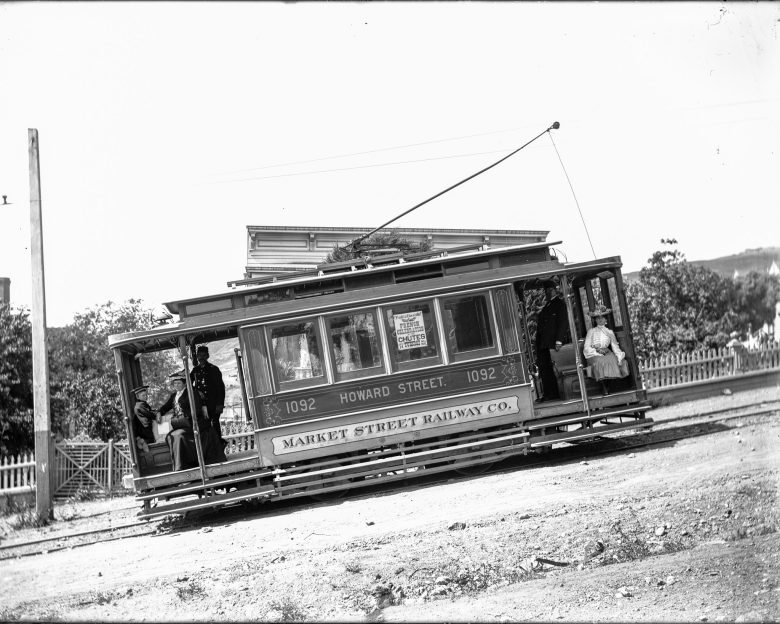

How a city moves is also how it breathes — its life force.
In a new City Hall exhibition highlighting 122 years of photographs documenting Muni travel, you see the flow: Rush-hour traffic clogs Market Street in 1940. Bus 76 climbs to the top of the Marin Headlands to catch up with a cyclist in 1976. And Fannie Mae Barnes, the first female cable-car grip, clutches a handle in 1989.
“Moving San Francisco: Views from the SFMTA Photo Archive 1903-Now,” which opened last week and is on display till June 18, draws together 100 images, many of them never before put on public display.
The exhibition, curated by San Francisco Municipal Transportation Agency photo archivist Jeremy Menzies with San Francisco Arts Commission galleries acting director Jackie Im, becomes a history of San Francisco itself.
The photos include a series in the era of the Great Earthquake, images of the start of the Muni Metro, and day-to-day snapshots of the city in the late 1970s and 1980s.
San Francisco’s beloved public transit system is the subject of running routes and viral holiday-sweater drops, online games and storytelling series.
“It feels like a part of your family, your apparatus, your living organism,” said Ralph Remington, director of cultural affairs for the arts commission. “For over 100 years, Muni has been the steady presence that has carried us through the areas that define San Francisco.”
The historical images, culled from thousands in the SFMTA photo archive, showcase notable figures who have appeared in support of Muni (Tony Bennett, Phyllis Diller, Harvey Milk) as well as the many operators who keep the city’s lifeblood running.
Along with the photographs are quotations from Muni-riding San Franciscans: There’s Stuart Schuffman (aka Broke-Ass Stuart) recounting the time he fell in love both with Muni and San Francisco; local artist Jeremy Fish claiming the cable car as his favorite and only Muni ride; and TikTok Muni fan Daisy (mysolo.dias) reminding us of the “muni” in community.
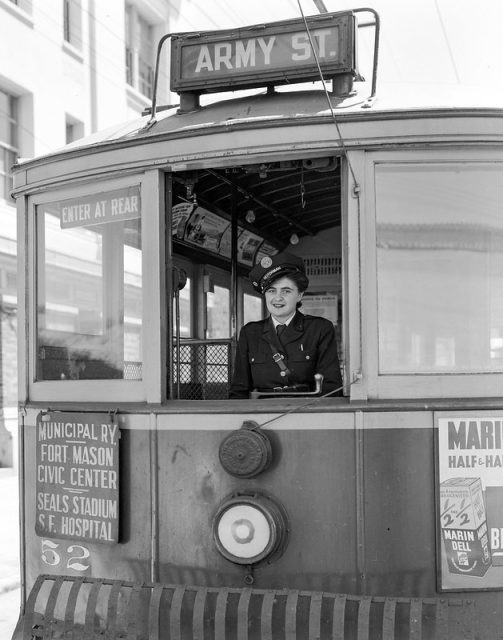
At Thursday’s exhibition opening, a Muni bus driver garnered the loudest applause.
“We have the opportunity and privilege to participate in the daily rhythms of the city,” Mc Allen, a driver in the Woods Division, said. (Allen is the same Muni driver who, last March, wanted Muni to break a 550,000-ride mark for “Transit Operator Day.”)
Allen was wearing, of course, a Muni jersey, and signed off with what he called an “oversized stop announcement:” the many transfers he calls out at Powell and Market streets.
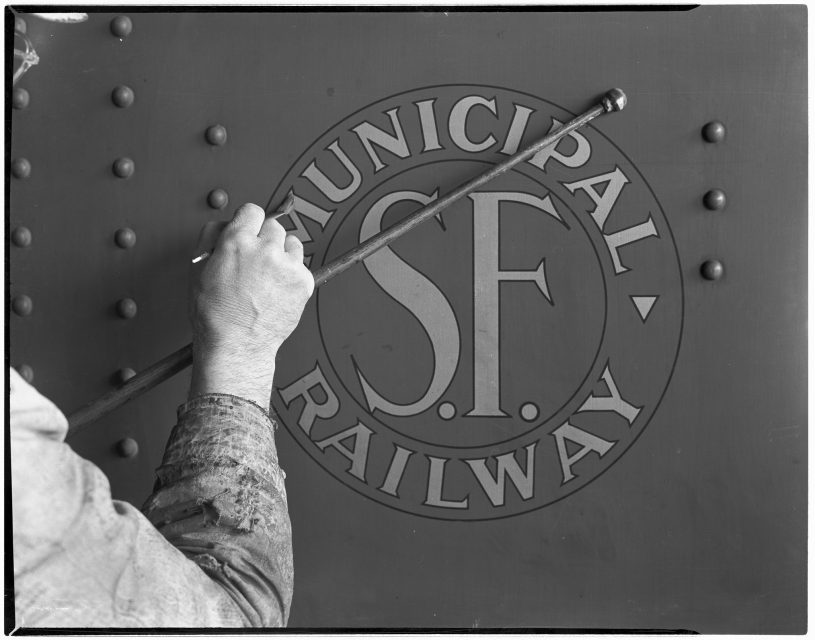
Courtesy of the SFMTA Photo Archive.
The opening drew a giddy crowd ready to reminisce about favorite transit rides, talk about their Muni tattoos, and enter the raffle for free Muni merch. It also featured a 16-foot long Subway-style sandwich (N-Line veggie, J-Line chicken, M-Line beef, L-line turkey).
Archivist Menzies is not only in charge of taking care of the existing images: He’s also the agency’s photographer, out on the street to document Muni for the future, as the photographers in the show did before him.
Menzies sees himself as following in their tradition, and points out that even though images might have been taken for a more mundane reason — for example, to show traffic congestion — they end up capturing the zeitgeist of a time.
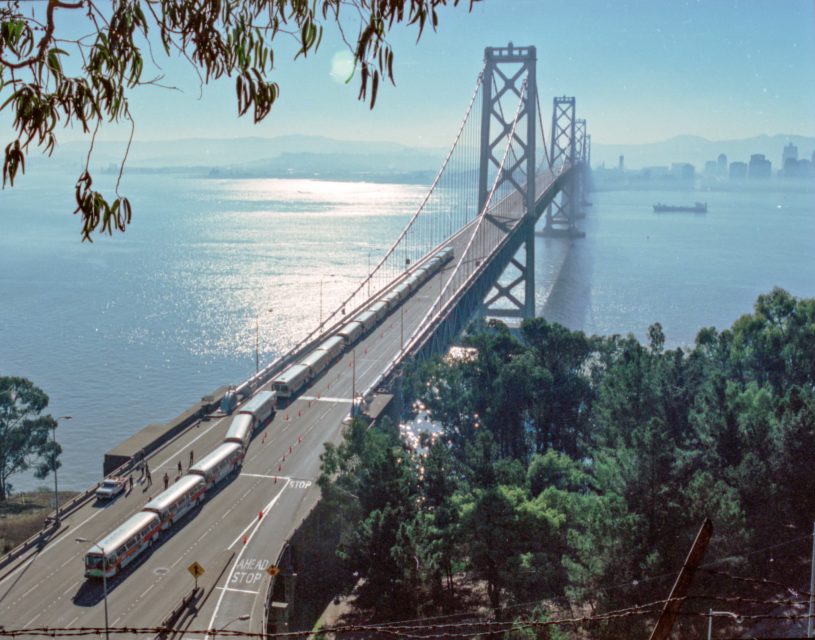
“People came to look at all the weird hippies,” he said, looking at a 1967 black-and-white photo of Ashbury Street, where pedestrians strutted across the walkway.
SFMTA is one of the few city agencies to have a full-time photographer on staff. “It’s amazing that people who head the agency had the forethought to document it,” said Julie Kirschbaum, SFMTA’s director of transportation.
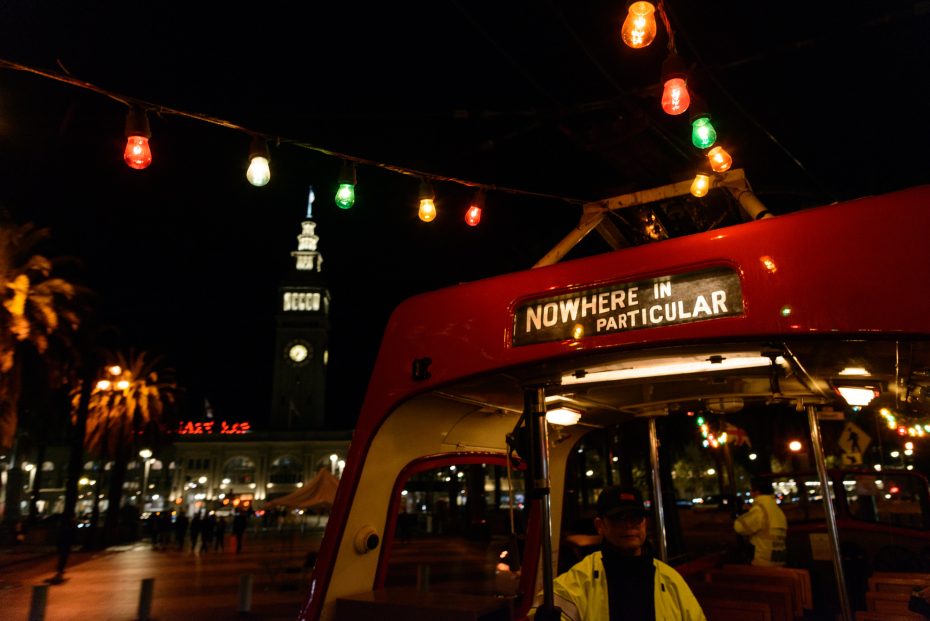
Kirschbaum noted that the transit system is tied to so many firsts: First day of school, first date, first day on the job.
“There’s not a place in San Francisco Muni doesn’t touch,” Kirschbaum said. “It’s stitched into people’s memories.”
Despite all the love, Muni continues to face service cuts as the city experiences budget shortfalls. Mayor Daniel Lurie cited Muni as a top priority in his State of the City address the morning of the exhibition opening.
“Two things we need right now,” Remington said, “are more art and more transit.”
“Moving San Francisco: Views from the SFMTA Photo Archive 1903-Now” is at San Francisco City Hall on the ground floor and in North Light Court, from Jan. 15 to June 18, Monday to Friday, 8:30 a.m. to 6 p.m.
This is wonderful. If only SF would tax the billionaires and make muni fast and free, instead of handing over the responsibility of transporting people to private corporations like Waymo/Uber/Lyft.
Making Muni “free” would make it infested with drug addicts and effectively useless for San Franciscans. We our transit to be actual transit.
Most of the billionaires in the region do not live in SF. The few ones who do would leave if that tax passed…
The “Moving San Francisco” exhibit at City Hall beautifully captures over a century of life in San Francisco through the lens of its iconic public transit system, offering both longtime residents and newcomers a compelling visual narrative that intertwines the evolution of Muni with the city’s cultural and social history; by showcasing historic and rarely seen photographs alongside personal reflections from riders and operators, the exhibition underscores how deeply transit is woven into everyday memories and community identity, even as Muni faces modern challenges like budget shortfalls and service cuts.
The exhibit wasn’t that easy to find in city hall. It’s on the lower level and the photographs are just on the wall of a corridor i.e. there’s not really a dedicated gallery space. I feel that my sense of civic pride was strengthened by viewing it.