

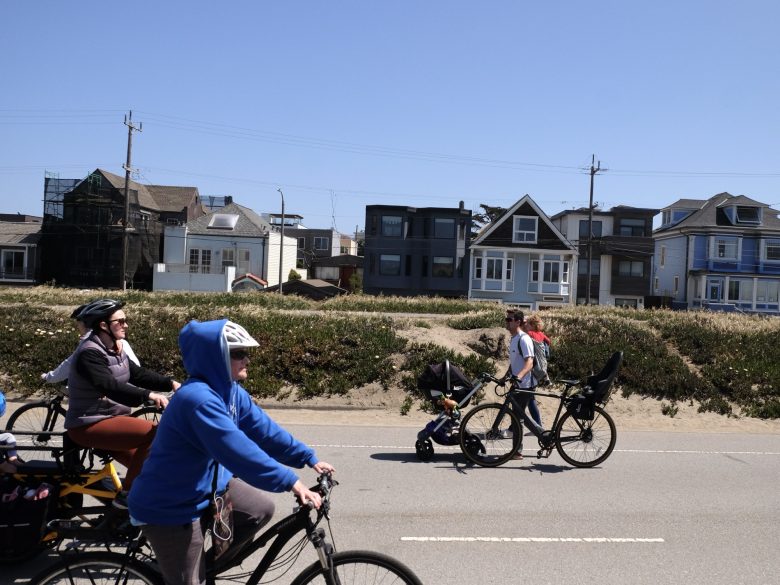

A San Francisco judge denied all arguments in a lawsuit that sought to undo Prop. K and return cars back to the coastal road.
The voter-approved ballot measure to turn the Upper Great Highway into a park remains intact.
After three hours of oral argument on Monday afternoon, San Francisco Superior Court Judge Jeffrey S. Ross dismissed all four counts from the petitioners, ruling that San Francisco voters had the legal authority to close the road when they voted 55-45 in 2024 to do so.
He discounted the argument that the state has a “regulatory interest in managing its roadways.”
Judge Ross also denied other arguments based on the road’s “partial closure” (it is closed to private vehicles but open to emergency vehicles), environmental review requirements and its consistency with the city’s general plan.
Those against the Sunset Dunes park, which opened in April 2025, said they may challenge the ruling.
“Every single part of this ruling is ripe for appeal,” said James Sutton, the attorney who represents the plaintiffs, including Matt Boschetto, Vin Budhai, Albert Chow and Lisa Arjes. Plaintiffs have 60 days to appeal.
“It sounds like today’s hearing, his mind was totally made up. We’re extremely disappointed,” Budhai said after the hearing. “However, for every one of his decisions, we feel it stands a chance that we could file for an appeal.”
“Raising the money for this leg was not that difficult,” he added. “So if we find the right people to help us fund the appeal, then we’ll go forward with it.”
The parties spent the longest time in court on Monday — some 90 minutes — discussing whether Prop. K complies with the California Environmental Quality Act (CEQA).
Petitioners argued that Prop. K is invalid because the city did not conduct an environmental review. But the judge determined that Prop. K is not a CEQA “project,” because a project under the state law must be initiated by a “public agency.”
The measure was put on the ballot by a minority of city supervisors, who do not constitute an agency, Ross said.
Therefore, Ross said, an environmental review was not required before the ballot measure went to the voters.
James Sutton disagreed. “Five supervisors who are part of the legislative body, in a collective action, is not an act of individuals.”
Even if Prop. K is a CEQA “project,” the judge said, the petitioners should have appealed within 180 days of it being put on the ballot, back on June 18, 2024. They did not file their suit until March 2025, 267 days after the measure was introduced.
When the ballot measure was approved by the voters in November, the city determined that it was exempt from a CEQA review because it is a pedestrian and bicycle facility that “improves safety, access or mobility,” the deputy city attorneys said in their briefing.
The petitioners, again, did not appeal the exemption that time, the judge said.
“There were opportunities to appeal, but no one appealed,” Ross said.
The judge also denied the plaintiffs’ argument that Prop. K is inconsistent with the city’s general plan “because the plaintiffs failed to challenge it timely,” according to a tentative ruling sent to both parties on Friday.
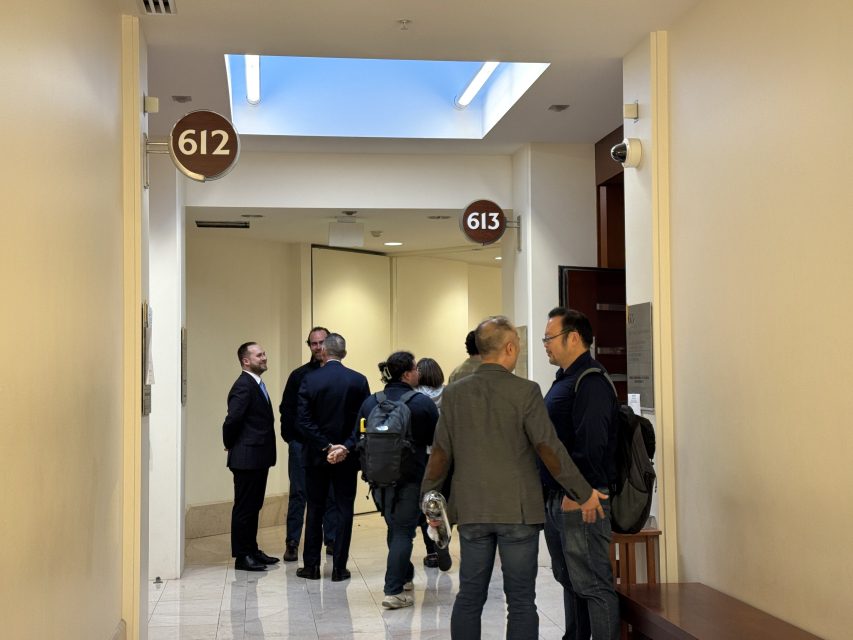
Room 613 at the Civic Center Courthouse was filled with some 50 people for the three-hour hearing. The judge invited the crowd, including both supporters and opponents of the Great Highway closure, to sit in the jury box.
Park supporters, for their part, hope the dismissal is the final word.
“It’s time to consider Sunset Dunes settled,” wrote Joel Engardio, one of the respondents and former District 4 Supervisor, who was recalled over his support of Prop. K.
Lucas Lux, president of the Friends of Sunset Dunes group, said he invites “anti-park zealots” to “accept the will of San Franciscans and work with us to make the most of our collective coastal park.”
Supervisor Alan Wong, who was appointed by Mayor Daniel Lurie as the Sunset supervisor in late November, sat in for the first half of the proceedings. He said Monday after the hearing that he would move forward with his earlier plan to put forth another measure to reopen the Great Highway to cars during weekdays.
“If this decision holds,” he wrote in a statement, “then the only way to reopen the Great Highway for vehicles on weekdays is for another ballot measure.”
Congrats on wasting your money, car brains.
Westside residents have legitimate complaints about inadequate north-south transit service making them dependent on cars. Instead of trying to close a park, I’d suggest focusing on improving Muni to fill those gaps. If they do that, they’ll find San Franciscans across the city willing to join them as allies.
Do you imply that Muni should have service from Sunset Blvd to peninsula commute destinations like Palo Alto or Mountainview? Of course not! That’s for cars, brains and roads like the Great Hwy come together. Those three together actually get people to their jobs.
Bill, just stop. You are so blinded by car-brain-ism that you don’t even know that Palo Alto and Mountain View are in the South Bay, not the Peninsula. “That’s for cars, brains and roads like the Great Hwy come together.” – what even is this gibberish. So guess what—if you feel like you are entitled to your own special road to get around your own city’s grid so that you can commute 40 miles every day, that is a sign of pathological selfishness. Any sensible person would figure out how to get themselves to BART and connect to Caltrain from Millbrae. And if you find that route to be too slow, then rally your neighbors and demand better connections between BART and Caltrain. And also advocate for Muni or bike paths as a last-mile solution if you need that too.
I like Muni, cycling, and walking where they get you to a destination in a reasonable time. However, efficiently traveling around the west side often means hopping in a car. Don’t take my word for it. Look at tomorrow morning’s commute. Cars Everywhere on westside streets – legions of them outnumbering cyclists or muni riders by the gazzillions. Thanks for admitting that traveling efficiently to/from the peninsula or (if you must) south bay via Muni/Bart/Caltrain does not yet exist. My carbrains tell me that until major improvements you cite are online, people will continue to choose to drive their cars for these routes. No shame on them. And no selfish entitlement in wanting to keep that road open. Note: there was always a bike and pedestrian path along the road until – some would say – an entitled group decided they didn’t want to share anymore!
This result was quite predictable, and predicted. The arguments in the challengers’ brief were extremely weak. The city attorney did a nice job. Judge Ross is a good, smart judge, and this was a pretty easy call for him following clear law. I don’t yet see the written ruling on file. We’ll see if anyone continues to throw good money after bad to fund these expensive lawyers for an appeal.
@SFAtty – Over on Nextdoor (which is ground zero for the Sunset Dunes h8rs) they’re hauling out their “Yer not from aroun’ here” stuff yet again, in the form of speculating where the Judge lives.
please don’t make us vote on this again, there are more urgent crises that require the time and resources.
What the heck — I support voting yet again on the closure of the Great Highway and look forward to an even more overwhelming “YES” on the measure.
Doubtful this is over, because it’s indicative of the polarizing public divisions as to SF’s forward path.
Could you please report on the costs of maintaining the Great Highway as a road for driving, vs maintaining it as a park. My understanding is that it was quite expensive to clear the sand as frequently as was needed, and that a park requires less or no such maintenance. In all the arguing about cars vs recreation, I haven’t seen a good explanation of the financial implications.
This was discussed in the November 2024 voter guide, where the City Controller’s office wrote:
“If the proposed ordinance is approved, annual operational cost savings could range from approximately $350,000 to approximately $700,000 annually for reductions in sand removal, roadway maintenance, and operating costs, which may be partially reduced by additional costs to inspect and maintain physical infrastructure.”
They also estimated a savings of $4.3 million otherwise budgeted to replace the aging, decrepit traffic signals on the Upper Great Highway, but predicted this would be offset by $2.7 million of new capital costs for traffic calming and signals to accommodate diverted traffic, for a net of $1.4 million in one-time savings. You can read the statement on page 157 of the pamphlet, archived here: https://digitalsf.org/record/56778?ln=en&p=november+2024&v=pdf
Judge got it exactly wrong on the law. Appeal will win.
@Pete – Riiiight, and the previous judge got the previous ruling wrong, too. And the voters for Props I, J, and K also got it wrong. Everyone gets it wrong.
Looks like the missed deadlines are clear-cut, but the ability to push aside the need for CEQA review because a city government’s officials put it to the voters – that should have a chance on appeal. Certainly the framers of CEQA would object to that kind of exemption. I’d say this rationale by Judge Ross should trouble anyone who cares about environmental issues.
@Bill M – The Sunset Dunes h8rs tried this specious CEQA argument based on the fact that the Supervisors put Prop K on the ballot. Meanwhile, they are trying to get the Supervisors to put a do-over of Prop K on the ballot with no CEQA review.
One marvels at the consistency and integrity.
idiot judge – no surprise.