

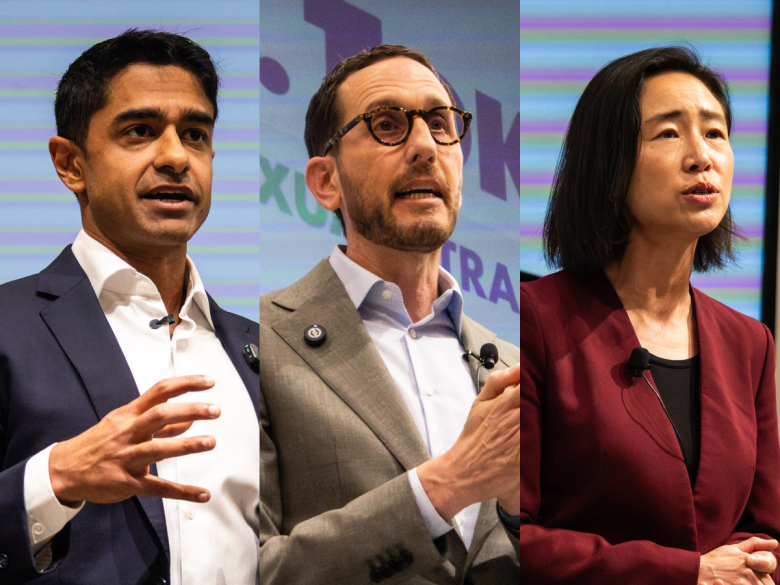
This is the second article in a two-part Q&A series with San Francisco’s major congressional candidates focused on foreign policy.
Part one, published Tuesday, focuses on Congress and the military, with questions about Israel and Palestine, Ukraine, Iran and Venezuela. Part two focuses on trade, foreign aid and the relationship between the U.S., China, and Taiwan.
As San Francisco’s congressperson and speaker of the House, Nancy Pelosi was a strong supporter of Taiwan. In 2022, she became the highest-ranking U.S. official to visit the island in 25 years.
China condemned that trip, because it sees the self-governing island as part of its territory. The trip also sparked strong public outrage among Chinese citizens.
“Our delegation’s visit to Taiwan honors America’s unwavering commitment to supporting Taiwan’s vibrant Democracy,” Pelosi tweeted at the time. “America’s solidarity with the 23 million people of Taiwan is more important today than ever, as the world faces a choice between autocracy and democracy.”
Two days after Pelosi left, China spent a week conducting military exercises close to the island’s shores.
Pelosi was a harsh critic of China. In 2022, she called for a boycott of the Winter Olympics in Beijing because of what she dubbed a “genocide” of Uyghurs and other ethnic and religious minorities.
She criticized heads of state visiting China, and asked: “What moral authority do you have to speak again about human rights any place in the world?”
What will her replacement think?
The candidates running to succeed Pelosi in the House of Representatives will be able to chart their own path on Taiwan and China. In Mission Local’s foreign policy interviews with the three leading ones, some did.
While Saikat Chakrabarti, a tech multimillionaire and former chief of staff to Rep. Alexandria Ocasio-Cortez, said he supports maintaining relationships with Taiwan and would consider going on a diplomatic trip to the island, he also took a stab at Pelosi.
“Would I have gone to Taiwan at a time when tensions were really ratcheted up, and former Speaker Pelosi went? No, I wouldn’t have done that,” he said.
When asked whether the United States should use force to defend Taiwan if it was invaded by China, Chakrabarti said yes.
By contrast, State Sen. Scott Wiener and District 1 Supervisor Connie Chan sidestepped the question.
“The U.S. should support Taiwan’s defense and I support the current U.S. policy of selling defensive arms to Taiwan,” Wiener said.
“The goal is that the United States will always act as an agent for peace,” said Chan, the only major Chinese candidate in the race.
Chan did not say the two places were one country, but she did emphasize “linkages” between China and Taiwan that she saw as a child growing up in Hong Kong and Taiwan.
“To somehow think of [China and Taiwan] as just simply one space and not the other, that there’s no linkage of people, that people don’t travel, and that people don’t do business or have family and friends all across, that’s not us,” Chan said.
Candidates also shared their perspectives on trade, tariffs and foreign aid.
Chakrabarti presented a vision for U.S. foreign policy, arguing that the United States should scale back its investments in the military and invest more in foreign aid.
“If we’re moving away from a place where we are using our military might to scare the rest of the world into being our allies, we have to switch to a place where we’re using foreign aid and development as the way to earn other countries’ trust and earn allies around the world,” he said.
Wiener also argued that rebuilding USAID, the American government’s foreign-aid agency, would not just benefit foreigners, but also Americans.
“It’s also in the U.S.’s interest to improve health globally,” he said. “When you have disease spreading, no disease stays within borders.”
Chan threw her support behind USAID as well, but struggled to get specific on some of the questions about foreign aid and trade. “Can I get back to you on that one?” she said after attempting to answer a question about the International Monetary Fund and World Bank.
To learn more about the candidate’s stances, click on the arrows to read their answers below. They have been edited for length and clarity.
China and Taiwan
Should the U.S. use force to defend Taiwan if it is invaded by China?
In 1949, the Republic of China lost the Chinese Civil War to the Chinese Communist Party and retreated to Taiwan. The Chinese Communist Party established the People’s Republic of China and began ruling the mainland.
But for the next 30 years, the U.S. continued to recognize the Republic of China as the legitimate government of China.
In 1979, the U.S. established diplomatic relations with the People’s Republic of China after adopting its “one-China policy,” a key step which recognized the People’s Republic as the sole government of China.
But, under the Taiwan Relations Act, the U.S. continued to maintain unofficial relations with Taiwan and regularly sold weapons to Taiwan.
China, meanwhile, maintains its own “one-China principle,” which says that Taiwan is a part of its territory, and that the People’s Republic is the government of all of China.
Xi Jinping, the president of the People’s Republic, has regularly vowed to “reunify” China and Taiwan and China has increased the frequency and scale of military drills near Taiwan in recent years.
If Taiwan were to be invaded by China, do you think the U.S. should use force to defend the island?
Chan: The U.S. has a longstanding one-China policy since 1979, and that also comes with the Taiwan Relations Act in the same year. The goal is that the United States will always act as an agent for peace. That is the position that I’m going to be consistent with.
There is no reason to impose an arms embargo on Taiwan at the moment. Arms sales to Taiwan from the U.S. government has been a very longstanding policy that has been affirmed by both Republican and Democratic presidents.
I was born in Hong Kong. I went to grade school in Taiwan. My family roots clearly trace back to China. I think, on a personal level, that I do appreciate this longstanding U.S. one-China policy, and also the Taiwan Relations Act since 1979.
I still have family in Hong Kong. I have friends in Taiwan, and definitely still have family back in China. I know that everyday people living in Hong Kong and Taiwan and China would always hope for peace, and would always hope for a stabilized economy where they can actually travel and visit.
To somehow think of them as just simply one space and not the other, that there’s no linkage of people, that people don’t travel, and that people don’t do business or have family and friends all across, that’s not us. We have all those linkages all across. For me, that’s deeply personal.
Wiener: The U.S. should support Taiwan’s defense, and I support the current U.S. policy of selling defensive arms to Taiwan.
Chakrabarti: I don’t want to get into the situation in the first place, but yes, we should defend Taiwan. We should continue providing defensive capacities to Taiwan, but it’s very important that they are defensive capacities.
If we end up in a hot war with China, we’re looking at World War III. So, I hate this question, because my view is, we have to do everything we possibly can to never get to this position, and that means making sure China knows they shouldn’t invade Taiwan.
What kind of relationship should China and the U.S. have?
What kind of relationship do you think China and the U.S. should aim to have over the next decade?
Chakrabarti: I think we have to significantly move away from the current Cold War stance we have with China. I don’t believe our attempts to ratchet up tensions with China have been productive at all.
We have a large Chinese American population in San Francisco, and our relationship with China, the Cold War that we’re having, is having real impacts here as well. Visas are being canceled. People are scared about what’s going to happen to their families. This stuff hits at home as well.
Overall, there’s two major things that matter here. One is, we have actual global problems we need to work together on. I’m talking about things like climate change, nuclear nonproliferation, or the threat of AGI {Artificial General Intelligence). These are things that we cannot solve by ourselves.
Then the second piece is, yes, China and the US, we will have a lot of disagreements. And there are going to be places where we’re going to have to use our position to put leverage on them to stop human rights violations and various other issues.
But those need to be targeted, and they can’t just be blanket ratcheting up of the Cold War, because we’re getting to a place where we could end up in a hot war, and that would be disastrous.
Wiener: The U.S.-China relationship is incredibly important. First of all, it’s important culturally. Our Chinese American community has been a core part of San Francisco since the very beginning, and Chinese Americans helped make the city what it is today.
There are so many deep cultural and family relationships between San Francisco and China, and that’s really, really important.
The economic relationship between the U.S. and China, but also between San Francisco and China, is incredibly important. That’s why I do not support Trump’s chaotic trade war with China.
Of course, we need to have fair trade with China, and we absolutely need to make sure that the trade relationship is balanced and good. But having this chaotic meltdown with random tariffs that go up and down, that’s not helpful to anyone.
We’ve seen small businesses in Chinatown that are getting really harmed by this trade war with China, because they can’t even import products that they need in order to function as a business. I want to have a stable, predictable trading relationship between the U.S. and China that is mutually beneficial.
The U.S. and China, we’re the two largest economies in the world; we’re the two world superpowers.
And, while there’s always going to be disputes and differences and rivalries — that’s normal — I want to see a relationship where the U.S. and China are working together to promote peace and stability and economic prosperity in the world and that we’re working together to fight climate change, to ensure that AI is safe.
There are so many areas where the U.S. and China can collaborate to benefit both countries and the whole world and when we have these chaotic trade wars it doesn’t help.
Chan: I would say that to understand and recognize that we got to have respectful dialogue, and we ought to prioritize peace, and we ought to prioritize economic solutions that bring peace to both countries and regions. And to recognize that if we don’t handle our relationship diplomatically, and with a thoughtful approach, we are hurting and threatening global security and putting so many people at risk.
What should the U.S. do about China’s human rights violations?
China has been accused of numerous human rights violations.
In Hong Kong, it has imprisoned activists and clamped down on the free press. In Tibet, it has been accused of torture, repressing the use of the Tibetan language, and detaining people contacting Tibetans outside of China, protesters, and people who post unapproved content online.
In Xinjiang, it has been accused of detaining millions of Uyghurs arbitrarily and torturing many of them, mass surveillance, family separation, cultural and religious persecution and forced labor. China has denied many of these accusations.
In 2022, the U.S. passed the Uyghur Forced Labor Prevention Act and denied entry of nearly a billion dollars worth of goods that were potentially produced with forced labor from Xinjiang. China has condemned the act and said that the situation in Xinjiang is an internal affair, and is about countering terrorism and preventing separatism.
Should the U.S. be including these violations in its diplomatic dialogue with China?
Wiener: What’s happening in Hong Kong is very problematic. There was just a recent criminal conviction of someone who is critical of the government, and it’s bad. Yes, that should be part of the dialogue.
We also need to make sure that the U.S. is not violating basic human rights, because that’s happening right now, like shooting people in the face in Minneapolis and blinding a guy in Anaheim.
Our federal government is also engaging in some pretty severe human rights violations. So we all need to hold ourselves and other people accountable to respect basic human rights.
Chan: The United Nations should be involved in any type of human rights violation. The Trump administration has set us back significantly in our role with the United Nations, and that is, really, also where the problem is.
We should absolutely continue to support the efforts of the United Nations and make sure that the United Nations is sovereign and that it actually has enforcement capability around the globe and not just, in this case, with your questions around China, but really all around the globe for any countries that are having any type of human rights violations.
They ought to be held accountable and, frankly, that includes the United States.
Chakrabarti: We should include those violations in our dialogue. We should have a relationship with China where we can use some of the levers we have to try to stop these violations. I think part of that is using our ability to move supply chains out of China where there are human rights violations in that supply chain.
ML: China has historically had an attitude that these are domestic issues that foreign powers should not be getting involved in.
I think they have an attitude that America also has many human rights violations in our supply chains and in our use of slave labor to fight fires in California.
I’m a believer that we should not have human rights violations, right? And we can control what we do in America much better than we can control what happens in China. But that doesn’t mean we can’t have influence on what happens in China.
Would you go on a diplomatic mission to Taiwan or China?
In 2022, then-Speaker Pelosi visited Taiwan and met with the Taiwanese president, Tsai Ingwen.
“Our delegation’s visit to Taiwan honors America’s unwavering commitment to supporting Taiwan’s vibrant Democracy,” Pelosi tweeted at the time. The visit was condemned by the Chinese government, which conducted military exercises in the seas around Taiwan after Pelosi’s visit.
Would you go on a diplomatic mission to Taiwan?
Chakrabarti: Yes, depending on the circumstances. Would I have gone to Taiwan at a time when tensions were really ratcheted up and former Speaker Pelosi went? No, I wouldn’t have done that.
But in general, we work together with Taiwan, we have a relationship with Taiwan, we obviously have a strong interest in Taiwan through their semiconductor manufacturing and their high tech.
Chan: If I were elected, I would be a junior Congress member. I would think that San Franciscans, they look to me to really focus on what is important to working San Franciscans. And that means that immigration policy.
We’ve got to affirm birthright citizenship. We have to ensure the naturalized citizens also can continue to have their citizenship because Trump administration has been threatening to take that away. We need to invest in pathways to citizenship.
There’s healthcare issues and education issues. I would think that San Franciscans are expecting me to spend my first years to either be in San Francisco or be in Washington, D.C., fighting for them.
Wiener: Yes. I’ve been to Taiwan on a delegation.
Would you go on a diplomatic mission to China?
Chakrabarti: I would go on a diplomatic mission to China. I believe they’re an important superpower in the world, and I believe it’s very important to understand that country and have relationships with that country.
I would look forward to that as being a way for me to see what’s happening on the ground there and see what we can work together on.
Chan: I have a consistent principle and approach that if I, as a sitting Congress member, visit foreign countries, be it in Israel or be it in China, it is with the understanding that I need to have a clear goal and deliverables in the best interest of the American people.
When I do go, I want to make sure that visit is to prioritize peaceful and respectful dialogues, and that we are going to result in making sure that the U.S. plays a role in ensuring our national security as well as global security during those dialogues.
Wiener: Yes, as a general matter, but I can’t speak to any specific invitation. I definitely am interested in visiting China.
Is the U.S. too dependent on Taiwan for chip manufacturing?
The proportion of chip manufacturing in the U.S. has declined in the past decades, particularly more advanced types of chips used for artificial intelligence. Instead, production has shifted to Taiwan, which produces more than half of the world’s semiconductors and around 90 percent of advanced chips.
In 2022, Biden passed the CHIPS Act, which funded domestic chip research and manufacturing. Under the CHIPS Act, Taiwanese chip manufacturer TSMC invested in chip production in Arizona.
On Jan. 15, Trump announced that he would lower tariffs on Taiwan in exchange for $250 billion of investment in U.S. chip production.
Is the U.S. too dependent on Taiwan for chip manufacturing? If so, what should we do about it?
Wiener: Taiwan is a very important trading partner, and it’s a valued trading partner, and it’s a democracy. We should have a robust trading relationship with Taiwan, just like we have a robust trading relationship with China.
I also support the U.S. building out or rebuilding our domestic chip manufacturing capacity. That’s why I supported the CHIPS Act. I think it’s horrible that Donald Trump has been tearing it apart, and I do want to see a lot more domestic manufacturing of semiconductor chips in the U.S.
Chakrabarti: Yes we are. What I’ve been pushing for a long time in my politics is, we need real industrial policy to build high end chips locally. I think the CHIPS Act was a good step in the right direction. I think there are a lot of implementation mistakes. Trump has not been expanding the CHIPS Act.
A large part of what I’ve been pushing with my think tank is, how do we actually manufacture and develop high-end, high-wage industries in the U.S.?
And part of that is industrial policy. A lot of that is public financing. A lot of it is having actual plans for how we get from here to there. You’re not going to be able to build a semiconductor manufacturing industry in America by just passing a few policies. It’s implementation that matters there as well.
Chan: I definitely think that Buy America is a very critical initiative that the United States should focus on.
ML: Could you say a little bit more about how you would like the U.S. to handle its chip manufacturing?
Chan: During the Biden administration time, there’s the CHIPS Act and there’s already been consistent effort to really want to cultivate the efforts to produce semiconductors in the United States. I do believe that we can continue in this effort, and I’m supportive of those efforts.
But in this case, there should not be an embargo of economic partnerships, be it soybeans, be it semiconductors. Trade policy is critical to the global economy, but at this moment again, Trump’s excessive tariffs and ridiculous trade policy is what is hurting the United States the most.
Should the U.S. sell chips to China?
During Trump’s first term, and then under Biden, the U.S. blocked China from accessing advanced chips that can be used for AI and military weapons systems.
Recently, the Trump administration announced plans to allow Nvidia, a large California-based chip manufacturer, to create an advanced chip to sell to China.
Do you think that the US should have export controls on selling chips to China?
Chakrabarti: I believe that we should use tariffs and sanctions in a targeted way on specific industries where we want to develop. So I’d say, yes, we should do that while at the same time investing in our local chips industry. I believe similar sorts of things could work with our EV industry, our solar panel industry.
But it’s key to pair any sort of sanctions or tariffs with domestic investment so we have an actual plan for building up our own industries as well. A strategy of just trying to contain China through sanctions and tariffs alone, long-term I don’t think is going to work because they’re just developing these industries locally anyway.
That’s not a way for us to actually be competitive with them in a global market.
Wiener: I think it’s a bad idea for the U.S. to allow export of highly sensitive semiconductor chips with national security implications. Trump likes to talk about how we want to win the AI race with China, and then he turns around and authorizes sale of highly sensitive chips that undermines the goal that he stated.
I feel the same way about Saudi Arabia. We should not be selling these chips to other countries.
Chan: I would like to think that trade policy should have a lot more nuance and data in negotiation and diplomacy in these conversations, unlike Trump. Right now, the way that he negotiates tariffs, the way that he proposed tariffs is arbitrary and driven by personal agenda to gain wealth for himself and his affiliates.
Just today [Jan. 19] Trump has proposed to increase tariffs on eight European countries, our very own allies, because of the issue over Greenland.
In fact, he has again threatened the U.S. standing on a global stage, basically disregarded peace altogether. And that is the very same approach that he’s approaching with semiconductor trades in Asia, which I do not support.
Foreign Aid
Should USAID be rebuilt?
USAID was the American government’s agency for foreign development and humanitarian aid. USAID funded education, health, poverty, and hunger programs in countries around the world. In 2025, Trump shut down the agency.
Should USAID be rebuilt? If so, how?
Chan: Absolutely. First and foremost, Congress needs to exercise its power of oversight to have a hearing about the status of USAID and understand what happened to the workers that were let go, to — in their spending bill that is upcoming — be able to include terms and conditions to restore USAID.
As I’m sitting there as a member of Congress and I’m looking at a spending bill, I will be saying withhold funding for ICE until an independent investigation is completed, until we bring in ICE agents, terrors and violence on our city streets.
And then at the same time, allocate that funding into USAID and restore its foreign aid around the globe.
When we provide aid around the globe to support people so that they can be empowered to fight for independence, democracy and power to self-determination, they are safer.
So, then, is the U.S. It is not, as the Republicans and DOGE have characterized it, a handout and giveaways. The reality is that it is actually part of the U.S. national security strategy.
Chakrabarti: Part of my larger foreign policy vision here is, if we’re moving away from a place where we are using our military might to scare the rest of the world into being our allies, we have to switch to a place where we’re using foreign aid and development as the way to earn other countries’ trust and earn allies around the world.
One critique I’ve had of USAID in the past is, it often has been used somewhat punitively just to push U.S. interests.
I think going back to the Marshall Plan, we should be looking at developing the rest of the world, helping the rest of the world become self-sufficient and become true sovereign and equal partners, as beneficial for us.
That’s going to create a more stable world and create more trade partners for us. It’s going to create more allies for us.
We used USAID to fund a lot of critical services like healthcare and food assistance. That stuff, I think, is baseline. Cutting that has led to millions of deaths.
But I think we should go beyond that and actually use USAID as a way to help other nations develop their industries and their infrastructure, help the rest of the world get off of fossil fuels and develop their own clean alternatives.
Wiener: Yes, USAID should be rebuilt. And I think this is true of a number of agencies that have been sort of blown up by DOGE and the rest of the administration. As we rebuild, we also want to look and make sure, ‘Hey, can we make it even better?’
USAID has played such an essential role globally in public health and just building stronger and healthier communities. I know hundreds of thousands of people have died because of the destruction of USAID.
Also the PEPFAR program [which funds HIV/AIDS treatment, primarily in sub-Saharan Africa], this kind of health-focused foreign aid is very cost-effective. In the scheme of the federal budget, it’s a very small amount of money, and it saves so many lives, and it’s the right thing to do, morally.
It’s also in the U.S.’s interest to improve health globally. When you have disease spreading, no disease stays within borders. And so having disease spread will eventually make its way to the U.S. And when you have famine it’s horrible and it’s immoral, but it’s also destabilizing.
What should the role of the IMF and World Bank be?
The International Monetary Fund (IMF) and World Bank aim to stabilize and develop low income countries by providing loans. As a condition for loans, the IMF and World Bank often require countries to make policy reforms including increased privatization and free trade agreements.
What do you think the role of the IMF and World Bank should be in U.S. foreign policy?
Wiener: When an economy is going into free-fall, that can have impacts globally, and so the IMF and World Bank play an important role in really helping stabilize countries whose economies and monetary systems are struggling.
Chakrabarti: Historically, the role of the IMF and World Bank has been to try to implement austerity measures on countries by creating pressure from outside creditors and then trying to make sure predators and wealthy nations get their money back.
It’s been a way to impose neoliberal policy on countries, and also a way to force countries to lose their economic sovereignty. We’ve used their pressure over countries to open up, to do free trade with us so we can extract from them.
I think we have to fundamentally shift that to a place where we’re actually using the funding from a source like the IMF and the World Bank to be a real development bank for the world.
So if a nation has its own goals of industries and infrastructures that it wants to build, we should come in with funding and loans to help them build that, to create stable, sovereign nations around the world.
Chan: Can we actually start with the Federal Reserve and its role? Can you elaborate on the question?
ML: We can talk about the Federal Reserve, but I’m specifically asking about the IMF and World Bank.
Chan: And what do I see the role of them? Outside of the traditional realm? Outside of what has been established?
Maybe I’m not understanding the question. Because you’re asking this question in what context though?
ML: I’m just sort of curious if you could evaluate what you see the IMF and World Bank doing in the world and whether you think that should continue or not.
Chan: Can I get back to you on that one?
Chan’s response, emailed a few days later: The IMF and World Bank were created to help stabilize the economies of nations devastated by colonialism and World War II. In the decades since, their authority was too often used to benefit the wealthy, powerful and well-connected.
President [Barack] Obama took steps to elevate environmental justice, workers protections and the rights of indigenous people. Of course, like in so many areas, Donald Trump is taking us backwards.
We need to ensure that the IMF and the World Bank prioritize putting worker power, anti-monopoly, and climate justice at the center of development, support debt relief and health care access for the poorest nations, and leave room for democratic governments to make decisions that prioritize their own people.
Tariffs and Trade
What role should tariffs play in U.S. trade policy?
Trump has increased tariffs on almost all countries in the world and on almost all products during his second administration. Some tariffs have been rolled back as countries have struck trade agreement deals with the White House.
The Trump administration has said that tariffs will help strengthen domestic manufacturing and even out trade deficits, but economists say they increase costs and create economic uncertainty.
A case on the legality of certain tariffs is being heard by the U.S. Supreme Court, with a decision expected imminently.
What role should tariffs play in U.S. trade policy?
Chakrabarti: Blanket tariffs and sanctions are a bad idea. All they’re doing right now is driving costs up for consumers while getting us into a Cold War position with China.
There is a role for targeted tariffs, but only if they’re part of an actual comprehensive plan to build up an industry domestically. That’s going to mean domestic investment. It’s going to also mean building out the surrounding supply chains and infrastructure around that kind of industry.
I’ve made very detailed, comprehensive plans at [my think tank] New Consensus with the Mission for America, for how do you actually build up a battery industry in America, EV industry, solar panel industry, a hydrogen industry.
In each of those cases, sometimes we talk about using tariffs, but they’re really a tiny part of the answer. There’s no example in the history of the world of any country developing any industry from tariffs alone.
Chan: Tariffs absolutely have a role to play for the United States on a global level. The question is, how and what? And it’s certainly not — I know there’s one thing for sure — not Trump’s trade policy, and not Trump’s tariffs policy.
ML: So how would you like to see tariffs being used?
Chan: It should be in the best interest of the American people and making sure that we do not lose our jobs overseas and ensure that when we have those tariffs and trade policy that it is mutually beneficial and upholds a labor standard that is consistent.
Wiener: Tariffs have a role. I’m not opposed to tariffs, but tariffs need to be reasonable, not unpredictable and not chaotic. One of the big problems with what Trump is doing, he uses tariffs as a weapon based on what kind of mood he woke up in that morning.
I think for a lot of businesses, whatever the tariff is, they can price that in and compensate for that in their business model. But when you have chaotic trade wars, that is very harmful for the ability of business to function and trade.
In addition, we should not be declaring trade wars on our closest trading partners like Mexico and Canada. NAFTA should absolutely be subject to scrutiny to make sure that the American people are being treated fairly, but that doesn’t mean declaring trade wars on our closest partners.
ML: What do you think the appropriate role of tariffs is?
Wiener: There are times when another country is treating us unfairly and tariffs can be an appropriate response, but it needs to be done in a really consistent, rational way and not like a firehose, which is the way Trump’s been doing it. The way Trump is doing it is really harmful to our economy, to our strategic relationships, and to global trade stability.
Have free trade agreements benefited the U.S.?
NAFTA, initiated in 1994, was a free trade agreement between the U.S., Mexico, and Canada where the countries agreed to eliminate tariffs on most goods and services and remove barriers to cross-border investments.
During Trump’s first term, he brokered a new deal, the U.S., Mexico, Canada Agreement (USMCA), which went into effect in 2020. The USCMA included provisions that introduced labor standards, a boon for the U.S. since wages tend to be higher compared to Mexico.
It also included provisions specific to auto manufacturing, dairy farming and environmental protections.
Do you think NAFTA and the USMCA have benefited the U.S.?
Wiener: I think that NAFTA has had some benefits, for sure. But it’s also had some real detriments, in terms of so much manufacturing leaving the US. We’ve seen communities that have gone into free-fall. NAFTA went beyond where it should have gone.
There was the reform back in 2018, 2019, and NAFTA should be subject to reevaluation. I’m not saying get rid of it, but we want to make sure that American workers are being treated fairly and environmental standards, etc..
But with all of that said, Canada and Mexico are critical trading partners for the US, and we should not be engaging in firehose trade wars with them.
Chan: No. The United States, in terms of what we have gained from the agreement, has consistently projected less than what we thought it was going to be. I would be in a position to support the renegotiation of NAFTA, and particularly to ensure that labor standards are consistent across the board.
Chakrabarti: I believe it’s been net bad for workers in the U.S. Yes, in some ways there were benefits in terms of consumer prices. But what NAFTA did was wipe out a whole bunch of industries in the US. The furniture industry in East Tennessee and North Carolina pretty much got wiped out by NAFTA.
And that had dramatic localized effects where those economies never recovered. The result of that has been sort of a backlash to a certain economic consensus that’s resulted in people like Trump getting elected.
I think NAFTA should have been tied with actual plans for what to do for those areas where those industries were going to get wiped out. We should have said, ‘Okay, the furniture industry is gonna get wiped out. What are we going to replace that with? Where are these people going to go work?’
San Franciscans will have their first chance to weigh in on their next congressperson on June 2. The top two vote-getters in that “jungle primary” will advance to the general election on Nov. 3, regardless of party affiliation.
ML’s final question to Chan- “Can you answer one question regarding China without immediately veering off topic to Trump?”
Good foreign and domestic policy is easy, just find out what Trump’s is and do the opposite.
“Defend Taiwan” means lead them into a proxy war. Ukraine is in the toilet for taking up the US/EU on their deals and anyone that thinks Taiwan will fare better is delusional.
Also, here we again have candidates speaking of “defensive weapons,” which is illuminating as the US is looking to send billions in himars and howitzers to Taiwan, a deal which is sold to the public as “defensive.” It’s a meaningless distinction for the most part, obvious from Wiener’s “defensive arms” quote.
Once again, Saikat Chakrabarti exposes himself as a phony socialist.
Like other DSA “socialists” (such as Bernie Sanders and Alexandria Ocasio-Cortez), he is a nationalist– not very unlike Trump and his MAGA goons who claim to be putting America first.
True socialists put the international working class first.
On China– who is willing to honestly recall decades of relatively peaceful cooperation and coexistence that raised living standards on the mainland and Taiwan, and benefited consumers here? What changed?
For a start, would it have anything to do with how China has a trillion dollar trade surplus now, while the United States is quickly approaching a 40 trillion dollar deficit?
Clearly, all three candidates stick to simplistic tropes and definitions (such as for the IMF) which hide what has been the real character and consequences of United States foreign policy for generations.
Let’s be clear.
All the candidates who are running to represent us in Congress will work for us inasmuch as doing so won’t interfere with the master they truly serve. That master demands global hegemony for American capitalism to insure profits for an exponentially diminishing and increasingly enriched oligarchy.
Can any of these candidates fulfill that role as ably as had Nancy Pelosi? Of the three, Wiener is the most fluent in the requirements demanded of that task.
However, the financial oligarchy is cornered by the historic crisis confronting capitalism. In its support of Trump as its vulgar representative, it shows us how it has already dispensed with the norms of democracy which most Americans believe in. Those norms require functioning courts, robust public debate, and a free media– all under attack.
War, austerity, disease, genocide– in a word, barbarism: that is what we all face (if we are not already experiencing it).
There is but one way out. That is for the international working class, as citizens and stewards of the planet, to assert its decisive power and build genuine socialism.
What have these candidates to say about that?
To AOC Staff !!
Congress does not need another rich man.
It could use a few more immigrants of color who have pulled themselves up by their bootstraps.
Saikat’s staff refers to Supervisor Chan as: “Oh, you’re talking about that PTA lady.” …
In fact, she was Chair of our Board’s Budget Committee for the past 2 seasons and negotiated over 30 billion in Union contracts and department asks and her co-parent is an SF Firefighter so no snobs here.
Please tell your boss that this old lefty voter (81 and did bumper stickers for Adlai Stevenson when I was 8) thinks sending a native of Hong Kong to Washington to succeed Pelosi would help you more than a rich guy.
Also, would it ever piss off Trump.
lol
h.
You wrote the same for part 1!
Sotaro,
When I went back to see if my first comment was posted there was a whole new article to which I pasted my original comment while asking Joe to delete the earlier duplicate.
Sorry for the confusion.
h.