

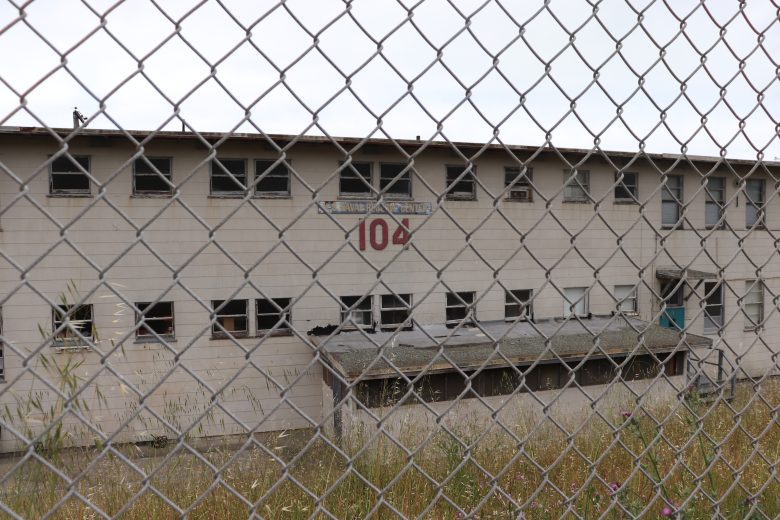

At a Board of Supervisors hearing on Monday, representatives from the U.S. Navy reassured San Francisco city officials that the discovery of radioactive contaminants at the Hunters Point Naval Shipyard last year was “unusual,” but no cause for concern.
But the feds were criticized for only notifying regulators 11 months after plutonium was detected in the air above Parcel C, a subsection of the shipyard, at twice the “action level,” which is the threshold requiring action to monitor and review dust control.
“Our greater concern is not notifying the regulators,” said Dr. Susan Philip, the director of the population health division for the San Francisco Department of Public Health.
The department, on Oct. 30, released a public letter soon after it was made aware of the elevated levels, which officials said today should not pose an immediate danger to the public.
That level of plutonium is still “very, very small,” said Dr. Kathryn Higley, a professor of nuclear science and engineering at Oregon State University, at the city hearing today. The level is less than one would be exposed to on a flight from San Francisco to New York, for example.
Still, Philip said, that determination should have been made by the city and the EPA, not the Navy. The EPA said today it will review the Navy’s actions, and that it must notify regulators of any high reading within two weeks, even if the Navy doesn’t deem it to be a safety hazard.
“We need to get an understanding of what it means when they say they will do better,” said Michael Montgomery, the EPA’s director of its Superfund and Emergency Management Division.
The Navy has been undertaking a cleanup of the shipyard, located in southeast San Francisco, for more than three decades since it was found to be contaminated with hazardous waste and designated a superfund site by the EPA in 1989.
The former shipyard today employs dozens of workers who truck contaminated materials to dumping sites daily. It is home to a community of artists who work within the abandoned Navy buildings, and is surrounded by housing complexes.
Anthony Megliola, the Navy’s director of the Base Closure and Realignment Program, which aims to clean up the site and return it to the city, said that the lapse in reporting was due to a number of factors.
Those include a third-party audit of the laboratory conducting the test, the Navy’s own testing to ensure the accuracy of the data, and its conclusion that the finding was not a threat to public safety.
Montgomery argued that the agency could have stepped in to help the Navy determine whether the finding was a public threat “early on.”
“We value accuracy over timeliness,” said Danielle Janda, base closure manager for the Hunters Point shipyard.
The finding, said Megliola and Janda, was “unusual.” Out of 200 samples of soil and materials taken from the shipyard since July 2023, the sample of plutonium found in asphalt at Parcel C, a subsection of the shipyard used for shipbuilding when it was used by the Navy, was the only “outlier.”
“But we’ll have to work to get that trust back,” Janda acknowledged.
Residents of the southeastern neighborhood’s trust in the Navy has been eroded over the past decade, since it was discovered, through a report obtained by NBC, that an engineering firm contracted by the Navy, Tetra Tech, falsified numerous soil samples to hide contamination of the site, setting the cleanup process back years.
“We can, and will, be better going forward,” Megliola said. “While the detection was an extremely small measurement, we fully recognize and appreciate how concerning news of plutonium detection is.”
Are they really saying that taking random cosmic rays on an aircraft is the same level of risk as inhaling a purified, concentrated quantity of an alpha particle emitter?
That is exactly what they’re doing. Relying on the public’s lack of knowledge of radiation types and concentrations to push plausible-ish BS.
They are liars again today.
Yeah, a decades old, tired comparison by Dr. Higley, who should know better than fielding such a statement? The thing is, radiation from Plutonium (or other radioactive isotope) that’s lodged in one’s body following ingestion will rip through soft tissue 365/24/7, which can lead to cancer.
The good news, or non-news perhaps? What may have been detected, and that’s a function of the low sensitivity levels that the Navy applies, is “leftover” Plutonium that’s spread all across the globe following above-ground detonations of Plutonium bombs from WW II on. Meaning…. you can expect to trigger the same kind of alerts if you sample anywhere else on the planet over a long enough stretch of time.
That’s half true – they literally dismantled the highly contaminated Bikini atoll navy vessels directly exposed to fallout in nuclear testing AT PORT 70 and surrounding buildings long since razed, and the protocols for decontamination and scientific understanding of radiation dangers back in the day were less than adequate as an objective understatement. They buried it and consider it out of sight, out of mind – until construction of new condos stirs it right back up after they declare it all “safe”… this is entirely preventable and now mitigable, but they still insist on deception and cutting corners rather than doing the job correctly.
As the article states, this about Parcel C, which has turned out fairly mundane actually, following scans and remediation of every square meter there.
The “real fun”‘ hasn’t even started yet, which will be at attempting to decontaminate Parcel F. I would not be surprised if they’d have to pass on that altogether, and just leave everything undisturbed, perhaps enclose it Chernobyl style. One thing that I find puzzling is how they did not check Parcel F first, so they can find out how bad it’s going to get, and whether it’s even worth trying to rehab the site altogether.
“The ‘scans’ were airborne”.
That’s history, when the Navy tried to pull a fast one? In any case, they manually scanned every floor inside every building right on the ground.
The ‘scans’ were airborne and would never have detected the ground level alphas, by design. This was known by the administrator who authorized those flyovers. It was designed not to detect what they knew or suspected was there and would be detected on the ground. If asking why they didn’t test the worst parcels first and make that public, consider the entire volume and contiguity of their charade to date. It’s obvious why.
This story is conflating contamination and radiation. Different causes, test programs, and risks. Nobody is exposed to plutonium in an airplane flight, and it shouldn’t be in the air unless engineered controls for a handling process failed. That is the concern, and yeah the EPA should have been informed. I bet it was LT Sulu from the incident in Star Trek VIV.
The main problem, as I understand it, is that the on-site monitors do not trigger an alarm of any sort. At a meeting they held following the news of this event, the Navy representative told us that four months passed before the data was analyzed and the spike was even recognized. That makes no sense. Why bother monitoring at all if there is no way the information is actionable? That’s their big mistake.
Followed by lying about it, a long history of lying about it. Plutonium in the air at ground levels twice above the accepted ‘safe’ limit is a problem and the Navy and Lennar Corp and others have tried many many times to sweep it under the proverbial rug without success. It’s not their children that will have to blindly accept an increased Leukemia risk, or bone cancers, or brain blastomas, it’s OURS.
Thank you for shining light on this example of corporate malpractice. Over 20 years ago, we attended many hearings on the USN’s cleanup of Hunters Point. People were irate, yelling. The USN calmly presented charts about existing conditions and explained procedures for cleanup–citing what the DOD was doing elsewhere. Cleanup of superfund sites was big business then. I think the same company that was cleaning up a much bigger site near Seattle (was it called Hanford?) won the contract. The fee might have started as $3.5 billion in Washington and $1.5 billion here. That company spent years at Hanford and Hunters Point and declared success. Then Lennar got approvals and started construction. After new buyers moved in and praised the amenities, someone discovered leftover contamination. But the company responsible for $billions in cleanup no longer existed. How did such a big defense contractor disappear? Where did it go? Where are its CEO and owners now? It’s as though the US allows corporations to be PACs when convenient and worthless certificates when inconvenient.
Marina,
Please, a little more digging.
Talk to Dr. Ahimsa Sumchai to see if there are enough SF Heal Department to suggest that living on TI is more dangerous such as increased cancer rates and the like ?
h.
1 microgram of Plutonium in your lung can kill you = 1 millionth of a gram.
There is no safe amount of Plutonium liars.