

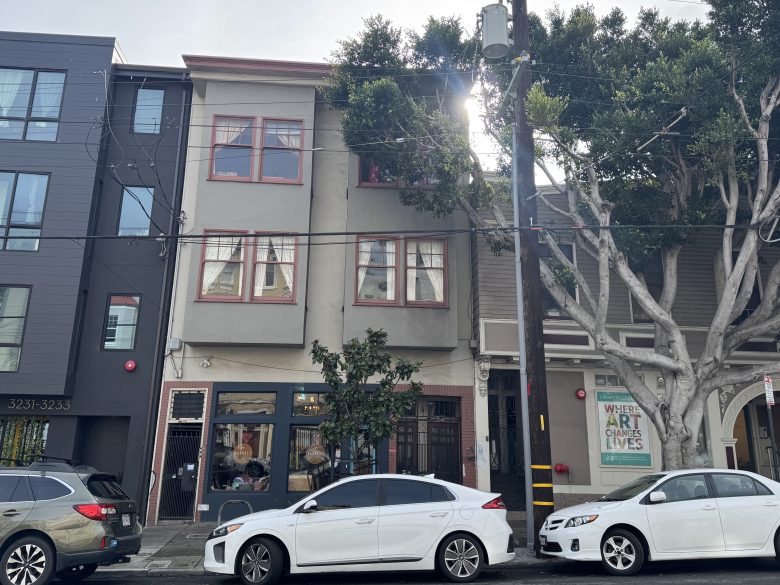

Christmas came just about a week early for tenants of 3235 16th St., a five-unit apartment building two blocks from Dolores Park.
The San Francisco Community Land Trust officially acquired their building last week, retaining rent-controlled units and dissipating tenants’ fears of displacement.
“It’s really a relief, the stability and the security. Over the years, we always thought, ‘What if somebody sells our building?’” said Alana Herron, a high-school teacher at an Excelsior school, who has lived in the building for 24 years. “This really means a lot.”
About a dozen tenants live in the building, and many have for decades.
Conversations between the San Francisco Community Land Trust, which buys mid-sized buildings and has 17 in its portfolio, and the prior owner, Deborah V. Vanpatten, started this summer. The discussions began after the owner notified the nonprofit that the building would be sold.
Under the city’s Community Opportunity to Purchase Act, owners of buildings with three or more residential units, or land that can accommodate such numbers, are required to inform qualified nonprofits of their intentions to sell. That guarantees the organizations the right of first refusal on the properties.
“This has been a lot of work, and it’s been great to see it culminate in knowing that these long-term residents will be able to stay in their home,” said Kyle Smeallie, the policy director for the land trust.
The building, which dates to 1905, has five residential units and one ground-floor commercial space, the home of Barnets Salon. Smeallie said the residential tenants worried a new owner could find ways to displace them.
“For them to have the feeling that they don’t have to worry about that anymore … that’s a sense of relief that is really palpable,” said Smeallie.
The San Francisco Community Land Trust purchased the building for $1.55 million with loans from the city’s Small Sites Program, which helps nonprofits buy smaller buildings for affordable housing, and the Preservation and Seismic Safety Program, which has money for the same.
The land trust has been growing and, two years ago, received a $20 million gift from MacKenzie Scott, the billionaire ex-wife of Amazon founder Jeff Bezos. It said at the time it would use the gift to expand as part of a $60 million capital campaign.
“Everyone feels like this was a really fortunate thing that happened,” said another resident, who has lived in the building for more than 30 years. The purchase, she said, gave a sense of relief, particularly for the artists and teachers who live alongside her.
“When you talk about preserving teachers and artists, we’re kind of a living proof of that,” she said. “That’s who lives here.”
While there has not been an official celebration yet, Herron said she and her husband took it upon themselves to toast the purchase by going out to dinner.
“We’re really grateful,” said Herron. “It is really a gift, and we know that.”
It’s nice for a handful of people, but it’s clear that this doesn’t scale to the city. The city obviously cannot afford to give millions to every building in the city and take them all off of the property tax rolls. So this is a solution that can only benefit 1 or 5% of residents. In other words, it is a non-solution.
Jeff, your analysis is correct. According to the SF CLT website, it owns just 14 buildings. And it was formed in 2001, 25 years ago. So on average it buys just one building every two years. It is a footnote to the affordability problem.
And it is not just a matter of it not having enough money. It is also hard for it to successfully buy a building. If a building is viable in SF then generally a private landlord will always be able to offer more than the CLT.
This means that CLT will only succeed where there is an inherent problem with the building. That might be serious structural defects. Or it might be a troublesome set of tenants.
There is a floor beneath the price of any SF residential building. And that is its value for an owner who does an Ellis eviction and then sells it as a vacant TIC. The CLT may only prevail if for some reason that would be difficult e.g. as it was with the Merry-Go-Round building on 23rd Street
This is a steal for the city. At $310k a unit, it’s much cheaper than new construction or the purchase price for a condo. It is absolutely a solution – among other solutions, like landbanking and building social housing. What we can’t afford is to displace our teachers, artists, and other workers that fuel the city’s culture and make it go, out to the far reaches of the outer Bay Area. What we can’t afford is the churn of managing homelessness as a permanent condition. We can’t afford NOT to scale up great programs like this.
It’s cheaper than new construction in the same way that adopting a cat is cheaper than new construction. Neither thing creates homes. But my point about it not scaling is that this activity destroys its own funding, by removing the subject property from taxation. So the more of these deals that happen, the less money there is for the next deal. Since the amount of money available is already incredibly small, this is a scheme that destroys itself long before it makes a dent in the problem it purports to address.
The best we can do is to stabilize our neighbors in place and to acquire as many units at risk of eviction for conservation as permanently affordable and social housing so as to build enough market power to set market rents at affordable.
But the entire problem is that this solution can only work for a tiny proportion of the properties out there. So this kind of thing becomes a lottery that is great for the tiny number of tenants who benefit from it. But does nothing for the other 99.99% of tenants.
Rather like the new build “affordable ” homes that hold a lottery for the tiny number of lucky winners’.
As cute as this story is, the method does not scale. And there has to be real concerns that these buildings will not pay their way, meaning further financial obligations down the road for the non-profits that fund them.
Tax exempt mortgage revenue bonds can be scaled to purchase housing with the existing rental streams covering most of the debt service.
The City would need to commit to paying the gap, but that would be paying down notes on assets, not subsidizing anyone.
Mortgage revenue bond scaling of land trusts or social housing has a better chance of scaling than market rate production that only scales when rents/prices are reliably rising and the Rube Goldberg machine of affordable housing that requires supercomputers to assemble funding from a range of restricted sources.
marcos, you assume there that investors would want to buy revenue bonds backed by the rents from low-income tenants in a rent-controlled building.
There are a lot of things that can go wrong in such a situation, and so investors would require a much higher yield to compensate them for the extra risk.
If it were as easy as you say, it would already have been done. In practice the city would have an ongoing liability to keep putting more money in. And in case you haven’t noticed, the city has a huge budget shortfall.
It can scale over time.
Over how much time? According to Gloria, the CLT has bought just 17 buildings so far. And that is in over 20 years.
One does not follow the other. What does “build enough market power to set market rents at affordable”, mean exactly, and what would that entail?
“ Smeallie said the residential tenants worried a new owner could find ways to displace them.” these tenants seem blithely unaware of the vast reaching protections of, and compensation afforded to, long-term rent controlled tenants in San Francisco, should that have come to pass.
The purchase was a beautiful thing and a great way to end 2025!!!
Well I lived in the rent controlled building owned by a non-profit and was evicted recently so not all non-profits do good work
Any property owner will evict if a tenant fails to pay the rent, as an example. That includes non-profits or a government agency.
Without knowing the cause cited for your eviction, it is impossible to assess whether that action was fair or not.
Just curious, was this as- Judy Judy,would say, A constructive eviction, where the landlord, figures out a reason, to get rid of a tenant that is really terrible, as in smoking on the premisses, bothering other tenants, or has a pit bull, that he trying to pass off as a therapy dog? Sorry, that happened to you with the tight housing market in S.F, but to be honest it’s really hard to get evicted on San Francisco.
Beautiful story.
SF Community Land Trust, with 17 buildings now, has rescued hundreds of tenants from displacement. Lurie, et al, must be pressured to furnish this non profit with ongoing funding so they can continue acquiring rent controlled buildings when they hit the market.
Let’s Land Trust the City!