

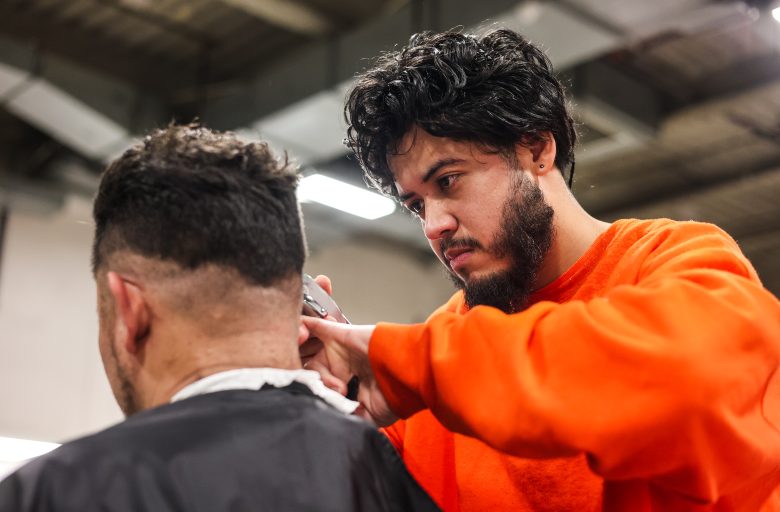

The haircut of each member of the Barber Pathway Program graduating class, as one might expect, was unique: Gelled back, braided, buzzed, mohawk, man-bun.
The program’s graduates, 13 men incarcerated inside a San Francisco county jail, were the first to pass through the jail’s new in-custody barber-training program.
An intimate graduation ceremony was held Wednesday evening in the annex, a wing of the labyrinthine San Bruno jail that was reopened two years ago to accommodate a spike in bookings. Metal beds and tables were cleared from a large room for the occasion.
It took eight weeks for three teachers from the Academy Barber College to teach the men, who are either serving time in jail or awaiting court hearings, the basics of barbering.
It took years — and the collaboration of the sheriff’s department, the San Francisco’s Office of Economic and Workforce Development, and community organizations — to make the Barber Pathway Program happen.
There were times when it almost didn’t.
The once-robust extracurricular programming in San Francisco’s jails came to a halt during the pandemic, people working and incarcerated in the jail said. Amid understaffing at the sheriff’s department and frequent lockdowns, they said, it has been slow to pick back up.
It’s easy to get sad in jail, said Orbin, one of the graduating class. The class, he said, was a moment of happiness that felt like a privilege.
“I feel fortunate to have an opportunity,” he said. “I never thought that it would happen.”
The seed for the program came when founders of the Bay Area Student Barber Expo heard feedback from students who’d been impacted by the criminal justice system. Many were clients of the San Francisco Pretrial Diversion Project and the Latino Task Force, organizations that support formerly incarcerated people in the community.
After a public “barber battle” hosted by the Mission Language Vocational School, Barber Pathway coordinator Tatiana Hernandez and manager Jenny Robles realized that the craft was about more than cutting hair.
“We saw how limited access to programming inside custody contributes to cycles of socially and economically driven crime,” Hernandez and Robles wrote. “If barbering can provide stability, income, and purpose on the outside, why should that opportunity not begin on the inside?”
Following through on that realization took a year and a half of meetings with the sheriff’s department, Hernandez said. Starting a program in the jail is not easy, several community partners added.
There’s a lot of “red tape,” like security-clearance requirements and safety precautions. Even figuring out what barber tools could be ordered — older models of clippers were fine, but no trimmers — was a challenge.
For two years, the Barber Pathway Program operated on the outside, with different students who were out of custody. This year, the program secured $100,000 in funding for an in-custody program from the city, said Ruth Barajas, the executive director of the Latino Task Force.
The class met for an hour and a half every Monday, which came out of inmates’ allotted time for activities like making phone calls or visiting the commissary.
The students made the most of it. Inside the jail, there’s more pressure to make free time count, and nowhere to step out for a break, Hernandez said.
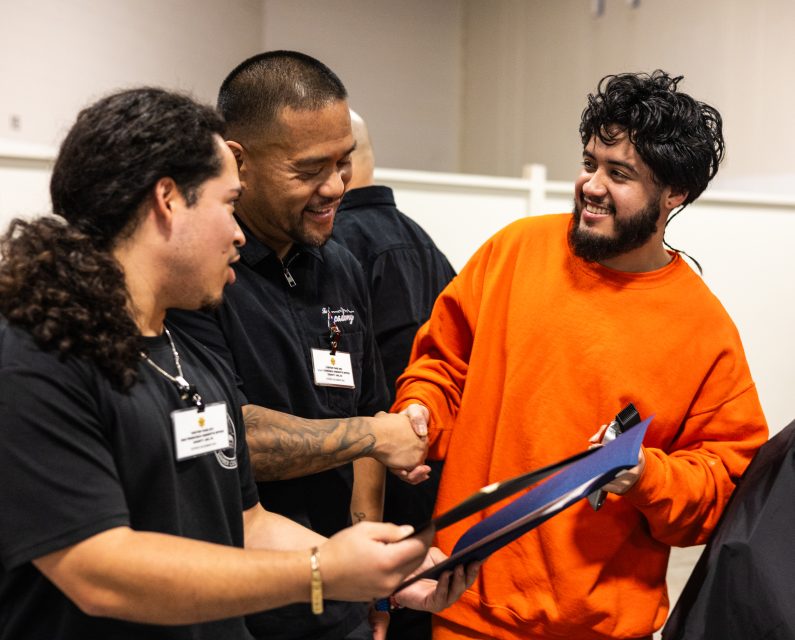
All but one of the 13 graduates spoke only Spanish; about a third of the San Francisco jail population is Latino, and most are housed together in this unit.
But their gratitude was not lost in translation, and it helped that a staff member of Five Keys, another organization that facilitates jail programming, had been volunteering ad-hoc interpretation all semester.
“Thank you,” the men chorused, in accented English, after Sheriff Paul Miyamoto made his remarks to an audience of about a dozen jail programming staff and a couple deputies, who sat facing the rows of graduates on identical plastic chairs.
Two of the three instructors spoke only English. But their message was also clear.
“I don’t see inmates,” said one. “What I see is myself. I was once wearing the same jumpsuit.”
During the remarks, two students put on a demonstration. One draped a cape over another’s loose sweats and gave him a fade. He swept loose hairs from his tattooed cheek with a delicate pastel-yellow brush.
A third member of the class was moved to fill the silence, and stood.
“Thank you all for taking the time to come here,” he said in Spanish. “If I had the opportunity, I would use what I learned here to cut everyone’s hair.”
“How faithful are you to your barber, sheriff?” a staffer asked Miyamoto.
“Depends on the price,” the sheriff grinned.
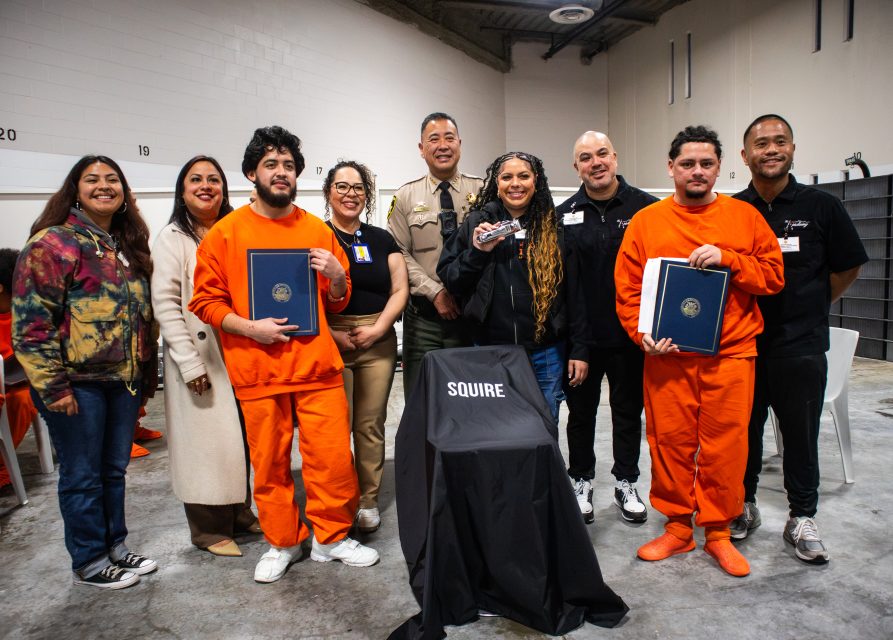
The men held hands to say grace, then quietly sat down to a dinner of meat, beans and plantains (much better than jail food, they agreed), which was served with red Solo cups of mango Arizona juice.
“It matches our outfits,” one observed.
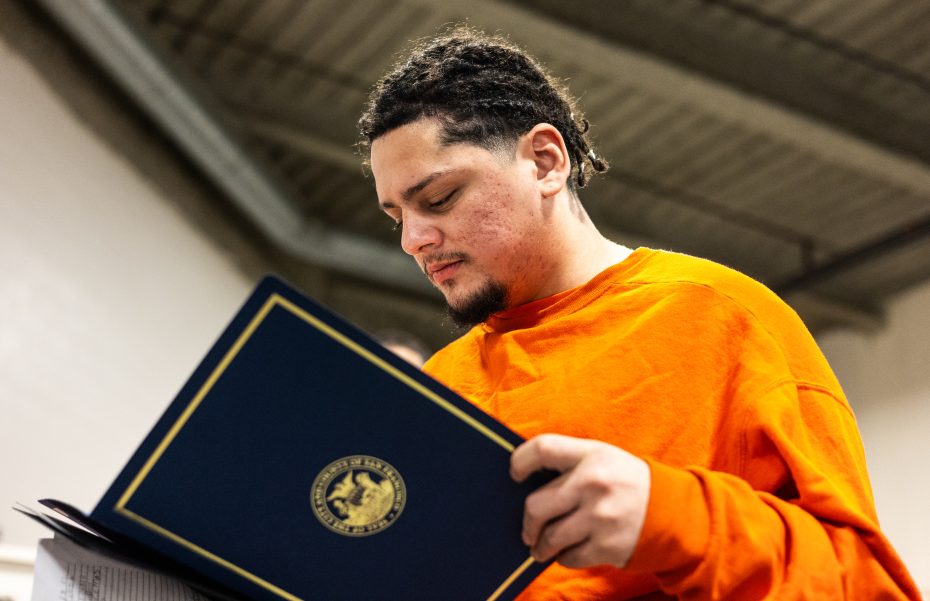
Each man received a certificate on behalf of the barber academy and District 9 supervisor Jackie Fielder, marking the first time such a City Hall award has been given to someone in custody.
The men are not allowed to keep their certificates; the foil and cardstock could be used to light a spark or open a door, a deputy said. But they’ll be waiting for them when they’re released.
While the students will remain incarcerated in the new year, the hope is that they will eventually rejoin the community with skills to build toward economic independence.
“When you get home, because you will come home, come see us,” Barajas said. “We only exist for you.”
Bravo! So glad to see the barbers coming out of incarceration! It should always be about rehab!