

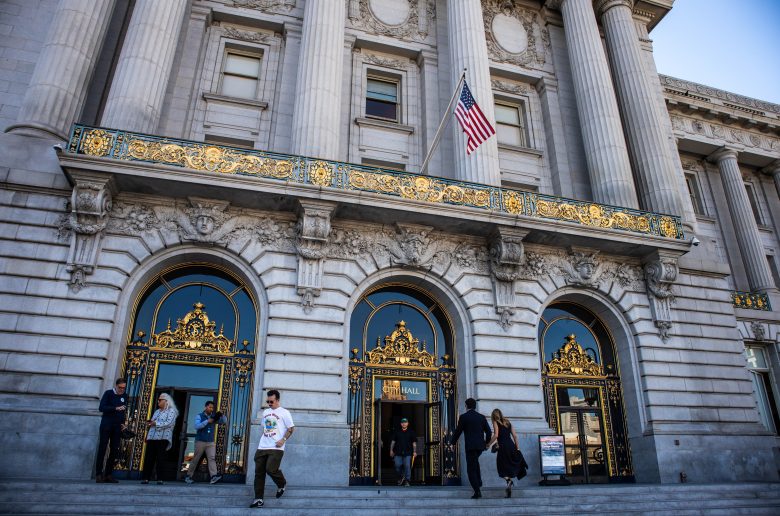

Mayor Daniel Lurie said Friday that his office will pare back city functions during next year’s budget cuts and focus on “core” services like public safety, clean streets and transit in a bid to shave some $400 million and continue addressing the deficit.
The mayor’s office said departments are being instructed to reduce the total number of funded programs and services, stop new hiring, review all contracts for potential savings and reduce administrative costs.
The cuts could include layoffs, with Lurie’s office telling departments that it will work with them to assess how downsizing will affect services.
That leaves broad swaths of city programs — like arts and culture spending, event funding, youth and elder enrichment programs, and advocacy work — potentially on the chopping block next year, even after Lurie cut some $260 million this summer.
The city is still spending more than it’s taking in. Lurie’s office projected a $936 million deficit in the next two fiscal years if expenditures don’t come down. That would become $1.2 billion by fiscal year 2029 to 2030.
The mayor also directed departments to reduce the amount they charge each other for interdepartmental work by 10 percent.
“My administration will work closely with department leaders, the Board of Supervisors, community partners, and labor to deliver a responsible budget that prioritizes core services — clean and safe streets and a durable recovery that benefits all San Franciscans,” Lurie wrote in a statement.
“We aren’t simply going to do everything we were doing a little less well.”
The cuts, the mayor’s office said, will focus on changing how city services are delivered and include elimination of certain programs.
The mayor’s budget team will be sitting down with department representatives to decide which programs to keep and which to cut. That’s a departure from the budgetary planning process of 2025, when every department was told to come up with its own ways to cut 15 percent from its existing budget.
Last year’s cuts, which mostly came from the city’s contracts with nonprofits, ultimately netted about $260 million in savings, but resulted in cuts to programs like youth resource centers, street ambassadors, and outreach to tenants in substandard housing.
Public safety departments, like the district attorney’s office and the police department, however, declined to offer any cuts and, in the end, walked away with larger budgets.
Today’s announcement is structured around a list of “core” priorities: affordability, strengthening the social safety net, safe and clean streets, public transit, health and homelessness, and the city’s economy.
If programs don’t serve those priorities, they may be phased out, the mayor’s office told departments.
The city has been running a deficit since the pandemic, when declining population and a high vacancy rate in commercial buildings decreased the city’s revenue. Its fiscal situation has gotten worse as COVID-era subsidies expired.
The federal budget (also known as the HR-1 Bill or the “Big Beautiful Bill”) will also hit the city hard.
The Department of Public Health, for example, expects to lose $90 million to $180 million a year starting in fiscal year 2027-28. The Human Services Agency could lose $26 million a year, now that the federal government has reduced its share of administrative costs for CalFresh from 50 to 25 percent.
To stanch the hemorrhaging, departments like these may need to actually spend more on staff to help residents with new, more onerous paperwork required for MediCAL and CalFresh benefits.
One spot of good news: Fueled by the AI boom, the city is now projected to earn an additional $277 million from gross receipts taxes, which are collected when a business sells a good or service.
Hoping for a smart hybrid strategy – cut the wasteful spending is the most important need. I still can’t believe the $2 million toilet episode, or the fraud at some of our former mayor’s non-profits. Fix these issues and roll into charter reform. The mayor is correct on keeping core services in tact. But instead of building a utopia for only the upper income, let’s repurpose the new funding to programs that genuinely (with measurable/proven success) help the struggling working class, immigrants, and the like. We do need a major overhaul of our city government. Crossing my finger this gets done right.
Stop grifting, corruption, nepotism and rent seeking, and there will be little need for “austerity”.
Classic, cut youth services which keep kids busy and out of trouble. Then, spend 10X more on police, jails, and attorneys to put those kids in jail when the kids get into trouble because don’t have anything else to keep them busy 🤦🏻♂️ What kind of world do we want to live in?
Maybe a world in which parents take responsibility for their children’s behavior.
SF budget of over $15 Billion is an obscene amount for a city this size, and a reckoning has long been coming. It will take a while to ratchet down the overhead but it’s essential. Kicking the can down the road and banking on a revived economy are denial traits. This City spends far too much.
And yet the mayors office just announced that the city will be spending another $3.5 million on immigration lawyers? How is that a “core” city service?
Protecting immigrant workers and families from sub-legal and unConstitutional persecution is a core service of any and every American city.
Where did you say you were from?
As Dr. Gonzo said “Even a werewolf is entitled to legal counsel, man”
Close some schools, finally. Parents will object. Have some courage and do it anyway.
Stop giving a blank check to homeless NGOs.
Stop handing out $700 cash every month to junkies from out of town.
The sfusd budget is separate from the city budget. Their money comes from the state. Nice try tho.
“Kurt”,
SFUSD receives about 25% of its annual $1.B budget (approx. $300M) from the City and County of San Francisco through the Public Education Enrichment Fund (PEEF) and similar measures.
“Three Steps” is right, SFUSD has, for far to long, refused to face the fact of its dramatically shrinking student population, continued to kick the can down the road and has failed to make sensible and timely decisions regarding its infrastructure and finances. SFUSD has insisted on keeping school facilities open — based upon 1970’s-levels of enrollment (approx. 96,000 students) that should have long ago been closed as the current student population is now closer to 50,000.
Nice try tho.
So you admit 75% comes from the State then?
“Karl”?
Rather then lay people off , how about everyone in city government taking a 10 percent pay cut , or work more hours liike a 44 hour work week , in the office , for a 40 hour a week job .
Kaiser did that years ago for about two years .
Also no profits should be cut first .
Also no overtime pay .
SF government does have one of the largest number of employees for any city at 35,000.
Also the salaries here are the highest in the nation.
SF has more employees than most cities because it’s both a city and a county. You don’t see many other cities in the Bay Area (or elsewhere for that matter) which run their own dedicated justice system, public health department, transit system, or utilities systems because those are usually services that are provided either by counties or a single purpose special district (like AC Transit or EBMUD in the East Bay).
The city and county functions are largely overlaid and duplicative. Using that as an excuse is a trope. Recall, it’s 49 square miles.
Philadelphia and Denver are also consolidated city-county governments. Philly serves 1.6 million people with a budget of $6.4B.
Denver serves +700k people with a budget of $4.4B
SF’s $15.9B budget is an outlier in every way. $9B would be a more realistic figure.
This would be a great opportunity to defund the poltiical class that’s manipulated our politics for so long by closing the revolving door between campaigns, government jobs and city funded nonprofits by cutting loose the nonprofits during these tough budget times.
“To staunch the hemorrhaging, departments like these may need to actually spend more” ugh…did you proof read this before you posted it? That reasoning is exactly why you’re in a deficit to begin with – you’re spending too much on programs Medicare/Calfresh, while not taking fraud or mismanagement seriously so you never patch the hole. A city cannot spend its way out of austerity, that’s just absurd, and only fools are naive enough to place all their bets on a sketchy AI scheme when the bill comes due next March. I hate to say it, but we’re screwed – we didn’t learn our mistake from the Great Recession, in which we’re repeating every mistake made before, but this time, when the ball drops it won’t be a recession – it’ll be a full blown depression.
The Mayor, Scott Weiner and the other corporate democrats need to come clean: With a declining population in San Francisco, who would be benefitting from up-zoning? Developers, Investors, the Ultra-wealthy who invest their diverse holdings in real estate internationally.
There are over 20,000 approved units ready to build but SF and every other CA city has no power to force them to be built. Meanwhile the ones that exist empty now are owned by for-profit Private Equity corporations that have no incentive to make them reasonably priced for the ‘housing crisis’ that Wieners keep lying about. They don’t want to do the tough part, but YIMBY giveaways to developers are the easy part – they get all their campaign donations from them, so it’s win/win as far as the sucking sound is concerned. Meanwhile rents continue to spike like nowhere else in America, and a dearth of low-income housing is being built if any at all.
YIMBY liars know what they’re doing, and why. $$$
AI bubble can pop anytime, we won’t miss it.
AI tax revenue is about all we have left……
Not really! It’s a bubble that WILL pop, so building up huge budgets that rely on fantasy taxes from companies that will best case downsize and/or move away within a decade, that’s just stupid. We need to build sustainable budgets and prioritize sustainable industries over flash-in-pan hype bombs. There will not be an even distribution when the AI hype bubble bursts, so diversify now or cry wolf later.