



Tenants who are facing temporary eviction from a four-story Mission District apartment complex following a fire earlier this year are refusing to move unless the landlord, Mosser Living, meets their relocation and return demands.
Protections under city law for temporary evictions, they say, don’t go far enough, especially for the many low-income, disabled, senior, and family renters at the rent-controlled building at 907 Valencia St., a 28-unit rent-controlled complex at 20th and Valencia streets.
The tenants’ demands appear to be aimed at ensuring that the landlord has an incentive to complete the renovation work quickly.
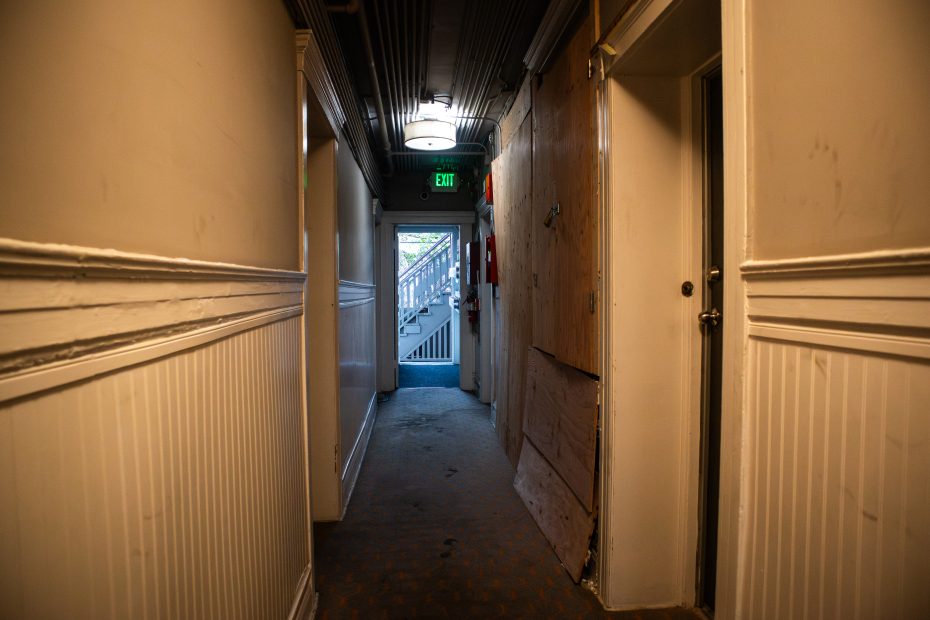
In documents obtained by Mission Local, Mosser said that all tenants have to move out for health and safety reasons. During construction, the company said the utilities will be shut off. The work seems to focus on the hallways: Carpets will be replaced, and new sheetrock and panels will be added.
Mosser is in the process of getting a permit for more than three months of construction — a requirement for temporary evictions. Mosser said the project will take about a year.
The fire initially displaced tenants in two of the 28 units. Angel Meza, one of those tenants, said that, after 10 days at a hotel, the company secured him housing at the same rate until his unit is renovated.
Tenants who remain in 14 of the units want assurance from Mosser that they will be relocated to another Mosser-owned unit with the same rent for the duration of construction. City law requires landlords pay relocation expenses for so-called capital improvement evictions, but the tenants worry it is too little.
These are set at $8,062 per tenant. Seniors, people with a disability, and minors under 18 receive that $8,062 plus an additional $5,375. Payouts are capped at $24,184 per unit.
But median rents as of Nov. 10 in San Francisco are $3,300 for a one-bedroom apartment and $4,545 for a two-bedroom apartment, according to Zillow.
Of the 28 tenants still living in those 14 units, three have lived there for more than 30 years, and six for more than 20 years. There are also seven residents with disabilities, including four disabled seniors and two children.
Mosser did not reply to repeated requests for comment.
Joseph Tobener, a tenant attorney with nearly 30 years of experience at Tobener Ravenscroft LLP, said that, even though tenants have the right to return at the same price under temporary capital improvement evictions, landlords often count on tenants finding other housing arrangements.
That leaves the landlord free to raise the rents for new tenants.
“Oftentimes, the displacements last for a very long time, and the tenants end up giving up on the units, or the landlord will pay them a nominal sum to waive their right to return,” said Tobener.
Tobener added that, even though the right to return is secured under city law, delays in negotiations between landlords and insurance companies, the permitting process and, at times, foot-dragging by landlords, can make the process very slow.
The city’s Rent Board does not collect data on how many people return to their homes following a temporary capital improvement eviction.
The fire took place on Feb. 10 after a guest, tenants say, discarded a cigarette into a lightwell from the rooftop. A fire report of the incident lists the cause of the fire as unknown, but points out that a naked man was detained at the scene.
On April 25, Mosser issued 23 capital improvement eviction notices, a temporary eviction served when construction is planned. Tenants then formed the 907 Valencia Tenants Association and sought help from the Housing Rights Committee, the nonprofit currently representing them. Some of the tenants moved out, but 14 units remain occupied.
The 28 tenants who remain have refused to accept any relocation checks from the landlord.
Their demands for temporary housing at their current rate have been ignored, and negotiations appear to be at a standstill. Tenants also say they want to see the construction permits to verify that all of the units need to be evacuated. City rules require permits prior to serving eviction notices.
Tenants say the April eviction notices took them by surprise, as their landlord had failed to communicate with them following the fire, despite smoke, mud, and debris at the property.
The group drafted a list of 11 demands. The company agreed to many, which were already required by city code. Others — including allowing three contractors who are tenants to inspect the damage, the assurance of temporary housing at the same rate, and the translation of notices into Spanish — have proved more contentious.
Tenants say that at a meeting with two Mosser employees on July 7, Maria Villegas, the property manager, verbally agreed to all their conditions.
Two days later, however, in an email obtained by Mission Local, Mosser’s lawyer, Dave Wasserman, informed the tenant association that the company would not sign the agreement. The law, he said, did not require them to do so.
Wasserman’s response angered tenants, who argued Mosser was acting in bad faith by walking back much of the agreement.
Under city law, however, the company only has to meet the provisions for capital improvement evictions. Tenants say that gives them no guarantee of temporary housing they can afford.
Landlords have to give displaced tenants half the relocation payment at the time the eviction notice is served, and the other half when the unit is vacated. Tenants rejected the checks, and said the amounts were below the required minimum.
Linda Lewis, 74, and her son, Russell Lewis, 53 are disabled, entitling them to relocation payments of $13,437 each. But Russell Lewis said that, at the time the eviction was served, only one $4,000 check came with their eviction notice. They declined to take it. Finding another place to live, they said, would be difficult.
“It would be devastating,” said Russell, whose family has lived in the building for more than 50 years. “It bothers me to no extent the way they have come at us and tried to disrespect us by thinking that we would just take the money and go and not say nothing.”
Moreover, tenants said they don’t trust the landlord, because earlier dealings with them have been disappointing. Repairs, they said, have not been done for problems including broken mailboxes, overflow of garbage, a leaky refrigerator and other issues.

Five complaints have been filed with the Department of Building inspections this year at 907 Valencia St., including fire damage, leaky rooftops and fixtures, garbage not being picked up, rodents in the garbage area, mailboxes not working, damage to common floors and the need to renew a boiler permit. Only two of the cases have been closed.
The building also recorded fire-code violations on April 30 for fire extinguishers and their sprinkler system.
“We don’t trust them. We don’t trust what they say,” said Russell Lewis. “We want something in writing to feel safe.”
This is almost a perfect example of how well intentioned regulations can cause unintended consequences. A private landlord who is not allowed to raise rent is incentivized to find ways to evict or constructively evict his below market rate tenants. The government then tries to play whack-a-mole with those attempts, but is always on the back foot.
So we get situations like this where the landlord delays routine repairs because it benefits them if tenants get fed up and leave. They then seize the opportunity to temporarily evict for repairs or improvements because it benefits them if the original tenants decide not to return. They also are incentivized to let the construction be delayed because that further pressures tenants to leave.
This leaves the city in a bind because the appropriate amount of maintenance on the property is something reasonable people disagree about. Whether the required repairs rise to the level of requiring temporary evictions is something that reasonable people disagree about. And the city certainly can’t complain if construction timelines slip when regulations almost always contribute to those delays.
I don’t understand why this is the system we’re continuing to choose in order to house those who can’t otherwise afford it. We’re getting the worst of both worlds. The city meddles with every decision made in maintaining below market rate housing, and the inhabitants are still exposed to the downsides of a landlord that is fully profit driven and has no reason to care about them (since they can’t afford to leave). Finally, any costs borne by that private landlord from paying relocation expenses or fines inevitably have to be recouped from their market rate tenants.
It would be much simpler to have the city or state run any below market rate housing they deem necessary, then let privately owned housing be privately owned.
Mike S, I agree. Rent control causes all kinds of problems like this. It sours the landlord/tenant relationship by positioning them as being in constant conflict. This in turn leads to ever worse behavior by both sides. Rent control benefits aggressive landlords and stubborn tenants – not qualities we really want to see.
And by deterring landlords from doing business, it suppress the supply of rental housing, which in turns paradoxically drives up rents.
To ensure that people are housed the government tells landlords (who are incentivized to make a profit at all costs) that some percentage of their units (that has nothing to do with the number of people who can’t afford market rates) have to be leased out for way below what the market will bear (but not necessarily for an amount that is actually affordable to the residents), and we have a long list of rules that they have to follow (that we also have to pay to enforce) and in exchange our most vulnerable people get to live in decaying buildings owned by people who hate them. Then we act shocked when the landlords (who have more time and money and are typically more able than their tenants) find ways to enrich themselves at the residents’ expense.
“Rent control benefits aggressive landlords and stubborn tenants”
Is bullsh1t, frankly.
“It sours the landlord/tenant relationship by positioning them as being in constant conflict” – More BS.
“And by deterring landlords from doing business” – It doesn’t at all.
“which in turns paradoxically drives up rents.” – There’s zero regulation that forces landlords to rent their properties, and with more and more privately owned investment groups buying up properties to maximally extract the highest rents possible, that’s actually what drives the rents up OBVIOUSLY, as opposed to your hypothetical paradoxical BS understanding of the market drivers.
Welp, you obviously have nevr been a landlord, because you have no understanding of how all these regulations actually drive up the cost of rental housing.
This is a big part of why some property owners leave their units vacant rather than rent to tenants who they might be stuck with for decades.
Also explains why renting via Airbnb etc. is preferable to risking “lifer” tenants.
I’m a landlord RIGHT NOW, in fact. I have tenants who I scrutinized prior to leasing to them and it’s worked out marvelously. I actually do understand why the San Francisco rental market stays relatively high – techies and private equity groups buying up all the stock for miles in every direction. It’s plenty expensive in nearby cities without rent control as well, which further debunks the poor landlord pity party you’re throwing. Rent control doesn’t apply on new apartments, doesn’t apply to SFHs, and if you set the rent too low to manage the costs of the building that’s YOUR FAIL, not “the system” doing that. If you don’t want to rent because you want to maintain control, absolutely fine. Don’t whine about people getting protection from spurious evictions and 2x-5x rent increases – they have rights too under the contract you are freely entering into with them. If you blow it, that’s on you Ray. Meanwhile if you think sitting on vacant apartments is a good financial strategy I’ve got a vacant lot to sell you in the middle of the Bay.
What you are saying is that rent control doesn’t work! How can anyone in the right mind expect landlords to invest into business when government has made almost impossible and extremely long to recoup investments?
“A private landlord who is not allowed to raise rent is incentivized to find ways to evict or constructively evict his below market rate tenants”
In rent controlled units in NYC, for example, there is a limit on the amount rent can be increased between tenants. In CA our rent control laws allow for an unlimited increase between tenants. Perhaps remedying that can chip away that the misaligned incentives.
I think that would probably improve situations exactly like this, but it’s the kind of whack-a-mole situation that I was referring to. The benefits of a free market are supposed to be that competition drives innovation and efficiency. A landlord is incentivized to keep costs down and quality high because their tenants will move to a competitor’s unit if they don’t. With a more comprehensive rent control like you’re suggesting revenue is fixed and tenants can’t easily leave; so the only way landlords have to increase profits is to pay as little as humanly possible for maintenance. This is a recipe for slumlords. We could try to counteract that with even more regulation, but I just don’t see how we get any benefit from involving a private owner in units that we don’t expect them to make a profit from.
Yeah — that’s working out just great in NY, where landlords are leaving those units vacant since the rent is not sufficient to justify the expense of renovation
You are describing the mechanic that means apartments are never brought back to market when a tenant leaves. They get held until the whole building turns into a co-op. This is what the tenant protectors want?
Why ask dumb hypothetical questions as if anyone but you is actually suggesting that?
gw, what you are describing there is Vacancy Control. It is illegal by California state law. It causes even bigger problems as landlords would then have no chance of ever again getting a market rent. So why would they bother or care?
You don’t know what you’re blathering about.
Cry me a river for the landlord as victim! The Mosser family has been in the real estate racket for over half a century. A neighbor of mine showed me her Mosser tenants organizing newsletter from the early 1970s, when Mosser was pulling these same stunts before rent control was instituted. Landlords like these know how to play this game, the same one Veritas was guilty of.
If you can’t play by the rules and treat your tenants with respect, then get out of the game.
“A private landlord who is not allowed to raise rent is incentivized to find ways to evict or constructively evict his below market rate tenants.”
Actually under Rent Control you are allowed to raise rent, so fact check fail there. Capital improvement passthrough is once example. If you agree to take a certain amount for a rental, you are entering into a contract and you must abide it. Period. If you want to hold out for “more rent” (they always want more…) that’s also your right, but once you’ve accepted and entered into a contract at a certain rate, that’s what a contract is for – enforcement.
You want to pretend the person entering into the contract is somehow being trapped by the rental rate THEY THEMSELVES ARE SETTING. Well, that’s ridiculous and makes for a dishonest and whiny misrepresentation of the situation that you yourself are voluntarily entering into, for your profit. Dry your tears with dollar bills, if you earn them legally you are entitled to that much.
1. Protected tenants can have any pass through application rejected for hardship.
2. Many terms of the contract are changed after the landlord enters it. Just this year the scope of habitability expanded yet again. The only reason past supreme courts have in theory allowed this is because landlords may exit through the Ellis Act, which of course the city tries to make as hard as possible by imposing procedural restrictions and funding free attorneys who are experts at getting cases dismissed on technicalities. (Not to mention the extremely slow housing court jury setting timelines plus the most hostile and prone to ignoring instructions set of jurors.)
1. You rented a unit to them. Your choice, your decision, your background check and your legally binding contract that you freely entered into knowing their situation at the time. Genuine hardship is no picnic and unless all of your tenants fall under that, you still can raise the rent. Yep.
2. The scope of habitability hasn’t changed drastically and the costs associated are negligible compared to local rates. What specifically are you saying is a serious cost increase there? Don’t just pretend, have a specific. Ellis Act evictions are actually slam dunk when the legal conditions are met. If you can’t manage to find a lawyer in San Francisco who can handle that, either you have problems with google searches or you’re blind entirely. You either comply with the tenets of the Act or you are not in compliance and it’s RIGHTLY kicked out. That’s how the law works on almost everything so I don’t really understand the crocodile tears there. Do it right or it’s your fail. The law protects both tenants and landlords and the latter obviously has more tappable resources in general than the former. Jury timelines are <60 days now that the pandemic is over with. Being upset that juries are given instructions on how the law works vis a vis their best judgment in a given case simply doesn't make sense. Juries are always given instructions and no, there's nothing in there that's anti-landlord or somehow biased towards a given party – or it would be immediately grounds for an obvious appeal. No more excuses required.
Does anyone remember when small apartments (4 units or less) were exempt from rent control? Then in 1996, the city imposed rent control on small buildings as well. Government also stepped in during the pandemic and relieved tenants of the responsibility of paying rent. Many small owners still have not recovered from this; others lost their buildings.So yes, there is a tenant landlord contract, but the government can–and does– change the terms. So far it has not changed them in owners’ favor.
Rent control generally applies to:
Multi-unit buildings (apartments, condos, or homes with two or more units) built on or before June 13, 1979.
Single-family homes or condos rented before January 1, 1996.
In-law units built before 1979, treated as second units for full protection.
Commercial units used as residences with the landlord’s knowledge, unless otherwise exempt.
Tenants can verify their building’s construction date using the San Francisco Property Information Map or contact the Rent Board at (415) 252-4600 for free counseling.
The following units are typically exempt from rent control:
Units built after June 13, 1979.
Single-family homes or condos rented after January 1, 1996.
Subsidized housing, residential hotels (occupied less than 32 days), dormitories, hospitals, and non-profit cooperatives.
Owner-occupied buildings with fewer than two units.
The law has not substantively changed in the recent years, so don’t make things up.
Please no more money to the government. They are thieves. Anything they touch turn to s**t.
I’d add this to my above comment but alas there’s no way to edit: The tenants of this building are right to be worried- this seems part of Mosser’s playbook: https://oaklandside.org/2021/05/26/i-was-getting-sicker-and-sicker-oakland-renters-sue-landlord-company-mosser/
I’ve lived in the same apartment for a long time. I am no longer young, my resources are modest and are unlikely to change. I live on a budget. If something happened to me like what these tenants are undergoing, I have a sinking feeling I would end up homeless. Even just thinking about that makes my insides curdle.
Thomas – what did you do with your life? Were you employed in full time career jobs or did you choose to wonder through life, got high, attend festivals and defy 9-5? Most people who benefit from rent control have provided very little contribution to society and have been drain on the system. Off you pop!
It is true that a lot of tenants who cling to their controlled apartments are Peter Pans who do not provide a lot of economic value and add little to the tax base.
Many of them moved to SF because they could not hack it elsewhere, and now expect us to subsidize their inadequacies.
The good news is that no new build since 1979 is controlled, nor condos nor SFHs. So rent control will gradually fade away as the ageing hippies and losers die off.
Again you have no idea what you’re blathering about.
You are full of it. People who benefit from rent control include cops, firefighters, nurses, teachers, physicians, students, CEO’s, techies, pretty much everyone and anyone is represented in that.
Where do you get off pretending all renters are unemployed festival-goers or some weird crap like that? Which planet do you even come from? Feel free to go back anytime.
Wow, what a completely awful thing to say, Thomas P.
I remember when this building was owned by the Barrios family, who also ran La Rondalla on the first floor. Unfortunately the same conditions that resulted in La Rondalla getting closed for health violations extended to the residential areas above- the building has a long history of it’s owners treating their tenants poorly. One would have hoped that when a larger company took over the building that things would have improved (hah!). From Mosser’s “about us” page: “Mosser has become a highly experienced leader in rent-stabilized urban community housing specializing in West Coast gateway markets. The company owns and operates boutique mixed-use apartment and ground-floor retail properties and spaces in historic and culturally vibrant neighborhoods throughout San Francisco, Oakland, and Los Angeles.” “Boutique” must have a meaning in real estate lingo that I’m not aware of.
It costs money to operate buildings, but San Francisco regulations ask owners to cough up that money like they’re running a charity. The funniest one to me was when the city banned passthroughs for property tax increases (not that you can ever pass through operating increases on a protects tenant).
Nope! You have no concept if you think capital operating increases cannot or aren’t passed on to rent protected clients because you obviously don’t know the law at all.
Fewer banned pass throughs for property taxes in summer 2018, and here’s what SFTU has to say about the rest:
> The Tenant Financial Hardship Application (available from the Rent Board in multiple languages) can be filed at any time after receipt of the notice of rent increase or the decision from the Rent Board is issued, whichever is earlier, for petitions for capital improvement passthroughs, general bond passthroughs (effective 12/6/19), water revenue bond passthroughs, utility passthroughs, and operating and maintenance expense increases. The tenant need not pay the approved rent increase while the appeal is being processed and considered.
‘Mandated’ capital improvement passthroughs still go through and unless all of your tenants successfully apply for hardship status you’re still able to raise rents.
When the appeal is being considered it’s being considered – if they don’t get it they owe the rent increase back to the time of notice. If they do get it, they have actual hardship status – and you’re what, jealous of them? You choose to enter the rental market = you play by the rules like everyone else has to, and if you rent to someone without the resources to pay their rent just remember that YOU entered into that contract freely based on YOUR background check and set the requirements. You set the base rent, you did that to yourself. If you failed to set rent high enough to cover the costs of your building, that’s still your failure and lack of foresight and planning, same as any small business. Isn’t it funny how landlords like you want to be a public-facing business but have none of the expectations of doing things legally and correctly, like everyone else has to do? World’s tiniest violin, landowners. Don’t want to play by the rules? So don’t rent it. Write off your losses instead. Boo hoo.
Lesson #1, why being a landlord in San Francisco is an occupation for commited masochists only…
It’s really not. Some just don’t do their homework and then complain that everything is too complicated and they didn’t consider things before they entered into them. Well I feel for them, but what would be the response to any other business? A: That’s something you should have thought about beforehand.
When SB 330 passed in 2019, it was meant to address situations like these, but clearly there are still gaps. Covering “relocation expenses” is not enough to achieve the same quality of living at the previous cost, and because it’s a one-time payment, it provides no time-based incentive to complete the work quickly enough for tenants to move back in. This underscores the legitimacy of the displacement concerns of those wary of development, even in a situation where the new building is 100% affordable.
“the assurance of temporary housing at the same rate” might be expensive, but it would allow development and capital improvement to be undertaken without fear of displacement. Whether that high cost is worth the pain of those who would be displaced is ultimately an ideological question that San Francisco has addressed by saying “the benefits of new units justify neither the cost of supporting existing tenants nor the pain of displacing them”
Housing is a business not a fricking charity. If you can’t afford to live in SF then move! It’s time to abolish rent control!
Go abolish a book already. Rent control simply means the rent the landlord agrees to accept is adhered to and increases happen on a predictable publicly posted schedule. Don’t like it, don’t rent it out. Sell it and GTFO of SF with your craven greed and lack of respect for people’s rights.
Or just do Airbnb’s, and never risk being stuck with a “lifer” tenant.
You haven’t done it so you know nothing about the pitfalls.
You’re just an anti-renter blatherer who will say literally any dumb thing.
The city should pass an ordinance, that states that the landlord, should have repairs done in a certain amount of time, and use union labor. If these people had an affordable place to go,I’m sure they would leave in a NYC minute.
If frogs could fly, they wouldn’t have to bump their ass on the ground…Union Labor? LOL! That’s the sure way to affordability. You amateur economists are hilarious.
The landlord should also buy every tenant a pony.
You should buy 1 actual factual argument, 1 time.
It’s interesting the editors approve all these low info personal attacks I would last hear in elementary school but regularly decline to post my comments which are about the topic at hand and illuminating, even if uncomfortable to hear.
Except that’s not a personal attack at all – I’m saying your hypothetical garbage commentary about buying ponies and whatnot has no value or basis in fact or discussion. It’s a throwaway one liner. Admit it or don’t.
Landlords should also have rights to raise rent to recoup their investments. Government is not limiting grocery price increases so why should they have any right to limit rent increases. It’s fricking business!
They have the right to set the rent at time of rental contract being entered by tenants. They do not have the right to renegotiate arbitrarily on that contract outside of the law.
If you want to set an unrentably-high price for your property and insist on that, that’s your right as a landlord. It’s a business but it’s also a contract they are entering into freely.
Yeah right. If the landlord can’t afford it, then what. Your response makes no sense given that this building likely doesn’t break even with the high % of really long term tenants.
No mention of how much these 53yr long tenants pay. They’ve probably been living there practically free for decades!
Such a ridiculous system. The 53yr old guy, never got out and made anything of his life? What disability does he have? Seriously is it rent control that’s stifling the next generation from launching due to being too soft?
This is America, and for most people you can choose to be a victim or a make a go of life. Too much whining in the USA.
OTOH The lawyer, Tobener knows exact how to make money! He’s not Robin Hood that’s for sure. BEWARE!
This whole conversation is fascinating, but very provincial. Vienna has had heavily subsidized rent control for the majority of its housing stock since the 1920s. Somehow, Vienna has managed to work it out.
The tenants should not be evicted , due to upgrading apartments on Valencia street. They should be relocated to apartments that are vacant in other property that the owner owns within California. Until the apartments are renovated. And if he has the right contractor to start immediately it should not take more than 3 months to achieve the work that Valencia Apartment needs so that all inspection codes pass, so that the tenants could move back into their apartments. Do not put this stress on these tenants, and comply with their demand. They deserve it. Remember they have right also. Good luck tenants. FCD
Mosser is entitled to evict once he gets his DBI permits. The tenants are not in a position to make “demands in that case. If they fight the UD then a judge will rule for Mosser and the SFSD will enforce an eviction.
Unless Mosser is found guilty of causing this fire then he is under no obligation to write the tenants a blank check to fund other accommodation. The tenants should instead have bought insurance to cover this possibility.
The tenants have first right of refusal to move into the new or repaired building. Although it typically would take up to 5 years to redevelop such a site in these situations, so in practice that often never happens. The building at Haight and Fillmore that burned a few years ago has entirely new tenants at this point.
The tenants should have bought insurance to cover… what kind of possibility? The possibility that their landlord’s building would be damaged?
Please tell us what kind of policy that is, and which companies offer it.
Cynthia, tenant insurance is widely available from major insurers. It is advisable for all tenants, although few tenants bother to buy it.
Renters, insurance is for the items that the renter owns within the apartment. Such as their tv, they’re clothing, jewelry, etc. It does NOT cover situations like this where there was a fire in another unit and they are being forced out supposedly temporarily unless some of their personal property was damaged in said fire or from whatever water damage was caused by having to put out that fire.
Renters insurance and every single insurance company.
I have renter’s insurance with coverage for displacement. I maxxed out that coverage, and even with that, the most I can claim is $5,000 per displacement. That’s not enough to cover a comparable Air BNB for even 1 month.
Why would you expect to be indemnified against any loss in the event of a tragic fire, whilst paying only for low cost insurance?
And you understand, surely, that renting was only ever designed to be temporary housing. You are being loaned a home by its real owner.
Renting is only as temporary as the lease terms of the contract, Ray.
You can’t pretend you didn’t sign that.
You notice that the tenant mostly starts the dam fire and the landlord gets all the blame!!
Started by a naked tenant, no less 🙂
How many naked tenants did you rent to?