



San Francisco supervisors voted Monday to table many of the proposed amendments to the mayor’s housing upzoning plan, and instead approved only those that California state officials support.
The plan, which allows housing developers to build taller, denser buildings throughout the city’s north and west, has generated concern that developers will displace tenants and businesses to build taller, more profitable buildings.
The state is requiring San Francisco to create capacity for 36,000 additional units. As YIMBYs in San Francisco and the state legislature see it, building a lot more housing is needed to address the city’s affordability crisis, and rezoning is a necessary step.
If the city fails to rezone, it may face the “builder’s remedy,” where it loses control of its ability to approve or reject new housing developments, regardless of where they are and their height and density.
A Sept. 9 letter from state housing authorities warned San Francisco against “introducing potential constraints on development.” While the plan was currently compliant, they said, amendments would need to more or less preserve the new capacity created.
At the Land Use Committee meeting, the planning department explained what officials at the California Department of Housing and Community Development had communicated about each amendment, plus an estimate of how much the amendment would change capacity.
Amendments to protect rent-controlled buildings with three or more units and exempt historic landmarks went through, because the formula that the planning department used to calculate capacity already assumed that those sites would not be developed.
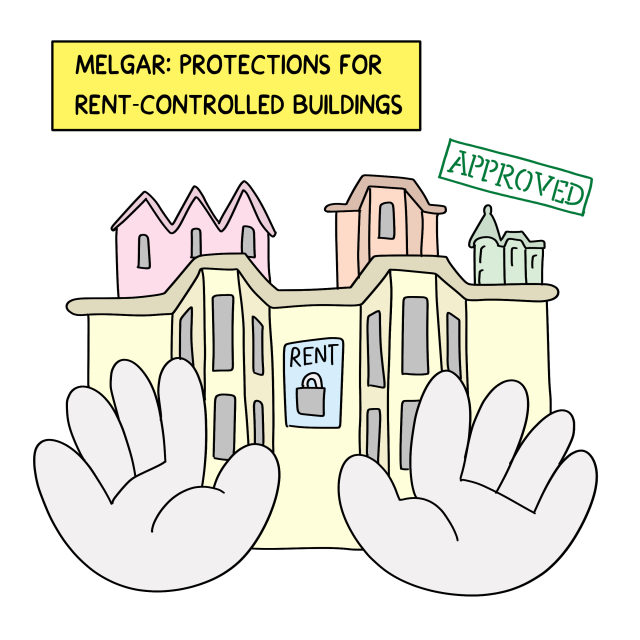

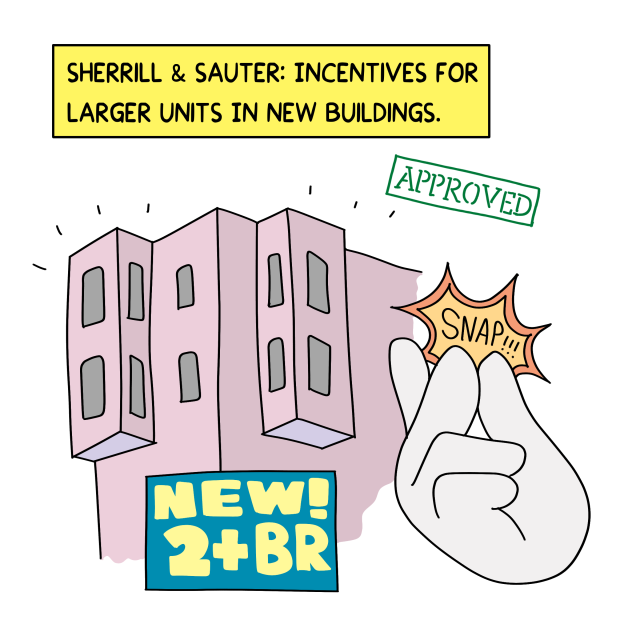
Another amendment, from Supervisors Stephen Sherrill and Danny Sauter, added incentives for developers to build units with two or more bedrooms. That also passed.
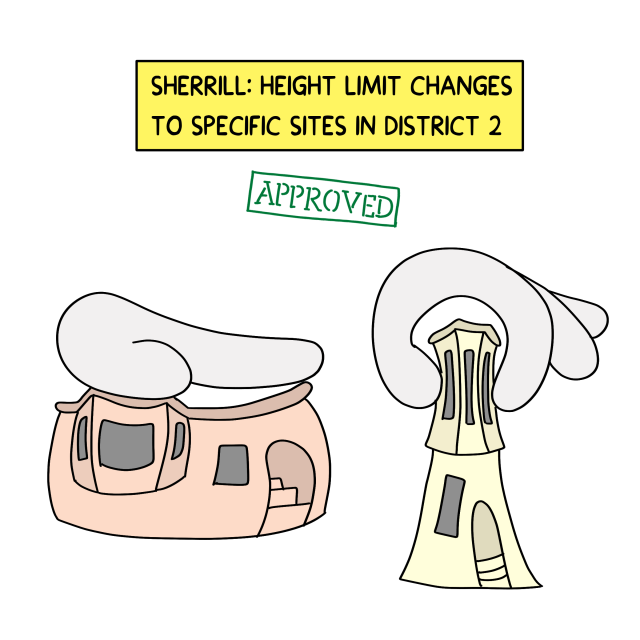
Sherrill also exempted the Safeway in the Marina, Ghirardelli Square, and a senior-living facility on Geary, but increased heights on Van Ness Avenue and Pine Street to make up the difference. That amendment also passed.
But other amendments were tabled, including many of Supervisor Connie Chan’s proposed changes.
Those included removing all existing housing from the plan, lowering heights on commercial corridors within her district, removing areas along the coast from the plan, exempting historic districts, removing provisions that allowed developers to build more units per site, and more.
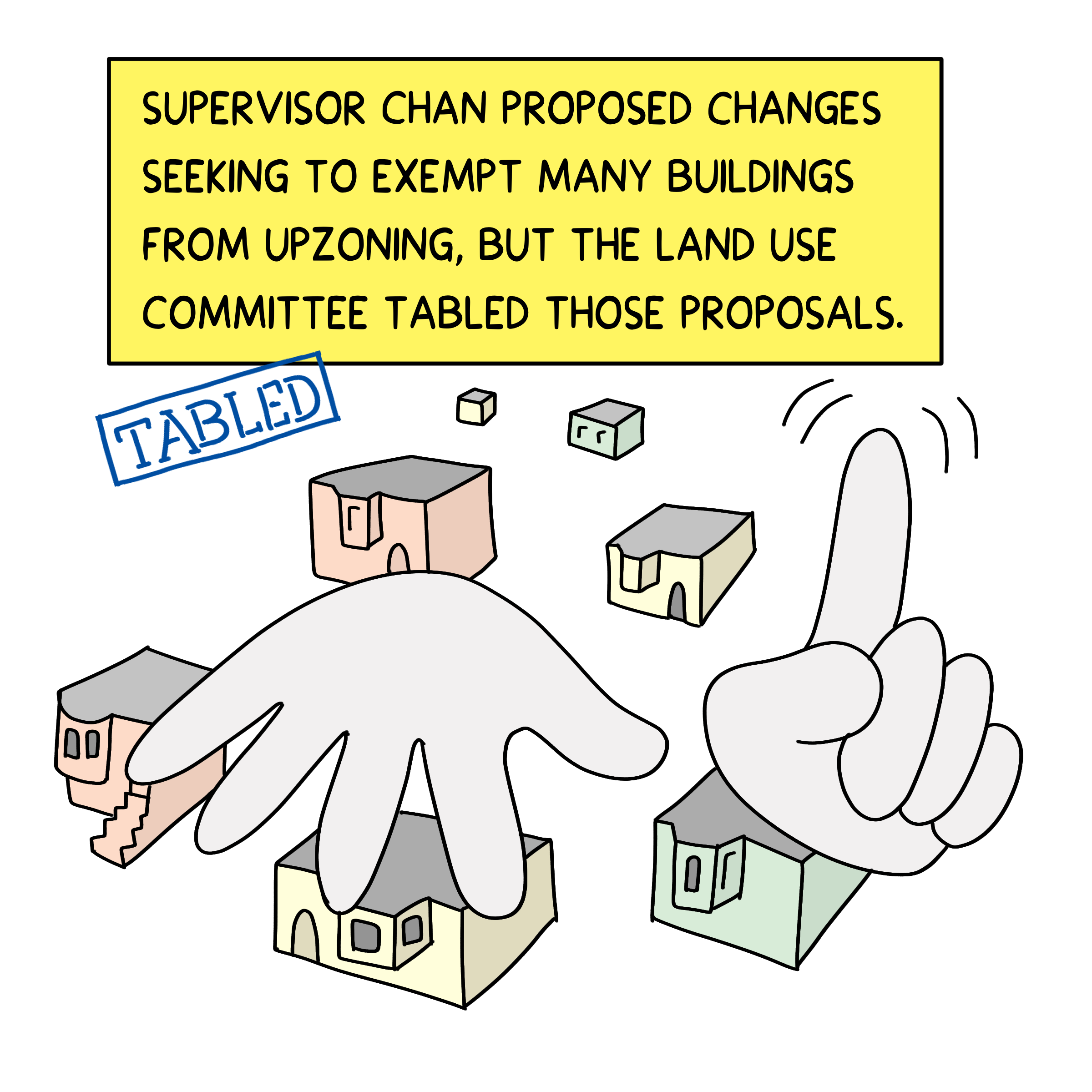
Each of those changes had the potential to decrease the capacity of the plan by thousands of units, the planning department said, and the amendments were not accompanied by height increases in other areas.
Also tabled was Supervisor Chyanne Chen’s amendment to remove the city’s “priority equity geographies,” areas that have larger proportions of low-income residents and residents of color.
The planning department said that change would decrease capacity by several thousand units — too much for the state.
Plus, the planning department added, many of the blocks included in the plan are relatively better off; they are “medium resourced.” Supervisor Myrna Melgar, for example, said that several golf courses in her district were included in the priority equity geographies.
For the tabled amendments, it is likely the end of the road. Theoretically, they could still be integrated when the plan is finally considered at the Land Use Committee meeting on Dec. 1, or when the plan is voted on at the Board of Supervisors meeting on Dec. 2.
But unless the sponsor can find a way to offset the number of potential units lost under their amendments, they are unlikely to succeed.
Mayor Daniel Lurie, who sponsored the legislation, will likely have enough votes to pass the measure when it goes before the full Board.
But at the board meeting, Chan continued to push for her changes, calling them “non-negotiable.”
“As elected leaders, we cannot simply agree to demolish San Francisco for the sake of meeting a state mandate legislated by a simple-minded legislature based on unproven housing ideology,” Chan said at the hearing, to loud cheers.
But, failing to meet the state mandate could have bad consequences, Supervisor Bilal Mahmood pointed out.
“If we don’t meet the estimates of capacity, then builder’s remedy takes effect and we lose local control,” he said, also bringing up the fact that the city could lose millions in state funding if the zoning plan does not go through.
“The fact that the proposed amendments that we’ve been working on for so long to be rejected today, is a moment for San Franciscans to recognize that we must make some change in this city,” Chan said. “If we can’t do that with our elected leaders, then we must put that power back to the people and make that change.”
I don’t know what kind of reality Chan is operating in, certainly not one rooted in pragmatism or the confines of the possible
Chan seems deluded that she can tell the State what to do.
It is the other way about.
You seem deluded to think State law always dictates local affairs in all cases. Or only when you agree with them? Either way find a specific, you’re drowning in a sea of nonsensical rhetoric.
You forgot to cry “RENT CONTROLLLL” this time.
Slippin bud.
You don’t understand our system of government.
Connie chen is rooted in opportunism. She was the first to proclaim “Defund the police”, then was one of the first to backtrack on it when it was no longer popular and crime rose.
She actually was not the first, and no funds went away.
But don’t let facts get in the way of a good snipe!
The police were never defunded. Your narrative is false.
Protecting residents as opportunism, hmm. Nope.
Chan have five years to “protect” residents, and only got exercised once Pelosi tapped her on the shoulder.
Throwaway commentary < actual facts.
Fact : replacing low/middle class housing under the market rate and paid off with brand new top of market housing does not at all help the housing crisis. What it helps is Scott Wiener's gentrification plan and campaign coffers with contributions from the developer groups he's taken to enriching as his #1 concern.
YIMBYs think lying about that wins the internet.
They try it over and over and over. Nope.
It’s possible to build 36,000 units without razing a single building on the west side.
Yes, it absolutely is. The political will to gentrify is not more important than San Francisco families and blue collar workers trying to get by in an increasingly expensive city and region. There is no reason to punish them simply because of the AI/techie boom and bust cycle that we’ve seen repeatedly. YIMBYism is funded by developer groups which are funded by private equity Billionaires. It’s not about you or me, CERTAINLY not about the poor or the housing crisis. It’s all about cash.
I’m curious, what does a plan to build 36,000 units look like without “razing a single building on the west side” and exempting all tenant occupied buildings? Where in the City? How high can they be built? What would you do differently than what is being proposed, yet still achieve the same # of units?
The under-built southern portion of the City has literally acres and acres and acres of space to build on, and I’m not talking Hunter’s Point. Also SF is a ‘City & County’ which is misleading in terms of exactly where the housing ‘needs’ to be built. South SF has a veritable ton of wide open space with good transportation and could use it. SF’s west side is the opposite. Why do they only want to raze below-market housing on the West Side? Because they don’t care about solving the housing crisis, they care about tax revenue and developer donations to campaigns.
Gentrification: when you replace 1.5 million dollar homes with cheaper condos.
“Cheaper condos” aren’t replacing in law units.
I hope you are well paid.
“Cheaper condos” that are tiny but cost about the same as the existing paid-for housing that people now rent for below-market, allowing them to survive in SF? That’s who you want to replace?
I hope you techies like blue collar jobs when AI puts you in the same position you put everyone else.
Why are you replacing people’s homes? Do you even care to start by asking that? No, you immediately take the YIMBY lie at face value that poor people have to go to make room for more techies.
They bought those homes before you were born for less than your current annual salary, YIMBY.
Why are we replacing existing structures when there’s plenty of places in SF ready to build on?
A: YIMBY’s don’t actually care about solving the housing crisis, they only care about tax revenue.
If you own a fully paid-off home on the West Side, you are not working class. Those people have a net worth of over a million dollars.
We can lower housing costs by increasing supply or lowering demand. We saw that the lowered demand during Covid led to lower rent prices. Demand is up, so our only option is increasing supply.
Here come the progs with the “you’re rich!” exclusion criteria. This is how you winnow down a movement to a bare nub.
So trickle-down economics redux?
Really YIMBYS? This dumb?
That’s entirely wrong-headed nonsense.
You’re delusional. The price of those houses 30 years ago was absolutely affordable to the middle class and hard working blue collars who live there now.
YIMBYs will say anything to stick it to the poor.
Increasing supply takes decades. You’re supporting the displacement of existing people to promise lower housing prices that have NEVER EVER materialized.
The YIMBY promise is predicated on a lie they keep repeating as if that means anything.
It does not. Housing prices have never been reduced because of YIMBY policies and the opposite is demonstrably true.
The Eastern Neighborhoods was upzoned with no exemptions for parcels with RC units. On what basis would you conclude that upzoning the west and north sides would lead to RC demos that we’ve not seen in The Mission?
A few RC demos is a price worth paying if it means thousands of new homes, as we have seen in the Mission.
The city is not a museum.
Pete- demolish the hideous Richmond Specials that were forced on the neighborhood in the 1980s and are not covered by rent control.
marcos, nothing built in the 1980s, or later, is covered by rent control. That is the law.
Are you seriously asking that? There are virtually no vacant lots to build on. That’s NOT the case on the East and Southern portion of the city. To build large scale condo buildings on the west side defacto means razing people’s existing homes. I’m confused how you’re confused about this.
Also, most all of the Mission opportunity sites have been purchased. Next up, Mission rent control buildings for demo because lower income communities predominantly of color don’t count for progressives other than places for nonprofits to make money.
Demolish the 1980s era Richmond Specials that are not covered by RC.
He asked for something and gave something back to make up for it. Chan wants everything and is unwilling to give anything in return. It’s simple quid pro quo. Chan is playing politics instead of digging in and figuring out where she can compromise.
Chan wants San Francisco tenant protections to mean something. Lurie wants to keep his job and is making a dog’s breakfast of it lately. Chan wins.
Is every single last tenant in SF so sacred, precious and special that we should sacrifice multiple new homes just so that he can stay blissed out in a home he really cannot afford?
That is the approach that got this city into its housing mess in the fist place.
It’s not simple quid pro quo, it’s simply about protecting existing residents and their rights. If you don’t care about that you’re obviously not one.
Major inaccuracy in this story. Sup. Melgar’s amendments did not protect all rent controlled units but Sup. Chan’s would have. Melgar’s left out two-unit buildings which still leaves 20,000 rent-controlled units upzoned and vulnerable. Destroying rent-controlled housing and displacing tenants is not the path to equity in our city and will only make these neighborhoods more, not less exclusionary. We can build more housing including lots of affordable housing without harming rent-controlled tenants. Do No Harm.
ND, 2-unit buildings are easy to OMI and condo convert. So any tenant who lives in one does not have a lot of defense anyway.
That depends on their lease Ray. You’re no expert.
Not really. The SOP is to buy a 2-unit, do an OMI on one tenant and then pay the other one a few grand to move out.
Because 2-unit owner-occupied buildings are quick and easy to condo convert. The last one I did took just 8 months. And then the units drop out of rent control.
Under this plan it will be easier to get demolition permits from DBI, which is then a slam dunk for a UD. Rinse, repeat.
My understanding 20 yr ago is that the two unit buildings had all been converted to condo. We got a unit in one of the last ones in the Mission after we were evicted for a city housing project and got relocation compensation. There were no evictions in ours, the flippers bought it from a senior who was cashing out to be with her family for her last years in socal.
It would be extraordinary if any meaningful number of two unit buildings remain as rentals.
Yes, exactly. I have a buddy who specializes in finding tenant-occupied 2-unit buildings, winkling out the tenants, condo-converting them and then selling.
But he is finding it hard to buy them now because they are so rare.
Your understanding is based on…. what?
i can’t wait to volunteer to campaign against connie chan in whatever election is next for her.
Can someone please specify which rent controlled buildings are exempt from upzoning? All rent controlled buildings? Rent controlled buildings of a certain number of units? Is it 2+unit buildings? 3+ unit buildings?
IIRC, the Family Zoning plan was exempting 3+ unit rent controlled buildings, details:
https://missionlocal.org/2025/10/rent-control-exempted-sf-upzoning/
Problem being,, there’s probably hundreds of rent controlled buildings that show up as two unit buildings in the City database, when there’s actually three units as an illegal in-law was added at some point in the past. Not sure how this would play out if it comes down to it, i.e. whether years long residents in illegal in-laws would simply be ignored, or not.
So the west and north sides do get Jim Crow planning where their RC buildings get exempted from upzoning while RC buildings in the Mission got upzoned?
Why do you all hate Mission RC families so much?
It should be all rent controlled buildings and all tenant occupied buildings, period.
Which subsets of SF residents will be screwed and which will be spared will be determined by the amendments and last minute dealmaking no doubt.
Why not question the morality of scaring vulnerable tenants with falsehoods about demolishing rent controlled units despite this never happening under the Eastern Neighborhoods Plan or the Market Octavia plan? Sudden when it comes to Doelgeer homes, mostly homeowner-owned, on the westside, its totally O.K. to keep tenants up at night about mythical demolitions.
Why the hell were housing advocates, nonprofit staffers, alseep at the wheel when the Mission was upzoned in 2008 with respect to exempting parcels with rent controlled units from upzoning?
When housing advocates go to the mat to secure such protections for rent controlled units for whiter and more Asian American districts while abandoning browner and Blacker districts, advocates practice Jim Crow planning.
When there is zero evidence that rent control buildings have been demolished for luxe condos in the Mission over the past 17 years, advocates are just doing the only thing they know how to–scaring the living shit out of tenants while doing effectively little to actually stabilize people in place.
One city, one standard.
Next up, let’s upzone Bernal Heights, that has outsourced all undesirable matters to the Mission flats in D9 politics, so that there are 500′ luxe condo towers lining Cortland from Mission to Bayshore.
Many low income white and Asian Americans also suffered. I’m weary of this talk of equating Asian Americans with whites lately. It perpetuates the false Model minority narrative. Also, recent articles in ML showed evictions were done by Latino landlords. Sometimes it’s a class thing rather than a race thing.
I was here and definitely remember them raising holy hell about it.
Yeah they did. They just didn’t get Breed’s attention or respect.
Lurie at least pretends to listen as part of his PR. Same result.
Can’t even get the year right. Eastern Neighborhoods Plan was 2008 and Aaron Peskin was Board of Supervisors president. With far less state protection for rent controlled units, the Mission and Bayview were upzoned, and these demolitions did not happen.
Eastern Neighborhoods was upzoned in 2008 when Newsom was mayor and there were six progressive votes on the Board of Supervisors.
Unfortunately, none of those progs thought that it was a problem that Chris Daly, D6 supe who represented SOMA and the North Mission was conflicted out when Planning drew district lines to within 150′ of his home, intentionally. No supes lifted a finger to enfranchise Mission and SOMA residents. Ammiano was checked out for Sacramento at the time. This was an unforced error.
Typical SF stuff.
Welcome to San Francisco!
The nonprofits got paid off to stand down on Eastern Neighborhoods, CCHO with in-lieu affordable housing fees and the rest with “community benefits.”
Nonprofit staffer housing advocates raised holy hell until they were paid off. Apparently they’re not getting paid off here. Or the nonprofit apparatus is trying to provide a wedge for Chan to use against Wiener.
The nonprofits haven’t won a political contest on market rate housing in decades. I don’t think that their stale message is going to fly today. When you’re the controlled opposition, it really doesn’t matter whether you win or lose. All that matters is that you play the role of toothless opposition to keep up appearances.
Breed/Lee same criminal empire.
Let’s get rid of losers who never pay into system and only live off of it! Middle class of SF is sick and tired of subsidizing drug addicts and mentally ill people who come to sf for subsidies and drug tourism.
You don’t sound like a real San Franciscan.
sfgate.com/california/article/new-calif-study-reveals-beaches-winners-losers-21193485.php
Prop K YIMBY bullsht was based on lies, wonder what other YIMBY bullsht is?
@Congo – GHX is still in fact eroding into the sea, the UGH still gets covered in sand that costs millions more to remove for “a highway” than for a park.
Nothing whatsoever to do with a “YIMBY bullsht” conspiracy theory, but keep pluckin’ that tofurkey.
Good!
(Lame Duck) Supervisor Chan is no progressive —
Like her mentor, Aaron Peskin, she’s an anti-housing reactionary.
If protecting the rights of tenants is “reactionary” we need more reactionaries not fewer!
Protecting SF families is “reactionary” to YIMBY tools. Noted.
Yeah, being anti immigrant and wanting to “build a wall” is still reactionary, even if it’s at the local level.
“Anti-immigrant” is actually tearing out below-market housing in the Sunset to build market rate condos for wealthy techies who can literally afford to live anywhere in the world.
YIMBY pandering to the rich is shameless and all encompassing.
I’ve gotta question whether I’d want to live around any immigrant who would willfully move to the dumpster fire that is this US over the past decade. Who looks at this and says “Gimme a piece of dat?”
If progs were interested in protecting San Francisco families, they’d listen to residents of 1950 Mission affordable housing and Marshall Elementary families and get the fentanyl out of our neighborhood.
But the Mission is in the colony, therefore residents are expendable and can be ignored.
No dude, you’re using one district’s mistake against another. It’s a zero sum thinking.
Just because we made dumb moves in the Mission doesn’t mean everywhere else should do that too.
So you’re in favor of Jim Crow planning, separate but equal according to race and income, gotcha.
It’s still fundamentally unclear to me that building these units will bring housing prices down enough for SF to be affordable. Where’s the proof of pricing elasticity? Will it be enough even if the entire oceanside is leveled and built up to look like Miami Beach? I don’t think so. I think this is all pissing in the wind. Housing prices are, and will continue to be, outlandish here. Somebody please point to the evidence that any of it makes sense.
Sam, the purpose of these new homes is not to somehow magically turn SF into a city where housing is cheap. That can never happen.
The purpose is to provide homes at all price points to house present and future workers. And as a byproduct, property prices will grow less than they otherwise would have done.
the Chief Economist Ted Egan modeled the impacts of the plan and found a 22-to-1 benefit/cost ratio and modest rent reduction, since the strictures of Family Zoning as legislated (carveouts and limitations) and narrow timeline mean it won’t hit the unit target
Shame on Mahmood and Melgar. Both D7 and D5 are majority tenant districts. Scott Weiner and YIMBY state laws created the nightmare, creating incentives for mass demolition. In SF the question is whether to incentivize demolition through up zoning, and that’s why Lurie & Melgar exempted bigger buildings from up zoning but OMITTED tenants in small rent controlled buildings from the deal. Melgar pretends Lurie’s “family” upzoning plan doesn’t incentivize demolition of rent controlled homes, but in its current form without Chan’s amendments, IT DOES. And thousands controlled tenants through out the city are at serious risk of losing their homes if the supervisors do not correct this garbage legidlation. Why in the world aren’t they focused on development without displacement and demolition?
Why aren’t Mahmood & Chan focused on development without displacement? The link between real estate speculation, eviction, demolition and homelessness is starkly clear. This will increase San Francisco’s unhoused population unless all rent controlled homes are included and exempted from demolition.
Of course Sherrill got what he wanted for his district. Don’t fuck with the elite.
Yeah, preserving a Safeway reeks of elitism
Where else will they buy their Grey Poupon?
Well do they get preservation in less-elite hoods? No.
“amendments would need to more or less preserve the new capacity created”
That’s the crux. Therefore, incidentally coming out this week, drawings (illustrations, really) for a large apartment complex at the site of the La Playa Safeway by Ocean Beach. Which, according to one of the amendments, would require approval by the CA Coastal Commission. As a result, amendment squashed.
It’s all posturing, RE developers are not going to pursue this way-out project or similar fluff. At this stage, they’re simply interested in maintaining leverage to build what they are really interested in, ultra-luxury projects in North Beach and the like.
Neil Ballard’s illustrations are awesome.
This article still fails to mention that there’s no evidence that “supply and demand” actually works for reducing housing costs.
TL;DR: The only way to address housing cost is to address income inequality.
We keep hearing “it’s just common sense” but SF FRB study shows that the _only_ metric that tracks with house prices is average (mean) regional income. The arithmetic mean will go up if we have more billionaires, even if the median (middle) does not change. The ratio of mean/median is a direct measure of income inequality and it has been going up since at least the 1950’s
https://www.frbsf.org/research-and-insights/publications/working-papers/2025/03/supply-constraints-do-not-explain-house-price-and-quantity-growth-across-u-s-cities/
https://fredblog.stlouisfed.org/2015/05/the-mean-vs-the-median-of-family-income/
Newsflash, YIMBY tools don’t care about current SF residents.
It’s the ‘yuppies of the faux future’ who matter to them. And their wallets.