

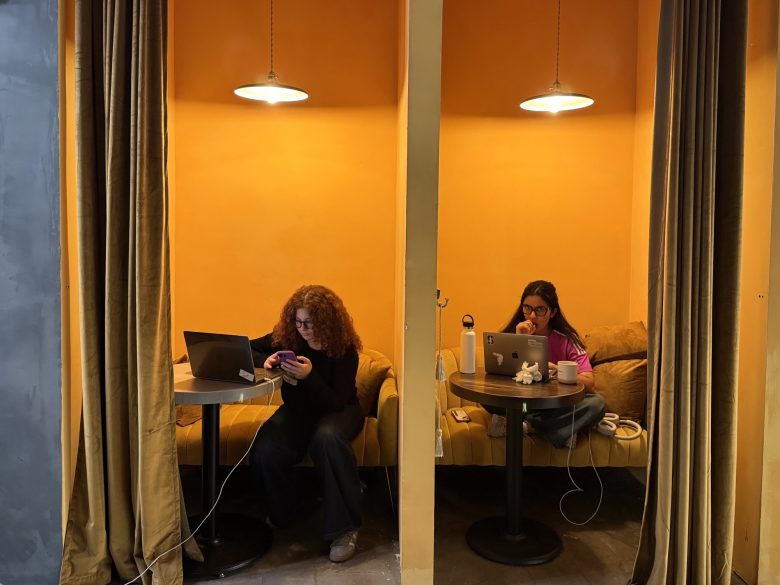

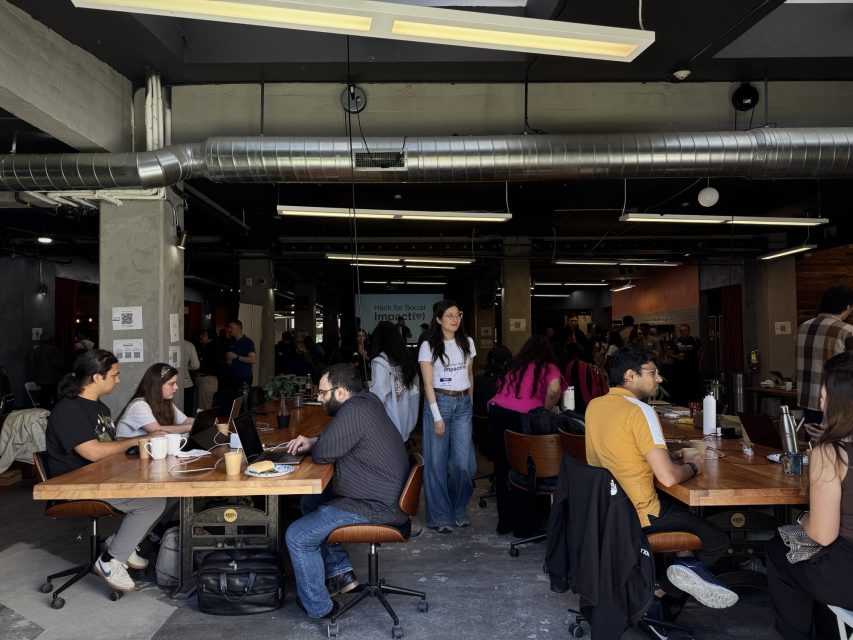
On a sunny, 73-degree Saturday in the Mission, the co-working space at 1885 Mission St. instead felt like a regular workday at any tech headquarters.
The venue, with the typical open floor plan and visible piping befitting a tech headquarters, was filled with some 150 young tech workers, mostly in their 20s and 30s — software engineers, project managers, AI developers — who gathered to “hack for social impact.”
In a two-day event, the engineers will create a project intended to help nonprofits solve problems such as fundraising, connecting unhoused people to services, or sifting through real-estate documents that reveal wrongdoing for newsrooms.
Seven nonprofits took the stage, including news outlets, homelessness nonprofits, environmental and social justice groups, and presented their problems.
Project Homeless Connect, a 21-year-old nonprofit that connects unhoused people to services, is facing a 92-percent funding reduction after the city slashed funding for nonprofits earlier this year.
“We’re asking you today to help us build a fundraising tool,” said Pamela Grayson-Holmon, executive director of Project Homeless Connect. “This is your chance to put your stamp on [our] legacy, to build something that protects the city and the services for those who are often invisible but in very much dire need.”
The Innocence Center, a nonprofit focusing on freeing wrongfully convicted people, needs a tool that can dig through years of parole transcripts, said Jasmine Harris, director of development and policy at the center. Generally, the information about their potential clients is buried in lengthy transcripts and audio recordings of parole hearings.
Mission Local also presented at the event. The tech teams are looking at several potential innovations that could help a local news nonprofit, such as Center for Investigative Reporting and Mission Local.
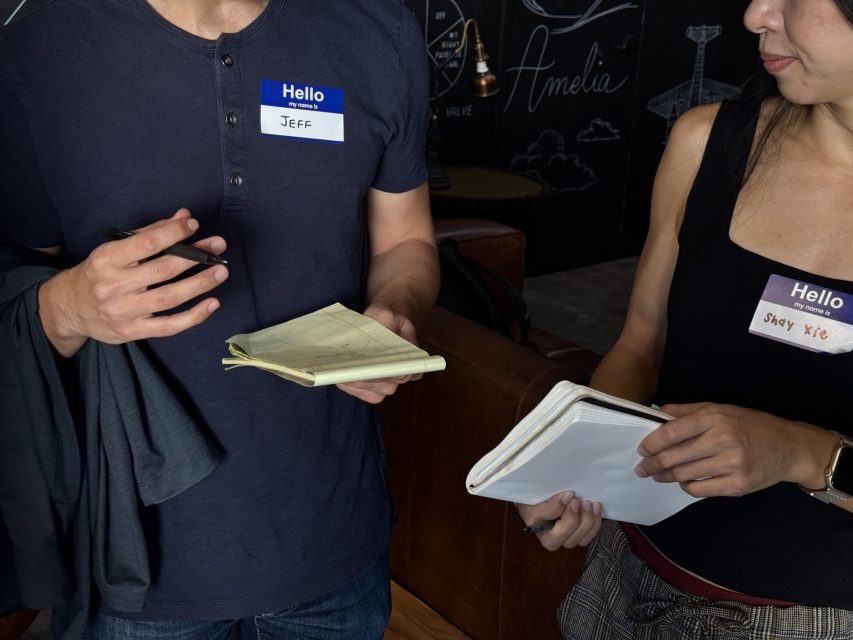
“We really want to change the discourse in Silicon Valley, which is very focused on raising funding,” said Cher Hu, founder of Hack for Social Impact, which is hosting the hackathon for the second year. “But there’s other ways that people who have those skills can use their skills for social good. And we want people to talk more about that.”
For the participants, some wanted to build something useful, some were there to network, and some said they wanted to recognize their privilege of working in a high-earning field and do something good.
“Giving back is important. There should be a purpose other than earning money for your own self,” said Rocha Pragat, a product manager. “This is something that will keep my sanity.”
But the engineers and project managers also seemed excited for the opportunity to obtain funding and start their own companies.
Roop Pal and Puneet Sukhija were the second place winners at last year’s hackathon, where they developed Bild AI, a tool that reads construction blueprints and estimates costs for developers.
“I met him on Saturday. Sunday, we got second place. Monday is the AI For Good conference. Tuesday we decided, ‘let’s make this a real company.’ And that’s the Y Combinator deadline. We submitted an application Wednesday. And by Friday, we had gotten into Y Combinator,” Pal said. The crowd let out the loudest applause.
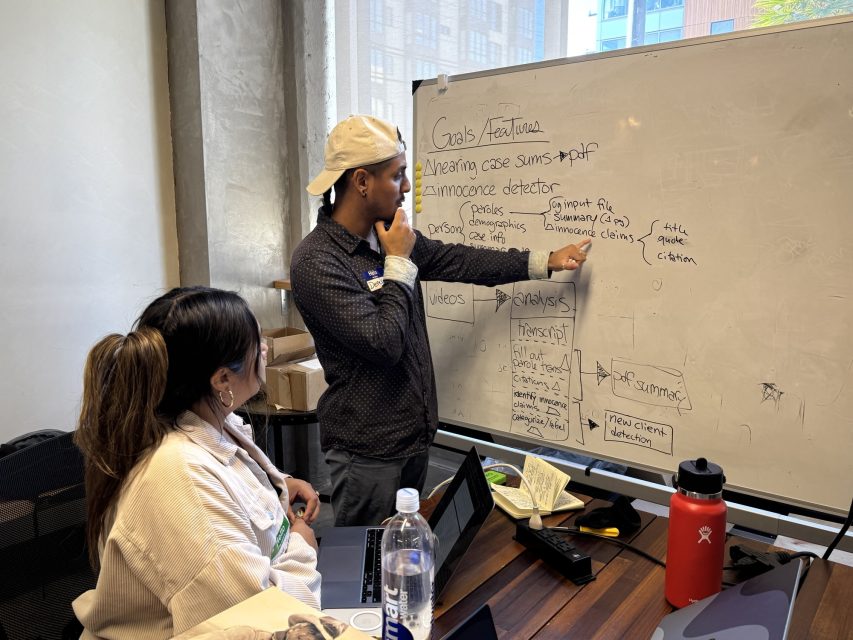
Around 11:10 a.m., after nonprofits explained their needs and problems, the crowd dispersed into groups of about five and got to work.
Before the event, people had already started teaming up in a Discord channel, introducing their skill sets and looking for teammates. Participants who hadn’t found a team went to the stage and started selling themselves to the hacking teams.
“I have lots of experience helping my lawyer friends with AI,” one said.
“We need more technical people on this team,” said another.
Those who attended were aware that the AI boom and the influx of tech workers has also meant rents are going up and eviction notices are spiking.
“It’s a complex and delicate conversation,” said Grayson-Holmon. “But it’s a beautiful thing when people are reaching out and saying, ‘How can we help support this? We don’t want to live in this bubble. We don’t want to walk in my office and close the door and not think about the people that I saw on my way in.”
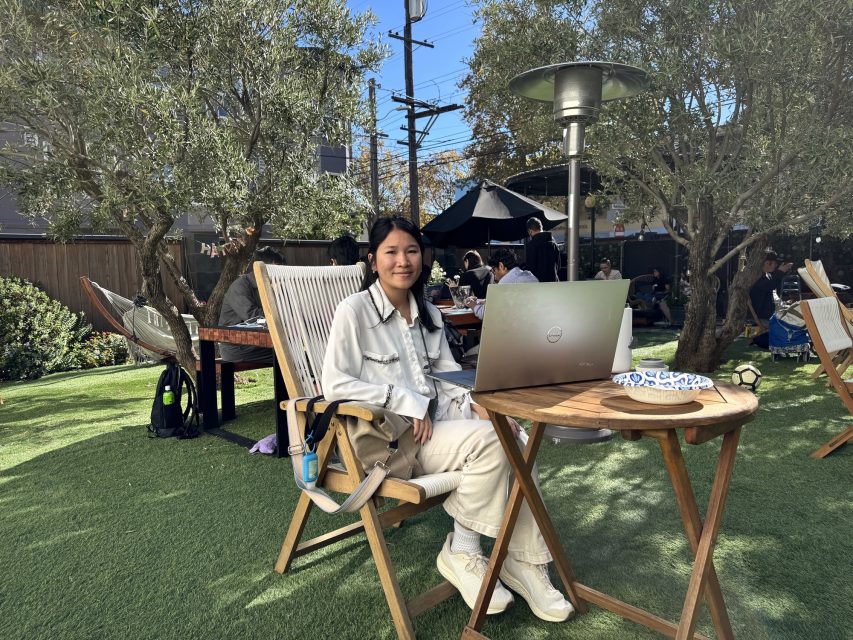
But It is those conversations that brought some of the hackers to the event.
Sunny Jain, an engineer who uses AI and machine learning in his day job, said he was, at first, oblivious about the environmental impact of the tools he uses daily. But his fiancé, an environmental journalist, always brought up AI’s environmental impact on “the real world.”
“I don’t really feel great about all the tools I use,” Jain said. “So I want to learn how to use those same tools for actual good.”
The hackathon takes place on Nov. 8 and Nov. 9 at 1885 Mission St. The final presentation is at 5 p.m. on Nov. 9.
my “hackathon” project is developing a website to make it easier to report ICE abuses to the ACLU. I think my next one is going to be helping to fundraise for people who are going to run in the primaries against spineless sellout democrats.