

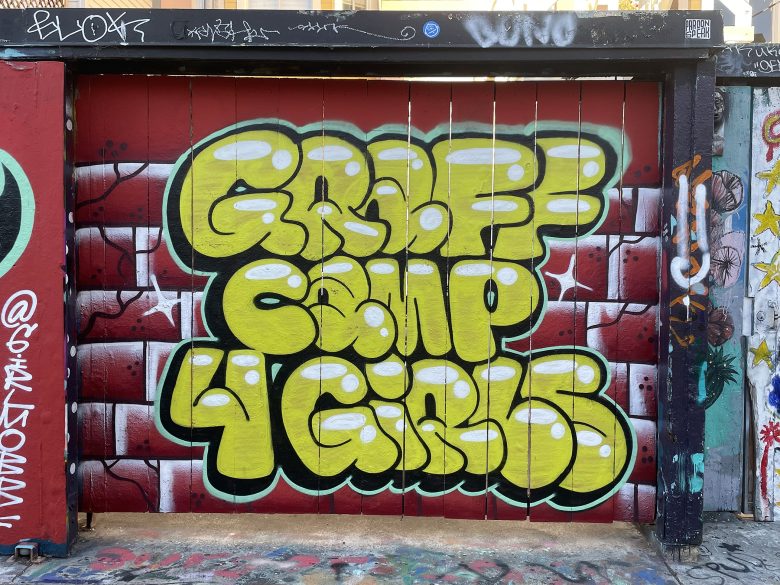
Some of the most legendary muralists and graffiti artists in the world leave their mark in Clarion Alley.
Nina Wright, aka Girl Mobb, has spent nearly a decade making sure teenage girls know that this alley — and other public art spaces across the Bay Area — are places for them, too.
Graffiti Camp for Girls originally started as a one-off project. Wright and a friend of hers, Deirdre O’Shea, got a grant from Southern Exposure, an arts nonprofit based in the Mission, to teach local girls how to use spray paint by making a collaborative mural. After the inaugural camp, held in Berkeley in April 2017, it was clear they were onto something.
The nonprofit now puts on a five-day camp, which culminates in the creation of a group mural and welcomes girl-identifying and gender-expansive youth, ages 12 to 18. It costs $250 a person. For every camp session, two to three scholarships are available.
Wright noted that they sometimes make exceptions on ages; some campers are slightly younger or older. What they’re looking for are youth who can be “respectful and supportive.”
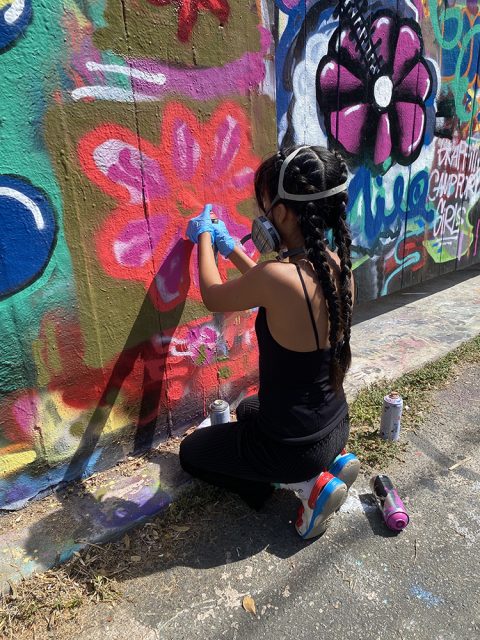
Wright and O’Shea hold camps all over the Bay Area, in spots like the Petaluma Arts Center and Omni Commons and Temescal Studios in Oakland and elsewhere in California, including the San Diego Art Institute.
Camp sessions have also expanded to cities in other states, such as Cincinnati, Ohio, and in other countries, namely Phnom Penh, Cambodia.
While the camp has branched out to other San Francisco locations, like Blick Art Materials and Smitten Ice Cream Shop, annual sessions on Clarion Alley are a mainstay.
Wright appreciates Clarion Alley, where she has a dedicated space, for its existence as a public art hub.
In the decades since the Clarion Alley Mural Project (located between 17th and 18th Streets and Mission and Valencia Streets) was established in 1992, artists and groups have painted nearly 1,000 murals on the garage doors and backsides of buildings that line the alley.
“The alley is really one of the best mural experiences for kids,” said Wright.“You’re in this historic spot, where there’s a bunch of other murals. You can take inspiration from them.”
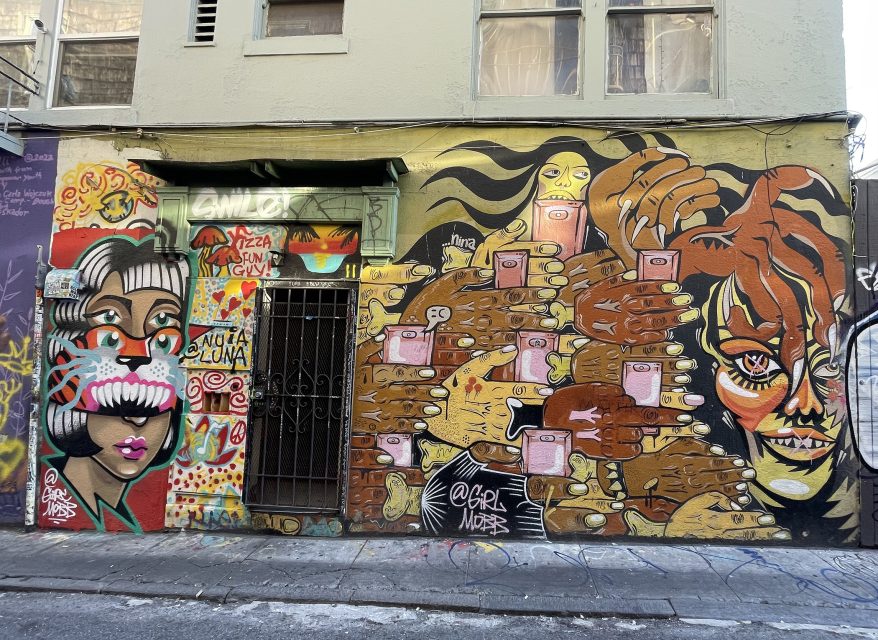
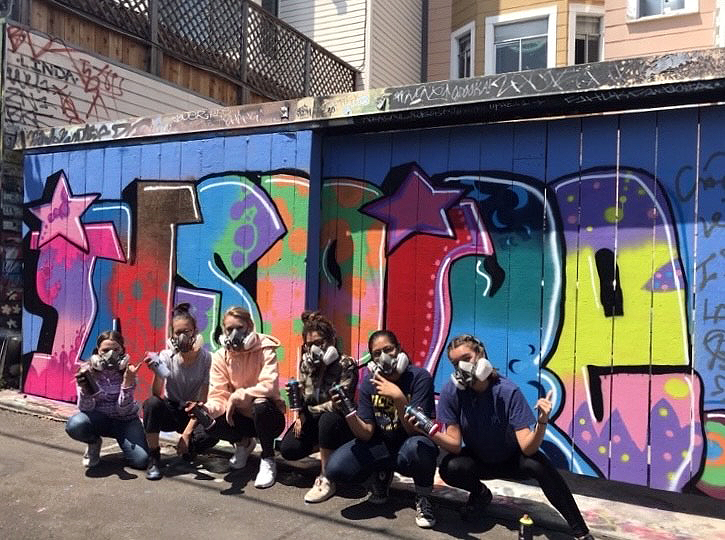
On any given day, the alley draws locals and tourists alike, strolling the alley for a close inspection of each artwork, with smartphones in hand for photos and videos.
“It really does challenge you and kind of put you on the spot,” she said. “There’s a lot of passersby, and they always check out the work and comment on it.”
For girls in the camp, there’s the additional pressure of learning to use new materials, like spray-paint cans, for the first time in a public setting. Wright has found that they handle the experience with poise and feed off of the attention they receive from onlookers.
“It really helps with their self-confidence and self-esteem to be able to do that in front of such a big group of people. I feel like it helps them get over this sort of stage fright,” she said.

The culture around graffiti art has changed somewhat since the camp began, Wright said. “At the time, there weren’t a lot of women street artists or women muralists that were really getting any attention.”
“I had a little bit of an agenda when I started,” she added, with a laugh.
Still, asserts Wright, there’s work to be done. “Usually, it’s boys doing graffiti and street-art murals,” she said. “To this day, I think it’s important to push girls to do art forms that usually they’re not known for being a part of.”
The next Graffiti Camp for Girls in Clarion Alley will take place in June or July, after school lets out. To sign up, go here. For more information, contact Nina Wright at nina@graffiticampforgirls.com.
Graffiti is unsightly and degrades neighborhoods, period end of story.
Ok sure. How about sanctioned murals in graffiti style?
Graffiti sprayed on nonapproved sites is vandalism not art .
Destruction of property by graffiti that damages or costs more then 400 dollars to repair is a felony.
I hope these kids dont get in trouble and realize that cannot go around doing this anywhere they want .
It is very ghetto.
And selfish
It’s a crime. Calling it a serious crime is unserious to a real criminal.
Yeah – don’t teach them any leadership skills and you’ll wonder why women are not CEOs or entrepreneurs.
Hopefully the program also does a day of cleaning up graffiti too, and what’s not ok to tag! Good to show both sides.
Counterpoint to some of the other comments here: I’m not a practitioner but I think graffiti (as the term is used in 21st and late 20th century USA) is an art form worthy of conditional respect. I don’t condone defacement of homes, small businesses, traffic signs, etc. But painting over an advertising billboard in San Francisco in 202x, say? In my opinion that’s probably good. Painting a subway car in New York in the 70s/80s? I don’t know, I wasn’t there. I’m ignorant of Bay Area graffiti history, forgive me for not addressing it.
Balancing property rights (if you believe in them) against the right to non violent self expression (if you believe in that) is not a trivial problem. Some people seem to equate the “crime” of graffiti with robbing someone or shoplifting or selling illegal drugs. I think that position is obviously wrong. “Degrading neighborhoods” is a matter of taste. I think marky B’s giant dildo is an embarrassing eyesore but there it is. Painting a graffiti piece/mural in a famous graffiti location in the mission? Obviously it’s art. Fill in your own example.
The “broken windows” discussion is another thing but personally I distrust that narrative. Could be wrong as always.
Also I don’t know if “tagging” is really the proper term for this type of graffiti. Hopefully someone more knowledgeable can explain the difference or ridicule my cluelessness as needed.