
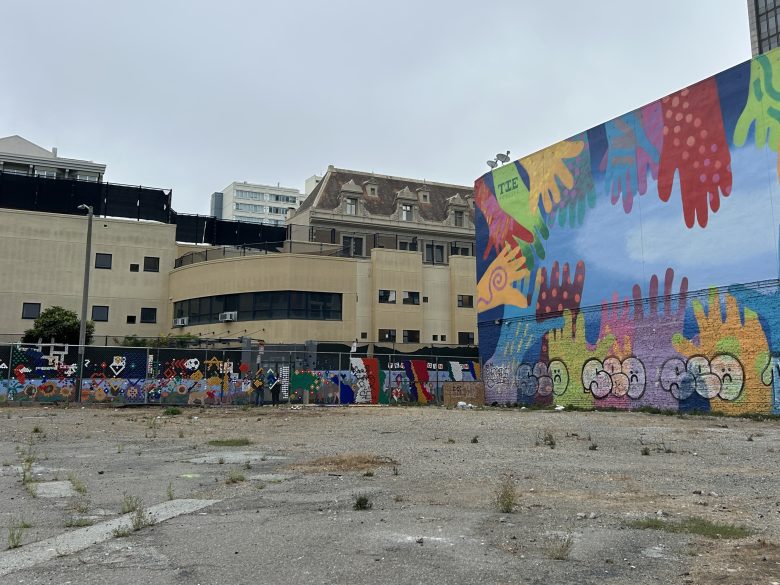

Two years ago, Brandon, a fourth grader at Tenderloin Community Elementary, was gazing out the library window at the gray dirt lot behind the school — the ruins of the former McDonalds at 600 Van Ness Ave.
It had been demolished to make room for housing that had yet to materialize. Scott Bravmann, a volunteer at the school, asked Brandon what he would like to see there.
A soccer field, he told Bravmann. He wanted there to be goalposts and a stall to buy snacks and drinks. He wanted to play games and run around the space, then scattered with used needles and scorch marks from small fires.
The Tenderloin has the highest density of kids of any San Francisco neighborhood, but lacks open spaces for them to play. Bravmann was part of a group that had organized to close off Elm Alley, a block of the street adjacent to the school, to car traffic so that kids could play there.
Fourth grade seemed like a great time to practice organizing skills. Bravmann helped Brandon write up a petition to build a soccer field, which Brandon then circulated around the elementary school.
In the uneven block letters of elementary schoolers, more than 130 of his classmates signed it.
On Monday, a pair of soccer pitches will finally open in that lot at Golden Gate and Van Ness avenues, providing a space not only for the school’s students but other Tenderloin residents and families to play.
The timing is fortuitous: Earlier this week, the Tenderloin lost one of its few outdoor recreation spaces, including its soccer pitch, until renovations outside the Tenderloin Recreation Center end in summer 2026.
“The kids live here, and they’re figuring out ways to be happy and find things that are helpful for them,” Bravmann said, perched on the edge of the lot last week.
It’ll be a welcome change. Not too long ago, Bravmann was putting out fires from homeless encampments and cleaning up discarded syringes from the lot many times over the past decade, since the McDonald’s closed. Soccer games, he said, will transform the space.
Bravmann searched for the right partner to make the soccer fields happen. Through former Supervisor Dean Preston, he got the attention of the nonprofit Street Soccer USA, but the group wanted a long-term commitment from the lot’s owner.
At the time, the lot’s owners, Golden Gate Van Ness LLC, were preparing for a development project that could start any day.
Then the pandemic happened. The housing will still be built, eventually. But earlier this year, after a soccer field in SoMa managed by Street Soccer USA got fresh turf, the nonprofit had to either store the old turf or find a new home for it. The lot at 600 Van Ness looked like the perfect place.
Street Soccer USA is now leasing the empty lot, which sits between Elm Alley, Van Ness Avenue, and Golden Gate Avenue, for $1 a month.
This weekend, the group and a crew of volunteers will install two 70-by-46-foot soccer fields there, with matching goal posts. A pair of storage containers adjacent to the fields will hold nets, balls and cones, and provide a shady spot for kids to play games, have a snack, or take a break from the sun or fog.
“We’ve developed a lot of great relationships with kids and families and community partners,” Keith Hsu Chernin, Street Soccer USA’s Bay Area managing director, said.
The group is paying for the pitch with help from the Tenderloin Community Action Plan, a resident-led process for using city funds, and has had a presence in the Tenderloin for a decade.
“This project feels like an extension of that work, and was responding to community hopes and dreams,” Chernin said.
To start, the fields will be open for school use during recess, after-school programs, and weekend and community events organized by Street Soccer USA. But its hours could extend beyond that in the future to allow greater community access, especially as Street Soccer USA brings on a site manager.
Earlier this month, Kara Wright, a pediatrician who once worked at the Tenderloin Community Elementary School, saw a glimpse of what the soccer pitches could do.
During an after-school event for the elementary school on Elm Alley, Wright and Bravmann brought out pieces of the turf that would be used for the soccer pitches and laid them out on the street.
As the Tenderloin Community School students finished school for the day, many of them plopped down on the turf to relax, lounging in the sun.
“As adults, we create this opportunity for kids, but we can’t always anticipate how they’re going to use it and see it,” Wright said. “They saw this stretch of grass that they could lie down and roll around on.”
Then, the kids got up and started playing soccer.
Great article,TCAP in the house.Great Scott.
The Tenderloin isn’t just home to the highest density of children in San Francisco — it also has the highest density of adults. Yet, this neighborhood continues to lack accessible, healthy public spaces for all ages.
Why not install a simple, low-cost pull-up bar or other outdoor fitness equipment (OFE)? Something as basic as this can promote physical wellness, relieve stress, and support mental health for everyone — kids, teens, and adults alike.
Currently, most “kids-only” play areas exclude anyone over age 12. But what happens when those kids turn 13?
We know that substance use often begins between the ages of 13 and the early 20s — right when young people begin to lose access to public spaces designed for safe, healthy activity. In San Francisco, age 13 marks the cutoff for using playgrounds or other youth-focused areas, leaving teens with virtually no free, healthy outlets for managing anxiety, trauma, and stress.
Meanwhile, access to harm reduction tools and substances is far more visible and accessible than access to fitness equipment.
This imbalance creates an environment where the development of substance use disorders is more likely to progress. Without prevention efforts like fitness-based infrastructure, mild use (2–3 symptoms) can escalate to severe addiction (6+ symptoms).
We can’t keep asking why people use drugs when we fail to provide healthy, stress-relieving alternatives. It’s time we stop creating exclusive, age-restricted spaces and start investing in shared public resources that support everyone — from toddlers to elders.
Let’s break the cycle of addiction — not by reacting to crises, but by preventing them through community wellness, inclusion, and equitable access to fitness.
Great news
Didnt know the Tenderloin has the most children.
In my building, children are too afraid to go outside or go to school due to the drug dealing , addicts and encampments .
Cedar at Polk
Geary at Polk
Alice b Toklas at Polk
Mrytle at Polk
Ofarrell at Polk
Olive at Polk
Ellis at Polk
Willow at Polk
And Larkin and Van ness are all drug zombie dens.
The childens park at next to Larkin and Myrtle always has drug activity .
Very sad that the city still ignores this area and allows the illegals to gather and prevent children a chance to be able to get outside here .
Wish you all would come and visit and help get this neglected area addressed .
If progressive policies didn’t favor and protect drug addicts, the poor families living in Tenderloin would already have good schools, a soccer field and safe parks for their children to play at! But hey, let’s protect criminals at the expense of our future generations!
Reading is fundamental. You should try it sometime.
The Tenderloin already has a good public elementary school, several pre-K/childcare programs, and a fourth- through eighth-grade Catholic school. The Tenderloin Children’s Playground (Rec Center) had a soccer field but that is now closed so the outdoor area can be renovated. There are several small parks/playgrounds nearby, but the neighborhood has virtually nowhere that additional parks/play areas could “easily” be put in. That’s why the community has worked to invest in and create new open spaces – the Golden Gate Greenway, the Elm Alley School Street and now the adjacent soccer pitches on a privately-owned lot, the Urban Alchemy Oasis, and Dodge Alley.
But these new spaces have taken a tremendous amount of time and effort to develop. Creating outdoor public activity spaces in a neighborhood that is 99% built (that’s a guess but can’t be too far off the mark) requires critical thinking about existing public spaces and persistent advocacy against the status quo regarding street use; the neighborhood’s many busy streets and slightly less busy alleys are basically the only opportunity for creating space in the Tenderloin.
Anyone who’s been paying attention should be aware that reimagining how streets are used always creates huge tensions and weird alliances: adding bike lanes, daylighting at intersections, creating a new park, building ADA-mandated boarding platforms for Muni, lowering the speed limit, adding speed cameras, removing vehicle lanes, Residential Parking Permits, closing part of Market Street to most vehicles, creating bus-only lanes, installing parking meters and increasing or decreasing their hours of operation, lengthening bus and commercial loading zones – all of those are contentious, fractious, and good for some people, bad for others and mixed for the rest. The difficulty in the Tenderloin is compounded by the fact that SFMTA does not recognize the neighborhood as residential and most people see it as their right to pass through (as fast as possible, because everyone is in a hurry) on their way to somewhere else. This disempowers the community and compounds the difficulties of developing much-need public goods for the neighborhood.
Your comment, as with the previous two, makes sweeping generalizations about a complex, under-resourced neighborhood. None of you offers meaningful ideas or steps up to do some of the work that you want to see happen. Feel free to create your own Friends of Fill-In-the-Blank Alley group; scout the neighborhood for viable all-ages public space options and then start the work of making them happen; consider making a cash or time donation (Street Soccer USA needs funding to maximize the opening hours for the soccer pitches; Safe Passage can always use more volunteers); or even join the various advocacy groups, community projects, and alliances that are working on these issues.
Eric Randall is wrong to think the solution will include opening children’s play areas to all ages. Children need spaces designed for them (they are smaller, developing their gross motor skills, and play differently from teenagers and adults). Nor would it be helpful to allow kids into adult spaces simply because there isn’t enough space overall.
This does not mean there are adequate spaces for older kids, transitional age youth, adults and seniors. The TL Rec Center is open to up to age 18. The Kroc Center has a teen drop-in space. The Curry Senior Center exists. But those aren’t enough. And, yes, new all-ages spaces and events are crucial as well.
Scott, congratulations on your soccer field! That’s huge.
The kids of the Tenderloin are very lucky to have you.
“Anyone who’s been paying attention should be aware that reimagining how streets are used always creates huge tensions and weird alliances: adding bike lanes, daylighting at intersections, creating a new park, building ADA-mandated boarding platforms for Muni, lowering the speed limit, adding speed cameras, removing vehicle lanes, Residential Parking Permits, closing part of Market Street to most vehicles, creating bus-only lanes, installing parking meters and increasing or decreasing their hours of operation, lengthening bus and commercial loading zones – all of those are contentious, fractious, and good for some people, bad for others and mixed for the rest. ”
SPOT ON, Scott for Board of Supervisors!
We need more people who understand this basic-yet-complicated dynamic in SF.