

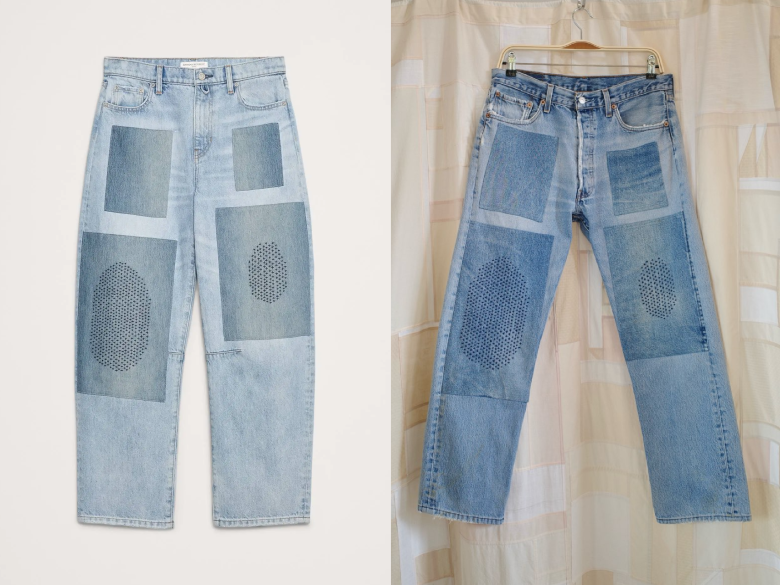

In the spring of 2024, Lindsey Hansen, owner of the Future Past secondhand clothing store in the Inner Richmond, sat down at her work table and restored a pair of threadbare vintage Levi’s 501 jeans using scraps of denim from around her shop.
The repair took about two days, Hansen said. She added patches from the thigh to the knee of each pant leg, and hand-sewed them on using a sashiko cross-stitch, a traditional Japanese denim repair technique.
More than a year later, she saw a corporate fashion giant selling what she said was her exact design, from the stitching to the placement of the patches.
She had posted photos of the restored Levi’s on social media back in March 2024, and put the jeans up for sale. They sold two days later for $288.
Business at Hansen’s small Clement Street shop carried on as usual until a week ago, when a coworker sent her a link to a $180 pair of jeans for sale on Banana Republic’s website: the “Mid-Rise Barrel Patchwork Ankle Jean.”
It was an “exact replica of the jeans that I had worked on,” Hansen said. She pulled up photos of her restored Levi’s and the Banana Republic jeans, which had four patches and cross-stitching in the same locations as Hansen’s, on both the front and back of the jeans.
“Side by side, it was undeniable,” Hansen explained, pointing to the photos.
Hansen thinks the Banana Republic jeans first went on sale a couple months ago, when a “behind the design” promotional video was posted on the company’s social media.
“I really strive to create washes for us that feel naturally worn-in, that feel like a vintage find from a flea market,” says an unidentified voice over the promotional video.
As of Oct. 30, the Banana Republic product page had been taken down. The video, as well as a comment from someone who claimed to be the designer saying they were “paying homage to a centuries-old Japanese tradition,” has since been deleted.
There appears to be nothing, legally, to stop Banana Republic from doing this. While labels can be protected by a copyright, fashion designs cannot be.
Absent legal options, Hansen took to the internet for justice, creating a video that she posted yesterday describing what she called a “blatant copy” of her design, and posting it to social media.
“You can recreate a vintage item, and it’s a reproduction,” said Krystyl Baldwin, a San Francisco vintage collector. “But to recreate a vintage item that’s been upcycled as someone else’s art is just dirty business.”
“We take their concerns seriously as a brand that supports the local creative community,” said a spokesperson for Gap, the company that owns Banana Republic. “Our team is looking into this matter and will handle as appropriate.”
Hansen has had The Future Past for the last six years. Before that, she spent her entire career working in the fashion industry, and said she wasn’t unfamiliar with smaller businesses’ designs being “stolen” by big companies. But this time, she said, it was “just too close.”
Hansen found the idea of a company “creating this new garment that doesn’t need repair, but looks like it has been repaired” particularly harmful. Her business, she said, was about recycling and reducing waste; Banana Republic, she said, was “making it a trend.”
“It’s not a trend,” Hansen continued. “We need to repair our clothes, because we just can’t keep consuming clothes the way that we are.”
“paying homage to a centuries-old Japanese tradition”
Of shamelessness? Banana Republic is nothing but an AI sweatshop.
Seriously? If so, then I can say that Future Past stole my design, since I would repair my torn jeans way back in the ’80s — just like that.
They should have just done a partnership with the Future Past. It would’ve been seen as cool and would have allowed Banana Republic to regain some much-needed street cred. A missed opportunity for Banana Republic, now they just seem like class A Clowns!