

While many in San Francisco’s Asian community opposed closing the Great Highway in favor of a park and are alarmed by upzoning the Westside and adding housing, a group of Asian urbanists are organizing to prove that they exist, too.
“There are definitely a lot of us who do want more apartment buildings, who do want better public infrastructure and biking as well,” said James Wen, 28, at the inaugural meetup for “Asian Urbanists” in San Francisco on Irving Street on Tuesday night.
“I do feel like there is a pervasive narrative where Chinese Americans on the Westside are generally anti-urbanist, generally don’t want to see growth,” said Wen, an AI scientist and a volunteer lead at SF YIMBY who’s lived on the city’s Westside his entire life. “I’m here to change that.”
Chang Sun, 31, a data engineer and another volunteer lead at SF YIMBY, agreed. “We want to make it easier to organize.”
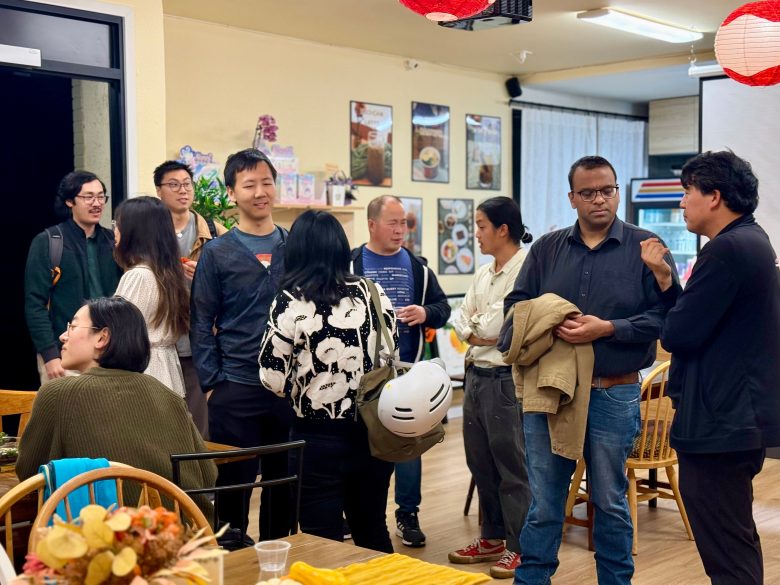
Wen and Sun were among roughly two dozen like-minded Asian San Franciscans who met at Sunset Commons, a three-month-old public gathering space on Irving Street. Most arrived on public transit or bikes and described themselves as “super environmentalists.”
Many were officially affiliated with various YIMBY groups. Nearly all were well-versed in Mayor Daniel Lurie’s upzoning plan, and familiar with city zoning codes.
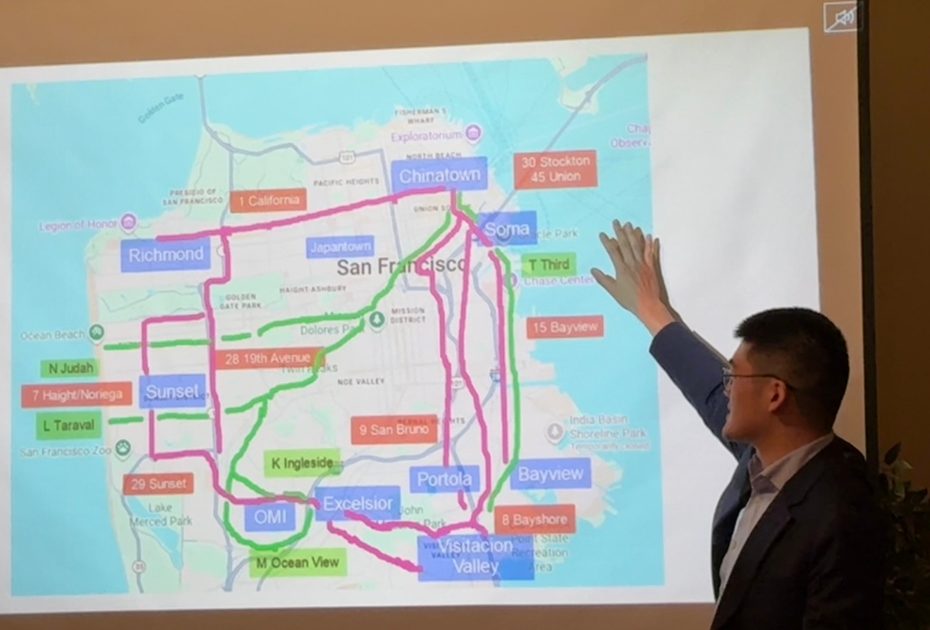
Mike Chen shares a spaghetti-like map he created in Microsoft Paint showing the public transit lines connecting Asian neighborhoods across the city on Oct. 28, 2025. Photo by Yujie Zhou. 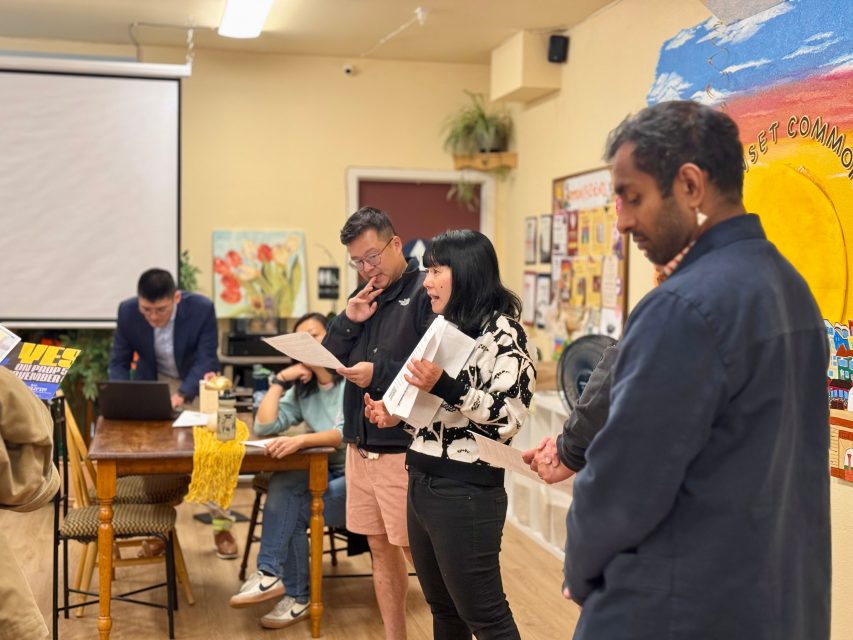
Lian Chang, who was a campaign manager of Engardio’s anti-recall campaign and currently an organizer at Abundant San Francisco, advocates for Lurie’s upzoning plan on Oct. 28, 2025. Photo by Yujie Zhou.
“We got to talk about these urban issues. We’ve got to talk about housing, transportation, everything,” said Janelle Wong, the former executive director of the San Francisco Bicycle Coalition. Wong said it was “important for us, as Asians” to get involved in housing debates.
As the Joel Engardio recall campaign heated up earlier this year, Wong said she pushed Brian Quan, the organizer of Tuesday’s meetup, to put the event together.
“Because the voice that’s being talked about for Asians or specifically Chinese voters in San Francisco — I don’t know about all of you, but it doesn’t fit for me,” she said.
“There are people that exist in our community, young people, old people … that care about these things,” Wong added. “We’re not invisible. We do have an opinion.”
For Quan, organizing the Asian urbanist meetup was a natural evolution of the Stop Asian Hate gathering he hosted at his Richmond District house during the pandemic.
A former president of the Chinese American Democratic Club, Quan recently served as the treasurer of Engardio’s anti-recall campaign, which failed to prevent the emphatic ousting of a supervisor who supported converting the Upper Great Highway into a park. Asian residents played a leading role in ultimately recalling Engardio.
“For me, it’s — how do we reverse that reputation of being against things and actively promoting what we see the community developing as?” Quan said.
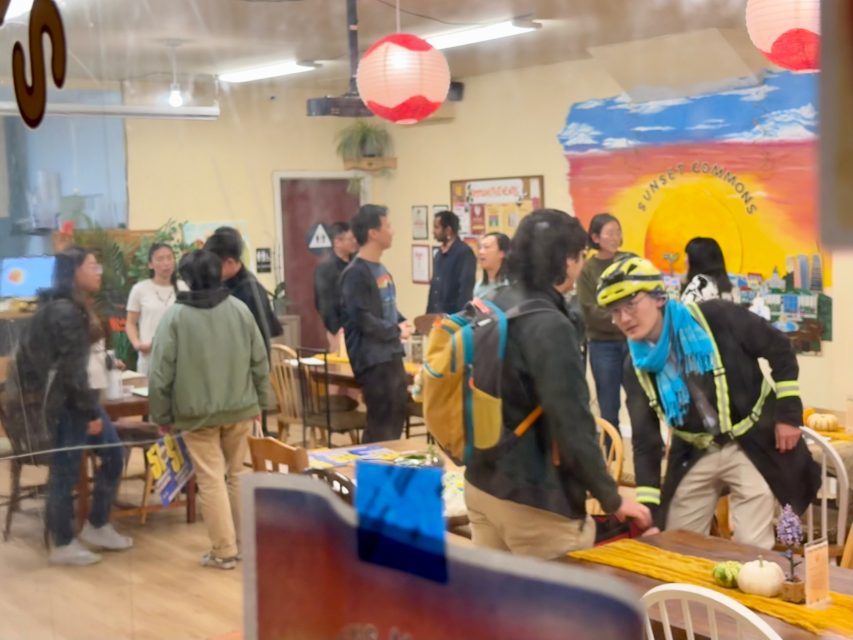
Most of those who attended Tuesday night’s meetup were 30-something tech workers who live on the Westside. One sipped a bowl of Shin Ramyun instant noodles.
Many already knew one another from various urbanist groups, on campaign trails, or when making public comments at the City Hall. Lian Chang, who was a campaign manager of Engardio’s anti-recall campaign and currently an organizer at Abundant San Francisco, was there to advocate for Lurie’s upzoning plan.
The crowd cheered when one of the two speakers of the night, BART board member Janice Li, said, “We don’t get cool shit in San Francisco if we don’t have really good transit.”
Li, who’s been on the BART board since 2018 and is a member of the city’s progressive faction, said she has no intention to run for another term next year. (She welcomes anyone interested in the seat, which represents a swath of the city from Balboa Park station to Embarcadero station, to reach out.)
She said in an interview Tuesday that she has often felt a lack of belonging in the Asian community groups that are supposed to represent her.
“A lot of the more organized groups that have ‘Chinese’ in their name, or ‘Asian’ in their name don’t necessarily represent the community as a whole, but they say that they speak for the community,” she said.
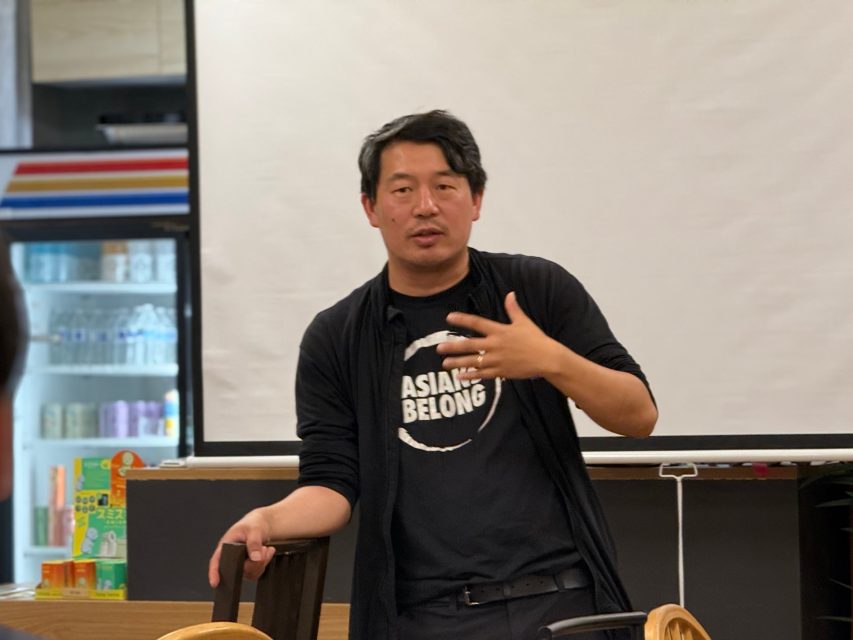
The other speaker, Mike Chen, is a more moderate YIMBY who was appointed to the SFMTA board last year. He walked the group through the transit agency’s work, including sharing a spaghetti-like map he created in Microsoft Paint showing the public transit lines connecting Asian neighborhoods across the city.
Li and Chen, who don’t usually caucus together in politics, shared a common passion for public transit Tuesday night.
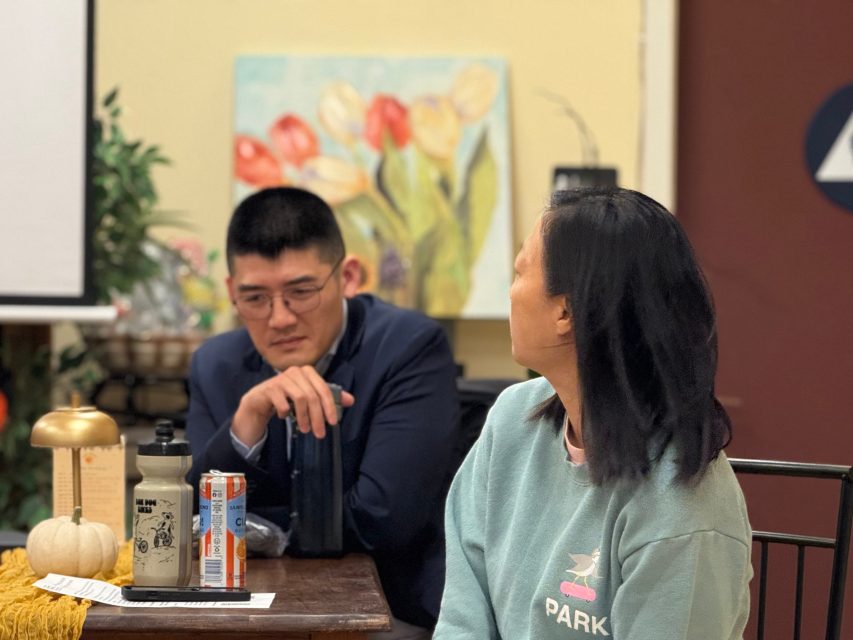
Participants asked questions about whether it’s possible for the state to fund BART, what a utopian future for the local public transit system might look like, and whether Lurie has abandoned a lot of street projects after Engardio’s recall (Chen said no).
The Tuesday night group, mostly second- and third-generation immigrants with limited Chinese-language skills, also faced a challenge that many other organizing efforts — including Engardio’s anti-recall campaign — have struggled with.
They’re trying to build a broad coalition that includes monolingual Chinese-speaking seniors who might actually support some of their ideas, such as improving public transit. “That’s why we are starting this up,” said Quan.
The group plans to hold its next meet up early next year, said Quan, when it will go into the weeds of SB 63, a bill aimed at addressing the long-term funding shortfalls for public transit in the Bay Area. In the future, they hope to move the gathering towards the east side, making it “more equitable,” said Quan.
And on this night, long after the discussion had ended, the group lingered in a neighborhood that had already fallen quiet. No one seemed in a hurry to go home.
The Asian side of my family are certainly not NIMBY. They’re fans of this YIMBY movement because they invest in luxury condos.
Interesting, usually people who invest in real estate are NIMBY.
People who invest in real estate are SPECULATORS.
That’s who is driving the cost up, because they extract it.
Here’s how OP’s point sticks: On the surface, the battle around SB79 is about building housing in general. In reality, SB79 is benefiting the development of ultra-luxury prestige projects where they otherwise would have been blocked, e.g. over in North Beach and the adjacent stretch on the Embarcadero. That’s because SB79 does not offer one cent for actually building anything.
I think part of the real story here is that younger people seem to desperately want these changes implemented but due to their lifestyles don’t get the same opportunities to be visible and vocal. (By lifestyle, I mean working a full time job or more than one, taking care of kids or relatives, etc). Who else is available on a random Thursday in the middle of the day to wait potentially hours to make their voice heard?
I noted in another article that when you look at the room full of opposition whether that’s local neighborhood town halls or City Hall, it’s usually grey haired individuals who bought their homes decades ago (and even some who got locked into rent control decades ago). In that same comment, I wished that similar attention was given to younger people on this issue and preferably those not directly linked to advocacy organizations. I think it would provide a more well rounded perspective on the issue.
-30 Something YO
SF Asian groups are intentionally considered a controllable ‘bloc’ because the (same old) political people want to use them as that – don’t be fooled by YIMBY BS or someone telling you how you ‘should’ vote no matter what. Decide for yourself.
Have home prices or rents come down as a result of YIMBY policies?
Hell no they haven’t! Do not buy the hype, trust your OWN eyes.
These political YIMBY groups get their money from the developers who benefit. If you think any of that cash is going to trickle down to little people, time to get real.
YIMBYism is a developer funded lie. Only morons believe it.
“AI scientist” has no problem with gentrification, news at 11.
If gentrification means cleaner streets, less blight, better maintained housing, lower crime rates, better quality shops and restaurants, and a stronger tax base, then bring it.
(And no, it actually the opposite, genius. Learn economics.)
“If gentrification means fewer ‘Davids’ being deliberate shameless toadies of the nouveau rich crypto-funded bubble class, then bring it.”
Thank you (again) for reminding us that having no actual work to do on the daily and a little unearned wealth to sit around on creates an environment for mindlessness and lack of common sense.
Garry Tan, Michael Lai and Bilal Mahmood are YIMBY poster boys. We really should retire the terms “NIMBY” and “YIMBY.” They are toxic slurs.
They’re industry-funded versions of “US vs THEM” – both funded by the same industry, Private Equity Real Estate Developer Corporations.
Asian Americans can be as gullible to neoliberal propaganda as any of us are. Why would anyone try to impose collective politics onto a heterogeneous population?
Look deeper in the alliances this so-called Urbanist group is involved with. See if they have ties to real estate or even to Weiner’s office (the politician who gets substantial contributions from real estate for his campaigns). The YIMBY play is another way for real estate to get into government to control development of NEW and EXPENSIVE (fair market prices) properties. It’s clear to many of us Weiner is compromised and is framing the YIMBY movement as something that will improve the lives of the local area. In fact, it will make it worse.
“One sipped a bowl of Shin Ramyun instant noodles. “
What the hell??