

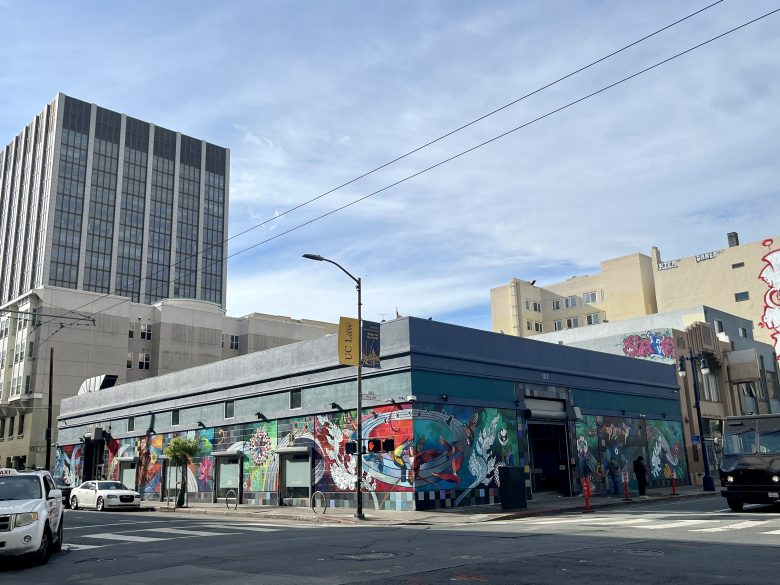

The large gray building at the corner of Golden Gate Avenue and Hyde Street is covered in a colorful mural evoking music, nature, and the diversity of the Tenderloin. Upon a closer look, the blinds are drawn, and signs in the locked doorways read: “Closed to the Public.”
On a recent afternoon, a passerby looked up at the building and shook his head: “It’s a shame.”
San Francisco city officials, citing a difficult funding climate, have decided to again stall a planned 85-unit affordable housing project at 101 Hyde St., despite its location in the city’s poorest neighborhood. Instead, Mission Local has learned, the city will award a five-year extension until 2031 on a lease for La Cocina’s incubator kitchen.
The Tenderloin has been promised housing at the spot since 2015.
The building’s history — and the recent decision by the Mayor’s Office of Housing and Community Development to postpone housing — offers a window into how an old post office, acquired by the city from a developer for the purpose of affordable housing, went from a place full of promise to a shuttered site with limited public access.
Shorenstein Properties originally bought the site and sold it to the city as part of a deal to fulfill its affordable housing requirements for a separate project.
It has since forged ahead with that 304-unit market-rate development nearby at Market and Jones streets; District 5 Supervisor Bilal Mahmood rented an apartment there until recently.
Affordable housing at 101 Hyde, meanwhile, seems a distant aspiration.
Anne Stanley, the spokesperson for the mayor’s housing office, blamed the plan to stall housing at 101 Hyde on the state’s designation of the Tenderloin as a low-resourced area, which puts it down on the priority list for state funding. She said the city has better chances of using its limited dollars to fund other projects.
What’s more, she added, with La Cocina in the 101 Hyde building, the city saves up to hundreds of thousands of dollars annually in fees it would otherwise owe for keeping it vacant.
“This is not a matter of prioritization, it’s about feasibility,” Stanley said in a statement. “Given limited resources and the competitive nature of affordable housing finance, we must be strategic and responsible stewards of public funds.”
A ‘public-serving’ use not for the public
At the start of the city’s first lease with La Cocina, it appeared that the Tenderloin would get a community space to revitalize a block once known for rampant drug activity. That was in 2018, after La Cocina won a competitive bidding process to temporarily activate the site with a public food hall.
The $6 million food hall at 101 Hyde opened in 2021, serving $5 meals that were affordable for residents of the working-class neighborhood. The place was meant to bring commerce, foot traffic and cheap food to the area, and to give its immigrant food entrepreneurs a customer base from the community and nearby office workers.
For a time, La Cocina delivered: Residents recall when the marketplace was filled wall-to-wall with diners, even though it opened a year after the pandemic had sent office workers home.
But in 2023, La Cocina reverted to operating a private commissary kitchen like the one in the Mission. Office workers were staying home, it said, and lunch crowds were lacking.
Nowadays, the building is almost always shut to the residents of the Tenderloin. While drug activity there has waned, the sidewalks outside it are deserted and unappealing.
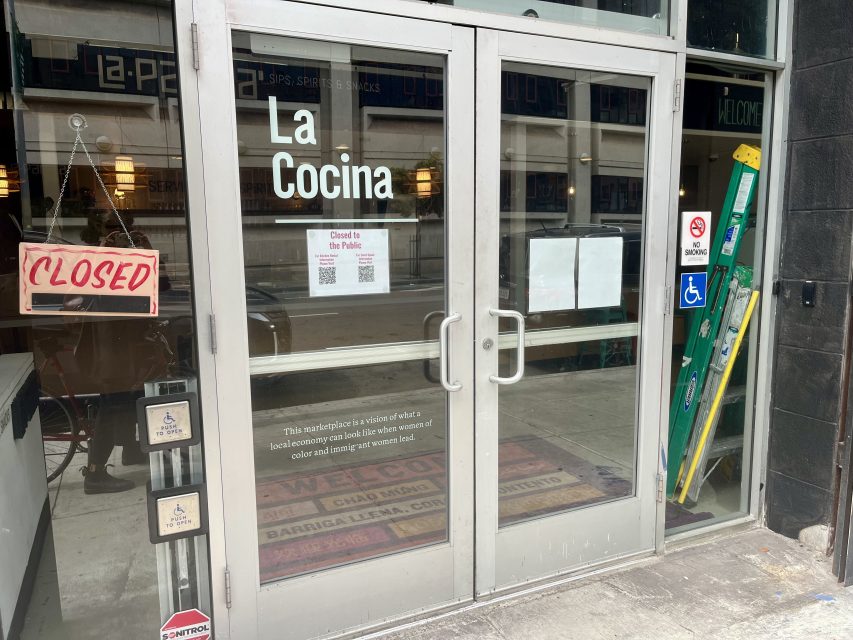
Tenderloin residents say La Cocina’s promise of a public-serving establishment — open to all and funded with more than $3 million in government funds — has been broken.
La Cocina says it wishes the food hall was sustainable, and that it still hosts community events when it can, and activates what would otherwise be a blighted block.
“They got the money for having that building based on that premise that they were going to be providing that ongoing benefit for the community,” said Kasey Rios Asberry, a community advocate who once worked on building La Cocina’s now-dismantled parklet.
“Most of the time, the metal doors are down. It’s again a blighted space on the sidewalk, instead of a free-flowing contributor to public health.”
Today, La Cocina still pays well below market-rate rent, and will continue to do so under its new lease.
According to the mayor’s housing office, the city covers basic utilities while the nonprofit pays $1,000 base rent plus 5 percent of its net income; La Cocina said this amounts to about $20,000 per month for the nearly 5,000 sq. ft. building. The city calls it a “cost-effective solution” preferable to leaving the space vacant.
La Cocina spokesperson Aniela Valtierra said it had little choice but to close: The marketplace was “consistently empty” most hours of the day aside from lunch, as the anticipated office workers began working from home, and “foot traffic was non-existent after 4 p.m.”
Free community events that La Cocina hosted went unattended, Valtierra said.
“We were trying to create economic opportunities for working-class immigrant and women-of-color small businesses while providing a welcoming space for the Tenderloin,” said Valtierra. “Places like the marketplace can’t survive on admiration alone. They require consistent patronage and support.”
After closing the food hall, La Cocina “heard the community’s disappointment,” Valtierra added, and offered free rent to two businesses to maintain food and drink service during breakfast and lunch. Even then, it wasn’t financially sustainable for either business, and the two business owners dropped out.
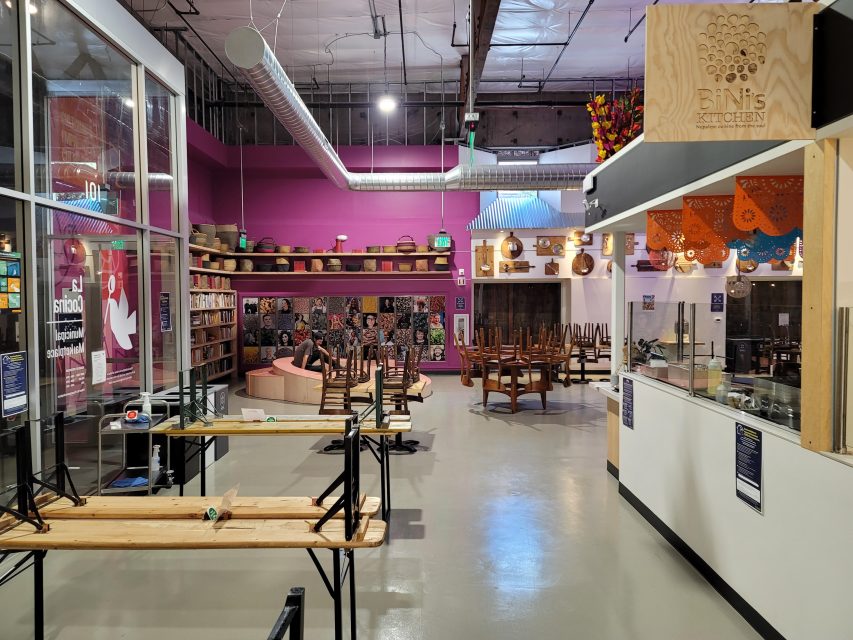
“The alternative to our presence could be vacancy, and we believe the Tenderloin deserves an activated corner,” said Valtierra, who said La Cocina’s work with budding restaurant workers is a benefit to the whole city. “We’re grateful to serve our mission of providing pathways to entrepreneurship at this location.”
85 affordable housing units delayed
The Mayor’s Office of Housing and Community Development seems to agree. Stanley said it was “not at all unusual” for the affordable housing end of housing development deals to drag several years behind.
In the competition for state funding, developers get points for factors like affordability or building in high-priority locations, like resource-rich areas. That works against the Tenderloin: According to the state, the entirety of the Tenderloin is considered “low resource,” which Stanley said makes state housing money for 101 Hyde lower priority.
Those factors, combined with the fact that the city sees La Cocina as a successful interim use of the 101 Hyde space, means the city has shelved the project for now.
The project is “still in our pipeline,” Stanley said, but the department won’t seek a developer until La Cocina’s lease ends in 2031.
While the state designation of “low-resource” also applies to the Bayview, most of SoMa, and chunks of the Mission District, affordable housing continues to be built in these neighborhoods.
The project at 1979 Mission St. at 16th and Mission streets just moved forward to seek financing this year, and 1515 South Van Ness Ave. is under construction. Both are relying on large amounts of state funding, and are located squarely in low-resource areas.
“Not all projects are equally positioned to attract funding; lenders and investors bring their own preferences, and projects must align with available programs,” Stanley said in a statement.
He added that affordable housing projects in San Francisco compete for the same pool of funding, and other funding is available to specific projects with specific attributes.
Contributing to the community
Although would-be chefs are still training there, the La Cocina site is no longer a community hub where neighborhood groups could hold meetings, or where residents grab a cheap bite.
The benefits to Tenderloin residents today are limited. They can rent out the space for events, and La Cocina sometimes hosts free programs. But not always: Tickets to a recent pop-up night market open to the public cost more than $50.
Scott Bravmann, who volunteers at the Tenderloin Community School, said he remembers when the La Cocina kitchen was a gathering space where he attended meetings to push for government support during the pandemic, or action on the Tenderloin Community Action Plan to make improvements in the neighborhood.
“I was disappointed,” Bravmann said of its 2023 closure, but since businesses fail all the time, “I wasn’t necessarily completely surprised.”
Bravmann said he believes La Cocina’s space and vacant storefronts in the area can still be made to serve the community in new or creative ways.
“People don’t have to throw something away, or just give up on the idea,” Bravmann said.
Thank you for your honest reporting on this no win situation. I am a early supporter of this project. Hopefully we can bring UC LAW into this since its on their campus. I like Kasey am very disappointed.
Sad and ironic that all the effort to protect lower resource areas from gentrification leads to lack of govt investment for social programs the low resource area needs. Not that any of our former elected who created the policy care.
Fix the infrastructure before you talk about building like that five street intersection where Costco patrons just make u turns in front of other drivers and block the opposing lane because they think they are better than others.
If developers had to include affordable housing onsite vs paying into a fund, affordable housing would be part of every building across the city. This would take the city out of the development game, provide more affordable housing, and spread out this housing across the city vs. only in poorer neighborhoods.
Meanwhile, the Board of Supervisors and the Mayor can justify support for and approve the construction of a luxury hotel and offices in a historic district while demolishing a city landmark — when clearly more types of these land uses are not needed. #WrongPriorities
I don’t see why they can’t combine both, like they do in Mission bay, on King Street, where there is commerce and housing.
Imagine if crime was lower in the neighborhood, and people wanted to go there to eat.
Never eat again, you’ll show em.
1) In this and similar discussions about “affordable housing”, who do you believe should pay for this housing?
2) How much (as a percentage of all SF housing) affordable housing would be sufficient in your opinion?
3) It seems like there is a blind spot in the reporting when the majority of funding to date for “affordable housing” comes from the taxes or fees paid by the developers of market rate housing projects and by politically limiting market rate construction, it also harms any potential for “affordable house”. The reason developers give for why so little housing of any kind is being built in SF is because of the high costs for building and the fact that rents don’t pencil out to cover those costs for even market rate housing currently.
If the STATE or CITY wants to meet quotas they self impose, they should fund and build the housing they are trying to abracadabra into existence. Anything else is a joke told by real estate agents to their Billionaire masters.
How much? More than 10% or 0%. Is that too much for greed to allow?
“omes from the taxes or fees paid by the developers of market rate housing projects and by politically limiting market rate construction, it also harms any potential for “affordable house”. ”
Is what a “free hand of the market” type of liar would say.
Funny how economic reality, trumps failed and really tired, 177 year old marxist ideology.
SF needs to split the Mayor’s Office of Housing, mayor can keep Community Development, into its own independent department with a commission to bring transparency to the allocation of affordable housing dollars.
CCHO does not want this because it wants to conceal its operations. The Mayor’s office does not want this because it allows them to have full power over allocations.
But these are public policy discretionary choices involving trade offs that are better made under the disinfecting rays of sunshine. If the Mayor’s office and CCHO don’t want it, then those are the best arguments in favor of an independent and transparent affordable housing finance department.
Hate to say it, but this city only worked,when we had Republican majors. They got it done! No P.C quibbling, they just did it.But of course, Repubs, are all about the bottom line-but still.
Sir or madam —
San Francisco has not had a Republican mayor since 1964.
JE
Well there was Feinstein…
It was under Republican leadership that the last freeway slashing through our middle-class immigrant neighborhoods (the entirely useless, loud, and utterly polluting stub of Interstate 280) was built, creating high-injury corridors all over the south and central parts of SF and not improving transit efficiency or commerce one bit. Yeah, we’re good on Republicans returning to city leadership.