


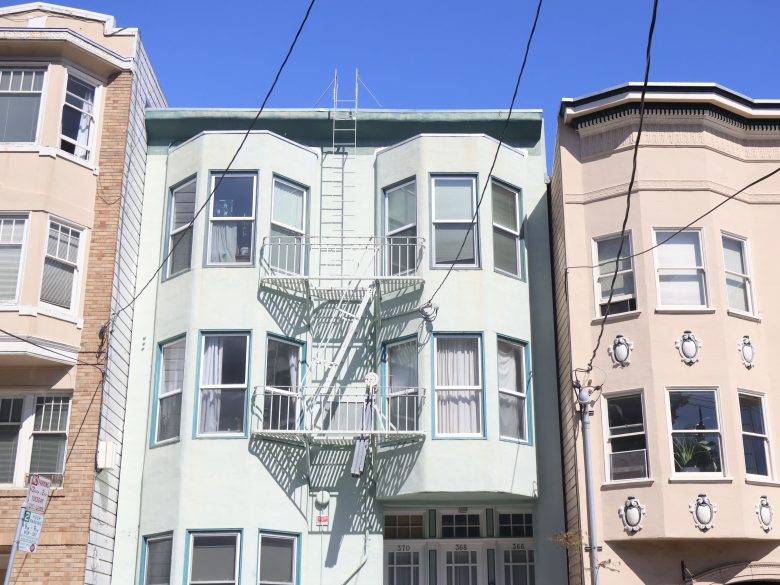

The mayor’s plan to upzone swaths of San Francisco will no longer apply to buildings with three or more rent-controlled apartments.
The amendment, drafted by District 7 Supervisor Myrna Melgar’s office, has been accepted by Mayor Daniel Lurie into the zoning plan.
If accepted by the Board of Supervisors and approved by the state, that plan will allow developers to build taller, denser buildings in the western and northern parts of the city, so long as at least one additional unit of housing is being added to the lot.
The amendment exempts at least 84,000 rental units in 11,700 buildings from the upzoning plan, and any ground-floor retail that might be under them, according to analysis by Mission Local.
This amendment is in response to fears from renters and tenant advocates that the mayor’s previous plan would result in less affordable housing, not more, by spurring the demolition of the only housing that the city is allowed to impose rent control on: Housing that was built before 1979.
“Rent control helps preserve economically and racially diverse cities,” Melgar said. “I have always believed it is sound housing policy, giving tenants similar stability and predictable costs that homeowners enjoy with fixed mortgages and Prop 13.”
“The Anti-Displacement Coalition fought for the exemption of all rent-controlled housing from the beginning, so exempting three-unit-plus buildings is a step in the right direction,” said Meg Heisler, a policy director at the Coalition.
Protecting the 84,000 number of rent-controlled units shouldn’t have an impact on the larger goal of the rezoning plan, which is to comply with a state mandate that is requiring San Francisco to create the capacity for 36,000 additional housing units — or risk losing its authority to approve or deny new housing projects.
That’s because the formula used to estimate how much housing San Francisco needed to add assumed that any building with more than four units constructed before 1979 — a proxy for rent-control eligibility — would not be redeveloped. This makes the amendment possible without risking loss of state approval.
“Supervisor Melgar’s new amendment to advance our Family Zoning plan will strengthen tenant protections while keeping our city on track to meet state housing mandates,” Lurie said.
Still, members of the Anti-Displacement Coalition warn that tenants remain vulnerable in the face of upzoning.
Two-unit buildings are not covered by the amendment, and there are some 20,700 of them still included in the upzoning plan.
However, since they are smaller (and some may be single family homes with accessory dwelling units), they tend not to be on the commercial and transit corridors receiving the bulk of the upzoning.
Approximately 32 percent of rent-control-eligible two-unit buildings are receiving height-limit increases under the plan.
Tenants of two-unit rent-controlled buildings already have fewer protections than tenants who live in buildings with three or more units, though, because a two-unit building can more easily be converted into condos. All that’s needed is for the owner to move in, and they can evict a tenant to do so.
Other changes to state policy have made tenants vulnerable in new ways, tenant advocates add.
During the city’s last development boom, the Planning Commission had the power to reject a demolition permit for any reason. But under the state law “The Housing Crisis Act of 2019,” the commission can only deny a demolition permit if a developer fails to meet specific criteria.
Those criteria, outlined by the Tenant Protections Ordinance introduced by District 11 Supervisor Chyanne Chen’s office, include maintaining or replacing any rent controlled and affordable housing units, the building not having any inspection violations, and the landlord not having a history of tenant harassment or wrongful eviction.
A building not being rent controlled is not a criteria in the current version of the ordinance.
Once granted demolition permits, developers will be required to notify tenants about their rights, hire a relocation specialist to assist tenants when they move out, provide financial assistance to displaced tenants for 42 months, and offer tenants a unit in the new building at the same or lower rent, if the tenant is low-income (or the opportunity to purchase a below market rate condo if the new building is not for rent).
While Lurie has previously said that there are already good protections for rent-controlled tenants, and that demolition of rent controlled buildings in San Francisco is rare, his decision to support these increased protections does not come as a huge surprise.
“I agree that preserving our rent control housing stock is essential to maintaining affordability in San Francisco,” he told Melgar during his Sept. 9 appearance in front of the Board of Supervisors. “I look forward to working with you on your forthcoming tenant protection proposals.”
The amendment is unlikely to fully satisfy District 1 Supervisor Connie Chan, who is mulling her own amendments that would exempt all inhabited housing.
The amendment will be formally introduced at the Land Use Committee meeting on Oct. 20.
Methodology
The San Francisco Planning Department provided the latest zoning files, from Sept. 30 2025. We joined this dataset with another one on property assessments from the Assessor Recorder’s office. This allowed us to gather more information about the properties on each parcel affected by the zoning changes. When we joined both datasets, a very small portion of the rows did not match (0.37 percent).
We isolated parcels eligible for rent control by including the following: Buildings built before 1979, with more than one unit, from selected class codes (that include apartments, dwellings, flats and exclude condos and TICs). This does not necessarily mean those parcels are currently tenant occupied – there is limited data on how many buildings have rental units that are rent controlled. The amended proposal map only shows parcels with three or more units.
To run calculations about change in existing height limit compared to the proposed ones, we excluded parcels that fall under several zoning classifications (representing 0.3 percent of parcels — 310 of 92,744). On the map, these parcels are shaded light gray.
Correction: A previous version of this article stated the number of remaining two unit rent-controlled units subject to height increases was 16. It is 32.
This is an extremely deceptive headline…
SB79 also protected 3+ unit buildings. Big deal.
Buried in the story is the real disaster looming: 16% of 20,000 two-unit buildings are targeted. That 3500+ buildings, more than 7,000 apartments. Two or three people per apartment (they’re mostly 2BRs) = 14,000 to 21,000 rent controlled tenants – many of them long-time community members – under threat of permanent displacement from San Francisco on short notice.
Long-time rent-controlled tenants in those buildings will lose their San Francisco homes forever. The story makes it sound like the problem is solved because low-income tenants have additional protections. But rent-controlled tenants aren’t necessarily low income. They’re middle-income, bringing in enough to stay in San Francisco in a rent-controlled apartment, but not enough to pay market rate rents for any period of time. When people are forced out, they lose access to their communities, friends, doctors, schools, banks, and often their jobs.
I’m in one of the targeted buildings. We’ volunteer for and support multiple nonprofits in the city, we care for an elderly neighbor, we work in San Francisco (nonprofit), and our best friends, doctors, and support system are here. We’ll lose all that.
This has been the low-key scam of SB79 all along — and they didn’t want to talk about it. Now Mission Local comes along late to the game and downplays the possible permanent displacement of thousands of people.
This also permanently destroys rent-controlled housing.
We also know from long experience that even when a tenant is offered a “right to return” after a “temporary” eviction… few do. They have to get on with doctors, schools, jobs, and their lives and can’t just bounce around at the whims of a developer.
James, two-unit buildings have always been relatively easy to remove from rent control. That is because two owners can condo-convert them without any lottery. The approvals are rubber-stamped in a few months. I know because I have done that myself.
And something as simple and easy as an OMI can generally evict one unit, with a relative move-in getting the other.
In my view tenants should avoid renting in 2-unit buildings.
You think renters shouldn’t exist. Run along now.
“so long as at least one additional unit of housing is being added to the lot. ”
What a joke. They need to raise that threshold or it’s pointless.
No, because it would mean added pressure to create shoeboxes, instead of places that are suitable for raising a family. The metric should be square footage of usable tenant space.
There’s a happy medium point of course. But if it’s only 1 unit added? That’s pretty negligible to knock and replace an existing building by my math. It doesn’t pencil out unless it’s super high-end.
That was an odd sentence to add. But the author is referring to state law 330’s actual language which took away the city’s local controls on demolitions back in 2019.
But that doesn’t change the facts does it? If they add a single unit to any building it makes it viable to demo the entire thing over like 5-10 years. Is that the most pragmatic use of time and resources you can imagine? I don’t understand how these things go unnoticed by YIMBY’s.
Were parcels with rent controlled buildings exempted from the Eastern Neighborhoods upzonings, or do the northern and western neighborhoods get special treatment?
I do not recall that there were any such exemptions.
On further research, it turns out that no, when the Eastern Neighborhoods were upzoned in 2008, no consideration was given to exempting parcels with rent controlled units from upzoning.
If defending rent controlled units from upzoning is important to tenant and housing advocates now, when the northern and western neighborhoods are being upzoned, then why was it not important to tenant and housing advocates back then, when the Mission was upzoned?
Did the nonprofits covet the in lieu and community benefit fees from new construction after demolition more than they were willing to go to bat to defend our neighbors? Did the nonprofits view rent controlled tenants as pesky annoyances that they could not control, like residents in their buildings?
In any event, there have not been any demolitions of rent controlled buildings under the Mission Area Plan, but there have been a couple of demolitions and rebuilds from fire.
If the hotter real estate market in the Mission could not put it together to demo rent control and rebuild, then I’d imagine that fears for that happening in less red hot real estate markets in the northern and western neighborhoods are overblown and misplaced.
Thanks to Supervisor Melgar and the Tenants Union who brought this amendment to save 84,000 rent-controlled units and their dwellers from displacement. Kudos to BOTH! As Supervisor Melgar mentioned, why should homeowners benefit from freezing their property taxes FOREVER while tenants have to struggle with the uncertainty of rent increases year after year?
We now hope that Supervisor Chen’s Tenant Protections Ordinance would go further to protect the other 20,000+ units from demolition and “major alterations” by providing stricter OBJECTIVE CRITERIA for approving demolitions and major alterations for these units. The most vulnerable residents of such units are the elderly and long-term tenants and that’s why Supervisor Chen’s TPO should go further and specifically prohibit the demolition and major alterations for two-unit rent-controlled buildings that have had elderly or long-term tenants in the recent past.
I really don’t understand how so many smart people think supply side economics works with housing in a single city.
Everyone involved in housing secretly (or not so secretly) knows it’s an empty promise that upzoning or deregulation will result in tens of thousands of new housing units being built– it will simply never be profitable for this to occur. Instead, YIMBYS are using the success off their supply-side propaganda to push through as much upzoning and deregulation as possible, because it will (in theory) increase the value of individual real estate assets and the profitability of individual real estate projects, which is their actual goal. Meanwhile, we can all look around at how very little is being built, despite there being virtually no barriers to new construction.
Meanwhile, the left, who care about existing communities and the stock of affordable housing, should exploit the YIMBY propaganda that upzoning will lead to tens of thousands of new units (built on the ashes of rent controlled housing), to secure as many protections as possible for tenants and rent controlled housing. It’s the best we can do short of expanding rent control to all new construction, vacancy control, or actual social housing, all of which YIMBYs and real estate interests will do everything in their power to stop.
It’s hard for the left to find victories in this fight, but it’s starting to feel like some of this overzealous YIMBY agitprop and may come back to bite them a bit on the upzoning issue.
dude… don’t dare offend the YIMBY crew. That supply side economics of housing is such a farse, but they just pretend any evidence of that is not even there, like a Maga with the epstein files.
TLDR — Just a pile of NIMBY Nonsense™
Honestly YIMBY tactics on display ^
Indeed. The conservative voters on the west side who probably voted for Scott Weiner because of his anti-homeless platform and votes against tenant protections are now viewing him in a different light. Our hope here at the Tenants Union is that his career ends here. And next up on the chopping block are his wanna-be state pals like Matt Haney. Mr Renters Caucus our ass…Haney has been completely silent on SF’s loss of local control and lack of demo controls, yet he represents us!. Despite claiming to oppose the Ellis Act and Costa Hawkins he’s been completely ineffective there too. Too busy at the ballpark and taking bribes in the form of free trips I guess.
True no place in the universe has ever built thousands of homes under capitalism. Do not look at any of the places San Francisco’s middle class moves to.
All those places will experience the same problems over time if not already. SF is largely already built and very expensive… You just don’t want to acknowledge how these things actually work, you want to throw out red herring slogans and pretend the “big hand of the market” is the trustworthy and stable guide people can trust. Just super naive YIMBY stuff.
Sure, I’ll take it. But why wasn’t this proposed earlier in the process? And this is why so many people including me thought the proposed zoning map was way too conservative because we knew it would get weakened as it went through the different groups/commissions.
I have a feeling, if/when this gets passed and not much changes, people will turn around and say these “pro-housing” policies are ineffective when what’s happening is that every bill from beginning to end is getting watered down and endless loopholes are being tagged on to it.
I guess I’ll be patient and wait for SB79 to kick in…
SF is mostly likely exempt from SB 79 so you won’t get your dream of mass demolition of rent control around transit hubs there either.
What is the public policy imperative that is served by preserving a large underclass of low income folks in a city that desperately needs housing for wealth-creating knowledge workers?
Not everyone can afford to live in the world’s favorite city.
May no one ever clean your home or drive your bus or flip your burger or stock your shelves ever again. You don’t deserve it.
Disgusting entitled nouveau riche attitudes like yours need to go the way of the dinosaur already. You only exist because other people worked hard, yuppie. You didn’t build that!
I assure you that the people getting rich in San Francisco would’ve gotten rich even if they didn’t have a burrito for dinner or their kitchen cleaned.
You need to get on the comedy circuit.
Oh right, it’s not funny, it’s cliches on repeat.
Well, workshop that. Someone will notice.
You’ll be a hilarious troll someday, just not today.
They can live in Oakland
You can move to Mars.
David, what is the public policy imperative of human rights?
Living somewhere that you really cannot afford is not a human right.
David you don’t decide because you’re obviously not human.
Human right is when someone else has to give you subsidized housing at personal expense in property they own. Extremely funny.
Dignity, it’s not just for “wealth creators”.
I suppose you are just trying to wind people up, but in the vanishing case where you are actually sincere:
maybe you didn’t consider that non-sociopaths are concerned with the well being of people in general and that an increase in aggregate wealth across a whole economy is maybe not desirable if that increase comes at the cost of people’s grandmas being thrown out in the street.
Poor people are often very nice, interesting, intelligent, creative etc and contribute a lot to the communities in which they participate. Try talking to some poor people, sounds like you could learn a lot.
The end result of gentrification is an unlivable city, Where are the service workers for all the overpaid tech workers going to live?
Larry-bob Roberts,
The surest way to gentrify a desirable place like SF (i.e., one with economic, social and cultural opportunities) is to NOT build sufficient housing relative to demand.
SF has continually not allowed sufficient housing to be created over a period of 5+ decades, hence chronic housing scarcity and runaway housing costs.
San Francisco has no housing shortage. There is plenty of housing in San Francisco.
David, you seem like a nice person. Thank you for the reminder of the 24/7-365 class war the wealthy and their symbol-manipulator minions wage against the people who grow, pick, cook, and bring them their food, clean up after them, wash their clothes, raise their children, maintain their houses, keep the lights and power on, remove their trash, plunge their toilets, sweep the streets, and deliver the garbage they order on the internet. Not to mention the power-guzzling, environment-killing AI data centers and crypto-mining Ponzi schemes, driving up temperatures and energy costs, sending endangered species into extinction, that is the main source of the wealth trickling down to your “knowledge workers” in this mother-of-all-bubbles era.
My knowledge of RC tenants is that many are on SSI or other SS payments, part-time (for the most part) workers, or else they live in crowded conditions with multiple roommates (that don’t always get along); all for the sake of cheap rent.
The housing situation in the city (or country) is burdensome, and I have no claims to a solution anymore. While I support Prop 13, I think it is fundamentally flawed – those taxes should only be postponed (til a sale is made) – not dismissed, while neighbors in similar props pay 10x. And businesses oughta pay wages that supports ppl living in the community. Perhaps a system of rent subsides could be provided to workers to live in SF who work in SF – paid in part by businesses doing business here. A transition plan instituted to provide a means to gradually leave the city for those who won’t be able to afford to stay.
You are the problem David.
The so-called wealth-creating knowledge workers have plenty of money to buy those million-dollar+ homes. Don’t blame the low-income folks for the high interest rates and their under-water stock options that is the real reason why these “knowledge workers” aren’t buying those luxury condos that were built for them.
^^Mask off yimby
Wow… why are you so entitled?
Cities should not just be playgrounds for rich kids. What is your deal? Who will push your children in the $1000 stroller, clean your condo, or deliver your food?
Who will sell you meth?
Disgusting.
The public policy imperative is that this underclass votes and likes their benefits.
Please, you spend all day whining about the poor online. Value = $0.00
Government absolutely has a role in crafting a housing policy that benefits as many of it’s residents as possible. We literally cannot function without essential workers providing services or catering your wealthy friend’s needs. Round up the poor and evict them? Where are you going to buy your groceries, get your blood drawn, teach the children, buy your cocktails, pave your roads, pick up your garbage, trim your trees and unclog their drains. It so funny to us how the bootstrapper arguments seem so clueless about how their needs are met. You do realize you are part of a society, David?
SFTU, Oakland has much cheaper housing and is only 10 minutes away by BART or bridge.