


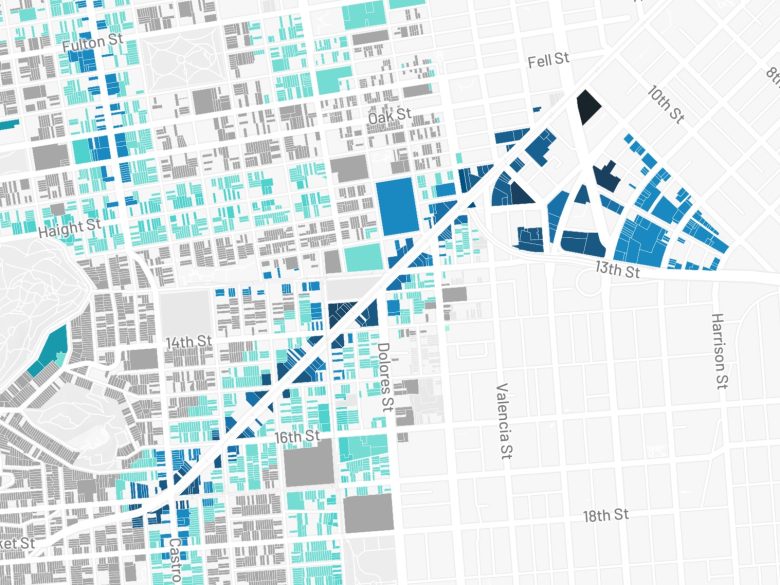

The buildings most likely to be affected by San Francisco’s new upzoning plan are those where apartments and multi-family housing already sit, according to an analysis of the plan by Mission Local. Single-family homes, meanwhile, are likely to see very little change.
The newest, amended version of the plan to make the northern and western parts of the city taller and denser, which was announced by Supervisor Myrna Melgar and Mayor Daniel Lurie on Thursday, would no longer affect some 84,000 units of rent-controlled housing.
Mission Local’s map of that proposal, which will go to the Board of Supervisors Land Use Committee on Monday, showed that 33 percent of multifamily units would see even higher and denser zoning. The category includes apartment buildings with as few as two units, but does not include condos, which are typically privately owned.
The low-lying areas of neighborhoods like West Portal, Forest Hill, the Sunset and the Richmond, meanwhile, are unlikely to see drastic change outside of commercial and transit corridors.
See how the new upzoning plan affects your neighborhood. Switching tabs shows the kinds of parcels affected in the amended plan.
Just 13 percent of single-family homes and condos in the plan would be upzoned. The large majority of those units would remain as-is: They were already allowed to be up to 40 feet tall before, and will remain at 40 feet if the plan passes.
That’s by design: The upzoning plan has focused on increasing heights along commercial streets and transit lines, including Geary Boulevard in the Richmond, Judah Street in the Sunset, and Van Ness Avenue in Nob Hill.
If you don’t live in a single-family home or condo, your building is more likely to be affected, because multifamily residences are located along transit and commercial corridors more frequently. They are more than twice as likely to receive height limit increases in the proposed changes.
That’s true even under the amendment that would exempt any rent-controlled buildings with three or more units, the majority of multifamily housing in the plan.
All buildings, regardless of type, will be subject to “density decontrol,” however. That lets developers build any number of units on a single lot, as long as height limits don’t exceed those in the plan and design standards are followed. Effectively, that means no more exclusively single-family zoning.
And businesses? Since many exist on commercial corridors, 84 percent would be upzoned.
That has some business owners, like the owner of Joe’s Ice Cream on Geary Boulevard, worried.
Sean Kim’s building was bought in 2022 by an architecture company. The firm then met with the Planning Department to discuss potentially redeveloping the site to add housing atop what is currently a single-story commercial building housing the ice cream shop.
Kim fears that his lease won’t be renewed when it expires in three years, forcing him to either relocate or close the business.
“Probably, once we’re displaced, we cannot come back,” Kim said with a sigh.
Relocating is extremely costly. If Kim can find another building that already has the freezers and grills needed for ice cream and burgers, he thinks it would cost between $100,000 and $200,000 to move. If the building doesn’t already have that infrastructure in place, it’s more like $500,000.
Kim and other business owners worry that building owners will have an extra incentive under the new upzoning to let commercial leases expire and then sell their properties for redevelopment. Taller buildings would let developers profit more.
The Planning Department, for its part, said development tends to occur on vacant commercial buildings and lots, not ones with profitable businesses that pay rent.
Planning staff explained that the upzoning focuses on commercial and transit corridors so that new housing is transit-oriented and more environmentally friendly. With housing near transit and businesses, residents can walk, bike, and bus more, and drive less.
That will ultimately help small businesses, staff said. “Locating new housing on or near these corridors means more vibrancy, more foot traffic and more customers for our local small businesses, especially over the long term,” Planning Director Sarah Dennis Phillips wrote in an email to Mission Local.
District 7 Supervisor Melgar, who introduced the rent-control amendment, is also concerned. She introduced the “Small Business Rezoning Construction Relief Fund” to give funding for small businesses displaced and impacted by neighboring construction, though it’s unclear how much the city will be able to afford.
Kim is worried it won’t be enough. A grant of around $10,000, for instance, “doesn’t even help one month,” of relocation, Kim said.
Tenant advocates, meanwhile, are also worried about displacement. Though rent-controlled buildings with three or more units will now be removed from the plan, two-unit buildings, plus non-rent controlled apartment buildings, are still included. Advocates say building owners may displace tenants in order to redevelop their property.
“The stress that it causes is so extraordinary,” said Joseph Smooke, an organizer with the Race and Equity Coalition. “You get this feeling of hopelessness. Your whole life is built around how you commute to work and where you get your groceries.”
The worry about the zoning changes comes after the state weakened cities’ ability to control demolitions in 2019. While the city used to be able to unilaterally decide whether to issue a demolition permit, now a series of objective criteria have to be laid out for developers to meet.
The criteria are written in Supervisor Chyanne Chen’s separate ordinance, and include the building being free of inspection violations and the landlord having no history of tenant harassment or wrongful eviction.
Once demolition permits are acquired, developers must notify tenants about their rights, hire a relocation specialist, pay the difference between the tenant’s old and new rent for 42 months, and, once the new building is complete, offer any low-income tenants a unit in the new building for at least the same rent as before (or a condo at a below market rate price).
The Planning Department emphasizes that demolition of existing housing has been extremely rare. Since 2012, the department said, an average of just 18 units a year have been demolished, 11 of them single-family homes. This is 0.00004 percent of the city’s 420,000 units.
Or, as one market-rate developer put it: “If you’re a developer and you can have two buildings, one is vacant and one you’re going to have a fight with tenants that’s going to drag out for years and cost hundreds of thousands of dollars, which one would you do?”
Methodology
The San Francisco Planning Department provided the latest zoning files, from Sept. 30 2025. We joined this dataset with another one on property assessments from the Assessor Recorder’s office. This allowed us to gather more information about the properties on each parcel affected by the zoning changes. When we joined both datasets, a very small portion of the rows did not match (0.37 percent).
We isolated parcels eligible for rent control by including the following: Buildings built before or during 1979, with more than one unit, from selected class codes (that include apartments, dwellings, flats and exclude condos and TICs).
This does not necessarily mean those parcels are currently tenant occupied; there is limited data on how many buildings have rental units that are rent controlled. For the amended plan, the same parameters apply but for buildings built before 1979 that have at least three units.
To run calculations about change in existing height limit compared to the proposed ones, we excluded parcels that fall under several zoning classifications (representing 0.3 percent of parcels — 310 of 92,744). On the map, these parcels are shaded light gray.
I understand that politically it’s the best we could get under the circumstances, and I understand that it’s light years better than the status quo, but it’s ridiculous to upzone buildings that are literally *on* commercial corridors, but go a third of a block away to where residents could walk to the bus in 30 seconds and suddenly up zoning is off-limits and we have to turn the neighborhood into a museum.
The early drafts of the state bill, which looked at sites within a quarter mile of transit stops, rather than this underwhelming major-street-only compromise measure, were much better ideas.
Message from homeowning, Prop 13 benefiting, boomer left NIMBYs to Gen Z: screw you, we got ours.
Yeah don’t go at Private Equity Corporate Speculators spending overseas cash in the Billions, let’s be mad at seniors who paid off their mortgages?
Jesus millenials.
Uh, no. It’s not their fault you were born later and the economy changed with your diapers, kiddo. You can be upset. Placing blame on them for being around when things were affordable is peak childishness. Grow up.
The blame isn’t for having more favorable circumstances, it’s for pulling the ladder up after them by protesting every attempt at densification
“Denisification” at market rates doesn’t solve the housing crisis. Building low income housing does.
You are ignoring the obvious and being youthfully ignorant. No, generations aren’t making humanity-wide economic decisions, you’re just high on YIMBY propaganda Kool-aid.
A lot of our older neighborhoods ARE museums – they give the city its unique and distinctive character.
Imagine what unique and historic cities around the world would look like if your kind of thinking prevailed. No thanks
Ah yes, block after block of Draeger homes in the avenues are worth putting in the architectural Louvre.
Move to Paris. You don’t own the Sunset.
There is zero reason why the Sunset and Richmond cannot have the same density, upzoning, transit and livability of Brooklyn. None. And Brooklyn is nearly twice the density of SF.
The people opposing this are tired, hypocritical Baby Boomers who will show up to No Kings in Hawaiian shirts and straw hats. Protest about how much they hate Trump, love immigrants, love the LGBTQ community, support science and diversity. Then, they will spend all their free time doing whatever it takes to ensure that the young and diverse are condemned to a future in oppressive, suburban, red states.
Upzone. Upzone as much as possible and give this city the future it was promised in Bicentennial Man and Star Trek!
Brooklyn LOL move there and give it up! They don’t have sand liquefaction zones during earthquakes, for which we are due one. Think harder YIMBY tools.
Classic San Francisco. Even when we “upzone”, we create so many restrictions that very little new housing will be built. Rent controlled buildings with 3 or more units are exempt. So only newer (built 1980 and after) apartment buildings can be redeveloped and the ancient buildings that are way past their useful life need to stay. That makes no sense.
These half measures don’t come close to undoing the downzoning of 1978. I looked in to my modest two story 1950’s single family house. Although it’s zoned for 40 feet, the existing structure violates multiple zoning rules for FAR (floor area ratio), minimum lot size, and rear setback. It’s grandfathered of course, but trying to expand would take years to (maybe) secure variances so of course it just stays as-is. We need more density everywhere in SF, not more of these watered-down half measures.
Pfft, if they empty the apartments they have full control over what to build.
They just don’t want to pay people what their leases are worth.
Your lease isn’t “worth” anything. It’s just a permission from the owner to be there, as long as you pay and abide by that lease.
You don’t understand, that’s on you.
OK, RS, tell me what your lease is “worth”?
This should be good.
Explaining basic sh!t to David is a fool’s errand to educate a fool who doesn’t want to think.
Obviously they can’t build if they can’t kick you out – so if you maintain a valid unimpeachable lease they have to pay you to get you out. It’s so basic, David needs it explained to him
This discussion is about zoning laws. Tennant buyouts are completely irrelevant in this context. The restrictive zoning applies to all rent controlled buildings with three or more unit units. The number of tenants has no relevancy.
In a word, wrong. You can zone all you want but you can’t build without buying out the tenants. They’re pushing this zoning crap plan as if it actually will result in more units – 10 or 15 years down the pipe mind you – but none of that is going to happen until the existing tenants are appeased.
*(I’ll discuss what I like and if you don’t understand that’s on your completely irrelevant understanding.)
‘“The stress that it causes is so extraordinary,” said Joseph Smooke, an organizer with the Race and Equity Coalition.’
Ah, Joe Smooke, another of the nonprofit industrial complexes “made men” who manages to ambulate between nonprofit gig and nonprofit gig, chasing grants and power. [People. Power. Media.] Bernal Heights Neighborhood Center. And now “Race and Equity Coalition.”
Digging down into this is like peeling an onion, complicated and it makes you cry:
Member groups of Race and Equity Coalition:
Richmond District Rising
United to Save the Mission:
Calle 24
Our Mission No Evictions (Roberto Hernandez) *
MEDA
Tenants Union
Housing Rights Committee
American Indian Cultural District
Clarion Alley Mural Project
Culture and Art in SF
Caminante
Media Alliance
Homey
Save Capp Street *
The Gubbio Project (!)
Glide
Young Community Developers (!)
Asian Law Caucus
Affordable Housing Alliance
American Indian Cultural Center
Calle24
Care Association
Cause Justa Just Cause *
Central City SRO Collaborative
Chinese Progressive Association
Coalition on Homelessness
Coleman Advocates
Communities United for Health and Justice
D4ward
Eviction Defense Collaborative
Haight Ashbury Neighborhood Council
Housing Rights Committee
MEDA
Mission Action (Dolores Street Community Services)
People. Power. Media
¡PODER!
Senior and Disability Action
American Indian Cultural and Arts District
San Francisco Anti-Displacement Coalition
San Francisco Community Land Trust (which I co-founded)
SF POWER
Safe House San Francisco
San Francisco Tenants Union
SOMCAN
Small Business Forward
Tenderloin Housing Clinic
Tenderloin Neighborhood Development Coalition
SOMA Pilipinas
West Side Tenants Association
Without Walls International Ministry
Most of these orgs are either city funded or defunct. Does anyone really believe that Race and Equity Coalition is anything but a front group for various cartels of organizations with claims on public tax dollars? Does this group meet? Does it do anything? Or is it a bauble to be hung on a tree to build the illusion of a broad coalition?
How many times can this crowd expect to be taken seriously when they do little but create new combinations and permutations of nonprofits into hollow front groups to create the illusion of broad popular support and political coverage?
Where was the “race and equity coalition” when Mission Housing and MEDA were planning permanent supportive housing adjacent to Marshall Elementary School?
These nonprofiteer “made men” (and women) coordinate and talk behind the scenes. The professional race nonprofiteers knew exactly what was being planned. But they remained silent because it was some of them who were doing a racism.
Why does Mission Local platform these corrupt self dealers who ignore acts of structural racism when calling it out would crimp their members’ bottom lines? Talk about devaluing the currency hard won through collective sacrifice.
“Race and Equity Coalition” is how white supremacy is reproduced in San Francisco. These people are here to suck up to and benefit from racist power, not to challenge it.
Ah Marc S….the OG techie (ie Original Gentrifier) who as bought a condo in the mission early on so gets to now lecture everyone else from his sofa how he is the superior activist and all those making minimum wage at non profit social service jobs as the “sell outs.” Is this shtick ever going to get old, Marc?
And if the nonprofiteers had not severed ties to residents, then unaffiliated residents like me would have opportunities to participate in electoral and policymaking process, putting more points on the board as I’ve done many times and you have not. The nonprofits have led progressives backwards to a position of political irrelevance, and still you talk like this. Here, they are trying to play chicken with upzoning, putting the Mission at further risk of the builder’s remedy because Race and Equity.
Frozen out by the nonprofiteers like most residents, I leverage my experience and knowledge to work at the grassroots with our neighbors to better our immediate community, along with our Marshall Elementary community, families, teachers and administration, all against unaccountable nonprofits who think that the North Mission is their free fire zone and our politics their private property.
Our neighbors and Marshall families applauded me and sat stone faced as MEDA and MHDC lied to them.
The day Ted Gullicksen died is the day that the Tenants Union became irrelevant. Ted did not believe his own bullshit and shifted billions of dollars from the pockets of landlords to tenants. That’ s not happened since he passed away. The SFTU is a pale shadow of its former self.
And to close the loop, here are the Plaza 16 Coalition key members:
Calle 24 Latino Cultural District
Calle 24 Merchants
Causa Justa :: Just Cause
Center for Political Education
Coalition on Homelessness
Coleman Advocates for Youth and Children
Clarion Alley Mural Project
Cultural Action Network
Dolores Street Community Services (Mission Action)
Eviction Free San Francisco
HOMEY
Housing Rights Committee of San Francisco
Jobs with Justice
MEDA (Mission Economic Development Agency)
Mission Neighborhood Centers
Mission Neighborhood Resource Center
National Union of Healthcare Workers (NUHW)
Occupy Forum
Our Mission NO Eviction
San Francisco Latino Democratic Club
The San Francisco Latino Steering Committee
San Francisco Rising
– Chinese Progressive Association
– Coleman Advocates for Children and Youth
– Mission Action
– The Filipino Community Center
– Mujeres Unidas y Activas
– People Organizing to Demand Environmental and Economic Rights (PODER)
– South of Market Community Action Network (SOMCAN)
This is a few dozen people using city money to project the illusion of a broad based popular coalition. Mission Local should throw some data analysis resources at mapping out these interlocking nonprofit coalitions.
What we’ve got here are Leninist style organizing principles, a vanguard cadre, popular front with Stalinist values being used to cement in a cartel that barely begins to manage the ravages of capitalism while allowing power to check a box that it is doing something.
– San Francisco Tenants Union
The state did not weaken the city’s ability to issue demolition permits in 2019. It is never mentioned in these articles but the state passed the Housing Crisis Act of 2019 which prohibited the demolition of rent controlled housing without right-of-return at the same rent in a permanently affordable unit on-site, and paid relocation services during construction. What this article is likely referring to is a 2017 court ruling which established that demolition permits must be issued for legally compliant developments. It wasn’t clear before this ruling whether demolition permits were protected under the Housing Accountability Act of 1982 which stipulated that building permits must be granted for projects that complied with city laws.
Fourplex and sixplexes are already allowed on all single family home lots so it’s not accurate to say that this plan “ends single family zoning”. That already occurred several years ago. What it does propose to do is override the requirement of rent control coverage on those units. It’s also true that projects can exceed 40 feet in those residentially zoned areas if they merge lots greater that 8,000 square feet.
Yeah, SB 9 passed in 2022 eliminating RH-1 zoning. It’s really time for the YIMBYs to give up their silly “legalize housing” t-shirts. What does that even mean?
It means that YIMBY, the shock troops for FIRE, are running circles around the housing advocacy nonprofits.
While you all are getting paid to be distracted by YIMBY rat fucking online, developer lobbyists have been rampaging across Sacramento and through City Hall, rewriting housing law to screw your agenda.
Were this a democracy, then we’d be able to vote out the city funded nonprofits that have been paid to lead us to this point, trying to scare people into giving them more tax dollars.
I mean, shit, Prop 33 from last fall to expand rent control statewide FAILED in San Francisco 57.36%
to 42.64%. You all don’t even connect with San Franciscans on the core of your politics.
It is like you all are being paid to fail.
Lots of resources spent (and counting), but nowhere near the stated goal.
Because they don’t intend to actually meet it, Wiener wants Builder’s “remedy”.
And by watering down the idea, the City is giving Wiener his Builder’s Remedy.
The city plan is a suicide note.
You need to write one rather than comment here.
You’re a would-be mouthpiece of dumb policy.
No, it was never achievable because the City can’t FORCE developers to build ANYTHING.
The entire idea is dumb and you fell for it.
I did not “fall for” anything. This is happening because the people voted in the politicians who said they would do this. Democracy.
Yes, you did fall for it David who doesn’t understand buyouts.
Yeah, west and north side neighborhoods repeatedly voted for Wiener and voted for Lurie when both made no secret of their upzoning housing agenda.
What we’re seeing here is the city funded nonprofits inserting their blood funnel into anything that smells like money.
Thanks for your careful, methodical description of the SF Up zone ordinance now in formative status. I intend to testify as a rent control building tenant with my plea not to apply income criteria to displaced tenants in their return to their previously non income criteria rent control units. I am a volunteer counselor at the Housing Rights Committee…
What we’re seeing here is the nonprofits taking an excursion from their role as colonial administrators of the lower income neighborhoods of color, trying to expand their business prospects.
The corruption here is that our tax dollars go to fund these nonprofits’ that then turn around and use those tax dollars to do lobbying before the government for policies that drum up more business from tax dollars. This serving two roles, shouting over taxpaying residents for policies that benefit their particular self serving interests, is corruption.
There needs to be a local law that if a nonprofit takes city money, then as a condition of receiving that funding that the nonprofit forfeits any right to advocate before the government for policies that would result in more tax dollar funding for them.
Combining advocacy for policies that would lead to more government funding with competing for the contracts and grants that those policies enable is the height of corruption.
Residents alone should advocate for and set policy and nonprofits should be limited to competing for and executing grants and contracts.
Where is the massive infrastructure investment needed to make any of this population increase work out?
Exactly. During the heady times of tech 2.0, say 2018/2019, when SF’s population and commute traffic was sky high, SF rush hour was a total fiasco, a living hell. It is only fair to demand to see the plan for how we will invest in transportation to meet a new, even larger population. Word has it, there is none. Is this the way we want to grow the City?
When the Mission was upzoned, the EIR indicated that new residents would delay and overcrowd 7 Muni lines.
Supervisors passed Eastern Neighborhood without concern for that.
Why should the western and northern neighborhoods get consideration and investment that the Mission never got?
Speaking from a west side Sunset District perspective. The new 8 story commercial corridors plan is way too much. It will destroy vital street parking for small businesses and residents as well as bring other negative impacts to the quality of life. The Mayor snd SF Planning should get better advice when looking at the west side. It is so wrong (that it is actually embarrassing) to imply west side residents will all give up their cars, flock to ride muni or cycle to their jobs. Major upzoning should be relegated to Muni/Bart underground station areas with expansion plans for more train service. This plan needs to back to the drawing board, big time.
A whole 8 story building on a commercial corridor in San Francisco? Grab the smelling salts!
Displacing a 4 story existing building at existing rent prices and raising it to 5-10 years from now market rates?
Smell an original thought!
Please show me where neighborhood serving ground floor retail has been displaced in the Eastern Neighborhoods plan, specifically the Mission Area Plan?
It’s all being rushed and forced by Scott Wiener, as if it actually *does* anything about the housing crisis – it doesn’t, and further it will take 10-15 years to even get halfway if they started today. It’s going to remove housing at low rents to ‘someday’ have it available at 3x prices for less space. They know it’s gentrification. They sell it as “everyone deserves housing” but if you read the fine print, that’s only for people who make like 150k a year and over. There’s no limit to their greed. They want to be able to skip CEQA and local input entirely. We need to fire these liars like we fired Engardio.
Can’t help but chuckle with the knowledge that back in 2015, Scott Weiner didn’t care about “supply” as he sided with Airbnb. Those 10,000 units listed illegally on their website somehow didn’t concern him as a loss of housing stock.
YIMBYism is the same ol’ story – kissing up to Big Real Estate – that this town has always suffered with. The kiddos pushing it think they are so original and righteous – but the goals here are the same as they’ve always been. Pushing prices higher and taking donations from the eviction machine.
You’re basically telling the story here of failed housing activism in San Francisco without mentioning your own role.
Hundreds of thousands of tenants are basically a captive audience for paid organizing, but the tenants UNION can’t be bothered to build and organize membership.
One “made man,” when I suggested to him that we organize affordable housing residents around 16th and Mission-Folsom said that was a bad idea because affordable housing residents weren’t “progressive” enough.
We see where you all stand.
Property owners did not want to Airbnb their units. I certainly did not.
But rent control makes it inevitable that owners will turn to shorter-term rentals. That pesky law of unintended consequences again.
RS: “Nobody cares what you personally want, nor do you understand law.”
I think I’ve found one of the main reasons for progressive housing collapse: If advocates don’t understand what animates their opponents or want to understand, then they can never figure out how to beat them.
Nobody cares what you personally want, nor do you understand law.