

Jake Lindsay-Ceniceros has a knack for surfacing the unusual at SCRAP, the Ruth Asawa-founded Bayview nonprofit where he works to help upcycle arts and crafts materials.
There was the time a messy breakup led to a disgruntled lover offloading her ex-partner’s prosthetic leg to the donation-based warehouse (they got it back with some identifying information). Or the time the corpse of a cat came buried in a bag of broken china.
Lindsay-Ceniceros’ favorite finds are not bizarre, but historical.
“It’s the cherry on the sundae when historical artifacts or time capsules come in,” he said. “It feels like breathing the same air as someone lost in our pasts.”
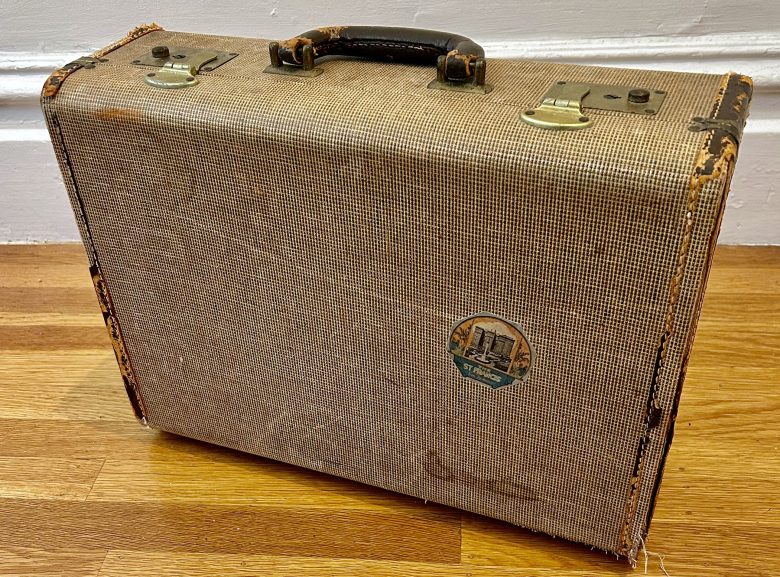
He could tell from the heft of a recent suitcase donation — and the pristine condition of the vintage photographs of athletes and artists within it — that it was something special.
It arrived in August, at a time when the warehouse was processing more than a thousand pounds of material every day for two weeks. He flagged it for his colleague Lisa Ryan, who has made research her specialty.
The small suitcase was crammed with photographs of jazz musicians, nightclubs, boxers, and basketball games as well as rare newspapers and magazines. Many of the photographs were autographed and inscribed. Ryan examined the contents, and could tell immediately they all belonged to one person.
“I was amazed and sad, because we don’t know who brought it,” she said. “Why aren’t there family members who would want this stuff?”
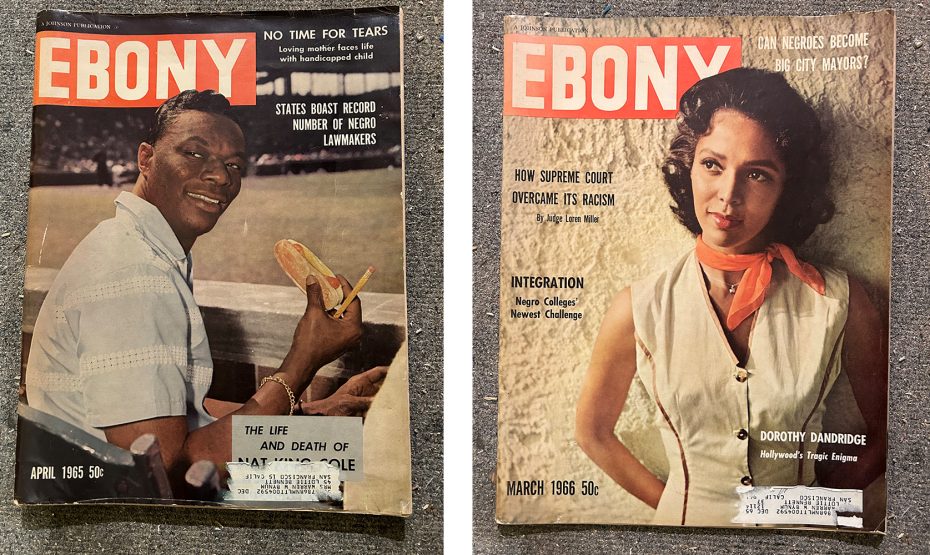
There were photographs of Duke Ellington and of musicians who played with Duke Ellington, many of them signed. “It was ‘To Duke, from Duke’,” she said. “It finally dawned on me that this person was named Duke.”
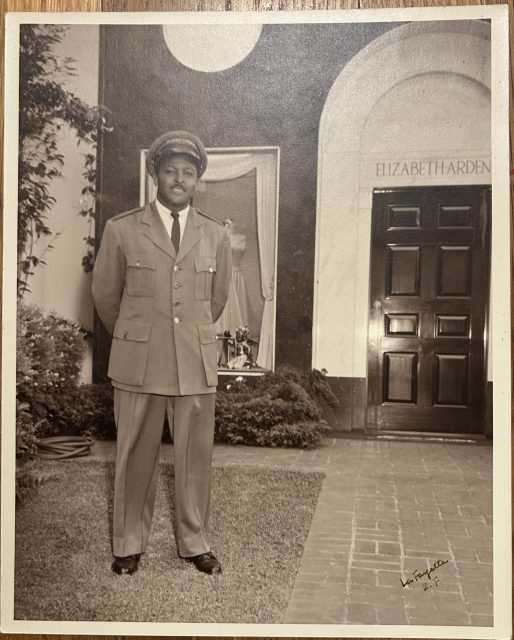
Ryan went online to research the suitcase owner, Warren “Duke” Bynum, who moved to San Francisco from Chicago and held many different jobs over the years, including being a doorman at Elizabeth Arden.
She also found information about his widow, Jimmye Bynum, who lived in an apartment community in San Francisco’s Fillmore District and was friends with Maya Angelou.
Ryan’s next step was to contact William Rhodes, the intergenerational program director at the Dr. George W. Davis Senior Center.
Since the suitcase’s impressive contents documented the Fillmore during its “Harlem of the West” days, when the neighborhood roared with jazz clubs, Black-owned businesses and barbershops, she passed it along to him.
Her decision would lead to a surprising revelation.
Serendipity sings
AfroSolo Theatre Company founder Thomas Robert Simpson uses prompts to inspire students at his weekly writing class at the Dr. George W. Davis Senior Center.
Learning from Rhodes about the suitcase discovery gave him the perfect entry point. Rhodes lent Simpson the suitcase so his students could examine the contents and write about their reactions for 15 minutes. The results were incredible, Simpson said.
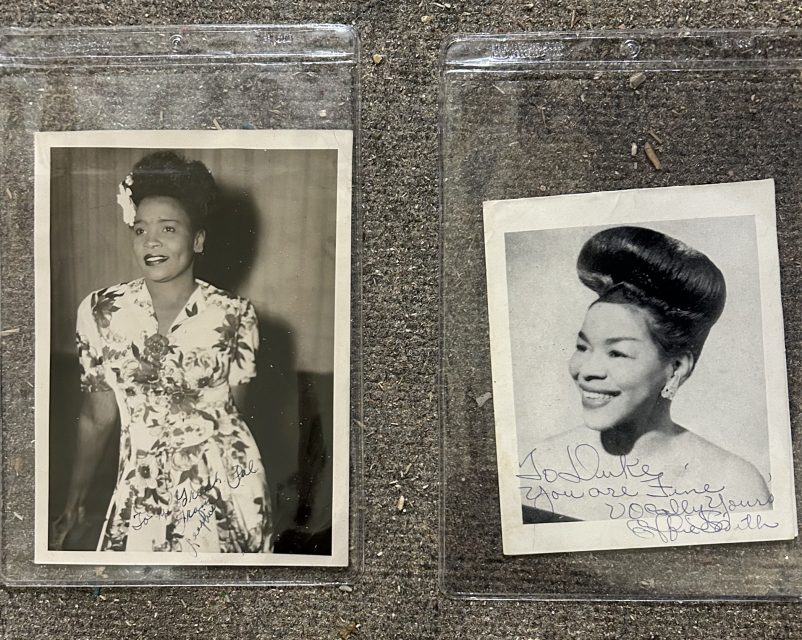
“I was astounded by how connected they all were,” he said.
One of the students, Darlene Roberts, the founder of Fillmore Jazz Ambassadors, recognized musicians like Fats Waller, Lionel Hampton and Earl “Fatha” Hines from the photographs.
“I met him before he died in Oakland,” she said of Hines. “He was a master on the piano.”
A photograph of jazz trumpeter Cootie Williams also hit her hard, reminding her of the loss of the Fillmore. “He had talent galore,” she said, “before gentrification shut us down.”
Possibly the most uncanny connection was made when Camisha Fatimah Gentry realized that the suitcase’s contents belonged to the husband of her onetime neighbor — the widow that Ryan had wanted to contact.
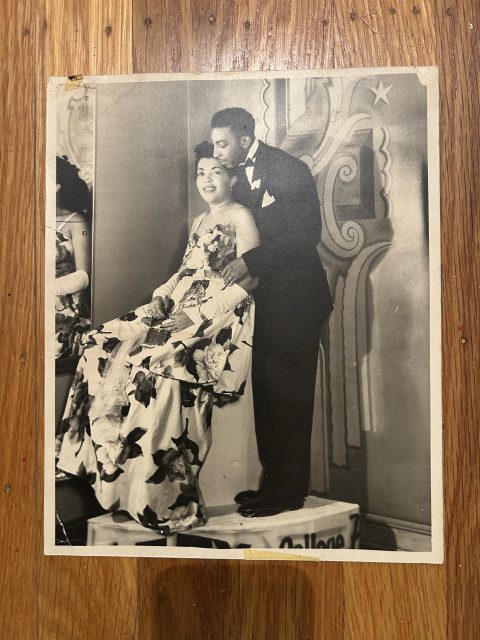
“This woman was just representing grace and space all day, all the time,” she said of Jimmye Bynum, “Duke” Bynum’s widow, who was an elder when Genty was a young girl growing up in a housing co-op.
She had a distinctive, raspy voice and wasn’t afraid to tell you when you were doing something wrong, Genty said. “She always had this way of being that epitomized the definition of the word grace, even in her sternness,” she said.
Genty, who is a restorative justice practitioner, believes the serendipity of encountering her former neighbor’s belongings speaks to a larger truth.
“It reminded me of alignment,” she said. “There’s so much that’s overwhelming, so many emotions, so much chaos,” she said. “But there’s calm within the chaos. People are organizing and connecting in ways that they have never done before.”
Genty said she learned Jimmye Bynum died a few years ago, and she is confident that a family member would not have given away such “royal” pictures. She suspects whoever cleaned out her apartment did so.
For SCRAP employees like Lindsay-Ceniceros and Ryan, chaos might mean taking in thousands of pounds of cast off materials and making sense of them, turning refuse into something usable.
That Ryan was able to recognize the value of Bynum’s suitcase at a time of such heavy intake feels like its own small miracle. Perhaps it is poetic justice for such a treasure to be plucked from a trash heap before it is lost forever, especially when a community has already lost so much.
For Simpson, the experience of sifting through the suitcase’s contents was an emotional one. Seeing the photographs made that era concrete, he said, while there was also some sadness, because it is gone.
It was more cohesive back then,” Simpson said. “The Black community seems to be floating around now, trying to find ourselves.”
Roberts, Genty and others are connecting to each other and their sense of identity because of the space Simpson has provided. The class serves Simpson as well and has become a beloved ritual he looks forward to. “Every week there’s a renewal in me,” he said.
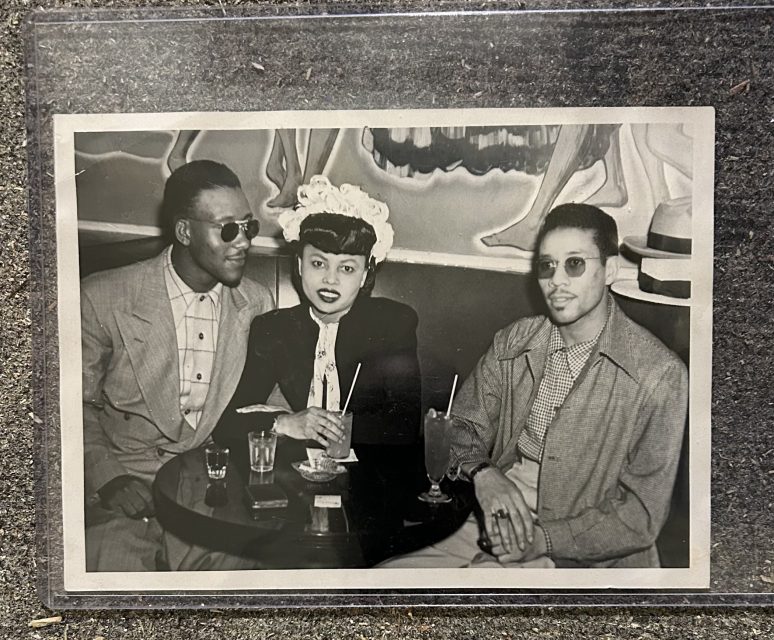
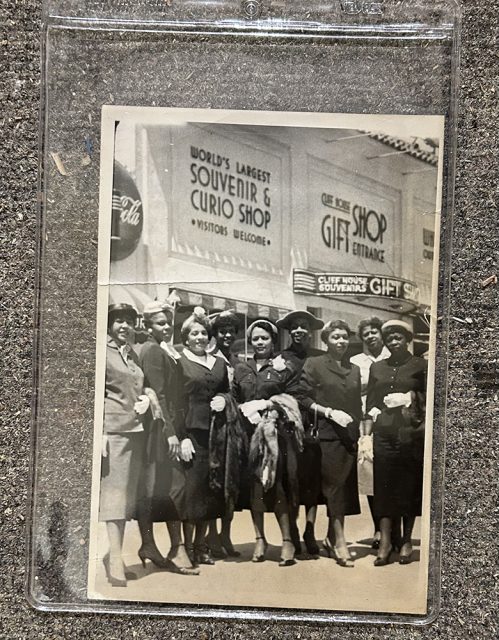
Below are some photographs of unidentified individuals.
This is an amazing story. Really touching. Thank you for this piece.
This is such a cool piece! Love when Mission Loc writes about stuff like this
What a fun story. We love SCRAP!
Warren “Duke” and Jimmye Bynum were our wonderful neighbors at St. Francis Square Co-op in the Fillmore (Laguna to Webster/Geary to Ellis streets). So glad that Duke’s suitcase was discovered and the treasures honored. Big Thank You to SCRAP employees.
Some of these might be a great addition to the San Francisco African American Historical & Cultural Society, which is located in the African American Arts & Culture Complex on Fulton.
I hope somebody will please give this material to local library or archive.
The Harlem of the West, killed by “urban renewal,” aka the YIMBYs of the mid-century. Don’t let it happen again.
Very cool.
A friend of mine used to run estate sales in Chicago and his collection of stuff is insane, including amazing photographs. He has a black and white series of some mid-20th century outdoorsman at a deer camp standing next to at least a half dozen hanging bucks; another photo the guy has a canoe paddle he is holding out from the canoe about a foot above the water and there is a freaking beaver perched on the end; and yet another he’s in a small boat holding a black bear cub he had snatched out of a lake by the scruff on the back of its neck. I told my friend ‘this dude is a fucking Northwoods legend’, but in my head I was thinking it was just wrong that my friend had these once-upon-a-time coveted photos.
This article doesn’t say if Duke had kids or grandkids, but if he does then the photos should be handed over.
So much history surrounds us in every physical object. Great story to inspire us to shop less, pause more, and learn so much.
Great find and article!
The history found in the treasures donated to SCRAP is priceless. Jake intuitively knew the value of this item.It wasn’t monetary,it was memories,community,history.