
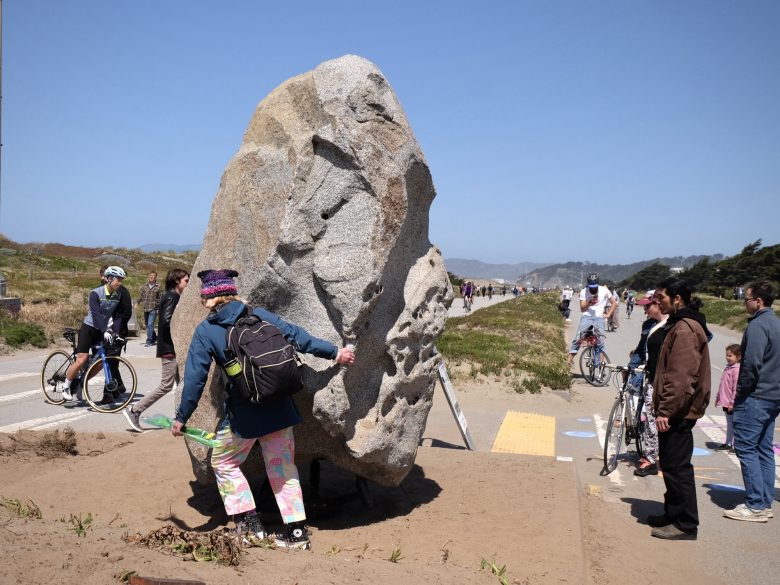

Over the summer, Larry Mazzola, Jr. read a series of news stories about a skate park going in at Sunset Dunes.
These stories were fun, but Mazzola wasn’t entertained. He serves on the Recreation and Park Commission, but the installation of a bitchin’ oceanfront skate park was news to him.
“I have to read in the paper that there’s a new skate park?” he asked Recreation and Parks Department general manager Phil Ginsburg at the July 17 commission meeting. “We should know these things.”
Mazzola asked the general manager for a full accounting of the funding for the buildup of Sunset Dunes. Ginsburg agreed.
He assured Mazzola that much of the money “did come from philanthropy and the private sector.” He emphasized volunteer assistance and partnerships. “I’ll compile all of that for you, commissioner. I don’t think you’re going to see some huge influx of dollars.”
Prior to the Sept. 18 commission meeting, Mazzola was presented with a one-pager, which Mission Local subsequently obtained from Rec and Parks.
The department’s document reveals that, in fact, more than 80 percent of the money expended at Sunset Dunes has been public, not private, as Ginsburg intimated.
Of note, the money going into Sunset Dunes is bond money: Some $700,000 from Prop. A of 2020 — the $487.5 million Health and Homelessness, Parks and Streets Bond — has been directed here.
“You told me there would be nothing substantial,” Mazzola told Ginsburg at this month’s commission meeting. “On the list was a $700,000 expenditure from a 2020 bond. Is that not substantial to you?”
Ginsburg’s answer was a fascinating and honest one, but also about as close in real life as you’ll get to the “It’s one banana, Michael. How much could it cost? Ten dollars?” bit from “Arrested Development.”
“In the context of parks, which cost in the tens and tens of millions of dollars, it was a minor investment,” he said. “It’s fair to say, given all the acreage we’re asked to steward out there, it is a relatively minor investment.”
It probably wouldn’t change Ginsburg’s point, but do recall that this is bond money. In 2020, 70.6 percent of us voted for this bond, duly noting the language in the voter pamphlet reminding us that repaying the $487.5 million will require $960 million. So, that $700,000 is actually more like $1.38 million.
Yes, San Francisco is a city with a big budget, and stuff costs a lot, though it does seem odd to go into bonded debt to pay for a skate park. But it’s one skate park, Larry. How much could it cost?
At the Sept. 18 commission meeting, both Ginsburg and one of his Rec and Parks staffers described the $700,000 in Sunset Dunes bond money as “environmental sustainability” funding.
The report on this 2020 bond notes that such projects could include “climate adaptation work along Ocean Beach … landscaping with native plants; acquisition, improvement, or expansion of urban agriculture sites … .”
The money spent out of this fund thus far on Sunset Dunes, however, is described by Rec and Parks as “seating, bike racks, surface improvements, bollards, a nature exploration area, and gate improvements. … Fitness Station, Hammocks and Skate Space.”
Hammocks? My goodness, what an idea. “Replacement hammocks,” incidentally, will be covered by the $170,000 in private funds thus far allocated to Sunset Dunes.
It seems a stretch, semantic and otherwise, to characterize much of the Sunset Dunes work coming out of the “environmental sustainability” bucket as being particularly related to environmental sustainability.
When queried how hammocks or skate parks met this definition, the department corrected itself and stated that, actually, the category isn’t called “Environmental Sustainability.” It’s just “Sustainability.”
“Its purpose is broader than environmental projects alone. It includes resilience and other elements that help San Francisco recover and adapt,” wrote the department. “Adding a new park like Sunset Dunes helps the city be more sustainable and resilient.”
What isn’t sustainable by this measure? You could put in a park at Sunset Dunes or a park on the top of Top of the Mark — on a lark! You could pay for a skate park or a waterfront discotheque or the world’s longest urinal trough. How can San Francisco call itself sustainable and resilient without one of those?
There is, however, one Sunset Dunes expenditure that easily meets the definition of “Environmental Sustainability.”
The city “transported and planted native dune grass” on a two-acre plot here. This was accomplished by enlisting a bevy of volunteers and $10,000 worth of seeds, nutrients, soil and whatnot from private donations.
Then the city spent $213,000 out of Prop. A bond money on signage and fencing to protect the native dune grass.
This was 8,100-odd feet of state-mandated fencing along the entirety of the Great Highway: At less than $26 per foot, this is not an exorbitant price, even on the private market. So, points to the city for that.
It is notable, however, that more than 21 times the money was spent on fencing and signage than on the proactive “environmental sustainability” portion of the work.
And, remember, this is bond money, so that $213,000 is more like $419,000. But it’s just one fence, Larry. How much could it cost?
Last week, Phil Ginsburg announced he’ll leave city employment by year’s end and take a position atop the Resources Legacy Fund, directing scores of millions of dollars toward worthy endeavors.
He leaves an intriguing legacy. Sixteen years ago, Recreation and Parks was a laughingstock among city departments. Ginsburg’s immediate predecessor had his elbow on the pulse of Rec and Parks, management-wise and, additionally, cost the city $91,000 in a humiliating settlement after sexually and religiously harassing his spokeswoman — in writing.
That’s the past. Ginsburg has turned the department around. By harnessing the power of public-private partnerships, he established lovely new parks and open spaces. But not without a cost that transcends the monetary.
The privatization of public spaces could be a cause of the San Francisco condition, or it could be a symptom. But it’s definitely a thing and, under Ginsburg, it accelerated.
Private dollars being leveraged to build new parks is great. But those private dollars are directed where donors want. Sometimes that’s an underserved part of town. But, not infrequently, we’re talking about neighborhoods that already have their fair share of resources.
So, Ginsburg shrugging off $700,000 in city money as a pittance hits differently among people asking his department for parks and open spaces in parts of the city without much in the way of either. These are people who have, continually, been told there is no money for them.
“I don’t want to pit neighborhood vs. neighborhood. But their investment in parks has not been equitable,” said Chris Schulman, the executive director of the Lower Polk Community Benefit District. “There is a lack of communication, a lack of follow-up and a lack of commitment by Rec and Parks to invest in the Tenderloin.”
Jane Weil has been pushing for more open space in SoMa and the Tenderloin for nearly 20 years. A park planned for 11th and Natoma streets, in the works since 2012, was recently shelved; of 30 active Rec and Parks projects, this was the only one placed on hiatus.
“Whenever a great opportunity comes up, District 6 gets shafted,” she said. “When money gets short and they have to decide what to use it for, all the things we promised get pushed to the bottom. Again and again and again.”
Voters in 2020 were in a different mindset than the present, and some of the arguments used to push Prop. A spoke of the need for places for city residents to get outside and socially distance.
Nobody talks like that anymore, but a lack of open space continues to be a problem for swaths of the city, including the Tenderloin — a neighborhood with many seniors, and the highest concentration of children in San Francisco.
I take my kids to Sunset Dunes; it’s a relief to not have to worry about cars running them over. But, whatever your thoughts about this park, it was hardly an equitable act to place a vast, city-funded open space here.
Sunset Dunes is a park next to a park next to a beach next to a park. The far west of San Francisco is not lacking for open space, though it apparently was lacking for open space with skate parks and hammocks paid for with sustainability bond money. Well, not anymore.
“There weren’t any other parks that have been waiting for funding to be upgraded and fixed?” Mazzola asked Ginsburg at this month’s commission meeting. “I’m just trying to figure out what our priorities are.”
“This park met the criteria for that investment,” Ginsburg replied.
“Who made the decision?” asked Mazzola.
“The department,” answered Ginsburg.
“Meaning you?” countered Mazzola.
Ginsburg replied, “Ultimately, yes.”
Skateparks are are great, shady backdoor dealings to appropriate funds are not.
Ginsburg needs investigated and locked up. He is so blase about fraud.
Further proof that green and public resources in D6 and D10 are consistently underfunded. That ain’t right.
Are landlords going to install parks on rooftops? I dont think so. The retrofitting every building would have to go through to meet ADA standards for those parks to be accessible would bankrupt the county. The county should have thought about that instead of building more housing when it wasn’t as dense as it is now.
Totally agree…shortsightedness all around…and it continues with Scott Wiener’s lousy housing demands and Mayor Lurie’s lousy upzoning plan, all of which have no accountability for affordability. What shams!
You mean Lurie, who D4 and the west side voted for and Scott Wiener, who D4 and the west side voted for ran for office on wanting to build more housing?
D4 is the acid addled meth addict of SF politics–Leland Yee, Ed Jew and Joel Engardio. We should give everything political that arises from D4 the widest berths, for our own safety and sanity, until they can put their political houses in order.
The historical record has shown that fighting Ocean Beach and its elements is a costly battle. Untold sums have already been spent in protecting the road from the surf, clearing the sand, and replenishing the eroded beach at the south. The place is rugged, and most unfriendly to those that favor a built environment.
That stands for any built environment. Never turn your back on the ocean.
Never turn your back on YIMBY Billionaire funding…
OB’s ruggedness is it’s charm. In my fifty years I’ve not met more than a few people who don’t love that about Ocean Beach. I hope it remains as rugged as possible at least we have Funston and we can cut through soon to be urbanized Park Merced.
Yes – the raw, untamed natural forces of the beach are why it is so beautiful. At the same time, those forces will create a major fiscal burden for Rec and Park. Keeping the road clear of sand will be a money pit in itself, the more structures they put out there like the skateboard park, hammocks, art work etc, the higher the maintenance costs. Ginsburg and Co. have no idea what they have signed up for.
They signed US up for it. They’re GONE.
Our money to pay for THEIR lies.
NONE of that cost went away, they still sweep the roadway, they still have to maintain the sewer pipelines under the GH all the way to the pumping station.
The Ocean has not moved but an inch over decades. It’s a false premise. EVENTUALLY yes it will be a problem.
I’m not sure I follow the logic of this piece. Are we mad about public money being spent on a public park? Or are we mad about other private money not being spent in certain places? I agree the Tenderloin deserves better but things like the Golden Gate Greenway have been stymied by SFFD, not lack of funding. Meanwhile RPD has been spending way more than $700k on brand new parks in other underserved places like India Basin and Treasure Island. I’m sure there’s lots to be written about RPD spending under Phil (hello, Illuminate), but it’s hard not to think this is only getting noticed because writing about Sunset Dunes draws angry moths to the flame.
Ginsburg putting his finger on the scale is hardly news at this point.
“I don’t want to pit neighborhood vs. neighborhood”
That ship has sailed. San Francisco politics is magnetized by an 8-3 Board of Supervisors split where the east side is held as a colony, generating the lion’s share of tax revenues from biz and luxe condos while being made to take all of the City’s undesirables as our tax surpluses are directed to the other 8 districts.
Even a conservative Democrat like Dorsey can’t turn the tide to keep the 11th and Natoma park from being shelved while Ginsburg was throwing more money at politically favored Sunset Dunes and in league with the cavalcade of corruption known as the San Francisco Parks Alliance.
If you manage to get elected or appointed and have no invite to the party, then you are subject to infinite accountability get whacked, legally or in the press.
If you are invited in, then you enjoy all consideration, and are allowed to loot until that becomes untenable, and end up getting swaddled through the revolving door into the nonprofit sector.
Great reporting, admitting it’s to my disliking as much as it is to my liking: The latter giving me the lowly opportunity to put my told-you-so hat on. Closing UGH comes at the expense of other parks. For those living on the east side of town, this is coming out of your favorite neighborhood park, for years to come. You’re a (fill in yourself) if you voted Yes on Prop K.
I visit Sunset Dunes from the east side of town and I love it! Plus, this $700k is only one-sixth of the $4.3 million it would have cost to replace the failing traffic signals if the highway had stayed. That savings can go to streets projects in the rest of the city. Like 17th & Folsom that finally got a walk signal and is now much safer to cross.
To be fair, I do wonder how much money CCSF was spending on keeping the highway drive-able. Has anyone looked at that? We could be saving some money on not having to shovel sand back and forth.
They still sweep it for sand if not even more than before. No, these liars pretending it saved money spent $50 million tearing out the existing traffic lights that, unlike most lights in the City, were actually timed correctly.
Keeping the road drivable was cheaper than closing it as a makeshift “park”. Just keeping the road ADA compliant will cost the city more due to sand learing every week instead ever so often when cars could drive it.
no it wasn’t, not it is not.
Yeah, it definitely is and will be again.
The cost of sand removal by DPW is paid for by SFPUC rate payers. And it should stop
That’s already a known quantity; the City will save some coin by not having to have the contractor come out remove sand from the roadway on a short turnaround. That said, overall there isn’t less sand to move around, so the savings are small. Probably offset by the cost of having to carefully clear the new fencing on the dunes they put in place.
THEY STILL DO THAT.
As the line from Animal House says, “You fucked up, you trusted us”! All those Law and Order obsessed residents who voted for the developer’s shill, Engardio will soon find out that the gridlocks and traffic jams resulting from the closure of the GH is the least bit of their problems. Wait till they see those luxury towers with unobstructed views of the Pacific going up along the Sunset Dunes Park. I’m sure the inhabitants of those luxury condos will be pleased with those hammocks!
Yep, the west side is fixing to enjoy the same zoning that the west side and the rest of the city imposed on the east side because the west side voted for upzoners Lurie, Wiener and Engardio.
You break it, you bought it.
Lurie before the election was (allegedly) on the fence. Engardio was always a sellout from day 1, a Breed Lieutenant. I don’t think it’s exactly fair to compare their records at this point lest of all equate them. Lurie for his part got saddled with Wiener’s disaster which predated him, not the other way around.
This article is why too nitpicky. Spending money on Sunset dunes, for signage and regular park infrastructure is a valid use of the sustainability line item. Especially for things like fencing and signage that is designed to protect the dunes. Like serious sour grapes here that you have to couch is actually in line with market rate pricing. What’s the complaint? Sustainability dollars,used to protect sustainable dune is a 6 digit number and makes me scared?
Shutting down the road is itself an inherently environmentally sustainable thing that will help improve not only the local environment but also our general budget. Nitpicking less than .5% of a bond 5% of the overall budget line item really feels like missing the forest for the trees here. Shockingly bad opinion from my favorite news outlet.
“signage and regular park infrastructure is a valid use of the sustainability line item”
Oh hell no it isn’t, that’s defending a fraud with mumbo jumbo and redefining terms.
Everything you just said is 100% provably false.
Not really. Cars driving at the speed limit on UGH is much, much more environmentally sustainable than those same cars having to drive at stop&go city driving (information on which is available on MSRP Car “sticker price” Pricing and Fuel Mileage, so not my made up idea, in case you didn’t know). Was there was an allocation for (electric) shuttle bus service, enough to displace each and every car now currently terrifying pedestrians in The Sunset that I did not hear or read about? And it’s not a “six digit” number, it’s actually a SEVEN digit number when you do the actual math, the number required to pay back those bonds, so closer to 1% but 1+1=2, 2+2=4 and that adds up when you take a non-chalant stance on budgetary stances.
The potential positive environmental impact of marginal shifts in driving behavior is entirely negligible compared to the massive negative environmental impact of inducing people to drive more in the first place by making driving easier and more convenient.
It’s a bit like the idea of reducing the negative health effects of smoking by making cigarettes that feel less harsh on the lungs… any teeny-tiny marginal health improvement on a per-cigarette basis is more than cancelled out if it helps people feel comfortable enough to smoke more of them, and in the meantime, giving any quarter to the idea of “healthy cigarettes” would only play into the hands of Big Tobacco’s overall misinformation war against the science of tobacco-related health hazards.
Wanted to go see the Rocky Horror Picture Show at the Balboa, an amazing theatre in the Richmond.
Taking Muni from 16th and Mission to the Balboa would involve 50+ min in each direction with a transfer. There is not much else out on Balboa in the 30s, so to get anywhere interesting to do something else on the west side, Clement Street, Japantown or Inner Sunset would take another half hour by transit.
I don’t own a car that runs, so I’m not going to see a film that it would take twice the run time on transit to get to. But this is why those who do drive resist urbanist diktats–Muni is not a competitive alternative for most people.
In contrast, I am going to see “Jeffrey Epstein: Bad Pedophile,” “The Onion”‘s first feature film. It is showing at The New Parkway in Oakland. The BART trip from 16th/Mission plus the walk from the station to the theatre takes 30 min.
Not a wrong-headed piece at all. Shutting down UGH is NOT an “environmentally sustainable” thing. Vehicles driving at a constant speed highway v (the traffic lights on the UGH are some of the only well timed lights in The City) use much less fuel thus producing much less GH warming gasses than those driving at city driving speed. Thbudget amount set aside for electric shuttle buses to replace those cars now driving at speeds higher than those posted through the sunset and running stop signs (factually, the sfpd is not that Keen on traffic enforcement) and on Sunset boulevard, which has a much much higher rate of pedestrians being killed, one injury on the upper Great highway versus 11 on Sunset boulevard (throughout 2014 to 2024) , the proposed alternative.
EVERY LAST ONE. I will fact check them to the very end.
Exactly, the proponents are shameless liars.
The most obviously corrupt thing here is the small group of mostly wealthy landowners demanding San Francisco taxpayers pay millions of dollars to maintain a road to nowhere, that is falling into the ocean, is hardly used, doesn’t meaningfully change commute times, impeded access to the beach on city parkland, and prevented the city from maintaining the dunes that protect the Sunset from sea level rise. The city would have to raise taxes to pay the millions of dollars to maintain a road and that gets more expensive to maintain every year as the sea rises and it falls into the ocean.
Tourists are coming to visit the park and are spending money in the city. Businesses near the park are making more money and generating tax dollars for the city. San Franciscans are enjoying the park. This small group of wealthy landowners thinks that none of that matters. They think we should raise taxes for everyone in the city and spend millions of dollars for a road on city parkland despite a large majority of San Franciscans voting for it to be a park. Highways are not compatible with parks. Why does this small group want to corrupt democracy and raise taxes on the city? Why would San Francisco waste millions on infrastructure that is washing away and is not needed. The city has voted multiple times to stop paying the millions this group wants to maintain this road on city parkland. It’s time for these mostly wealthy landowners to be called out for corrupting democracy and irrationally asking for tax dollars and denying the reality of sea level rise and the coastal environment. Wasting tax dollars on this road to nowhere that is partly falling into the ocean and built on city parkland would be the real corrupt use of everyone’s taxes.
I salute this article but I’m amazed that the Mission Local has not delved into the corruption allegations of the Park’s Alliance and Ginsberg further. I can’t believe that the feds haven’t gotten on board. Everyone knows Ginsberg has friends in high places but it’s really becoming obvious. Thanks Joe
The most hilarious part of the prop K. “controversy” is that the Great Highway was slated to be closed for cars regardless as to the outcome. But hey, why bother reading about what you’re *actually* voting on?
Actually, that is inaccurate – you are confusing two different parts of the road. The section of the road covered by Prop K was designated to remain open as part of the Ocean Beach Master Plan. As you have noted the hilarity that accomanies a premium on reading, just go read it.
*actually* that’s not true. The UGH was never slated for closure. The southern extension from Sloat to 35 was, but only because they had yet to secure funding to shore it up which they STILL HAVE TO DO because of the pumping station, Lake Merced, the National Guard station, the Zoo, etc.
Pretending it was going to be taken by waves imminently is a lie.
You fell for it.
Do you know how to *actually* read bro?
As a bicyclist for both transportation and recreation (I haven’t owned a car since 1987), I liked riding up and down the old pre-park Great Highway. It was especially fun when southbound GH was closed due to sand spilling on to the right side of the lane. (If I caught a tailwind it was almost like flying.)
So for me it was and is a case of “if it ain’t broke, don’t fix it.” This was true even when it wasn’t closed to cars. Too bad, then, that it’s been “improved”…
I live in the Tenderloin and I’m a big fan of Mission Local and this is the first wrong-headed piece I’ve read here. It’s the Recreation and Park Department. Supporting and providing for inexpensive
recreation like skateboarding is exactly what it should be doing.
Skateboarders are often young people who can only afford minimally expensive sports and recreation. I’m sure them and their families are grateful for the new skate park where the only cost might be public transportation to and from.
Andy —
Thank you for reading and thank you for the positive and thoughtful comment.
The issue here isn’t skate parks being good or bad. I think skate parks are great. The issue is the funding mechanism. Surely there is a means of financing a skate park that doesn’t require going into bonded debt and paying twice the cost. And surely it can be done without claiming this is a “sustainability” measure.
These are the sorts of shenanigans that keep people from voting for the general obligation bonds the City needs.
Best,
Joe
Please ‘bot enlighten all of us about how it is a good idea to skateboard on wet, slick, sandy concrete. The funds should have been used for a real skate park in the main part of the city that gets more sun and less wind, not for foggy dangerous garbage that weaponizes people to accomplish special interest group purposes.
NOBODY EVEN USES IT. It’s such a joke.
This is why People should stop voting for bonds that are slush funds and not for specified purposes. Diversion of funding from existing parks across the City should be cause for the entire City to revote to reopen the Great Highway.
If only this City operated on basic common sense instead of Billionaire SuperPAC money, we’d have solved like 90% of this stuff already.
But we don’t. They use these issues against us to dilute and fracture us.
I can certainly see the “sustainability” logic of wanting to nip pro-car rejectionism in the bud by making Sunset Dunes’ amenities a concrete reality (figuratively and literally) as quickly as possible: in essence, you’re running cover for the potential larger-scale sustainable land-use improvements that wouldn’t be feasible if there was any possibility of the park being reverted back to a part-time car thoroughfare.
That said, as much as it may be a good thing for the overall cause of sustainability, it’s also fair to point out that political maneuvering against “Make the Highway Great Again” zealots would probably stretch the scope of this specific sustainability-related bond funding.
Joe,
The 29th was supposed to be the hearing on the legality of prop K – why no mention of the lawsuit?
Our neighbors in Daly City, Pacifica and Marin got no say, that’s unfair.
In a city prone to natural disasters, this was a dangerous decision, it’s a major egress path.
did we get a say in the development of daly city, pacifica, or marin?
You don’t get a say here either. You give up your power to YIMBY tools of Dark Money.
[sigh] the southward link to Daly City and Pacifica was already slated for non-negotiable closure due to coastal erosion, regardless of anything that happened to the stretch between Lincoln and Sloat.
So no, it wasn’t “a major egress path” for residents of neighboring cities. Even if that’s ever what it used to be, all it actually would’ve been going forward was a minor out-of-the-way intracity express lane impeding public access to the city’s largest beach.
It’s basically the same brouhaha as when the Embarcadero Freeway was damaged beyond repair in the ’89 quake: rather than stubbornly try to keep performing CPR on the freeway’s rotting corpse, the city made the logical decision to put the waterfront land to better use, and within a few years barely anybody could even remember that something as dystopian as an elevated double-decker freeway along the Embarcadero had ever existed at all.
In a word, wrong. They are continuing to maintain the GHS road even if it’s closed to the public because there are major pipelines in use directly beneath the roadway. If anything they will spend more money in the future, not less, as a result of the closure that was decades away even in the worst case sea rise outcome, which is not at all guaranteed to occur at any rate. It’s a pack of lies.
Using the legal loophole of skipping CEQA because Scott Wiener and other known prevaricators says it’s legal, skipping all oversight and planning such as what you’re describing, that’s highly suspect in terms of your defense of a non-realistic decision made from a tiny group of Billionaire-funded sources. These decisions need to be made by engineers, or you’re just celebrating the repeat of mistakes and missteps that waste millions and make life harder for everyone involved.
Meanwhile the GHS road is entirely usable even today. Fact.
Do you know if 2020 Prop. A funds we used to pay for events out there, especially during the time Rec & Park was “measuring” park attendance?
Another disgruntled voice speaks about Sunset Dunes Park. And about Phil Ginsburg.
If the park survives the continual barrage of complaining, loss of the highway for commuting, the eccentric enhancements, and now griping about how much it cost it may live to be revered as a great addition to the storied career of a great parks’ manager.
San Francisco was spending $350,000 to 700,000 every year to maintain a semi-private dangerous highway for the wealthy landowners of the Outer Richmond and Sea Cliff. In addition the city needed to spend $4.3 million to upgrade the traffic signals to keep the road functional. The city will spend a fraction of that on the park. San Francisco should not be wasting millions of taxpayer dollars to maintain a road that is hardly used, ruins the beach and puts the coast at risk on city parkland. These facts were conveniently left out of Eskenazi’s article.
Dangerous? There was 1 pedestrian vs car incident from 2014 to 2024 in the same time period there were 11 pedestrian vs car DEATHS on Sunset Boulevard, the proposed alternative. How does it make sense to divert 20K cars a day from one of the safest roads in SF, which kept cross-town traffic off our neighborhood streets, where the cars are spilling off to and driving like maniacs? It doesn’t.
You are blindly accepting Phil Ginsburgh’s misappropriation of funds and the billionaire-funded fake community org’s manufactured false sense of urgency that led to a locked gate and no plan for where the cars go and the safety of the neighborhood, or how the many users of the closed road would interact, leading to a toddler and en elberly individual with a walker being pasted by a cyclist.
Disappointed there’s also no talk of the lack of public input regarding what the org has plunked and painted out there.
“Semi-private dangerous highway” ???
Where do you get that idea from? Anyone who needed or wanted to drive on the Upper Great Highway was free to do so. There were no residency requirements or tolls involved. And it wasn’t dangerous at all, as there were well-timed traffic lights for vehicles that also allowed for safe passage of pedestrians across it to access Ocean Beach.
The last death before the recent unfortunate dementia patient who escaped care 1.5 years ago was SHEILA DETOY killed in 1995~ by SFPD bullets as she was a passenger in a stolen car. It was a tragedy, nothing at all to do with traffic. They lie, they lie again.
Urbanists “logic” is that of Charlie Kirk. This is because urbanists and Charlie Kirk share ideological funding sources.
The city was sick of spending millions of dollars to maintain a road that ruins the beach and puts the coast at risk. The city was sick of paying for functionally a private road that was hardly used. Its main purpose was for the wealthy aristocracy in the Richmond to go to Costco. Another Eskenazi article that misses the mark and fails to describe the big picture that building and maintaining the park costs the city way less than building and maintaining the road.
Eskenazi’s articles need to clearly state opinion at the top of them. Or perhaps misinformed, poorly thought out and poorly researched opinions might be better.
Right, the City will never ever need to clear sand from “Sunset Dunes” again, because the urbanists are going to tolerate having to ride their pricey e-bikes over sand accumulated on the former roadway.
Urbanist zealots will demand that the asphalt built on hidden dunes be maintained in a manner that won’t damage their investments.
What’s with the quotation marks?
Sunset Dunes is temporary. A ballot measure is being prepared to revert to weekend closure. That ballot measure will pass.
Urbanists stand humiliated by the electorate. The billionaire oligarchs that finance your deluded movement have been exposed for what they are.
Prop K passed with 55% of the vote a year ago. You really think public sentiment has changed so drastically in the past year to swing the needle enough to undo Prop K? Just because 13,000 voters in D4 had a hissy fit? Unlikely.
it’s never going away no matter how much you complain on the internet.
it is popular and will not be reverted.
Prop K broke 2 state laws and was put forth at the last minute with a pack of absolute lies.
Not only will it be overturned, it will be struck judicially. It’s a scam.
We’ll take it back and the yuppies can fund skate parks and put up plastic art on their side of the City instead, hopefully doing so without the lies that got Engardio rightfully fired and sent packing back to Michigan.
“Friends of Sand Dunes” are liars being paid by Billionaires. Period.
Not only temporary, it’s a lie.
It’s being reverted to a road.
Watch it happen.
It literally cost $250,000 annually and the spending has only gone up since they put in the BS asphalt park and plastic crap art.
You need to research better, Joe is awesome, your logic is not.
It was going to cost millions to replace the end-of-life-nearing traffic signals imminently, just for starters.
What is the useful lifespan of those traffic signals? 30 years?
Millions to replace a dozen or so signals that have long useful lifespans is pocket change.
There’s no evidence they were end-of-life whatsoever, so maybe take a hint : Engardio got fired for lying, you don’t need to go down his path.
The lights worked perfectly. Stop lying if you’d like to continue a friendly debate on the merits.
This is a hilarious reply because the horizontal bar holding up one of the signals LITERALLY FELL DOWN. I was there, I saw it. For the last several months the highway was open, they had that signal strapped to the vertical post on the right-hand side of the road as a temporary fix. That’s how end-of-life they were.
Oh noes a sign fell down, that justifies spending $50 million to remove all the perfectly functional lights?
Get real Scott.
Complete nonsense. Just pulling one example out of the hat: these Transmetro ADA vans that are now driving through the neighborhood, are they there to serve a wealthy plutocraty?