


Just months after their installation, San Francisco officials plan to remove a series of benches and planters placed along Taylor Street in the Tenderloin, “due to budgetary constraints around the costs of future maintenance,” according to Michael Roccaforte, spokesperson for the Municipal Transportation Agency.
Though the project is not fully complete, Roccaforte said in a statement that the city could not fund the cleaning, repairs and other maintenance of the benches and planters. Much of it will be dismantled, though Roccaforte did not confirm when.
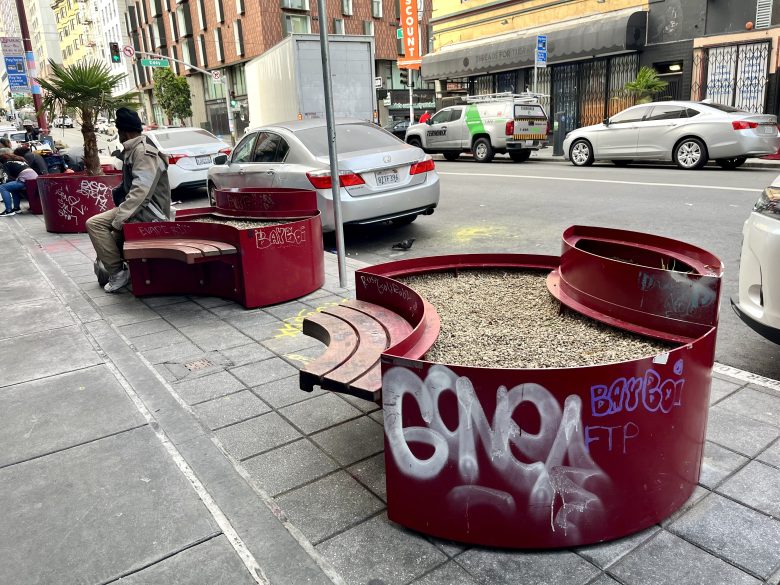
For now, the soon-to-be-removed public space remains. Walk down Taylor Street and you’ll see the evidence of “Safer Taylor Street,” a $20 million project that, in addition to traffic calming and pedestrian safety improvements, added bright red barrel-like planters and a series of benches along the street’s newly widened sidewalks in December.
In addition to planning and design costs, the city spent some $183,000 on the seating and planter materials and installation.
Today, the planters are mostly empty bins of gravel; only a few plants remain. The red paint on the planters is, for the most part, covered with layers of graffiti. Groups of people sit and socialize, but others lie slumped over on the pavement. Bags and shopping carts with piles of clothing sometimes crowd the wide sidewalk.

And so, soon the new seating and most of the planters will be gone. Only a few planters will remain, along with decorative elements like trees, new streetlights and crosswalks.
Tenderloin People’s Congress co-chair David Elliot Lewis called it a “slap in the face” at a recent community meeting.
“You can’t just do capital projects for construction without [a] budget for maintenance,” Lewis said. “It’s wrong to plan for construction and not maintain the construction.”
Lewis said that the People’s Congress wasn’t informed or asked for input about the removal, and suggested that, instead of paying to remove the street furnishings, the city could try to clean, maintain and activate the area.
This isn’t the first time the Tenderloin has seen public installations be constructed with great fanfare, only to subsequently be removed. In fact, the same thing has happened before, on this same street.
In 2010, then-Mayor Gavin Newsom announced a plan to revitalize the area and draw downtown visitors into the Tenderloin with a new Taylor Street Arts District. There were plans for street landscaping and redesigning crosswalks — just like Safer Taylor Street would feature some 15 years later.
That, too, fell into disrepair. “Now, two years later, the Taylor Street DPW planter box trees, unable to gain a foothold against daily deposits of litter and rough use as crack dealers’ stash holes, have been removed,” reads a March 2012 article in the Central City Extra.
The arts district of galleries, exhibits and studios didn’t materialize, and the landscaping was removed. It is not immediately clear how much was spent on the failed project.
Stewardship is a big part of maintaining public spaces, said Tenderloin Community Benefits District head Kate Robinson. She would know: A year ago, the Tenderloin CBD’s hard-fought Safe Passage Park — a blocked-off, expanded sidewalk with seating on Turk Street — was removed after three years when money ran out to maintain the space.
“It stopped serving the purpose that was initially intended and, like other parklets that we’ve had in the neighborhood, it became a negative element,” Robinson said, remembering open drug use, public urination and physical damage to the parklet structure.
“The conditions on the street became so overwhelming that it became a neighborhood … where we can’t have nice things,” she said.
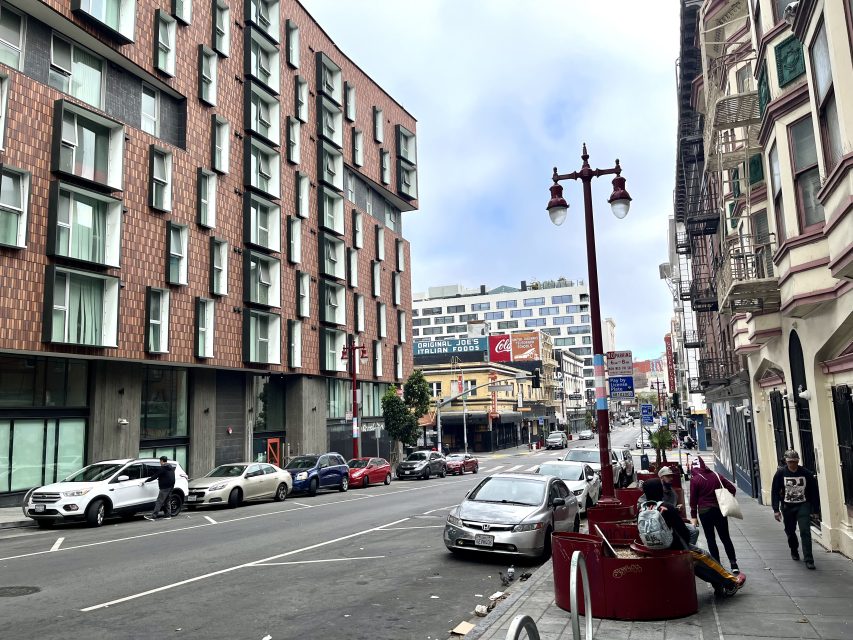
The community-led project that gave children a place to play outside during the pandemic became overrun. Instead of expanding to additional blocks as planned, the once-celebrated mini park was removed last year. It is now back to a pavement roadway.
In July, the parklet on the Golden Gate Greenway, part of a first phase of a larger car-free public gathering space planned for the Tenderloin, was also deconstructed.
Geoffrey McFarland, the senior community engagement manager for the St. Anthony Foundation, leads the community coalition developing the Golden Gate Greenway. He said that the community no longer wants permanent seating there, due to activity that proliferated on-site, particularly at night.
A worker on the greenway told Mission Local that the parklet became a place for some residents to openly consume or stash drugs.
Today, that project, too, has been scaled back and its future is being reassessed.
With constant attention, some public spaces like Elm Alley behind the Tenderloin Community School, and Dodge Alley, where the Tenderloin CBD hosts frequent events, are able to thrive.
But, Robinson said, “you need dedicated staffing … not just Urban Alchemy [ambassadors], but activation and ongoing programs and daily care, cleaning and programming.”
Aseel Fara, a community development assistant with the San Francisco Planning Department, helps organize a working group to improve and create more accessible public spaces in the neighborhood, as part of the Tenderloin Community Action Plan.
“We want the Tenderloin to have nice things,” Fara said. “But it will take more resources.”
I’d love to see comments about this from the UCSF Docs from your harm reduction article.
We can not have nice things until we stop accepting addictive drug use.
The best beautification project the city could do for the TL is free: cut funding for THC and all the nonprofits that concentrate the most dysfunctional people on the west coast into 15 blocks of free housing, crack pipes, needles, and EBT cashout corner stores.
The City shouldn’t invest not another dime in this rat-infested, drug-infested embarrassment of a neighborhood. Trying to beautify the TL is just a Band-Aid on a much bigger problem, and we all know what it is. How is the City going to stop the open-air drug trade?
The uncomfortable truth is this: the Tenderloin’s future will not be saved by cosmetic upgrades, or nonprofit organizations with no ambition beyond maintaining the status-quo. The neighborhood lacks imagination, influence, and the ability to execute bold change for open-air drug use. Their failure has left the neighborhood stagnant, unattractive to investors and locals alike, and irrelevant in the broader conversation about San Francisco’s growth.
The district desperately needs an influx of new residents, new capital, and new vision. Gentrification is not a threat: it’s the opportunity the Tenderloin has been wasting for years. Until this neighborhood stops indulging in the complacency fostered by Tenderloin People’s Congress and CODE Tenderloin, it will continue to decay while the rest of the City evolves without it.
Beautifying the Tenderloin is like putting a Gucci belt on sweatpants you haven’t washed in three weeks: it doesn’t fix the actual problem, and it just makes you look delusional. Taxpayer money keeps getting torched on shiny “revitalization” projects (murals, fancy planters, rainbow crosswalks), while the sidewalks are still a minefield of needles, feces and tents. It’s cosmetic surgery on a corpse.
The City budget is ballooning because politicians treat tax dollars like Monopoly money, throwing it at pet projects to score PR points, instead of addressing the root issues. They’ll spend millions painting over decay, instead of tackling housing, addiction, or safety. Beautifying the Tenderloin is peak performative governance: a desperate attempt to slap an Instagram filter on decades of dysfunction.
Bottom line? It’s not revitalization: it’s a waste of everyone’s money, and it’s exactly why SF’s budget is spiraling out of control.
My own perspective on this. The article mentions Gavin Newsom’s desire for a Tenderloin arts district in 2010. I was among Newsom’s critics then who supported his proposal. It took over a decade (from the 1990s) for the Tenderloin to clean up and organize. With two soup kitchens, a free clinic, and SROs from Dashiell Hammett days, the Tenderloin was always going to host the city’s low income populace. Nothing wrong with that. The facades were beautiful and restaurants were a bargain–just like in Dashiell Hammett days. Two hard-working community groups won recognition for the Tenderloin at around the same time: Uptown Tenderloin Historic District and Little Saigon. Newsom’s arts district was a cherry on top. It was a feel-good and fragile status quo buoyed on a shoestring budget, optimism of immigrants and the poor, dedication of stakeholders, the shrieks and laughter of children, and then it wobbled and fell to the burden of homelessness unabated and abetted by experts who misled their colleagues, the public and elected officials.
We can’t have nice things because extremely vocal ideologues shun any tangible consequences for misbehavior.
Yeah , they took out that water faucet and fountain that was in front of Glide. That is just plain evil.
Thanks for reporting
When will the city government wakeup and realize until they get crime under control ,and clear the the sidewalks which are like “crackhouses” , all the other things are stupid ?
The Tenderloin is a containment zone for dealers addicts thugs vagrants , gangs, homeless who dont want shelter and others who use and occupy public space as their own . The dont care and ruin everyone elses wellbeing
The streets and sidewalks need to have law enforcement walking aroung 24/7 like clockwork, trucks should be coming by 24/7 spraying the streets and sidewalks to clean them Just need to get outvof the way
This game and tolerance of the crap that is going on in the Tenderloin and Lower Polk street area needs to change
If sf cannot get control then call in help
I dont think the city really cares .
Harm is happening
It is a wasteland and garbage dump
Clean it up or close it down
Paddywagons need to be used to roundup these idiots who dont give a f k.
Fyi Last night many gunshots on eddy near polk
City has lost control
I would rather you risk your life to fight this crime. Let the good police go home each night to their families. YOU patrol the tenderloin and deal with what is there.
another SFMTA production, thousands of these projects within the last decade and why do you have a deficient? It’s just like the Noe Valley toilet, remember? Do you want me to talk about Hayes Valley, NPOA or the Mission projects?
I live in Noe Valley, and we did not want or need that million dollar toilet, because: One we used the bathroom before we left home, or two we would go into the local cafe/restaurant that we patronize. The bath room was Senator Scott Wiener, who lives in the Castro, idea.
Who is handing out the contracts for these projects? And why can’t they figure out how to engage the public in the decision making and maintenance of their own neighborhoods instead of contracting everything out?
If locals cannot resist the temptation to destroy or vandalize the, “nice things,” then they will have to go without. They should not expect everyone else to pay for and maintain things that they intend to destroy.
Like the bus shelters, there is one on Mission Street that someone vandalized, so bad that you, can’t read or even hear what time, the bus is due to arrive.
It’s nice try at civilizing the Tenderloin.. Haven’t lived there since 1981.. Seems like the locals are a different breed now, with hard core taggers and drug users, not like the 80’s when there were a more businesses and family people. Ah well. Maybe it would serve the city best if first, they could remove the criminals somehow. Then normal people would come out of the shadows and start to use some of these new amenities.
One of the readers, once stated so eloquently, “We can’t have nice things in the Tenderloin, because of politicians and crack heads” Amen!!!
Find neighborhood volunteers to clean up the benches. Maybe hose down the benches that are slept on. Those that are posting negative comments probably never approach those areas.
And they wonder why the people keep fighting back….people need places to sit…not really fair that they keep doing this nonsense
Cosmetic changes like this, without addressing the much larger problems that the TL has, is like rearranging the deckchairs on the Titanic or putting lipstick on a pig.
The TL is as nasty an example of urban blight that you might find anywhere in the country. And the only real way to clear slums is to redevelop the area, as happened with the other “half” of the TL that was south of market, replaced by the Moscone Center and surrounding area.
Big problems require bold solutions and not superficial tinkering like this.
“cleaning up” the TL in a permanent way requires big public spending on 1) incarcerating the poor/homeless, people suffering from addiction or 2) housing the poor/homeless, people suffering from addiction. Option 2 is cheaper and better for society. For the last 40 years SF has been committed to a half-hearted form of Option 1, which has failed at everything except giving politicians endless topics to exploit and distract from the fact that they can’t/won’t pursue any policies that will solve it.
While I don’t pretend to know how to clean up the TL, I’m skeptical about housing-first options. For example, during the pandemic’s shelter-in-place program, many homeless were sheltered at the Good Hotel. In addition to paying the hotel for housing, taxpayers also had to cough up 3.9 million to repair the damages that the guests inflicted on the hotel during their stay.
Ugh….how about just leave things alone and don’t remove them?! Sheesh….we already got enough problems as it is. Don’t take down things people are clearly using, this is so stupid….some cities just don’t learn to let anything be…but no….they just have to keep wasting their money by taking out things they built
The Tenderloin is one of the largest net contributors of sales taxes to San Francisco’s budget. Those tax dollars are being extracted from the Tenderloin and redirected to keep the peripheral neighborhoods clean and safe, after the nonprofit executive directors pay to keep a political lid on things take their cut.
The City extracts tax revenues from the east side while containing all undesirable activities on the east side like San Francisco were some kind of apartheid colonial system.