

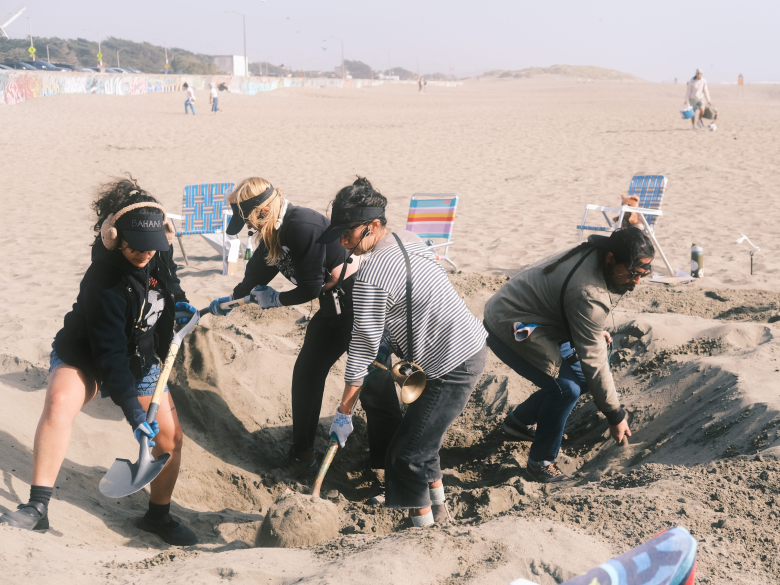

During an artists’ retreat in the Sierra Nevadas in 2023, the ensemble of San Francisco Neo-Futurists started a strange and silly group-building activity.
“Let’s all dig a big hole together,” writer and performer Bahaar Taj suggested.
Sixteen people started digging near the town of Twain Harte, a three-hour drive east from San Francisco.
That hole stuck with Taj and Amy Langer, writers and performers with the theater collective, which was founded in 2013 and is known for its short plays showing every Friday and Saturday night at 447 Minna St. in SoMa.
Two years later, they have turned the hole-digging session into “HOLE,” the company’s first in-person, full-length play. It will debut on an as-yet-unannounced San Francisco beach starting this Sunday.
The “HOLE” creators prefer to keep the location a secret, but on the event page described it as “a Muni-accessible outdoor S.F. location in the Outer Richmond.” If you know, you know.
The 75-minute play is about a cast of five digging a hole on the beach and filling it back in.
It explores themes of compulsion, exhaustion and why “human beings become obsessed with actions that don’t necessarily have a clear-cut end point,” said Langer, who co-wrote and co-directed “HOLE” with Taj. Other cast members, Sam Bertken, Mars C. Ibarra and Willie Caldwell, also contributed to the writing.
That obsession is at the core of the play.
“It tries to flip the feeling of individual and isolated obsession into something that is very communal,” said Topher Lin, the play’s producer. “Reminding ourselves and the audience that community and solidarity are possible, that you can ask for help, that you are not alone in your hole, so to speak.”
Earlier this summer, “HOLE” had a trial run at Ocean Beach to gauge how deep the hole could get and how long it would take to dig. It turned into a party. “The audience really wanted to dig,” Langer said.
In 45 minutes, the cast and audience dug a hole deep enough for 20 people to sit in.
The writers began to wonder: What draws people in when they see others digging a hole? What does it take to make them grab the shovel, too? In an hour and 15 minutes, “HOLE” tries to answer those questions.
The beach site allows the creators to “dig with reckless abandon.” But having an outdoor play has its challenges. Rehearsal workshops at Ocean Beach were often engulfed in heavy summer fog. Even on nice days, every rehearsal was a surprise, Langer said.
A serious monologue could be broken by cheers from a nearby volleyball tournament. When the cast encouraged audience members to close their eyes and make their own imagined holes with hand gestures, passersby joined in too.
“Without changing any text, each performance still feels unique,” Langer said. “It’s gifted additional meaning by the random chaos of what’s happening outside of our control.”
Digging holes on the beach is physically taxing, but also seems silly, at times. On days “when the weight of the world makes it difficult” to work on a project about digging holes, Langer said, she questioned herself: “Why keep doing it when it’s so tiring?”
But the action of hole-digging provided her with some answers. The knowledge that you could stop and be in a communal and exhausted space was gratifying.
“I’ve come to resent the hole,” Langer said. “And I’ve come back to loving it.”
It also led to interesting diversions. Taj and Langer started receiving recommendations on all things hole-related. “Once you tune into the hole discourse, you can’t really tune out,” Taj said.
That’s how the writers heard about HOLE PARTY, an ongoing hole-based project inaugurated in 2022 involving a group of people spending four to five hours digging a deep hole on Ocean Beach every few months. From them, the playwrights learned the “best hole-digging practices.”
Use your legs. Stretch beforehand. Dig one layer at a time. Trying to dig straight down does not work so well. Be careful of where to put your belongings, so that they’re not in the way of further expansion. Make sure the sand is far enough away, so it doesn’t just find its way back to the hole as you continue to dig.
Shovels are crucial. Counterintuitively, a heavy-duty, full-handled shovel is not ideal, Langer said. A half-sized shovel with a nice handle is much easier to wield. Try not to shovel someone else’s feet.
With six shows in September starting this Sunday, Langer seems giddy thinking about what the audience will say. In past work-in-progress performances, “Every person was so certain of their feelings on it. It’s about the environment. It’s about God. It’s about death,” Langer said.
“That,” she said, “is the only theater I want to make — where everyone leaves feeling absolute clarity about what it was, but each answer is completely different.”
HOLE will run the first three Sundays in September, at 2 and 5 p.m. No one will be turned away for lack of funds. Tickets can be found here.

This, or you could watch “Hole” as performed by the City and County of San Francisco at South Ocean Beach. There, you will find excavated sand used to fill in the ocean. It is also a group affair; but this one is a tragedy – born from a shared denial that a sewer plant was built too close to the sea (and on an actively eroding beach). Heavy equipment will do the digging and filling (at no small cost to taxpayers) in a Sisyphean attempt to manufacture a beach.