

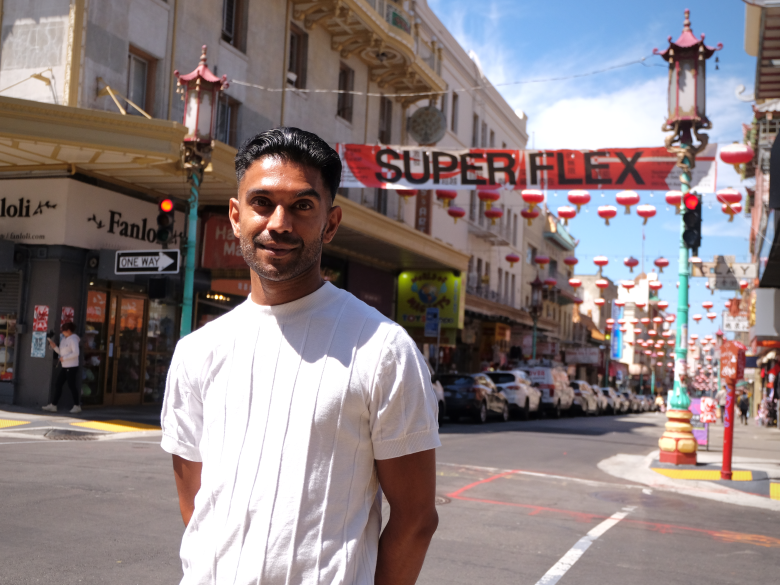

Raised by a Fijian mother and Indian father, the artist known as SNJV remembers seeing his dad’s ruffled green card in his wallet when he was little. Right at the top it read: “Resident alien.”
“It was just so jarring,” he said. “That terminology is intended to remind you, subtly but not so subtly, that you are different. You are other.”
Alienation is a familiar feeling for the artists — many first- and second-generation immigrants — showcasing Saturday at Chinatown’s Fourth Annual Contemporary Art Festival.
As the Trump administration “aims to silence, criminalize and eradicate” immigrant and LGBTQ communities, head curator Candace Huey said, the festival is focusing on the power of protest and solidarity — and flexing it by transforming fear and anxiety into collective action.
“We are going to let contemporary art do its thing, giving a safe place for freedom of expression and reframing what it means to be American today,” Huey said.
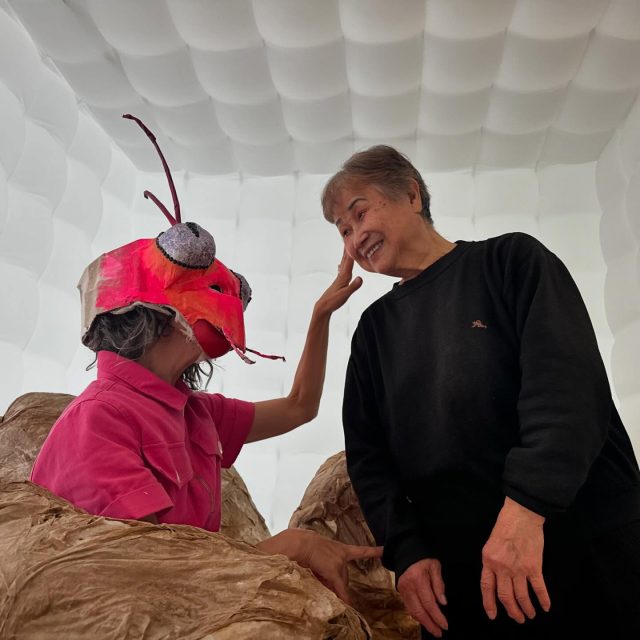
One installation by For You, an artists’ collective, asked Chinatown elders: “What does an alien look like?” and “What does belonging mean to you?”
Many seniors in Chinatown were once or are still “aliens” in the U.S. immigration system. The installation shows extraterrestrial costumes, inspired by the Chinatown seniors’ drawing of aliens.
In another installation, “Non Alien Box,” a group of international students used decommissioned newspaper boxes — San Francisco once had 1,000 mounted news racks on city sidewalks — to host stories of struggles with the job market due to visa restrictions.
The stories include companies that passed on applicants who needed visa sponsorship, workers who stayed at jobs for fear of losing their work visa, and employees who were laid off and given just 60 days to find another job or leave the country.
For his contribution, SNJV, a drag performer, is turning the concept on its head: Chinese people and other immigrants, he says, “do drag often” when they wear Western attire or give a Western name when ordering at Starbucks. “But we don’t call it that,” he said. Instead, it’s survival by means of code switching.
As a child, SNJV watched his grandmother take off her traditional muumuu and put on a Western two-piece suit and carry a purse when she left the house.
SNJV realized that this effort made her feel safe navigating the United States as a new immigrant. He says that is drag. “Maybe I want to escape from my core identity that’s directly under attack and lean into my alter ego,” he said.
The festival, this year named “SUPER FLEX: Powered by Alter Egos and Shadow Selves,” will take up four blocks in Chinatown — Grant Avenue, Waverly Place, Ross Alley, and Wentworth Place — with performances, installations and workshops from 4 to 10 p.m. on Saturday.
Presented by Edge on the Square, an art hub located at Clay Street and Grant Avenue, it will feature artists with connections with Chinatown “whether it’s with their ancestors, whether it’s just a place of belonging, a sense of home or chosen family,” Huey said.
For Rene Yung, an artist born and raised in Hong Kong, that means going back to the 1980s, when she got her citizenship. She remembers well the hoops she had to jump through, including the 10-part civic test with questions like “What is the one right or freedom from the First Amendment?” and “What stops one branch of government from becoming too powerful?”
Yung is turning those questions into an interactive performance, shredding the multi-lingual study materials for the test, turning them into cordage and making objects like a head dress, blanket or whisk broom.
“There is so much strife and polarization and anger around this whole American narrative,” she said. “There are very important values that are ensconced in these questions. But they are being devalued today, and that’s a danger.”
“SUPER FLEX: Powered by Alter Egos and Shadow Selves” will take place on Sept. 13, 2025, from 4 to 10 p.m in Chinatown. It’s free and open to the public. You can find the program schedule here.

“Instead, it’s survival by means of code switching.” Because America speaks English. It’s the national language, all our laws are written in it, our society uses it since inception. You can’t expect to emigrate to a different country and culture and expect everyone there should speak your language and act and value things exactly as the country you’re coming from, that wouldn’t make any damn sense. If someone can’t pronounce your name you deal with that and shorten your name. Lots of people do that. Not exactly ‘drag’ lol, whatever. Talk about cultural appropriation in reverse.