

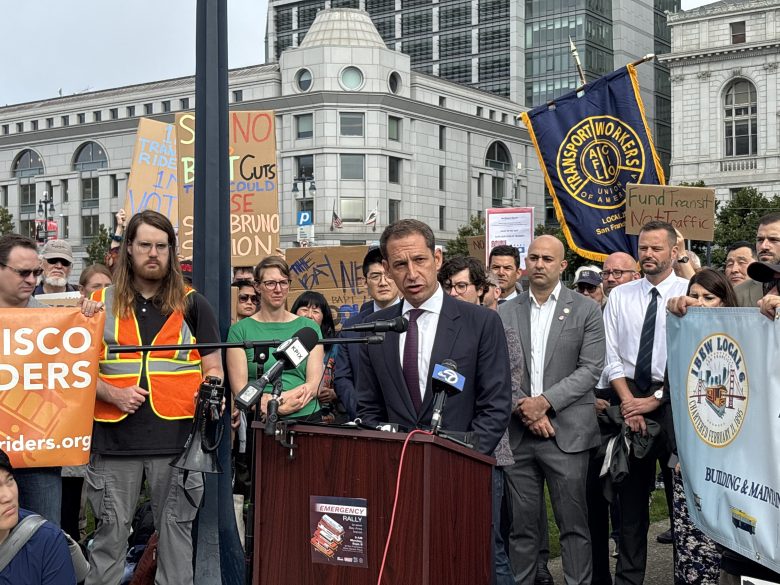

On Monday morning, Mayor Daniel Lurie announced at a rally that a $750 million emergency transit funding loan pledged by the state of California and subsequently curtailed is, once again, in play.
It remains unclear why the loan, which was approved and allocated for in the June state budget, is in flux.
“Since Thursday, we have been in hourly, and I mean hourly, communication with the Governor and his office to reach an agreement where everyone wins,” said Lurie, during a rally at Civic Center Plaza. “The governor has made it clear to me that he understands the importance of this.”
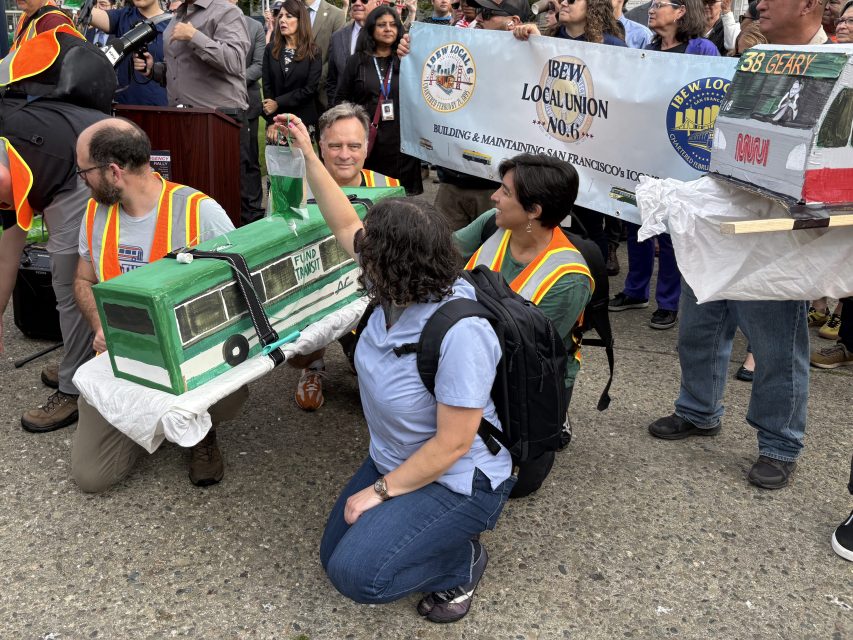
Dozens gathered to urge the governor to secure the $750 million, including many public officials, transit advocates and labor representatives. Several stood in scrubs holding a cardboard 38 Geary Muni bus, connected to an IV drip.
“If you’re going into a fight, you want advocates with a sense of humor and some artistic abilities, and we got that,” said Board President Rafael Mandelman.
The governor’s office also issued a brief statement: “We are working closely with all stakeholders on the parameters of a funding deal. Our shared goal is to agree on the terms of a deal by this fall.”
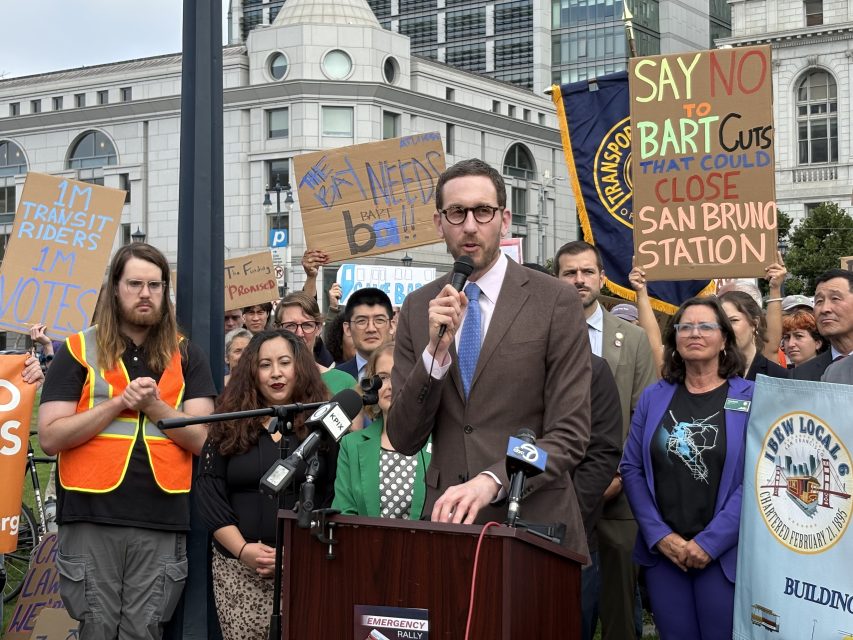
Neither Lurie, nor state Sen. Scott Wiener, who also spoke at the rally, specified what the holdup is. On and off the record, Bay Area politicos were confused by the on-again, off-again nature of the promised funding, and mystified. Still, they remained hopeful that an agreement would be reached.
“I thought the loan was dead,” said Wiener. “I think we may have put it back onto life support,” he added.
Last week, the governor’s office and the state’s Department of Finance informed Bay Area lawmakers that the promised loan would not be provided by the end of the legislative session this week.
The state Department of Finance explained that it needed a complete legislative proposal, and hadn’t received one by the end of last week.
Wiener, working with San Francisco and regional transit operators, countered that his office had submitted several proposals and made a good-faith effort to agree on the terms, but an agreement was not finalized.
According to state legislation passed in June, the $750 million loan is cemented into the budget, but the duration and terms of the loan are to be determined in separate “budget trailing” legislation. That is what is currently under negotiation.
“I am hopeful, but the terms of the loan also really matter,” said Laura Tolkoff, the transportation policy director at SPUR, an urban planning think tank.
Two of the agencies that would benefit from the cash infusion, BART and the San Francisco Municipal Transportation Agency, face massive structural deficits.
The loan would prevent either agency from cutting service, and act as a stopgap until more funding is secured through tax revenue. That’s conditional, however: Voters must approve revenue measures in 2026.
According to advocates, should the funding fall through, the SFMTA may have to cut Muni service frequency by 50 percent, eliminate service after 9 p.m. and cancel fare subsidies. BART would also cut service by an estimated 65 to 85 percent.
“I came here mystified this morning,” said Assemblymember Catherine Stefani. “I can’t believe that this is not yet done, or that they’re not at the table doing everything they can to do their job.”
Stefani added that legislators did their job in finding room in the state budget to allocate the stopgap funding. She also expressed frustration with her own party, given that the state has a Democratic governor and a supermajority in the state legislature.
District 6 Supervisor Matt Dorsey emphasized that sentiment. “I expect better of Democratic leaders,” he said.
“I would expect chaos and uncertainty from the Republicans in Washington — but with the eyes of America on our city and our state, let’s show them how Democrats can govern equitably so that we’ve got transit and paratransit and all the economic opportunities.”
CA Dems love to hem and haw about how they are leading the fight against climate change but they won’t fund public transit. CalTrans gets a blank check for tens of billions every year but we have to beg and plead just to get pennies for BART and Muni. Shameful.
Uh, who do you think wrote that “blank check” for CalTrans? Have you ever driven across a bridge in the Bay Area? Bought anything and paid sales tax on it? Bought gasoline in California? Paid to park in a garage or metered space in San Francisco? Do you pay property taxes, either directly as a homeowner or indirectly through rent?
All of the above contribute to funding public transit, because what you call “CA Dems” consistently support it, even when it raises their taxes.
How long is SFMTA going to keep service along the current Muni alignments that mostly serve a largely abandoned downtown office core?
What we’re seeing here is SFMTA being run in the red to keep downtown office valuations from cratering. In addition to this loan, Lurie and Wiener and Wiener are proposing a parcel tax and a sales tax to fund transit.
Do Lurie and Wiener intend to offer up any governance reforms in exchange for support for these taxes? Are the advocates independent enough that they’d cross the SFMTA to demand reforms as concessions in exchange for political support?
Or are we expected to throw good money, literally doubling down with taxes, after bad at an SFMTA that is being run to benefit downtown rather than move San Franciscans around town on our dailies?
Not one more red cent to this corrupt government without structural reforms to put more diverse eyes on these problems.
Loans should be for capital improvements and not just keeping the lights on.
you can’t maintain what you already have, how can you do capital improvements?
Um, no. That’s municipal and state bonds that you’re thinking of.
For more money, what they should do, licenses and charge bicycle and scooter owners, that would bring in alot of revenue. And give them tickets when they do not obey the traffic laws.
I would have preferred SFMTA had thought about their fiscal reality before green lighting all the recent massive investments in street safety infrastructure and the like. True, some of this work is welcome/makes sense for safety – in certain areas around in town, but much of it doesn’t – lots of overkill and a big waste of funds. I believe in transit first, biking and walking but fiscal responsibility and strategic investments are MIA at SFMTA. Little things can really add up to the bottom line. Then, there are the big boondoggles – like the Central subway line. Also, missed opportunities – no funding from Waymo for allowing them to use us as guinea pigs to test out their AV fleet? Wow! With management like this, the funding crisis is really no surprise.
Governor Newsom’s decision to block the $750 million loan to Bay Area transit was not just fiscally prudent, it was long overdue. SFMTA has shown, time and time again, that they are incapable of responsibly managing the enormous sums of public money already entrusted to them.
SFMTA is not suffering from a lack of funding: it’s suffering from decades of chronic mismanagement. Despite ballooning budgets, fare hikes, and repeated state and federal bailouts, riders have seen little improvement in reliability, safety, or accessibility. Instead, the agency has a track record of squandered funds, overbuilt bureaucracy, and misplaced priorities. It continues to ask taxpayers for more money, without ever fixing the systemic inefficiencies that drive it back to the well, year after year.
To hand SFMTA yet another massive bailout would not “save transit”: it would reward failure. It would send a message that waste, incompetence, and refusal to reform carry no consequences. The fact that SFMTA is already lobbying for even more money, while failing to account for the billions it has burned through in past years, shows just how detached the agency has become from fiscal reality.
Another Weiner bailout without actual reforms, just like his builder’s remedy BS.
Kudos to Lurie and the other moderates/conservatives doing their best. Frankly, if we had a more progressive tax system in SF and a budget that was less focused on policing we probabaly wouldn’t be in this mess to begin with.
But we all know the oligarchs run this town, so Lurie (who is one of them), is forced to beg the state for a loan in the hope of saving us from the economic devastation that would result from these cuts.
Meanwhile, the oligarch class would be all too happy for Muni and BART to crash, they could make millions from private alternatives and they gate people anyways.
Hency Waymos on Market street, the airport, the park, in your driveway 24/7, etc.
They install the wrong rail gauge at the cost of millions, then ask for more millions. They catch a $250,000 a year JANITOR asleep in a mop closet, more $ please. They drop BILLIONS on a half-baked train scheme while the existing system dies. More funding please.
At some point public transit in CA is a damn racket, and we need to let it die and rebuild it from pragmatic scratch. The CA and SF legislative process is mindless.
I sometimes think it would be ironic if everyone wore ICE uniforms—it would certainly confuse them. But on a more serious note, I do wonder whether ICE personnel are vetted with the same rigor as other federal agencies. Given the authority they hold, the public deserves assurance that none of them carry disqualifying criminal backgrounds. The Governor, together with the Attorney General and federal partners, should push for transparent background checks and publish verification that every ICE member meets the highest standards. ~d