

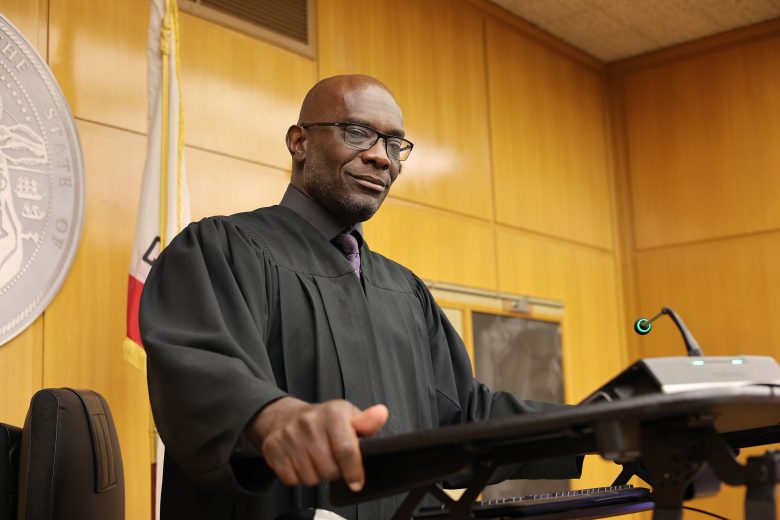

The new judge presiding over San Francisco’s Young Adult Court was a wide receiver at Tulane University. Old habits die hard: To Judge Eric Fleming, team-sport dynamics are an apt metaphor for youth rehabilitation.
The players are defendants ages 18 to 24. These are “high risk, high need” young adults getting a shot at having their charges dismissed, if they can make it through a year and a half or so of counseling and educational programming.
These players are surrounded by a bevy of coaches: Assistant district attorneys, defense attorneys and case managers, who must all agree to divert each defendant from the traditional criminal justice system to Young Adult Court.
The head coach, and sometimes referee, is Fleming, who worked in the San Francisco District Attorney’s office for 13 years as a prosecutor before becoming a judge in 2017.
Fleming takes a “firmer” approach than Judge Bruce Chan, his predecessor in the Young Adult Court, said Celina Hennessey, the court’s clinical program manager. At the same time, she continued, he’s a “passionate” leader.
“Coaches are hard on individuals they see potential in, because they want to bring out that potential,” Fleming said.
Chan, a former defense attorney, helped create the court in 2015, along with then-District Attorney George Gascón and others. The idea was to apply a modern approach to rehabilitating youthful lawbreakers who, scientists say, have brains that were still developing long after the age of 18.
In March, Chan stepped down, stressing the importance of the court outlasting any one individual. He also expressed a desire to find a replacement who would protect the court — which has only been around for a decade — from the “inevitable pendulum swings” of local attitudes about crime and punishment.
Fleming, a cop before his DA days, and the young adult court’s original prosecutor, took his place.
As a Black man who grew up in the South, Fleming is uniquely positioned to inspire the court’s young men to imagine a different future, Chan said.
A judge the DA’s office can trust
The hope — Mission Local was told by several people close to the court — is that a former prosecutor like Fleming will secure the program’s credibility in the eyes of crime victims, law enforcement, and District Attorney Brooke Jenkins, whose office must approve the defendants who are referred to the young adult court.
When the DA trusts the program, they said, more defendants get in, and more young people get a second chance.
“In collaborative courts, the DA may be more skeptical of a judge with a defense attorney background,” Fleming said. With one of their own, “There’s a possibility that that skepticism may not be as prevalent.”
“Fleming speaks their language,” said Behavioral Health Court judge Charles Crompton. “He understands their pressures and concerns.” At the same time, he’s been a judge for eight years, and can “see the other side.”
The DA’s office declined to comment for this story, but her office has, more broadly, moved away from diversion programs: The percentage of criminal cases resolved by diversion fell from 2022 to 2024 under Jenkins. She reversed an eight-year decline in traditional criminal convictions.
Still, some of the DA’s recent moves indicate support. In 2024, San Francisco raised city funding for the program from $800,000 per year to $1.3 million. Jenkins told CBS News she wanted to make sure the court was sustainable “because it does represent true reform in the system.”
In recent years, the number of defendants referred and accepted into Young Adult Court has been about half what it was before the pandemic. The reasons for this, however, are complicated. It is unclear if the DA’s office is referring fewer cases, or if defense attorneys are now using other diversion programs.
From a small southern town to San Francisco superior court
Before Fleming was a prosecutor, he says, he was the kind of kid that some authority figures would judge because of his appearance.
“I was a young African American male who had some friends who did bad things,” Fleming said of his childhood in small-town Mississippi. “I felt like no one would believe me or give me a chance.”
Fleming at least had a teacher who believed in him, which counted for a lot. He saw what happened to those who didn’t have anyone.
At 17, Fleming visited some cousins in Los Angeles, California. He wanted more. When he finished college at Tulane University in 1989 and saw that the Los Angeles Police Department was recruiting new officers, he applied and was accepted into the academy within a week.
Being a cop was everything Fleming thought it would be: Exciting, dangerous and a role that made him feel important to the community.
“Not a single day went by without a dead body,” Fleming said. Once, when he was patrolling a high-crime area, he almost shot a 14-year-old suspect who pulled out a weapon. He was glad he didn’t.
After three years on the beat, Fleming applied to law school and studied at the University of San Francisco. In 2004 he joined the San Francisco DA’s office, and worked his way up to become head of the homicide division.
Gascón, himself a former LAPD cop turned San Francisco prosecutor, remembers Fleming as “smart, hardworking and committed to doing the right thing.”
Fleming said he worked on many difficult gang-related cases. He couldn’t help but think that the right kind of intervention in the lives of the people he saw pass through the courtroom could have put them on a different path.
When he “caught wind” that Gascón was helping to open a collaborative court in 2015, the former DA recalled, Fleming volunteered.
A firm but understanding approach
Fleming, not one to put himself in the spotlight, according to his colleagues, seems most at ease when he’s speaking candidly to young people.
That is something that happens regularly on Thursdays, when the hallway outside his courtroom fills with twenty-somethings waiting for a check-in about their progress.
Throughout the week, participants are supposed to have been meeting with their case manager from the nonprofit Felton Institute.
Seventy-five percent of the feedback Fleming gives to participants is based on what he’s discussed with the assistant district attorney, the defendant’s attorney, and their case manager. The other 25 percent, he said, is “more instinctive.”
When the courtroom opens, defendants approach the stand one by one to speak to Fleming.
Throughout the day, his banter makes even the most stoic youth giggle. He calls out excuses, but never dwells on mistakes.
One participant, Omar, was asked why he hadn’t contacted his case manager. He didn’t save his case manager’s phone number, Omar explained.
“I won’t accept that,” Fleming said. “Do you have a flip phone?”
“I have a lot of people texting me. I don’t get to everyone,” Omar clarified. Fleming suppressed a smile.
“This is for people who want skills and opportunities,” said Fleming. “Six charges against you could be dismissed, but you can’t respond to a phone call?”
“It was dumb,” Omar muttered. “I should have saved it.”
“What is your goal?” Fleming asked. It’s a question he usually circles back to.
“Be there for my 8-month-old daughter,” Omar said.
Like Omar, many of the people in the program have small children. The court gives out picture books for young parents to read to their kids.
“Trying to be a good father can be an impetus in someone’s life,” Fleming said.
More problems, same needs
Fleming has returned eight years after he helped inaugurate the court to find a more structured, established program, he and others said. For one, defendants seem less “skeptical” about participating. That doesn’t mean their problems have gotten easier.
There is greater potential for health catastrophes from today’s drugs, Chan said. Young Adult Court participants show higher levels of anxiety and trauma-related symptoms, the clinical program manager, Hennessey, said. Meanwhile, the public is demanding more accountability from law enforcement.
On a recent Thursday, Fleming decided to admit an 18-year-old charged with possession of a firearm, despite the DA’s objection that doing so would contradict the court’s guidelines.
Later, Fleming said that the DA was right. But, he added, up until that charge, the teenager had no record, and if anyone could benefit from such a program, it was a teenager with no criminal record.
What hasn’t changed in Fleming’s time away, he said, are the needs of at-risk youth: Stable housing, life skills and mentorship. “They just want someone to listen to them without judgement.”
Earlier that day, Fleming addressed a participant who appeared via Zoom, wearing a collared shirt and tie.
“You got an interview?” Fleming asked. Yes, the young man said, at the “trash company.”
“Yeah, they call it Recology,” Fleming said. Warming up to the subject, the man began talking about the benefits he would receive.
“I know you want things to happen fast, and that’s a good quality. Just remember that things don’t happen overnight,” Fleming said. Still, he congratulated the man on his progress.
“I wouldn’t mind seeing you come to court with a suit and tie,” Fleming added before he signed off. The young man laughed; the standard attire of young adult court participants is black jeans and a hoodie. Fleming grinned back: “All right, man. Peace.”
Judge Fleming is well respected by public defenders as well. He has an amazing judicial temperament, he reads briefs and motions and does his own legal research and listens to both sides. He is also very respectful to all parties in his courtroom – including witnesses, jurors and defendants. Above all, judge Fleming is fair, and that’s what matters most. We appreciate you Judge Fleming!
Shamann Walton should work with local police and community leaders to prevent criminals from shoplifting. No business and let me say that again, NO BUSINESS, will come and stay in your community if the work environment for their employees is unsafe and shoplifting is allowed.
Proposition 47 (2014) reclassified theft of property worth less than $950 as a misdemeanor rather than a felony, protecting repeat shoplifters, resulting in little or no jail time.
Progressive jurisdictions reduced or eliminated cash bail for low-level offenses, so people arrested for shoplifting or breaking/entering are released while awaiting trial, leading to repeat offenses and more theft!
Progressive SF DA Chesa Boudin, or Manhattan DA Alvin Bragg, frequently instructed prosecutors not to pursue jail time for low-level shoplifting, trespassing, or drug possession, encouraging repeat offences due to lack of consequences!
Progressives enacted diversion programs so instead of jail or fines, offenders are sent to counseling, treatment, or community service. And the nonsense goes on and on.
Maybe Shamann Walton and other progressives should conduct business in Bay View and see how much they will enjoy subsidizing theft, monetary lossless and dealing with their nonsense laws they passed!
“Shamann Walton should work with local police and community leaders to prevent criminals from shoplifting. ”
That seems like a great use for a Supervisor’s time to you?
Campers,
Gascon and Adachi
Now, there was a match.
My first job out of the Navy in 1965 was playground coach on the same housing project where I grew up and last one was teaching gangster kids (they preferred that handle to, ‘Severely Emotionally Disturbed’ which is what SFUSD called them) on Potrero Hill and it all comes down to a choice between how you choose to approach them …
Revenge
or
Reform
60 years immersed in and around poverty and addiction and crime and love and courage and resilience and hard work and hindsight and more hindsight have led me to the conclusion long ago that …
Reform works
and
Revenge only makes more criminals and worse ones.
Studies from the best schools and institutions bear this out yet our City and the State and Country have all doubled down again and again on Revenge approaches.
I hope the court survives the metaphoric for now lynch mobs in the streets who might come after them via budget.
Is this the Tenderloin night court Adachi founded and staffed by himself nights for years ?
go Niners !!
h.
As long as he doesn’t take $150,000 in secret “volunteer money” I’d say he’s 100% more trustworthy than our current District Attorney Broke Janky.
Where is Chiu on that, still snoring through the days down at City Hall?
I wonder if a youth reoffends while in the program and now is over 18, do not collect, do not pass go, go to prison?
Judge Fleming is a highly regarded member of the San Francisco criminal justice system. He has put in the work and has high values. We need more judges like him in our courts.