


In an attention economy driven by algorithms, there exists a bimonthly escape in the Richmond.
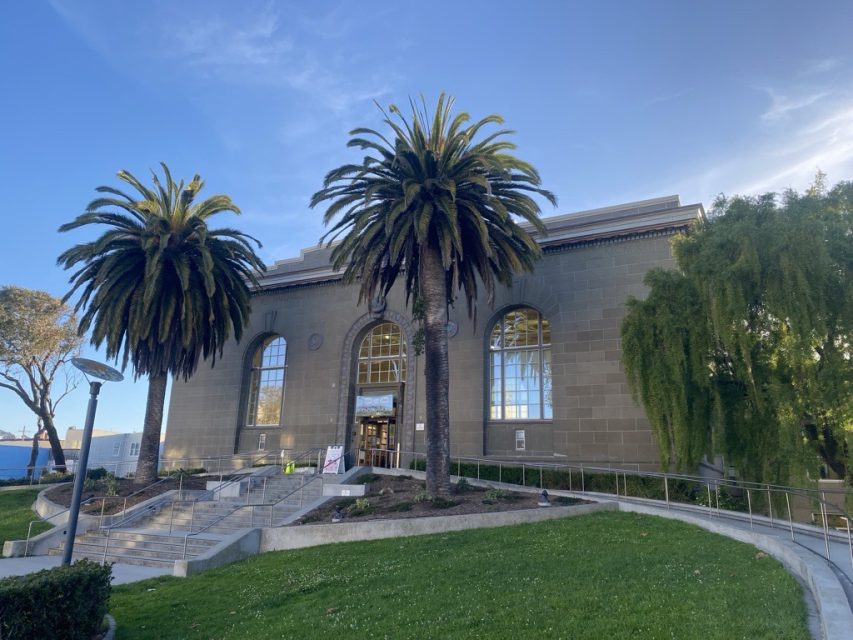
Every other Wednesday, San Francisco Public Library’s Richmond branch hosts a Silent Book Club chapter in a small, unassuming room set up with a circle of chairs.
From 3 to 5 p.m. the space turns into an ecosystem of ideas, jokes and stories that can include riffs from literature as diverse as the memoir of a playwright to a novel of exile set in the Malaysian islands.
The premise is simple: A group gathers in the Richmond branch and reads silently for one hour. At the end, the participants — nine on the day I joined the group — select blindly from a bowl of bottle caps labeled with numbers from one to nine.
Then, in bottlecap-determined order, each reader has around seven minutes to talk with the group about what they’ve been reading.
“It’s very unusual to just be able to sit and read for an hour,” said Annie Reasoner, a member since fall 2024. “If I’m home, the phone rings, I get a text, the cat demands some treats, somebody knocks on the door.”
Currently, she’s reading “Theater Kid,” a memoir by Jeffrey Seller on her Kindle. During the quiet hour of reading in late July, she let out a chuckle every now and then.
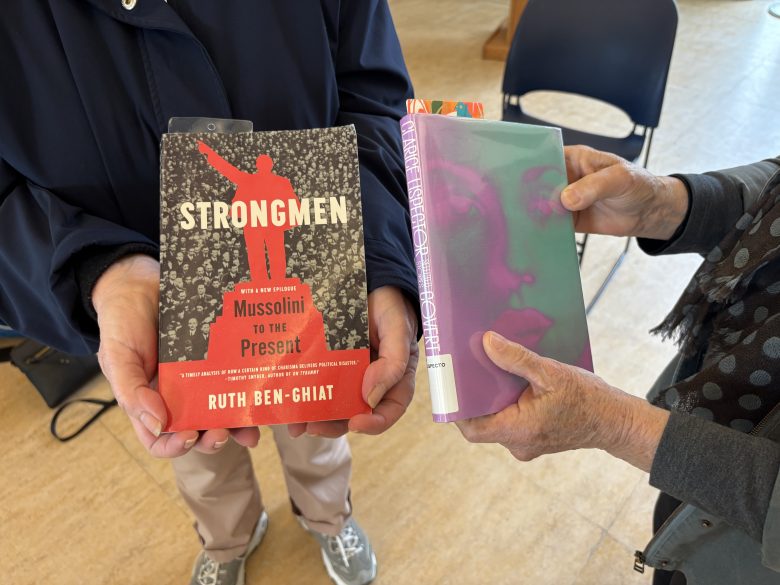
During the discussion, another reader shared illustrations from children’s book author Leo Lionni’s biography. A different attendee picked apart “Strongmen,” a book analyzing the commonalities of authoritarian leaders.
Nancy Berry, a 50-year San Francisco resident, confided to the group that she was finding a collection of short stories from Clarice Lispector to be uneven.
“I just read one that was terrific, so good,” she told the group. “But then there’s another one in here that’s the stupidest story I ever saw.”
She stopped to read a line: “Immediately I perceive that one cannot be seeing an egg. Seeing an egg never remains in the present: As soon as I see an egg, it already becomes having seen an egg three millennia ago.”
A few of the women laugh. Berry concludes that Lispector was probably “smoking something” when she wrote it.
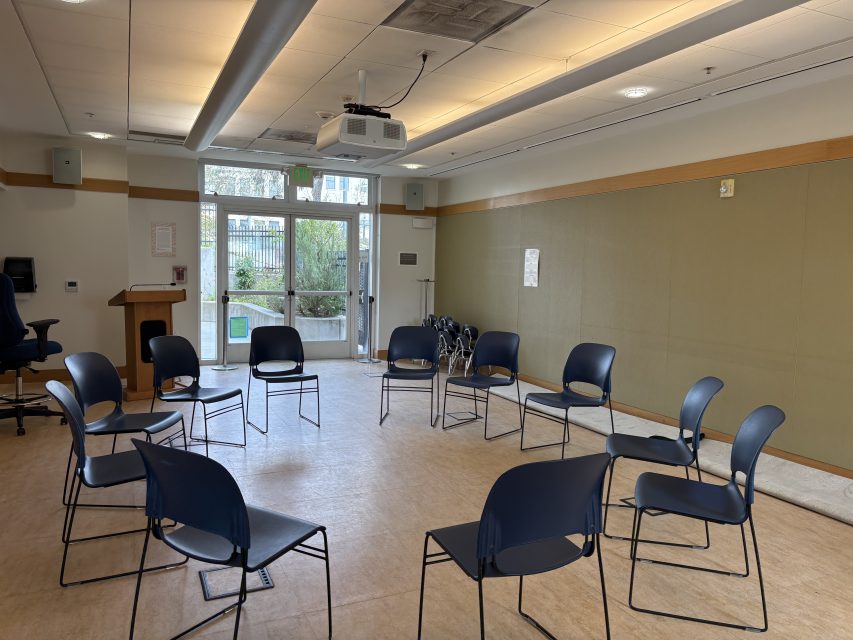
Individual meetings remain small, with roughly six to eight people coming consistently, though a pool of 20-something will rotate in and out, depending on the week.
Because of the 3 p.m. timing, mostly retirees attend, and a majority are women, said Marina Sobolevskaya, an adult services librarian at the Richmond San Francisco Public Library who first started the reading program in late 2022.
The group has also been a starting point for friendship. This was the case for Berry, a participant at the Richmond branch for years and a library user for the 50 years she’s lived in San Francisco.
Berry has a bone to pick with more traditional book clubs, “I have so many things that I really want to read, stacked up on my shelf and in my mind,” she said. “I don’t want to slow down for something I might not like.”
The silent book club offers the flexibility she seeks, Berry enjoys fiction by Eastern European writers like Franz Kafka. Lispector, a Ukrainian-born Brazilian novelist and short story writer, was a bit of a break from that.
Lyn Davidson, the branch manager of the Richmond library, hadn’t heard of a silent book club prior to the one at her branch.
“When I actually started talking to the staff and the patrons who had experienced it, they were really dedicated to it,” Davidson said.
One of Sobolevskaya’s colleagues was part of a different silent book club, and inspired her to begin a chapter.
While the Richmond one was the first one offered by a San Francisco library branch, the trend of silent book clubs began more than 10 years ago in San Francisco by friends Guinevere de la Mare and Laura Gluhanich.
The two discovered they enjoyed reading at their neighborhood wine bar, but dreaded the conventional book club model of reading a preselected book and doing “homework” for it.
So, in 2015, they dreamt up their own version, where every participant brings their own book to a period of silent reading, followed by a discussion. Now there are almost 2,000 chapters in 57 countries, including two in San Francisco; one in the Richmond branch and another in the Chinatown branch.
Lori Talarico, adult community engagement coordinator at the San Francisco Public Library, said there are anywhere from 12 to 15 more traditional books clubs a month across all branches. The typical book club model, she said, brings together those with similar reading tastes to discuss the same book.
“Silent book clubs really expand that, because now you don’t have to have the same taste, you don’t have to be reading the same thing,” Talarico said.
To find one near you at a San Francisco branch, check here.