

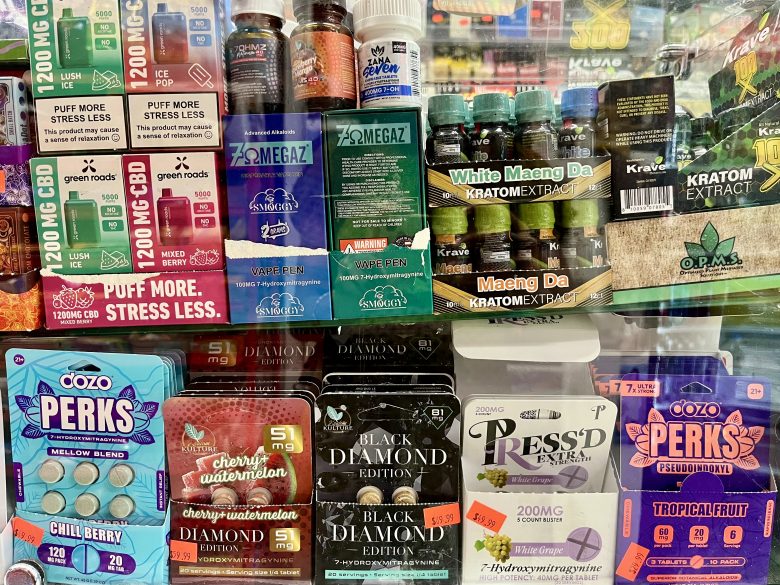

Aaron, we’ll call him, doesn’t want to give his real name. He has chronic back pain, but he’s on his feet all day, working in a San Francisco restaurant.
“I’ve been addicted to everything you could think of,” Aaron said on a recent August afternoon — from alcohol to the harder stuff.
Now, he has a new habit: 7-hydroxymitragynine, or 7OH, which he started taking a few months ago for his back pain. As we spoke, he exchanged cash over the store counter for the 7OH tablets, which sat in a glass case at the register next to brightly colored 7OH vapes and miniature 7OH shots.
Twenty dollars got him six tablets. Then, Aaron headed to work.
The 7OH compound is found at low levels in dried kratom leaves, a plant native to Southeast Asia. At low doses, kratom, which is often drunk in a tea, has stimulant-like effects, but acts more like a sedative at high doses.
Once extracted and concentrated, 7OH has effects not dissimilar to opiates like morphine or oxycodone, users say. Today, Aaron says he feels just as addicted to 7OH as anything else.
The difference is that it’s legal.
In the past year or two, 7OH has become widely available at smoke shops, corner stores, gas stations, and online, along with the lab-produced mitragynine pseudoindoxyl, or “pseudo.”
Public health experts say both 7OH and pseudo pose a real danger. They see them as untested and unregulated, with highly addictive properties.
“It’s a national concern,” said Dr. Keith Humphreys, a Stanford University psychologist who specializes in addiction.
7OH products are often marketed as “natural,” or under the guise of a “shadow medical system,” he added. But, so far, they aren’t held to any real medical or safety standards. Any outfit can obtain raw 7OH or pseudo components, press pills, and distribute them to smoke shops across the country.
Kratom has been sold across the United States for about two decades. While it is habit-forming, the Food and Drug Administration apparently has not seen it as posing a serious risk. It is not FDA-approved, but it has not been banned, either.
What little research has been done on the effects of 7OH and pseudo show that both “interact with opioid receptors and have been shown in animal experiments to be more potent than morphine,” said Oliver Grundmann, a researcher at the University of Florida studying kratom and its derivatives.
In other words, you need less 7OH than morphine to have the same effect, at least on a test animal.
Even though 7OH and pseudo are much more powerful in their effects, both are widely marketed as being the same product as kratom. Users and researchers warn that confusing them is misleading and dangerous, and could lead casual kratom users to become inadvertently hooked on what Grundmann’s research calls “de-facto opioids.”
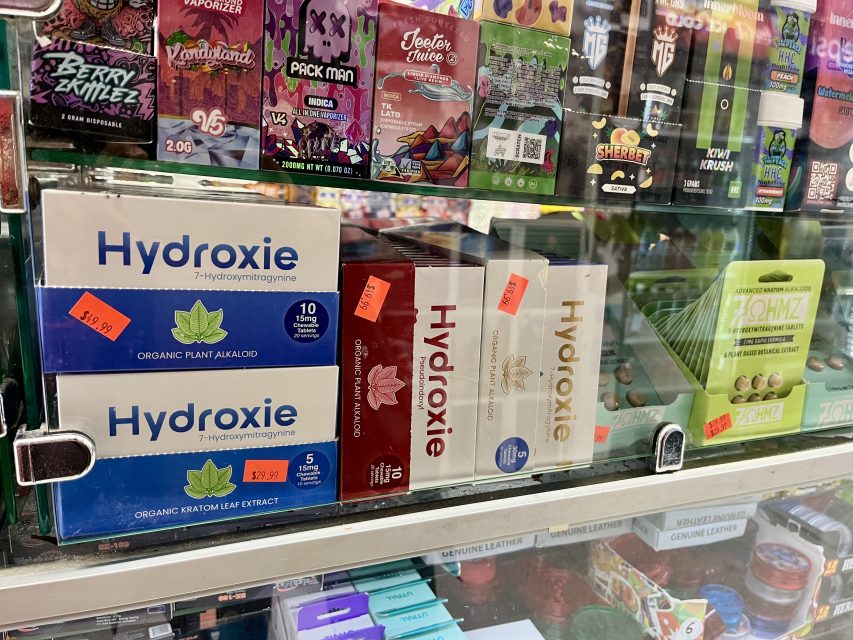
At Cigarettes for Less, on Market and Jones streets, for example, an assortment of 7OH tablets sit beneath large packets of kratom powders lining the wall: Oh-Mega brand 7OH tablets in strawberry, blue raspberry, and “natural” flavors; Hydroxie brand 7OH and pseudo, with a green leaf logo and “organic” label; and ON-7s — the ON stands for “Occurs Naturally” — which comes in strains that include “energy,” “relief,” and “focus.”
The prices aren’t cheap: Three 20 mg tablets of ON-7 run $25. At Gazebo Smoke Shop in the Tenderloin, customers encounter a large “Hydroxie” sign upon entry, and five 15 mg tablets cost $45.
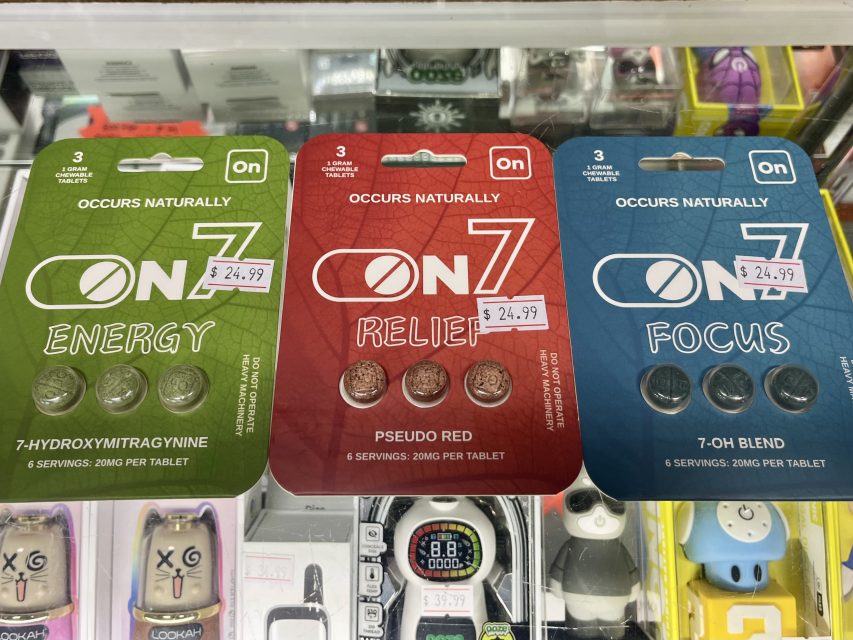
Just down the street, another shop carries 7OH vapes, berry or tropical fruit flavored 7OH “Perks” (alluding to Percocet), and 7OH tablets labeled “plant based botanical extract.”
A government crackdown: Preventative or premature?
The federal government and states are starting to take action.
On July 15, the Food and Drug Administration issued warning letters to seven companies, including Hydroxie, for “illegal marketing” of 7OH.
The letters allege that companies like Thang Botanicals and Relax Relief Rejuvenate Trading have added 7OH to food products and dietary supplements and made unproven claims of pain and anxiety relief, despite its not being FDA-approved as food or a supplement.
Two weeks later, on July 29, the FDA recommended scheduling 7OH as a controlled substance alongside drugs from narcotics to cough syrup.
“Critically, 7-OH produces respiratory depression, physical dependence, and withdrawal symptoms characteristic of classical opioids, such as morphine, fentanyl, oxycodone, and hydrocodone,” the FDA wrote in a 24-page report.
“This public health threat is troubling and requires immediate and impactful policies to educate consumers and take regulatory action that limits access to 7-OH containing products.”
States have begun to take action, too: Last week, Florida banned 7OH, classifying it as a Schedule I drug like fentanyl and methamphetamine. Also last week, the Colorado attorney general restricted sales of kratom products with significant 7OH levels.
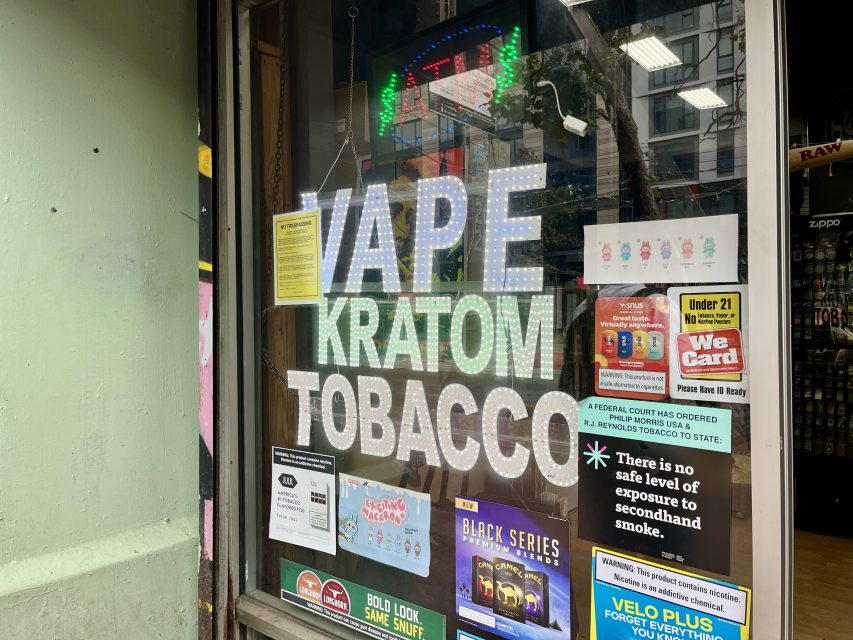
A California State Assembly bill proposed this year seeks to limit concentrations of 7OH sold in the state and regulate labeling and packaging but, for the time being, 7OH is available widely across the state. In San Francisco, multiple smoke shop clerks said they just began carrying products with 7OH in recent months.
Aaron has his reservations about a regulatory crackdown. The dependence he’s formed on 7OH, he says, is “less destructive” and has helped his pain. Still, he tries to warn other people of the risks.
“I tell people, ‘Be wary,’” he said. “Don’t replace one addiction with another.”
Researchers warn: Don’t let 7OH go the way of cannabis
Grundmann, the University of Florida researcher, disagrees with Florida’s decision to classify 7OH a Schedule I drug. When something similar happened with cannabis in 1970, he said, research into potential therapeutic effects ground to a halt.
“I really think that 7-hydroxy and … semi-synthetic substances should be studied — should be investigated for their therapeutic benefits,” Grundmann said. That said, he added, 7OH’s current availability was too risky to allow to continue unchecked.
“I do believe that at the moment they should not be on the market, because they are basically pure substances with a known pharmacological effect, acting on opioid receptors.”
In other words, as with any drug, Grundmann said, they should be administered with medical supervision.
Because it has a very short half-life, 7OH often remains undetected post-mortem, which means that it’s difficult to track in cases of suspicious death. Grundmann believes 7OH could be to blame for a recent, albeit small, increase in kratom-related adverse events reported by poison control centers.
Between 2011 and 2017, the U.S. Poison Control Center reported 11 deaths associated with kratom exposure, with only two of those solely attributed to kratom.
Just eight months into 2025, America’s Poison Centers saw 165 reported 7OH exposures, with 35 percent of those experiencing “serious health problems.” No deaths have been reported.
These numbers are nowhere near the incidents and deaths caused by other opiates. The U.S. Centers for Disease Control and Prevention’s National Center for Health Statistics reported more than 48,000 overdose deaths from fentanyl and other synthetic opioids in 2024.
The contrast has led some to believe that the new substances could offer hope for a safer pain treatment.
Katie Hill, a Yale School of Public Health epidemiologist and 7OH researcher, said that while she has surveyed users suffering harms of prolonged use of 7OH, others have been using it to limit their use of drugs that are potentially far more dangerous.
Hill, too, opposes “premature” scheduling of the substances.
“It seems to be a mixed bag of risks and benefits, and we’re still trying to weigh that out. We’re working on papers as we speak,” Hill said. “It might have potential in the harm-reduction space.”
Kratom advocates, meanwhile, want to distance the plant from products like 7OH.
“It’s unbelievable how quickly they’ve captured the marketplace, but they’re powerful products, and people think they’re taking safe kratom,” said Mac Haddow, a senior fellow on Public Policy at the American Kratom Association. “They’re getting suckered into buying these products, getting hooked on them.”
Dave, a corporate sales director from Southern California, said he was an active but casual Percocet user when he encountered Kratom a few years ago. He wasn’t sold on it but, when he found himself out of pills last year, he went searching for kratom at a smoke shop and was introduced to 7OH instead.
“This will get you buzzed,” he remembers the clerk telling him.
Before he knew it, Dave had effectively replaced his six-year low-dose Percocet habit with 7OH. Percocet seemed “kind of useless” in comparison.
“It’s like a limitless pill at first. You’re focused, your energy is on, you’re eloquent,” said Dave, who started off with 7.5 mg doses of 7OH. Within several months, he was taking more than 120 mg per day.
“By the fall, winter of that year, I was using it around the clock — including waking up at 3 a.m., taking one to continue to sleep.” He lost weight. His skin yellowed. His hair thinned.
Dave found that it was difficult to stop buying 7OH. In fact, it was difficult for him to stop buying things, period. Earlier this year, the normally conservative spender realized he had spent $4,000 just on golf equipment.
Dave wasn’t worried about overdosing, but still, he doesn’t believe something that addictive should be that easy to buy. “It should be administered, it should be prescribed,” he said. “I’ve never experienced anything like that … I’ve experimented with everything, and nothing was a problem to put down.”
Quitting 7OH
In May, Dave began to taper off 7OH aggressively, calculating his doses by the hour. He was fully off 7OH by June. He hasn’t gone back to Percocet, either.
“The whole experience was so scary and physical and mental that I just don’t wanna mess with anything like that again,” Dave said.
Aaron, too, has had to wean himself down to lower doses of 7OH more than once just within a few months. But not everyone can do so.
In a Reddit forum called “quitting 7OH,” users commiserate about their struggles to stop taking it.
“My story goes a lot like most with this substance … was under the impression it was a form of Kratom,” one user wrote. “3 months and thousand of dollars of later im dealing with an absolute fucking monster of an issue. I’ve tried quitting a few times but it’s extremely intense so fucking quickly.”
They ultimately used oxycodone to get off 7OH.
“In the last 3 weeks, I’ve relapsed three times after making it between 3-5 days through cold turkey withdrawal,” wrote another user. “I simply am not able to get off of this stuff while being in proximity (walking distance) to the smoke shop.” The user was planning to hike the Pacific Crest Trail to wean off it completely.
The clerk at Cigarettes for Less said he restocks 7OH products every three weeks or so. When asked if he knew that 7OH was addictive, the clerk shrugged. “I’m not that sharp,” he said.
Another store clerk in the neighborhood said that, in the last few months, 7OH sales have rapidly surpassed his Kratom sales.
He, too, declined to comment on whether or not 7OH was addictive. “We’re just a store — we sell whatever,” said the clerk, who asked that his shop name not appear in print. “We’re not out there to say we’re trying to save people.”
Sounds like a crock. I don’t hear about an epidemic of deaths from kratom. I think big pharma is missing their market share and now they have a foothold on the “news” and so called “science”… As long as jumbo jauffre is in office nothing called science can be trusted.
Complete bullshit. Peanuts cause more deaths a year than 7oh has total. Why should the people with proper self control be punished? Alcohol literally kills people… you cant go anywhere without seeing alcohol? Why attack a substance with a ceiling effect?
I will be forever disappointed over the inability of people to generate the smallest degree of empathy for folks that suffer intractable chronic pain. The tendency of certain individuals to assume a superior attitude that pain is something that can be ignored, denied, or otherwise, suppressed by willpower alone. Such individuals appear to lack the basic self-awareness that allows them to even feel pain within themselves. Consequently, they are indifferent to the pain that others are forced to endure 24/7. They pontificate on the on the evil of “addiction” while they themselves indulge in coffee, cigarettes, sugar, or any of the other addictions that surround us daily. Addictions to drugs, in and of itself, doesn’t need to be fraught with physical dangers. A properly regulated addiction, to any substance, may be be mitigated to allow someone to lead a normally productive and fulfilling life. The treatments for opiate addiction in this country is one of the cruelest and most hypocritical jokes ever perpetrated on a human being. Substituting Buprenorphine or methadone for illicit or prescription opiates does nothing to treat the underlying basis for the addiction. The massive and substantial evidence for the efficacy of Ibogaine therapy reveals the venal and exploitative strategy behind these so-called rehabilitative programs. The rush to outlaw alternative palliative approaches without allowing a path to recovery and cure, is typical of the establishments ignorance about the nature and aspects of human behavior surrounding addictions, habits, and the human sub-conscious and its inner workings. Ignorance is the the root cause of much of the suffering in this world. Ignorance in the hands of people in positions of power magnifies this suffering one thousands fold.
If we’re going to get rid of legal addictive substances, the key culprit is alcohol.
Even the guys in the story were able to curb their addictions, or manage on their own. If instead, one of them had gone to jail over this, things would have worked out much worse, all around. The War on Drugs has been an absolute failure.
Keep it legal! Liberty isn’t easy but it’s worth the little bit of pain associated with this compound! “Education” NOT “Prohibition”! We don’t need the Nanny State OR Big Brother involved with this because it’ll be half a century later before any form of it will be within reach of those who can benefit. Don’t let the lowest common denominator ruin another precious gift for ADULTS to enjoy!
“Critically, 7-OH produces respiratory depression…”
So that’s a bold face lie. Whats research has been done on it shows that it acts outside areas of the brain that cause respiratory depression, which is why it’s so important that it remain a healthy alternative for pain management and addiction. If it was causing deaths I could see why banning it might make sense, but as it stands the same exact arguments apply to it that apply to Kratom as to why it can be effective and should remain legal, all 7-Oh is a concentrated form of Kratom that’s extracted through mitragynine- it’s like saying we should ban THC wax but keep weed legal because wax is “semi-synthetic.”
If people wanna argue about keeping it out of headshops and maybe trying to change the marketing a bit I could see that, but all an outright ban will do is cause a spike in fentanyl usage/ODs, kick at least thousands of chronic pain patients off what is one of the most safe and effective medicines available, and personally wreak havoc in my life between my dad using it to get off alcohol/manage pain and my brother to go back to harder street opioids.
I can sum up what is written in this article in one word- Horseshit. As another commentator pointed out, where are the piles of dead bodies? 7-oh has yet to kill one person. Even in incredibly large quantities, it does *not* cause significant respiratory depression. It is absolutely amazing how these……articles(?) have suddenly popped up, spreading the word about how this is going to be some sort of 4th wave of overdose deaths. The only way that will come to fruition is if they DO ban it. Do your research. Dig deep. Overdose deaths have dropped significantly since 7-oh has found its onto the market. That is not a coincidence. If your goal is for more people to die then, by all means, ban it. This is all absolute horseshit.
You’ve got to be kidding. Put an age limit on it, fine, but it’s hurting less people than kratom. The government is going too far. Alcohol is legal, addictive, and kills folks (and those unfortunate enough to be in their path on the road) but this is getting pulled?
The most addictive drug out there is nicotine. Bar none.
Prohibition has never worked. It only raises the price to consumers.
From FDA:
FDA Takes Steps to Restrict 7-OH Opioid Products Threatening American Consumers
https://www.fda.gov/news-events/press-announcements/fda-takes-steps-restrict-7-oh-opioid-products-threatening-american-consumers
“There are no FDA-approved 7-OH drugs, 7-OH is not lawful in dietary supplements and 7-OH cannot be lawfully added to conventional foods.”
I am not asking for the FDAs blessing. I am saying that they need to leave it the hell alone.
RFK needs to amputate more money from FDA’s budget.
There is no such word as “preventative”. The word is “preventive”. Ignorance is bliss?
Robert —
Messrs. Merriam and Webster disagree with you: https://www.merriam-webster.com/thesaurus/preventative
JE
We really need to amend our Constitution to include the right to be left alone. That should be in there. Laws got out of hand a long time ago. When the Federal government used interstate commerce as THE excuse to regulate everything, our Country started dying. We had big government 50 years ago. Now, we have Big Brother.