

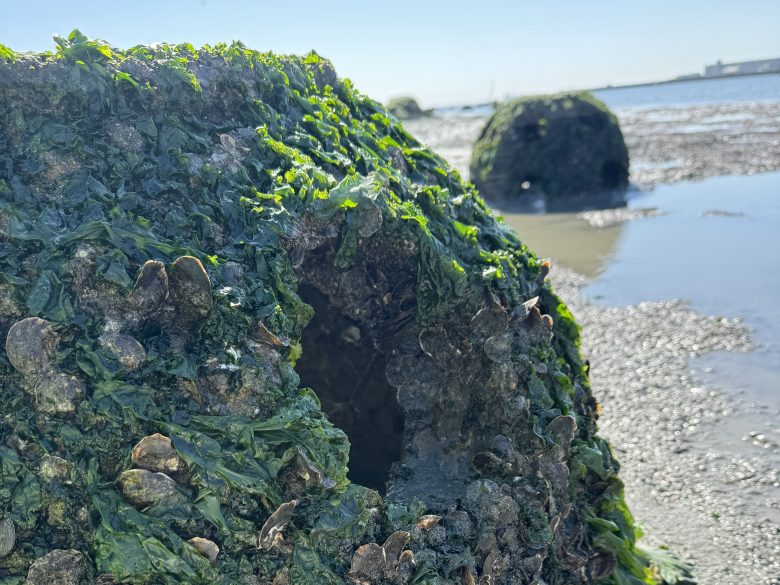

For much of the year, the oyster reef at Bayview’s Heron’s Head Park is hidden from sight below the waves, or under cover of darkness. But in the summer months, low tide coincides with daylight hours, and a flourishing oyster reef comes into view.
In these slivers of opportunity, Jivan Khakee, a graduate student at San Francisco State University, wakes up as early as 4 a.m. so he can go check on the native Olympia oyster reef, just half a mile north of the Superfund site where the Navy is still cleaning up radioactive and industrial waste from their Cold War-era activities.
The first thing Khakee does is don a wetsuit. It helps deal with the mud, he said. Next, he grabs a boogie board. Believe it or not, “they help you to kind of scoot across the mud flat to whatever reef you’re headed to,” Khakee explained.
Each morning he’s joined by as many as seven other surveyors, scooting across the mudflat by boogie board together, carrying clipboards for recording the organisms they see.
The group counts oysters, but also fish, crabs, shrimp, sea lettuce and anything else they come across on the oyster reef. Doing this can be a challenge when you’re groggy. “You have to be pretty good at counting very early in the morning,” Khakee said.
Even when they time the tide perfectly, working on the mudflat is a race against time — the flat is only exposed for about four hours at most. “We’re out there until the tide kicks us out,” Khakee said.

Heron’s Head Park is owned and stewarded by the Port of San Francisco. Its oyster reef project is funded by grants from the San Francisco Bay Restoration Authority, which derives its funding from the Measure AA parcel tax that voters in the nine counties of the Bay Area approved in 2016 to pay for projects protecting and restoring the bay.
Khakee works for the Wild Oyster Project, a San Francisco-based nonprofit that’s a partner on the reef project. He started out as a volunteer, working with local seafood restaurants to set aside their oyster shells so that they could become habitat for the native Olympia oysters. As larvae, oysters prefer to grow on surfaces containing their shell-making ingredient: calcium carbonate. Now, he is also one of the marine scientists recording data about the reef’s growth.
It’s a lot of work to attract a creature many don’t think twice about until it’s on a plate, but oysters are more than just a culinary delicacy. Oyster reefs protect coastal areas from storm surges. They also, said Giulio Salerno, deputy director of the Wild Oyster Project, reinforce the whole shoreline from erosion. And just like coral reefs, when oysters come back, so do other species.
The secret to fostering an oyster reef is creating the right conditions. One of the biggest threats to oysters is drying out, so providing shade was paramount to nurturing a thriving oyster community. To do that, the project at Heron’s Head placed wiffle ball-shaped concrete structures, each weighing 200 pounds, along the beach. They attached bags filled with oyster shells to the inside of each ball to entice drifting oyster larvae to settle there.
Moving 60 of these concrete structures onto the shore at Heron’s Head was quite an undertaking. The balls arrived at Heron’s Head on a barge and were offloaded by crane and placed on the shore where they remain to this day.

So far, the reef is doing well. When Khakee surveys oyster beds elsewhere in the Bay, he commonly observes densities of 50 to 100 oysters per square meter. Instead, in 2024, their survey of the oyster balls found an average of 1,006 oysters per square meter — an increase of more than 250 percent from the first year’s survey in 2023 and far exceeding the project’s expectations.
Khakee and the rest of the team wrapped up their annual survey of the reef last month. It was their third year of monitoring, and although their results have not been officially published yet, Khakee said the number of oysters is holding steady, likely on par with last year’s impressive count. They’ve still got a ways to go — the population of Olympia oysters in San Francisco Bay is only about 1 percent of what it once was.
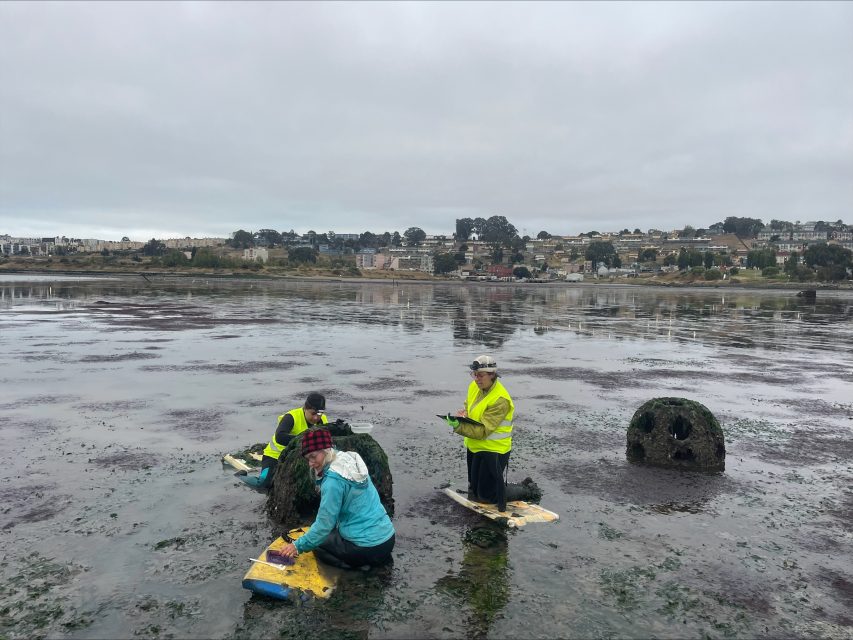
With clipboards and boogie boards, surveyors carefully record the organisms growing on the oyster reef balls. Photo courtesy of Jivan Khakee and Chela Zabin. 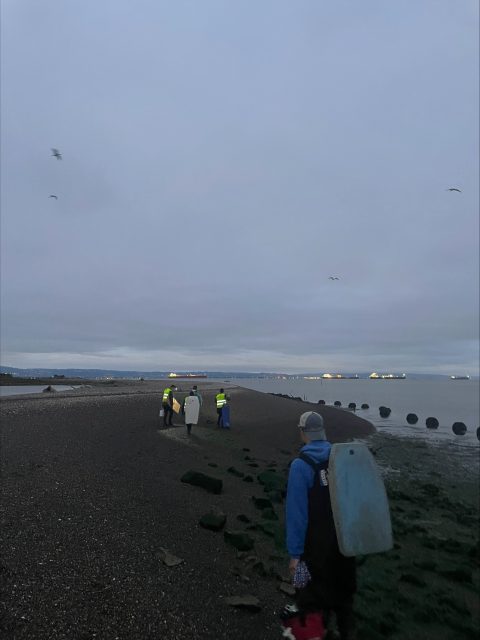
The morning trek out to the mudflat where the oyster reef is located. Photo courtesy of Jivan Khakee and Chela Zabin. 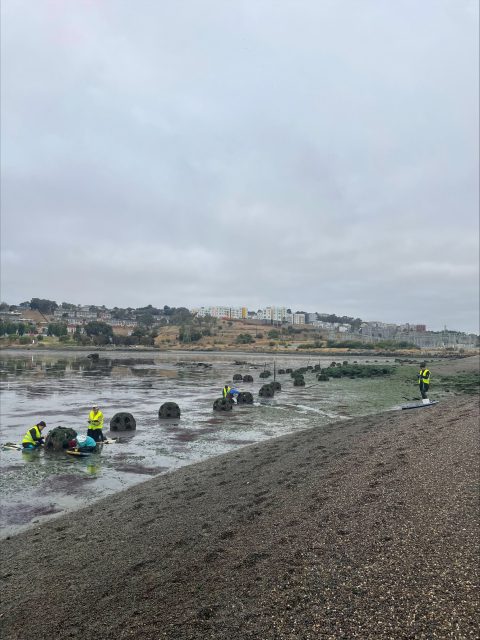
Scientists survey the 60 oyster balls at Heron’s Head Park. Photo courtesy of Jivan Khakee and Chela Zabin.
Already, parkgoers are noticing more birds frequenting the park, likely drawn by the increase in aquatic life in the mudflats, brought by the reefs. “I have seen lots of gulls, oystercatchers and egrets stalking the shoreline,” Khakee confirmed.
Still, Khakee says a young reef like this is just getting its sea legs. It could be wiped out unexpectedly by an algae bloom or an abrupt change in salinity. Oysters are tough, but they’re not invincible. “We’ve had project failures in years three and four. You don’t want to count your chickens,” Khakee said.
Scientists will continue to monitor the reef until the 10-year mark in 2032. At that point, if the oysters are still thriving, he thinks the reef will be there to stay.
In the meantime, Khakee delights in continuing to watch the reef grow despite the 4 a.m. wake-up time. “I’m such a sucker for finding a cool thing in nature,” he said.
Yay Mission Local for covering this. Kudos to Wild Oyster Project. Thanks to Linda Hunter for having the vision, energy and tenacity to start and grow the organization. Also, thanks to Carol Bach without whom Herons Head could not have happened. I always ask seafood purveyors to consider donating their oysters for bay habitat restoration.
Great article. In a followup article it would be great to know if oysters from here will ever be eaten or if factors like their limited number or pollution in the bay might prevent that.
It will be a long time before you can eat them. Too much heavy metals, chemicals and radioactive material in the muck from the Navy’s operations at Hunters Point. I’d be interested in knowing what radionuclides and amounts are detected in the oysters. Has that been studied?
Have you seen the infamous photo of naval vessels near Bikini Atoll, surrounding an underwater atomic bomb test with the mushroom cloud rising in between them?
Those vessels were towed to Hunter’s Point and attempts to decontaminate the vessels with steam and sand blasting in order to return them to service failed. The vessels were too radioactive to be reused and the contamination removed by the cleaning activities went into the bay and the silt.
I’m not entirely sure where they were scuttled, after they were unsalvageable, but the Gulf of Farallons National Marine Sanctuary seems likely. It’s the USA’s largest underwater radioactive waste dump site.