

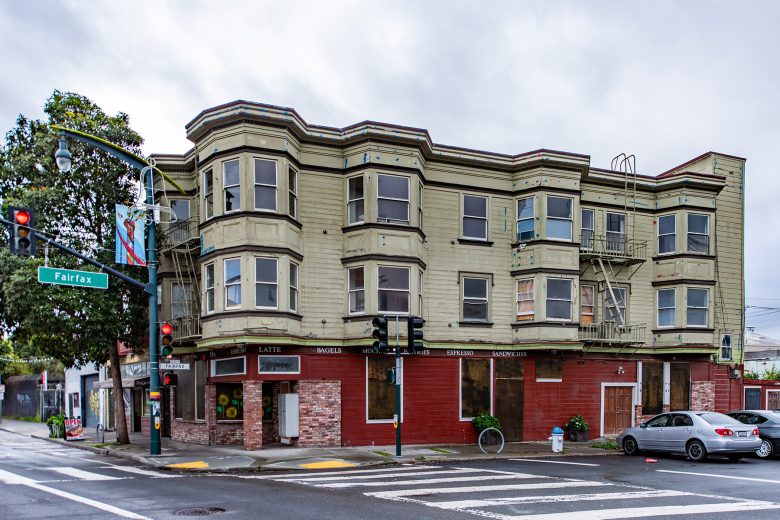

A three-story building at the corner of Third and Fairfax streets in Bayview-Hunters Point will soon become the latest addition to San Francisco’s stock of temporary housing for homeless adults, a major priority for Mayor Daniel Lurie in his first year in office.
Last week, San Francisco’s Homelessness Oversight Commission approved a $3.7 million grant for a transitional housing program for young adults at 3900 Third St., a building that has seen better days: Its pale green paint has begun to chip, and a corner cafe has been boarded up for nearly seven years. The cafe’s windows, in a sign of past times, are still decorated with brightly painted sunflowers.
Inside, two floors of single-room-occupancy units have sat empty for nearly a year — units that, come November, will welcome 19 new residents between the ages of 18 and 27. All are either homeless or have recently been released from custody.
Third Street Youth Center and Clinic, a Bayview nonprofit, will run the program, along with the Department of Homelessness and Supportive Housing. The nonprofit acquired the property in September 2024 from a private landlord who rented out the SROs. Since then, it has sat empty.
Joaquin Guerrero, a Commissioner of the Homelessness Oversight Commission, said that Third Street Youth Center and Clinic is a “model” for shelter programs that are “led by and for community.”
He is “just really excited that this is happening,” he added at last week’s commission hearing. “You have a fan club right here.”
Department of Building Inspection complaints at the address over the last few years, while the property was owned by Servio and Martha Gomez, describe peeling lead paint, a failure to report how the units were being used, and complaints about the abandoned storefront on the first floor.
The move comes as Lurie seeks to expand temporary homeless housing and increase the number of shelter beds across the city. In July, the Board of Supervisors approved Lurie’s proposed changes to Prop. C of 2018, which diverted funding intended for permanent housing toward temporary shelter, a decision that caused a stir among housing advocates and supervisors.
Though the units at 3900 Third St. are intended to be temporary, housing the young residents for up to three years, city officials said transitional housing is very different from a shelter.
Homeless Oversight Commissioner Joaquin Guerrero, who called Lurie’s decision to redirect funding away from permanent housing “ridiculous,” said transitional housing is “extremely effective” at last week’s hearing.
Such housing helps at-risk youth get connected to social services and develop the life skills to eventually become tenants elsewhere, he said. If tenants can’t find housing within 36 months, they can potentially stay longer, the Department of Homelessness and Supportive Housing says.
Joi Jackson-Morgan, the director of the Third Street Youth Center and Clinic, said neighborhood support has been strong. A community meeting she held there last month was the “fastest” she had ever hosted.
One business owner next door to the site, however, told Mission Local he was hesitant about his incoming neighbors.
Renato “Ray” Guerrero, the owner of La Laguna, a taqueria at 3906 Third St., says he didn’t go to the meeting — he felt there wasn’t much he could say to stop the project from moving forward. He’s “a little nervous” about a “halfway house” opening up next door, he said, and what it could mean for his business.
Still, Guerrero said he “hoped for the best,” and may even try offering the young residents tacos at a discount.
“I need all the help I can get,” said Guerrero, who says foot traffic has been slow on the Third Street corridor.
Arieann Harrison, a Bayview resident and former case manager for homeless San Franciscans, was excited. “They need somewhere like this,” she said, pointing to the building encased in scaffolding.
Young people she’s worked with, Harrison says, are vulnerable in shelters and other housing programs that aren’t targeted toward youth. They often return to homelessness.
“It becomes a cycle,” said Harrison. “Once you get out, you just go back to the streets.”
The 3900 Third St. project is part of a larger endeavor spearheaded by the Urban Institute and the MacArthur Foundation that aims to provide housing solutions for incarcerated and recently released people across major cities.
The building on Third Street will receive a mix of funding from the city, the state’s Homelessness Housing, Assistance, and Prevention Grant, and the MacArthur Foundation. The city funding specifically will help revitalize the building and pay for support staff, case managers, and wellness services to help residents exit the program, find housing, and adjust to life outside the justice system.
3900 Third St. will be the second transitional-aged-youth housing complex the Third Street Youth Center has opened and operated in San Francisco.
Construction is expected to finish in October, with residents moving into the building in November. The program will receive funding from the grant until at least June 2028.
“Our staff are more than willing to go above and beyond for this population that has been overlooked for a long time,” said Jackson-Morgan of the Third Street Youth Center, at the Homelessness Oversight Commission meeting. “It’s time to bring 19 young people home.”
that’s nice to hear. There are a lot of buildings that could be used for this. If the City literally bought the property, then it would be an investment and not an outright loss. Moreover, if they bought some crappy building that had “good bones”, but needed renovation, I’m certain that some youth from the other homes could be paid a fair wage to work as interns to build up skills and some connections with local construction people. Painting, spackling, basic dry-wall, simple flooring, or even just demo work and cleanup can be done by a 19yr old with no skills.
We could literally enhance the city and save these kids.
Unfortunately, none of the big political donators would make piles of money, so politically, it’s probably a dead end.
After the massively costly vehicle triage center debacle in the Bayview, I am happy to see this approach being taken, providing actual homes for the homeless. This could turn around the lives of these young people. And I love the idea suggested by D3 above of paying them to work on the building, which would give them skills that will help them longterm.
There goes the neighborhood….or more accurately, it already went, but now it’s going even more. The 2014-2017 blip of lasting improvement to Bayview just petered out. All the money the city dumped into “improving” Bayview and 3rd street largely failed. Simply put, the free market didn’t follow suit, and the neighborhood was unable to attract enough more financially sound residents or repeat patrons to 3rd street. So all you haters of gentrification can celebrate- Bayview is basically unchanged since it’s first bout of improvements ~2007 when the light rail went in. Going on 20 years now…it’s the neighborhood of broken dreams and promises.
Hopefully all of the remnants of the clandestine auto body shop that operated in the back of that place for the last 25 years got all cleaned up and cleared by the EPA before any tenants move in.
I’m going to go out on a limb and state that fiberglass and industrial automotive paint particles are not suitable for healthy living conditions.
Hi and thanks for supporting the citizens who are in need.Please i need low income or senior housing,asap.My email Abtahi4@yahoo.com
This is amazing, us Bayview residents are exited for TAY housing and we are anticipating the opening. We have always been Family/TAY centered and this program will be beneficial for both long-term residents and the TAY coming in.
Surprise! Yet another locally undesirable land use (LULU) clustered on the east side so that the “nice” neighborhoods needn’t be bothered.