

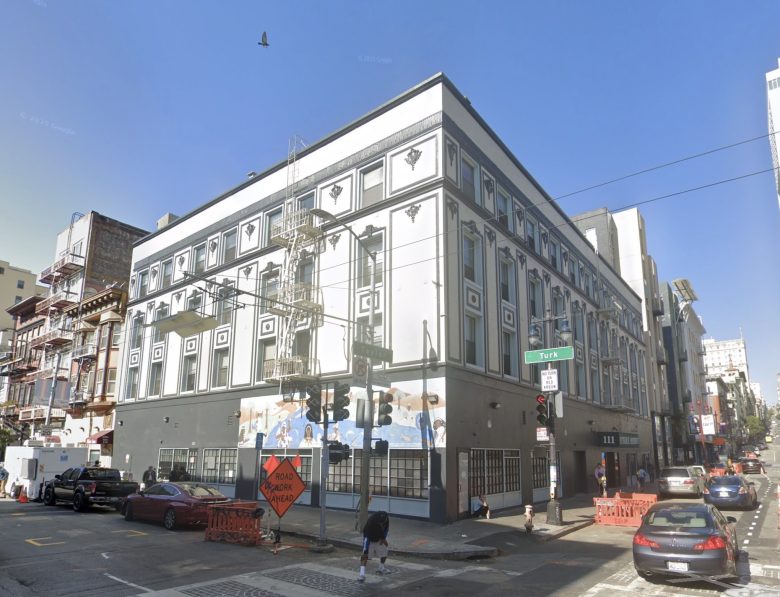

San Francisco activists and scholars seeking to reclaim the site of the historic Compton’s Cafeteria Riot in the Tenderloin will present an appeal today that they hope will be a first step to oust the private prison operator that has used the site as a transitional housing facility for over 30 years.
The advocates want to turn it into a more community-oriented space.
The facility for formerly incarcerated people is run by the GEO Group, a for-profit company based in Florida, which runs prisons, immigration detention centers, and reentry facilities like the one at 111 Taylor St. in the Tenderloin.
That use, advocates say, goes against the spirit and historical significance of the location. In 1966, the ground floor of the five-story building was a 24-hour diner in which a riot broke out between trans women and San Francisco police. The Compton Cafeteria Riot became a symbol of queer resistance, even before the more well-known Stonewall Uprisings.
The building became the first this year to get federal landmark status for its role in the transgender movement, and sits in the first legally recognized Transgender Cultural District in the world.
The Planning Department issued a letter of determination in January reaffirming the transitional housing center’s status at the Taylor Street address.
A coalition of activists and historians filed an appeal in May of that decision, saying that it was inaccurate. The appeal will be heard today before the Board of Appeals.
Chandra Laborde, who is leading the appeal, called today a “key moment” in the fight to reclaim 111 Taylor.
After years of organizing around the location, the TurkxTaylor coalition timed their zoning appeal in hopes of preventing the renewal of GEO Group’s contract with the California Department of Corrections and Rehabilitation, which ended in June.
That contract was renewed, according to Sen. Scott Wiener’s office, but the activists are still pursuing the appeal.
State legislators like Wiener and Assemblymember Matt Haney have stepped in to show their support for the appeal.
In a letter submitted to the Board of Appeals, Wiener and Haney called the location “ill-suited to be used by a multibillion-dollar for-profit private prison corporation with a documented history of zoning violations and deep contractual ties to Immigration and Customs Enforcement (ICE).”
Laborde and others say GEO Group’s parolee reentry services are more intensive than those permitted under the Group Housing classification that 111 Taylor is currently zoned as. She pointed to headcounts, curfews, and breathalyzer use, as well as extensive services that qualify the place as an institutional or residential care facility.
“GEO Group currently operates not only licensed transitional housing at the site but also parolee reentry services,” Laborde wrote in her appeal that “These include intensive supervision, mandated curricula, and a population exceeding 90 residents — a scale and intensity far beyond what is permitted for Group Housing.”
Attorneys for GEO Group called for a denial of the appeal, stating that the center “has existed and served the same population in the same capacity and at the same intensity for 36 years.”
In a brief, they said that about 200 formerly incarcerated people live at the center and rejected claims that the space is a prison.
“Ironically, if Appellant succeeded in this liberation mission, the hundreds of persons that rely on the Center could remain incarcerated,” the brief warned.
The attorneys also argued that GEO Group has tried to commemorate the history of the space by returning a cafe to the ground floor location where Compton’s Cafeteria once sat.
Zoning Administrator Corey Teague also called for the board to deny the appeal. He noted that 10 prior letters of determination confirmed the space was being used for group housing, and that the Planning Department is not responsible for enforcement if GEO Group is misusing the space.
In any case, for years trans and LGBT advocates have argued that the location’s historical significance should allow the space to be used for purposes better aligned with its history, and that the city should support this effort.
Janetta Johnson, a former resident at 111 Taylor St. who helped found the Transgender Cultural District, said that GEO Group is not a good fit for the location. The Tenderloin is often “not conducive” to recovery for those leaving the step-down program, she said, and keeping people in captivity at a place symbolizing resistance and liberation is counterintuitive.
“My hope for that building is that that becomes senior housing for queer trans GLBTQ community members,” Johnson said.
Sister Anya Streets, a drag queen who also lived at 111 Taylor St. after serving a prison sentence, said that creating a transgender cultural district in the Tenderloin was performative, unless it is accompanied with conversations about policing and the history of the movement.
“GEO does not have to be there. It’s not necessary for the city,” Streets said. “What’s necessary for the city is to go back to its roots … remember what made San Francisco as diverse as it is, and as forward-thinking as it used to be.”
Ass. Matt Haney, nice.
Unlike Stonewall that was etched in gay and lesbian’s minds since it happened, Compton’s was forgotten and not remembered until it was unearthed from archives by Susan Stryker, decades later.
“The Tenderloin is often “not conducive” to recovery for those leaving the step-down program”
Apparently it is now city policy to cluster such facilities where “clients” will have the worst chance of turning their lives around.
Let’s see if the supes favor trans people in the TL and give the finger to at risk students at Marshall.
I lived around the corner at 160 Eddy back in the 1990’s and I had a police-radio, a crystal job with two channels and I heard these super-fast shots being fired outside so I switched on the radio and it came over from Police Dispatch that shots had been fired at that building and they described the weapon as being either an UZI or a Mac-10. A disgruntled ‘guest’… Shootings were regular back then.
I support the idea of 111 Taylor St.
Facility being turned into housing for LGBTQIA Veterans Senior Housing .