

Starting Oct. 1, a new policy will allow homeless families to stay in San Francisco shelters for 90 days, and receive unlimited 90-day extensions.
Under its current policy, the Department of Homelessness and Supportive Housing allows only a 90-day stay with 30-day extensions.
Families currently in shelters will receive a blanket 90-day extension to bridge the gap between now and Oct. 1. Under the new policy, 90-day extensions will be granted to families meeting eligibility requirements, which include making progress toward finding permanent housing.
The 30-day extension policy was imposed in December 2024, reverting to a pre-pandemic practice. During the pandemic, families had been allowed to stay until they found permanent housing.
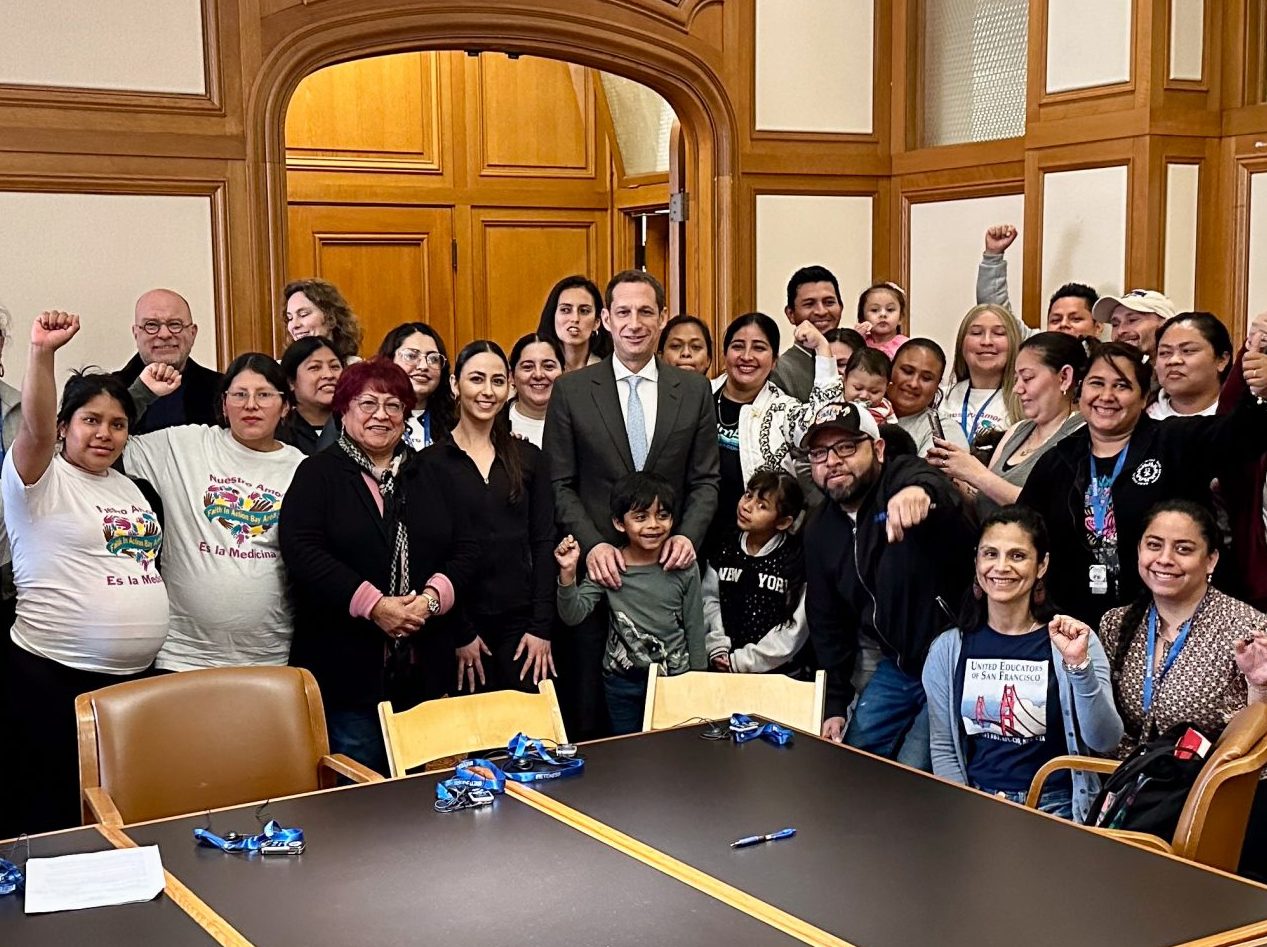
Mayor Daniel Lurie met with homeless families in late February, promising them that as long as they made “positive progress” towards getting permanent housing, they wouldn’t get evicted. Nonetheless, a few days later, around two dozen families received eviction notices.
After protests and media coverage, several of these families were able to get additional 30-day extensions. Soon after, District 9 Supervisor Jackie Fielder introduced legislation to expand the limit on shelter stays to a year.
Most of the families are immigrants and newcomers to the country.
Feng Han, a legislative aide to Fielder, said that the 90-day extension policy was the result of negotiations between the homelessness department, shelter providers, the families in the shelters, Fielder’s office, and Faith in Action, a nonprofit that has been working closely with homeless families.
Han said that, while the families initially wanted a year, they were willing to go down to 270 days, which could be achieved with two extensions under the new policy.
“This updated policy leads with compassion for those in shelter trying to provide for their families while helping them access permanent housing opportunities,” said Lurie in a statement.
“And it will help encourage flow in our system, opening up much-needed space for families on the street right now. When government isn’t afraid to try things and listen to feedback, we can craft thoughtful, effective policies, and that’s what we’ve done here,” he said.
In a press release about the new shelter stay policy, Fielder’s office also mentioned that the Board of Supervisors had secured $30 million for housing families and transitional-aged youth, young adults who are 16 to 24.
This money comes from Proposition C, a 2018 ballot measure that raises money for homeless services. This year, the mayor proposed shifting $89 million earmarked for permanent housing toward temporary shelters instead. Eventually, the Board of Supervisors negotiated that $89 million down to $34 million.
“This package is a major win for families who have been asserting that the most effective strategy to resolving long family shelter waitlists is to invest in housing,” Fielder’s office wrote in the press release.
A referenced ML article here (https://missionlocal.org/2025/04/sf-shelter-stay-limits-immigrant-families/) says that “about 90 percent of all shelter residents in San Francisco are newcomer monolingual Spanish-speaking families,” where as the famous 2023 statewide UCSF study on homelessness says that “contrary to myths of homeless migration, most were Californians: 90% of participants lost their last housing in California.” It’s not apples to apples, but that’s a surprising difference. Which is closer to the reality? If it’s the former, one has to wonder if the epicenter of housing unaffordability is the most promising place to find permanent housing for brand new immigrants to the US… which, admittedly, reads like a callous anti-immigrant take in today’s climate, but that’s not the intention. How can a national or regional problem like homelessness be solved when it seems that it’s up to big cities to do it alone in a vacuum?
Where are they from?
Why do they expect the taxpayer to pay their hotel/shelter costs ?
Medical bills and food?
Until SF is willing to also pay everyones housing and medical bills etc , I dont think this is fair .
Temp shelter for a month maybe ?
Dont have kids if you cannot pay for them
Dont come here expecting others to foot your bill?
Taxpayers get nothing .
Truely harm is being caused to the taxpaying residents of sf .
After their needs are met then we should be helping others .
We are paying and live in a lawless drug infested garbage dump .
When can I be able to actually walk out my door and not encounter a drug zoombie and blocked sidewalk or drug deal going on ?
Look around
amazing. i used to be a teacher for a title 1 school and had taught many homeless children for years. people dont understand how much these childrens’ lives are impacted by having to shift from shelter to shelter… 90 days is just simply not enough time for parents to establish a community and hold down a job! (in regards to the homeless students i taught, a majority of them only had a single parent.) when your resume only lists employment at sites for only 3 months at a time, many housing units won’t even bother to consider you as a tenant. an extension for these families has been needed for a long time.
Hey, I voted for permanent housing when I marked Yes on Prop. C. Thwarting the will of the voters is not cool.
You voted for a measure that earmarked a lot of money for a range of things but which also had to contend with the unitary budgetary authority of the Mayor and a provision allowing bypassing the spending plan by the Board.
This is why I could not vote for Prop C, because it gave the conservatives resources to screw progressive priorities.
If advocates can’t make a go of it with Prop C, if the advocates lost every punitive ballot measure that comes at them for like 30 years, then it is clear that the advocates are not going to be advocating us towards either making progress towards ending homelessness or disarming the political kill switch that homelessness has become for what once was San Francisco progressive politics.
Tell me about it.
The City just settled on a lawsuit with the CoH.
And the fuck up it is, even when the City’s LEGAL counsel said it’s a bad idea, does it anyway.
>Changing those funds, which were generated from a 2018 ballot measure tax on business that make over $50 million in gross receipts, has been controversial because it gives Lurie powers that weren’t set out in the measure. The city attorney’s office has warned that approving these changes opens the city up to lawsuits.
Here’s lawsuit #2, San Francisco boogaloo.