


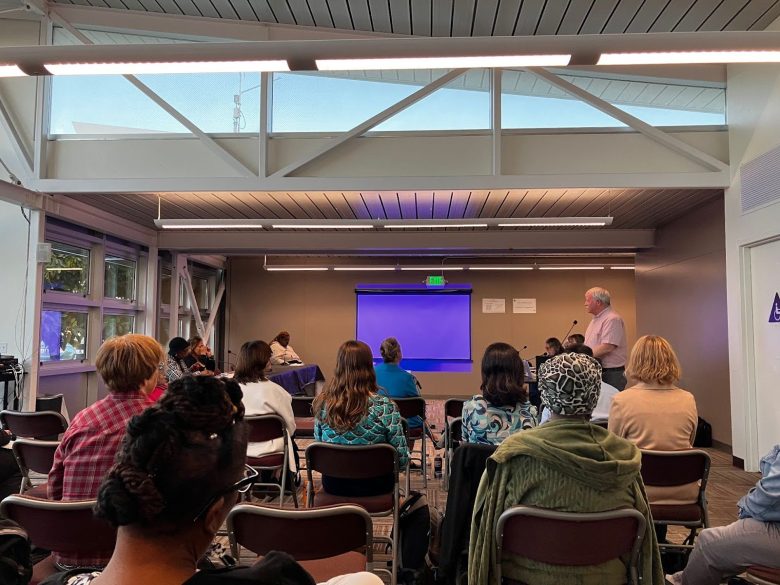

Bayview residents have nothing to worry about currently, in terms of radiation exposure from the former Hunters Point Shipyard, said Dr. Kathryn Higley, Community Technical Liaison for Radiological Health and Safety for the United States Navy at a meeting of the Hunters Point Citizens Advisory Committee on Monday night.
In fact, said Higley, the low-level radiation exposure for residents living near the “radiologically impacted” Navy buildings in the Shipyard’s “Parcel G” when they are demolished in February of next year is no more than those residents would be exposed to on a weeklong trip “going to Mt. Rushmore,” where naturally occurring radiation is common, said Higley.
The blowback was immediate.
“I don’t like when someone says ‘low-level radiation’ like it doesn’t affect us, because it does,” said Lonnie Mason, a Bayview resident. Mason has lost three family members, including a 5-year old child, to cancer, he added. “Whatever anyone says, we have a problem here.”
“Teasing out the reasons for [cancer] is a very very complicated effort, and there are a lot of confounding variables,” said Higley. Radiation levels at “Parcel G” average just over one “millirem,” a unit of measurement used to quantify radiation.
“Not even detectable,” remarked Higley, though she added that researchers “cannot tell” if any measurement of radiation under 10,000 millirems would “have an effect or not” down the line.
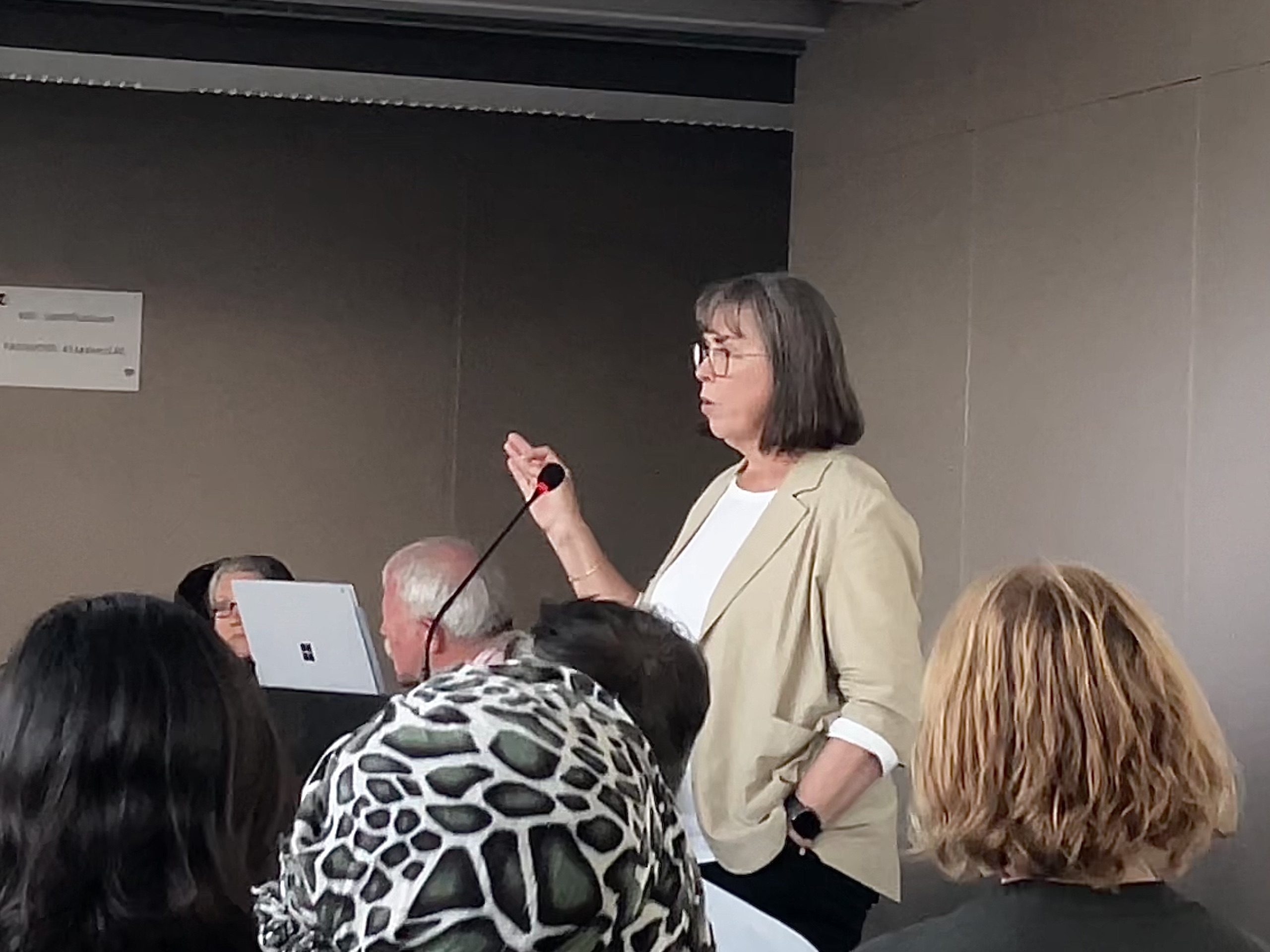
While Higley cited studies, residents argued that her reassurances didn’t ring true next to their lived experiences. “My sister is gone, my cousin just died, a childhood friend died last month, his sister died a year ago of lung cancer, my sister died three years ago,” said Mason.
Another audience member pointed out that one of the figures cited by Higley in her presentation was from a paper funded by Tetra Tech, a company the Navy contracted for cleanup.
In 2018, an investigation by the Navy into Tetra Tech’s data found that almost half of the work done by the contractor to clean the heavily polluted former shipyard was either outright fraudulent, or dubious enough to require retesting. Parcel G, once home to a nuclear radiation laboratory, was at the center of that scandal.
Higley’s was one of three presentations given at the meeting that night, but Higley’s talk drew the bulk of the outrage from Bayview-Hunters Point residents.
Before Higley’s presentation, Michael Pound, the Environmental Coordinator for the cleanup of the former shipyard, offered updates on the remediation of parcels G, C and B.
All “Parcel G” buildings were scanned for radiation at least twice, Pound said. When contaminated equipment and building parts were detected, those were removed, and the building was scanned again, until each building met Navy radiation standards. Now that the buildings are deemed safe, demolition is set to begin in February.
In a separate presentation Lila Hussain from the San Francisco Office of Community Investment and Infrastructure detailed the plans and progress of a third-party study of how projected sea level rise will impact the former shipyard. The study, said Hussain, was motivated by community concerns.
As sea level rises, Hussain explained, groundwater rises too, causing flooding and, potentially disturbing radioactive waste. Hussain couldn’t say much more than that — the research, she said, is still in its early stages. The results of that research, and any recommendations, would be presented to the community in a draft review in November.
Further questions from the audience were cut off in the interest of time, with many residents expressing disbelief at statements that the former shipyard no longer poses a threat to the community.
Residents and officials left the meeting at an impasse. Residents would have more chances to voice their concerns and hear from Navy officials, the organizers said.
The next update to the ongoing cleanup will be announced at the Citizens Advisory Committee meeting on September 22. The completion of the cleanup of the final area, Parcel F, is tentatively planned for 2029.
“You need to get to [these] meetings, “ said Dr. Veronica Hunnicutt, the committee chair, rising from her seat to face the audience directly. “We want you to be aware of what is happening, we don’t want misinformation out there. Get up in this booth … so that these questions can be answered by people who know.”
“While Higley cited studies, residents argued her reassurances didn’t ring true next to their lived experiences.”
Isn’t “lived experience” just an euphemism for anecdote?
Given the choice of believing an expert scientist and studies, or a tiny set of amateur anecdotes, wouldn’t it be prudent to believe the expert?
Not if her analysis is based on phony data:
“Another audience member pointed out that one of the figures cited by Higley in her presentation was from a paper funded by Tetra Tech, a company the Navy contracted for cleanup. In 2018, an investigation by the Navy into Tetra Tech’s data found that almost half of the work done by the contractor to clean the heavily polluted former shipyard was either outright fraudulent, or dubious enough to require retesting.”
People would trust them more if they weren’t caught lying the first time around.
It makes it a lot harder when they spent millions to do a sham helicopter survey, pretended that was all that was required and used it to ram through development without actually doing the testing required to know. How does the public recover trust after such a long-lasting series of lies? I’m asking, I don’t know how.
HP shipyard has been a huge disappointment regarding its housing potential, and consequently hardly anyone wants to live there. It is very isolated, has zero commercial or retail, and is still disconnected as ever from the rest of bayview, not to mention SF. New construction condos are selling for under $600 PSF, and developers can’t make a decent profit, which is another reason it’s stagnating. The whole thing has been an abject failure, and is another major SF housing initiative to file under the category broken dreams and promises.
Since the closure of the Navy Shipyard in 1974, Hunters Point has become a space where diverse populations are living and working side by side. I would be interested to find out how diverse, economically structured populations are affected by close and intimate contact with former radioactive sites. I would add that much of the waste was not just radioactive; there are heavy metals, petroleum products, and other industrial waste left over both by the Navy and subsequent ship-breaking operations that rented the docks after 1974.
Do you mean that Hunter’s Point Shipyard does violence to indigenous people’s sacred sites too?
?