


The war for freedom of expression is never won, but some of its most significant battles took place in the middle decades of the 20th century. And perhaps no publisher saw more action than Barney Rosset.
As the founder of Grove Press and its quarterly spinoff, Evergreen Review, Rosset championed writers, including William Burroughs and Henry Miller, whose work was at the center of landmark U.S. Supreme Court decisions that curtailed government censorship.
For Pat Thomas, the historian and editor of the newly published anthology “Evergreen Review: Dispatches from the Literary Underground: Covers & Essays 1957-1973,” Rosset served as the essential bridge between the Beats and the fluorescence of radical culture that followed.

“Along with the folks like Allen Ginsberg and Timothy Leary, Bob Dylan and the Beatles, Barney Rosset created the 1960s,” Thomas writes in the introductory essay. “He … always supported ‘the underground’ (that was his catch phrase in any advertising for the Evergreen Review); he loved writers that came with a new way of looking at the world, capturing it with words that weren’t commonplace in earlier books.”
Now living in Los Angeles, Thomas revisits the Bay Area for an Aug. 4 event at the unique Oakland gathering spot Clio’s Books, which is also a bar.
He’s joined in conversation by Heyday Books publisher Steve Wasserman, whose 2024 memoir, “Tell Me Something, Tell Me Anything, Even If It’s a Lie: A Memoir in Essays,” covers a good deal of similar ground. It includes Wasserman’s accounts of working and playing with the likes of Susan Sontag, Gore Vidal, Barbra Streisand, Christopher Hitchens, Orson Welles, Tom Hayden and Daniel Ellsberg.
Also a drummer and leader of the instrumental band Mushroom, Thomas then returns to the Make Out Room on Tuesday, Aug. 5 on a double bill with San Francisco singer/songwriter Sonya Hunter, who plays an opening set.
It’s where Mushroom debuted in 1997, delivering a blistering program of psychedelic jams inspired by prog, Krautrock and jazz fusion. This iteration of the ever-changing ensemble includes keyboardist Willie Aron, Rain Parade’s Matt Piucci on synth and guitar, Josh Pollock on acoustic guitar and vocals, and others.
While Thomas didn’t live in the Mission during his San Francisco period at the turn of the century, he was a denizen of the Albion, the long-shuttered dive on 16th Street with a backroom devoted to music. (It’s now home to a different dive, Delirium.)
He’s found the same kind of community at the Make Out Room, where Mushroom has become one of the venue’s house bands (a relationship documented on the album “Songs of Dissent: Live at the Make Out Room 8/9/19”).
His parallel pursuit has caused some confusion, as many people don’t realize that it’s the same Pat Thomas who’s delving into the back pages of various radical activists and artists.
But for Thomas, it’s a logical if multi-faceted path: It started in the early aughts, when he expanded his creative purview to reissuing neglected albums, like Aretha Franklin’s first five records for Columbia on vinyl, Public Image Ltd’s “Metal Box,” and protean guitarist Sonny Sharrock’s “Black Woman.”

Returning to college to earn a BA in American Studies, he ended up writing the PhD-worthy tome “Listen, Whitey!: The Sounds of Black Power 1965-1975,” a fascinating 2012 book focusing on music produced by the Black Panthers. More recently, he compiled and edited books gleaned from the archives of poet Allen Ginsberg and Chicago 8 defendant and Yippie party founder Jerry Rubin.
“I love playing live music,” Thomas says. “But as far as feeling a heartfelt reward, doing a book has become more of what I’m about these days.”
“Dispatches From the Literary Underground” is more of a visual than literary feast, with full-color reproductions of the front covers of all 100 Evergreen Review issues published from 1957 to 1973.
While there are numerous essays, poems, and letters reprinted exactly as they originally appeared, it’s impossible not to long for more. The second issue focused on the San Francisco scene, and helped put the Beat movement on the map.
“Note that Kerouac had not published ‘On The Road’ yet,” Thomas says. He credits Grove Press editor Don Allen with wisely curating the volume, “which propelled the Evergreen Review to become a literary contender nationwide while simultaneously catapulting the new generation of Beat writers to their first tastes of stardom.”
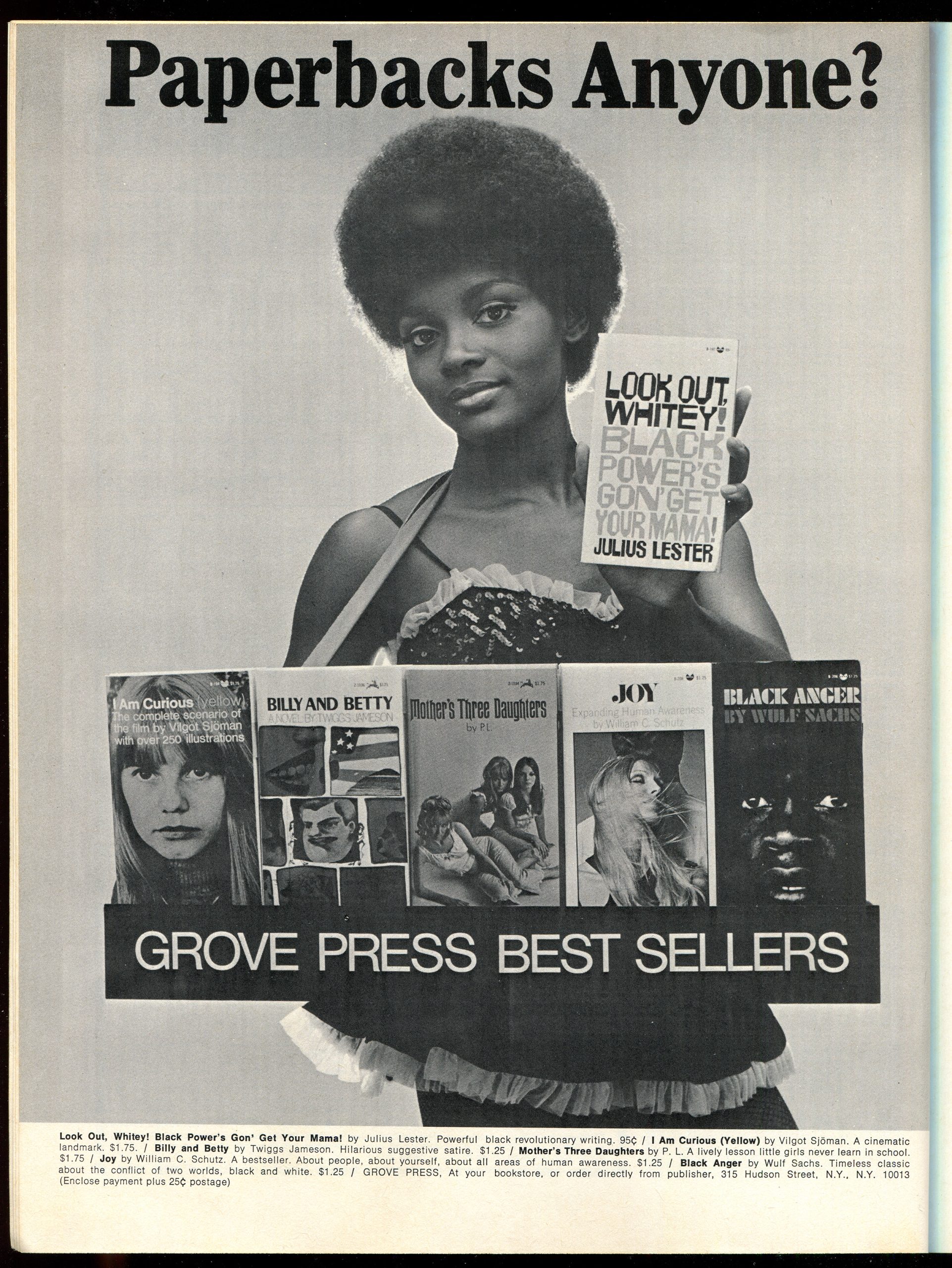
Thomas interviewed may of the 1960s-era Evergreen staffers to get inside accounts of the magazine’s operations, which put out seminal work by writers such as Judith Malina, Bernadette Devlin, Germaine Greer, William Burroughs, Brion Gysin, David Amram, Amiri Baraka, Eldridge Cleaver, Julius Lester, Timothy Leary, Dennis Hopper and Jean Genet.
Rosset’s commitment to free speech was such that “at least once, he published essays denouncing the magazine as shit,” Thomas says with a chuckle. “Can you imagine ‘Rolling Stone’ doing that? No other editor on the planet would do that. It was certainly fair criticism that there weren’t enough Black or women’s voices [in Evergreen].”
In an ironic touch that Rosset would have surely relished, “Dispatches From the Literary Underground” was scheduled to be released in May, but “the pressing plant in China literally stopped the presses at the behest of Chinese government inspectors,” Thomas says. Instead, it was eventually printed in India. The book isn’t officially released until Aug. 19, but he’ll have copies with him at Clio’s.
Pat Thomas appears with Steve Wasserman at Clio’s at 7 p.m. on Monday, Aug. 4; details here. Mushroom plays the Make Out Room at 7 p.m. on Tuesday, Aug. 5; details here.
Someone here commented that counterculture isn’t cool anymore because it became commodified. That may be true, but with all the MAGA and fascism around, I will take whatever counterculture I can get. People do get old and “cool” stuff seems to always go through these changes. I’d still rather have faulty ’60s and early ’70s counterculture than the Trumpist “rebellion” of nowadays.