


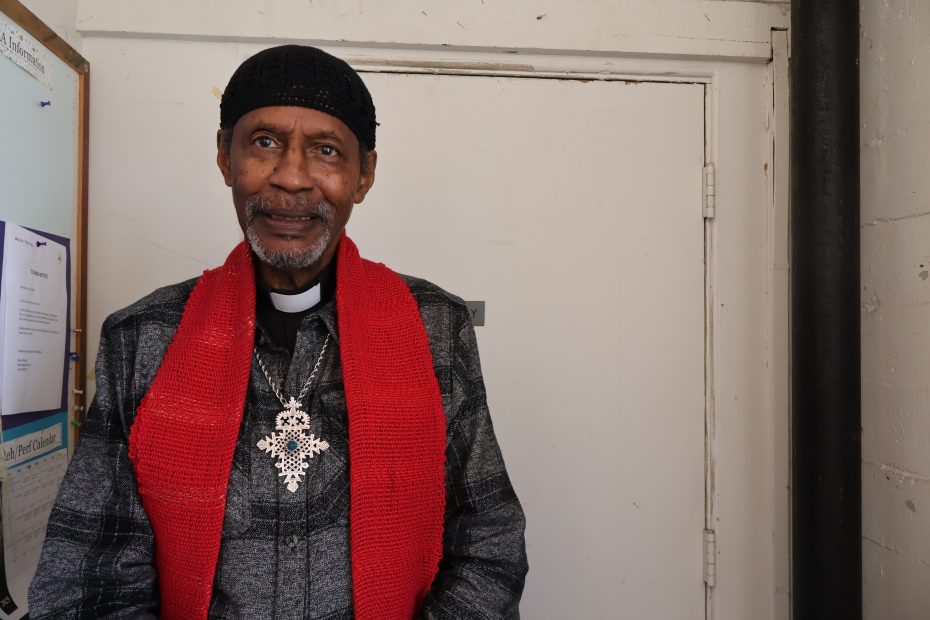
For almost sixty years, His Eminence Archbishop Franzo W. King has been leading what he calls “sound baptisms” at the San Francisco church of Saint John Coltrane.
Born in a North Beach jazz club and making its way from Bayview to Fort Mason, the church of Saint John Coltrane has become a strange San Francisco staple, a distant resonance of the summer of love.
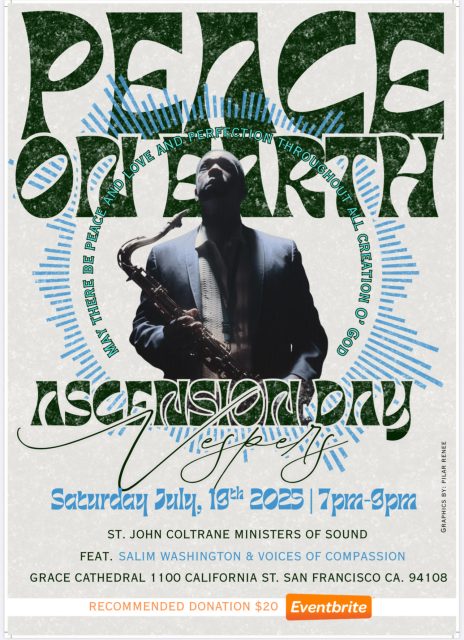
On Saturday, July 19, Saint Coltrane’s disciples will be performing and preaching at San Francisco’s Grace Cathedral, in celebration of Coltrane’s “ascension” — the 59th anniversary of his death on July 17, 1967. Lasting from 7 to 9 p.m., there will be 20 musicians, poets and priests.
When King and his wife, the now Most Rev. Supreme Mother Marina King, saw John Coltrane play at the tightly packed Jazz Workshop in North Beach in 1965, they were struck by what seemed like a meditative faith among the wild musicians.
Inspired and moved, they began holding listening sessions in the basement of their Bayview-Hunter’s Point home, calling it the “Yardbird Club.”
Sliding between names at an improvisational pace, the “Yardbird Club” quickly became the “Yardbird Temple,” and then the “One Mind Revolutionary Church of the Hour.”
“There were tons of jazz clubs in the Bayview and Fillmore,” said Rev. Chaplain Wanika Stephens, who is also the daughter of the two Kings and their musical successor. But “after those clubs closed down, the One Mind Club was a place for the music to play after hours.
Stephens’ parents and the congregation members believed that jazz had a special political and religious place in the evolving world. The vanguard, avant-garde, civil rights and music were deeply intertwined; and radical jazz was behind it all, she said. “It was a consciousness-raising kind of music.”
King re-found faith in God around the same time that the church was started. In a Sunday service July 6, he told the crowd a story from his youth: at 19, King broke parole. Sitting in the processing center, ready to appear before the judge facing a two-year sentence, he began chanting “A Love Supreme” under his breath.
His lawyer came up to him, looking shocked. The judge had dropped dead on the bench.
“And I’m not saying that it was the cause of his death,” joked King. “But it was the cause of my liberation.”
King cites two sentences from the liner notes of “A Love Supreme,” which Coltrane wrote: “I asked for the means and the privilege to make others happy through music,” Coltrane had written. “I feel this has been granted.”
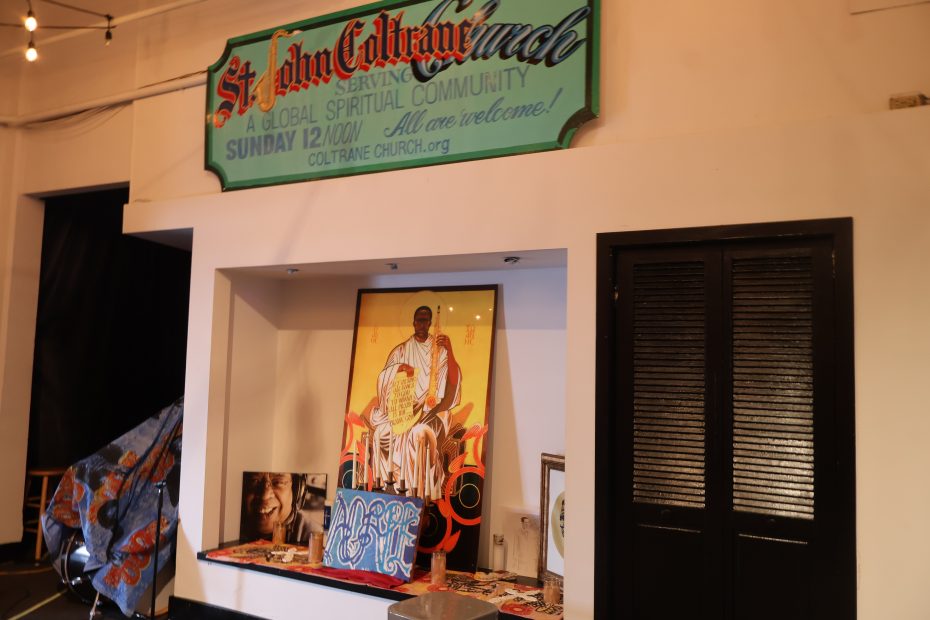
Now, every Sunday at 11 a.m., a number of congregation members enter a crowded room, adorned with sacred paintings and mosaics of jazz legend John Coltrane, on the third floor of a Fort Mason arts center.
Visitors are handed instruments as they enter, bejeweled tambourines and shakers. Newcomers seem to hold them with hesitance at the start, afraid to call attention to themselves.
That changes quickly.
“Hallelujahs” and “amens” — nearly undecipherable amidst the saxophone and the banging of tambourines — continue for the 32 minutes and 47 seconds of Coltrane’s famous “A Love Supreme.”
The sermons, which take up a portion of the two-and-a-half hour services, are distinctly religious (technically, they part of the African Orthodox Church) but the majority of the time on Sunday morning is spent absorbed in sound.
The Sunday that this reporter first saw Saint Coltrane’s disciplines deliver musical wonder, a Native American man spoke to the congregation about Palestine, and a Chinese immigrant read a passage by Frederick Douglass. A middle-aged white man in flip-flops delivered the first sermon, and an older Black man wearing his backpack delivered the second.
The service felt deeply diverse, even in religion, as many of the people present admitted being agnostics. The type of religion doesn’t matter, King said. It’s “whether or not a man knows the truth.”
“Love is the ruling principle of the universe,” he continued. If you accept that, Saint Coltrane’s church is open to you.
The church is under slight risk, King said. With declining funds, they’ve been evicted from previous church spaces, year after year. Their small space in Fort Mason is a significant demotion from the church that they preached in when Alice Coltrane, John’s wife, came to visit them in the 1980s.
Still, it is moving.
Four conga drums stand in the back. Djembes, too. Visiting musicians in the audience are invited up to join, including saxophonists, drummers and trumpet players. The most surprising moment comes when Archbishop King himself touches the saxophone to his lips and lets a cascading solo fall through.
The entire time the audience is urged to engage, to get loud with their voices and drums.
There’s a lightness to the air. “No one leaves the services walking,” said Chaplain Stephens. “We all just kind of glide.”
There are some lacunae in your article. For many years, Norman Bishop Williams, a saxophone, jazz musician, held services at the St. John Coltrane Church on the 300 block of the visit Darrow Street. Then the church moved to Fillmore Street in The Fillmore District. None of this is mentioned in your article. Why
Members of the Church of St. John Coltrane also host a weekly radio show, “Uplift,” on KPOO FM 89.5 on Tuesdays noon-4PM. Wonderful DJs and great music!