
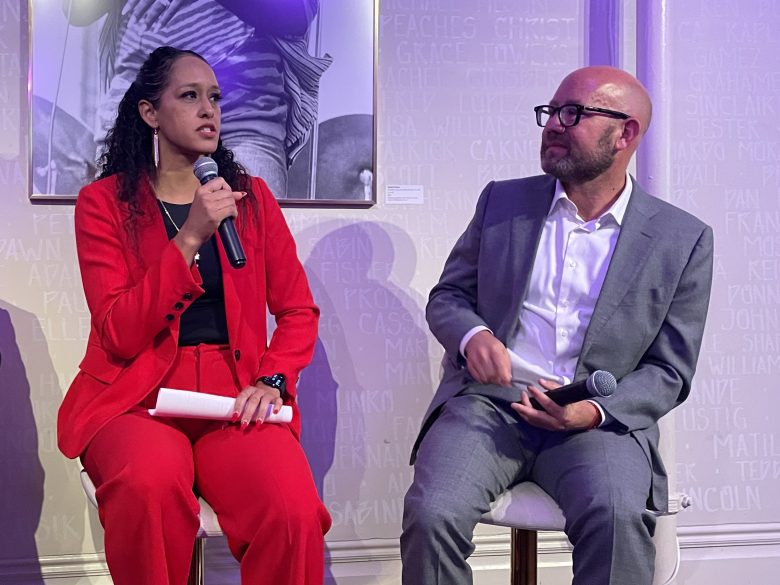

The San Francisco mayor’s chief of health and human services told an audience in the Castro Thursday night that the city needs “to focus on the families, the residents, the small businesses who have people sleeping in their doorways.”
“We’ve spent a long time rightly focused on the folks in crisis, and we will continue to do that,” said Kunal Modi, the mayor’s chief of health and human services at at the Academy, an LGBTQ+ social club in the Castro where a bevy of department heads and city officials were on hand for the meeting of the Castro Merchants Association.
But Modi made it clear that families and residents are on the agenda, and stressed that San Francisco is taking a firm approach on drug use and crime.
“Public health means the whole public,” said Modi. “We’re trying, on the health and human services side, to take that mandate seriously.”
Modi said that the city wants to do more conservatorships, which can be used to take drug users and mentally ill people off the street, compelling them to go through treatment.
It’s unclear if conservatorships have been used for substance-use disorders, but in October 2023, California Gov. Gavin Newsom signed Senate Bill 43, which made it possible for cities to use conservatorship for people with mental illness, chronic alcoholism or substance-use disorders.
The city, however, does not currently have enough “locked beds,” which are needed to expand use of conservatorships. It is currently working to add 100 more “locked beds” specifically to its current supply of 140-240, according to Modi.
At San Francisco General Hospital, it has moved to shift some board-and-care beds to locked beds, eliciting outcry from patients and nurses.
“You can’t really go to a judge and say, ‘Let us take away all the autonomy from this person, but we have no plan for them,’” said District 8 Supervisor Rafael Mandelman, who oversaw a hearing on the implementation of SB 43 in June.
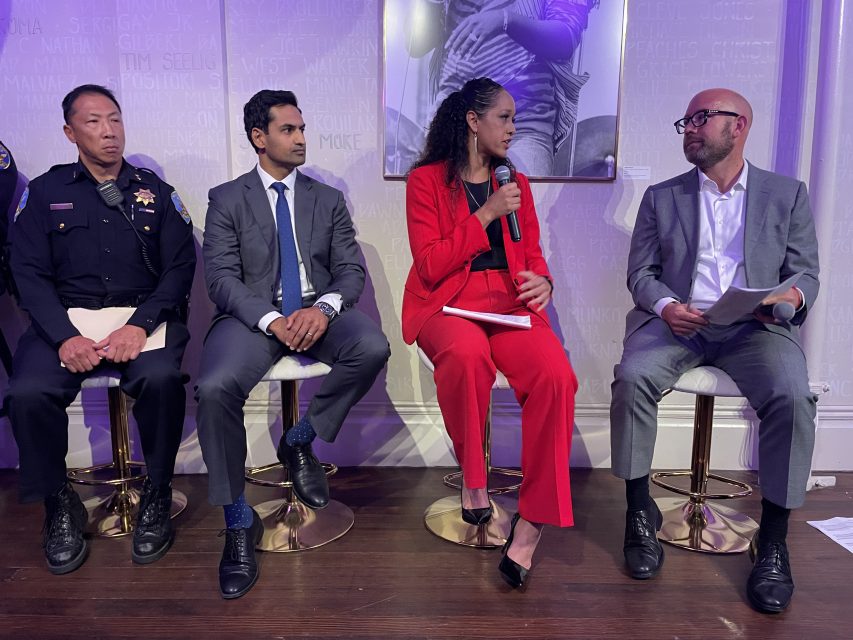
District Attorney Brooke Jenkins said drug use is a priority for the DA’s office. “We’re dealing with the fentanyl crisis. We’re dealing with an overwhelming problem of the prior DA having essentially decriminalized drug dealing in our city, and people thinking that it was okay to do that,” Jenkins said.
Her predecessor, Chesa Boudin, was elected as DA in 2019 and implemented criminal justice reform policies, but was recalled in 2022. At no point did he decriminalize drug dealing, but Jenkins frequently makes allusions to Boudin to mark a contrast with her approach — and she wasn’t the only one.
“We have enjoyed working with you,” Mandelman said as he introduced Jenkins. “It makes a difference who our DA is.”
The DA’s office prosecutes both drug dealing and drug use. Under state law, the latter is typically a misdemeanor, but Jenkins explained that, as a result of Proposition 36 passing in November, after two misdemeanor charges for drug use, the third instance can be prosecuted as a felony.
“We are going into court every day, trying to make sure that the bench understands the severity of the fentanyl crisis and that we must hold people responsible for what they are doing,” she said.
She expressed frustration that judges sometimes decline to hold people in custody and give light sentences. Jenkins and her prosecutors often challenge how judges conduct themselves, at one point grinding court proceedings to a halt by blanket challenging a judge before she had heard a single case.
But no DA can do much, if anything, without cooperation from the police. The San Francisco Police Department’s deputy chief, Derrick Lew, was in attendance along with Mission Station acting Captain Manny Bonilla to explain the progress officers have made clearing out UN Plaza and other downtown areas that used to be filled with drug users and illegal street vending.
In the past two years, Lew said, they’ve arrested nearly 8,000 people. However, it is unclear how many of those actually faced charges. The jail population is back up to pre-pandemic levels after holding steady between 2020 and 2023.
Lew acknowledged that breaking up drug use downtown has created a “Whac-A-Mole” effect of people moving to other areas of the city, particularly the Mission. He emphasized, though, that breaking up crowds lets the police work more effectively and prevents street populations from growing.
Meanwhile, in March, the city launched a new strategy for dealing with the Whac-A-Mole: Roving neighborhood teams consolidated between different departments, so people can go to one place for resources on medical attention, drug use treatment or homeless support.
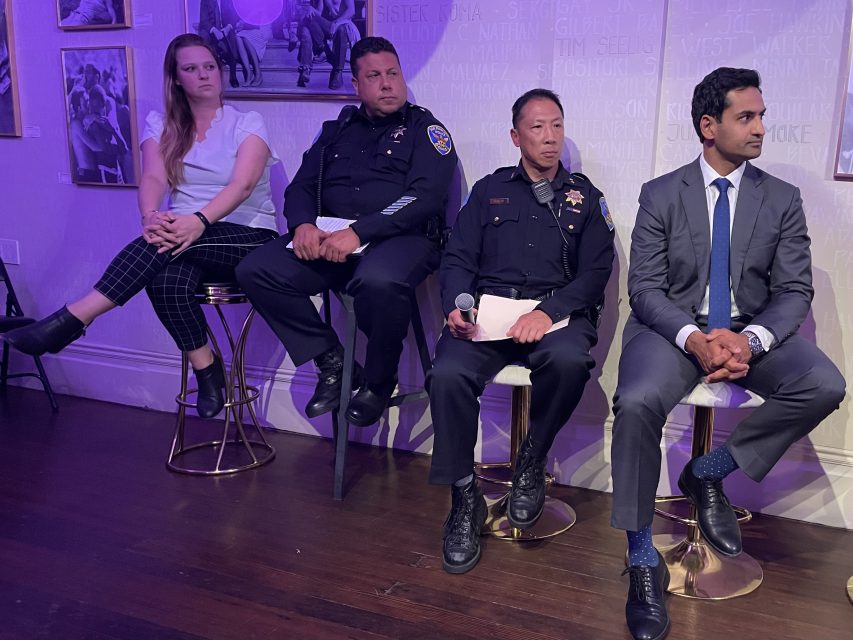
In the Castro, that means a team is out there starting at 6 a.m. every day, spending the first hour evaluating how many tents and “problem individuals” they are seeing in their assignment area, which includes the Mission.
Then, the teams meet at 8:30 to go over the resources they have for that day and delegate people to meet up with the people they identified, said Adrienne Bechelli, who recently started overseeing the city’s neighborhood street teams.
However, people tend to be transient, she said.
“When we send services, oftentimes, by the time those services arrive, they are no longer there,” she said. So the team tries to be “agile,” responding to what they’re currently seeing on the street.
As the panelists wrapped up, Mandelman read out an audience member’s question: “Crime is allegedly lower now, but it doesn’t feel like it. So what is going on?” It prompted a ripple of laughter through the room.
Conditions have improved since a few years ago, Mandelman said, “but still there’s too many neighborhoods, too much of the time, where it does feel unsafe and it just feels unpleasant to be in these public spaces.”
The crime rate is statistically lower, but changing that perception of street conditions — “I think that’s a big chunk of the work that’s still to be done,” Mandelman said.
Brooke Jenkins blaming her predecessor for crime in the Castro is the just nonsense squared. This is her second term and she owns what happens in this city. Girl, Bye!
Brooke “Nothing Has Ever Been My Fault” Jenkins can’t say ‘Good morning’ without dragging The Horrible Previous DA into it.
She is an embarrasment to her profession.
Wow, this author is fantastic!
Politicians and civic leaders should always keep their eyes on the middle class. We pay full price for everything, and all our taxes. It’s time to refocus the lens from those in crisis to those who are invested most in this city. Without a solid middle class, there will be no “extra” for charity or tax dollars for shelters.
You are right about the middle class. But the focus on those in crisis is in a way responding to the common complaints from the middle class about safety in public. If there is no sense of safety, then there will be no business in the city. Honestly I don’t envy the jobs of the civil workers or the police right now. But I’m glad they never give up.
Jenkins is still blaming Chesa for things she promised to “fix” immediately….three years ago.
It is really quite remarkable that she spends so much of her time blaming her predecessor and never tells us what she is doing to address an issue. I wonder if she actually thinks Terrence Hallinan is the villain in all this drama going on in her head, but she simply can’t remember his name …
Lmao criminalizing drug use/war on drugs didn’t work the first time around but sure go ahead and try it again. Sounds to me like you just want to fill up the industrial prison system and militarize the police more 🤔 what are y’all scared off? Class consciousness maybe…
What a joke! They meet at one of the safest neighborhoods in the City, the Castro and they focus on crime? The funny thing is that at least two of people on the panel have committed crimes that were NOT prosecuted: Crooke Jenkins who only got a slap on the hand for what she did when she was a lowly prosecutor in Boudin’s office and Modi who was a McKinsey partner, a high-level executive for a company that was implicated for fanning the opioid crisis:
https://www.justice.gov/archives/opa/pr/justice-department-announces-resolution-criminal-and-civil-investigations-mckinsey-companys#:~:text=For%20Immediate%20Release,civil%20recovery%20for%20such%20conduct.
The alleged criminals talking about busting criminals and drug addicts in the Castro! Totally laughable!
Thank you for the detailed reporting. Outstanding work as usual.
How was this a “town hall” meeting when ONE question from the audience – written before anything was presented – was read aloud? How is a “town hall” meeting being held at a private LGBTQ club not criticized or at least examined by a journalist paid to attend and report back? What was accomplished at this meeting? What was the point?
Thanks for reporting
Lawlessness is lawlessness
There are some here in SF who still dont understand that there are laws in regards to selling distributing sharing and using drugs
Drugs are lethal poisons .
There must be zero tolerance .
Both law enforcement and treatment are necessary ; most will die anyways .
In countries around the world where there are severe penalties very few take drugs .
No one forced a person to take poison.
I think we should try to stop the selling and usage .
I am not supportive of allowing people to harm themselves and think they will just stop unless they realize their are severe penalties and we will not tolerate this .
Dont do the drugs and you wouldnt have to go to jail
Otherwise let us just not intervene and let them rot like the progressives in this city think is ok?
Addicts are addicts unless removed from a place where they have access they will not stop.
Get real
You are harming others if you think otherwise
Zero tolerance .
Drugs kill people .
Wake up and stop being cruel.
Also great article 🙂
Campers,
.
I’m an expert on this subject by schooling and life experience and I say sterilize that entire segment of the population by bribing them.
Offer anyone who is booked into jail $10,000 tax free and a thousand a month for a year to get sterilized.
As a teacher of Behaviorally Disturbed Middle schoolers I found that the one thing they had in common was that their parents or guardians did not want them to be born in the first place.
Lack of Love can have some pretty anti-social end game results and it is particularly pernicious if you’re poor.
Smart people use drugs as tools and poor people use them as an escape.
Purt near everyone does drugs.
From the richest man in the World (Musk ?) whose drug of preference is ketamine (never tried that one) to Supervisor Matt Dorsey who was able to function at a high level as the mouthpiece for first the City Attorney and then the cops and I don’t know his drug of preference.
Top business people do ‘micro’ doses of a variety of drugs and it helps them to produce.
I’m just over 80 and doctors have been propping up my naturally failing organs for 20 years or so with a variety of drugs that don’t get you high.
But, thanks to the miracles of modern medicine I’m able to work hard physically for the first 5 hours of the day and the rest of the time I study AI under the tutelage of Nobel laureates and pass the fruits of my labor on to you.
My dog’s given name is Skippy.
go Niners !!
h.
Devil suit strikes again!
Mandelman is just as much of a disgrace as a Supervisor as Weiner was. They throw everyone under the bus to get moderate tech and real estate funding.
They meet at 6, spend an hour evaluating, and then don’t do anything else until . . . 8:30? That’s not very efficient.