

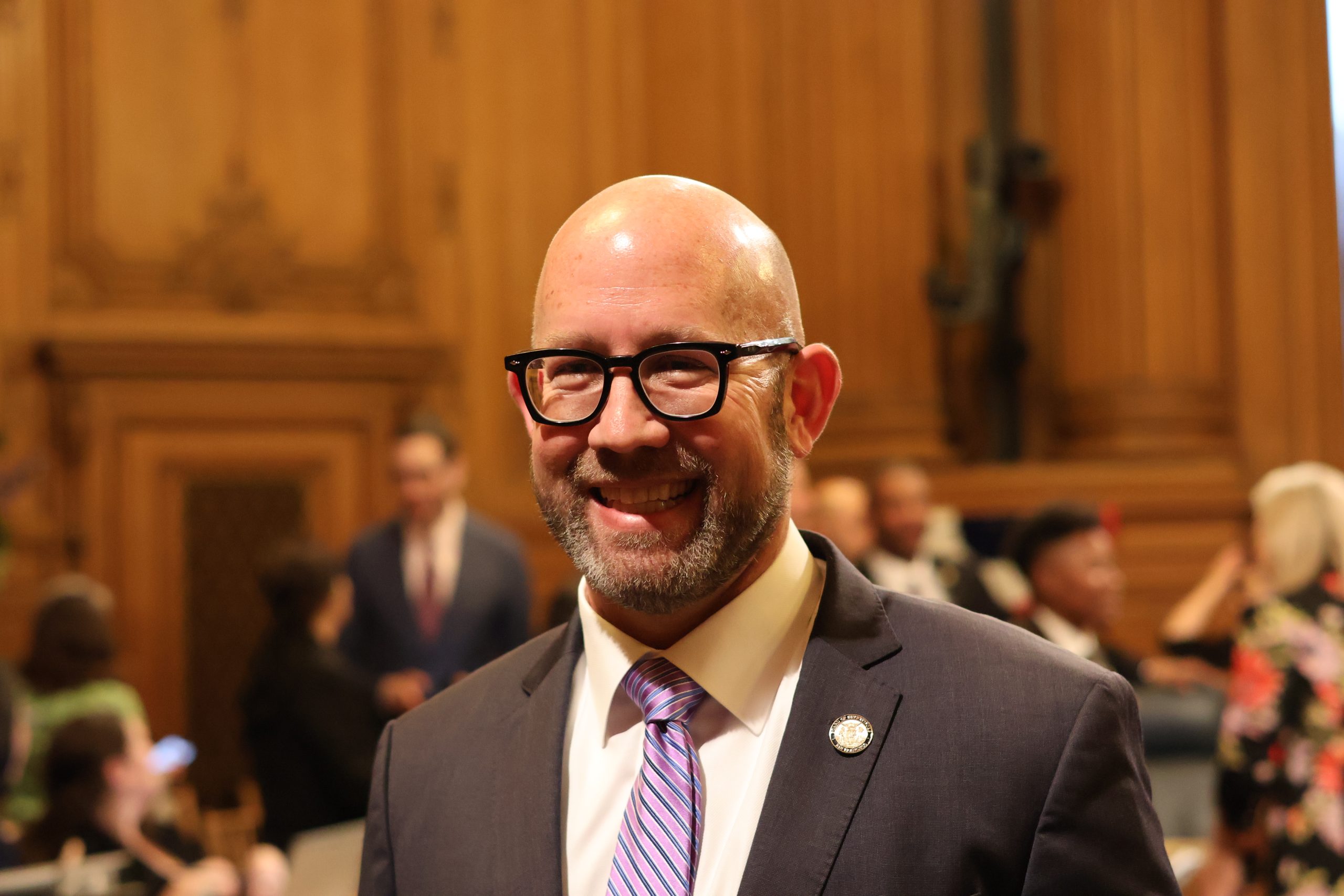

It was the stuff of an Ezra Klein fever dream: The president of San Francisco’s Board of Supervisors, Rafael Mandelman, was trying to streamline the city’s complicated and convoluted process for contracts and procurement.
The current process treats large contracts — think $5,000,000 or more — the same as contracts worth less than $230,000. That administrative burden leaves staff spending tons of time sifting through applications for relatively small amounts of money, and makes it harder for small businesses to work with the city, according to a report published in 2024 by the Office of the City Administrator.
It’s the kind of mess that Klein and fellow journalist Derek Thompson wrote about in “Abundance,” a wonky manifesto that critiques inefficient government bureaucracy in blue states and prescribes, in part, deregulation to make government work better.
At the Board of Supervisors, “Abundance” seems to have resonated for some supervisors.
In voicing his support for Mandelman’s streamlining, District 6 Supervisor Matt Dorsey called San Francisco’s procurement process “everything-bagel” policymaking, seemingly quoting from a 2023 article in which Klein assails San Francisco’s hefty regulations.
Mandelman introduced his legislation in February. It went to the Budget and Finance committee earlier this month, and from there to the Board of Supervisors for a full vote at Tuesday’s July 15 meeting.
The legislation is a “hodgepodge” of “low-hanging fruit of procurement cleanup,” Mandelman said in an interview after the meeting. Lots of it focused on waiving some requirements for contracts worth less than $230,000.
But inside that “hodgepodge” was legislation to eliminate a little-known advisory group.
The legislation Mandelman introduced included a clause to get rid of San Francisco’s Sweatfree Procurement Advisory Group, which was created in 2005, when the Board of Supervisors passed the city’s Sweatfree Contracting Ordinance, which requires San Francisco to buy garments like city uniforms only from manufacturers that don’t produce goods in sweatshop conditions.
When it was passed, the ordinance was a big win for local labor groups. It took aim at garment factories abroad with poor working conditions, but also those in San Francisco, where often immigrant women made well under minimum wage in garment factories South of Market or in the Mission District, according to an editorial in the San Francisco Chronicle at the time.
Mandelman’s legislation would waive that ordinance’s requirements for contracts that are less than $230,000. (Most orders for garments are for contracts much larger than this, so the ordinance would generally still apply, Mandelman later said in an interview. Though, in a heated moment at Tuesday’s Board of Supervisors meeting, Mandelman said he was open to reconsidering the entire ordinance.)
But Mandelman’s legislation would also eliminate the Sweatfree Procurement Advisory Group.
The proposal to waive some of the ordinance’s requirements, plus do away with the group, struck a chord.
District 1 Supervisor Connie Chan read an impassioned letter from former San Francisco Labor Council Executive Director Tim Paulson, calling the weakening of the ordinance and getting rid of the advisory group “unacceptable.” The letter accused the supervisors of going down an “anti-worker path.”
District 4 Supervisor Joel Engardio asked to “take a pause” on “the sweatshop part.”
The entire conversation left Mandelman flabbergasted. “This conversation,” he said, “is a bunch of nonsense.”
Others disagreed. Minutes later, the Board of Supervisors voted 6-5 to return the legislation to committee. The swing vote appeared to be Engardio. He voted against the legislation despite, less than a week earlier, voting to advance it from the Budget and Finance committee to the entire board.
The other others who voted with Engardio: Supervisors Chan, District 7 Myrna Melgar, District 9 Jackie Fielder, District 10 Shamann Walton, and District 11 Chyanne Chen.
The Sweatfree Procurement Advisory Group’s cost to the city is negligible. It has essentially no power. It simply advises San Francisco on how to meet the ordinance’s requirements.
Unless his “colleagues come to their senses,” Mandelman said in an interview after the vote, what’s likely to happen next is that the legislation will be heard in the Budget and Finance Committee again, and the committee will likely send it back to the full board for a vote with the portions about the sweat-free ordinance or advisory group removed.
This delay has meant his legislation, leaving the sweatshops portion out, will not pass until September at the earliest, Mandelman said in frustration.
Advocates of the “Abundance” agenda would say these sorts of delays are exactly the problem.
For Conchita Lozano-Batista, the chairperson of the Sweatfree Procurement Advisory Group, it’s the adoption of “Abundance“ that is actually the issue.
In a letter written to the Board of Supervisors and provided to Mission Local, Lozano-Batista wrote: “This wholesale adoption of a bestselling book’s philosophy on how to cure the ails [sic] of government is dangerous and embarrassing. Ezra Klein sells books for a living. This body is tasked with legislation, which requires nuance, investigation, questioning, and the adoption of best practices, and often the creation of new ones.”
She attached a critique of “Abundance” for supervisors to read.
One victory for the Sweatfree Procurement Advisory Group at the Board of Supervisors does not mean, though, that it is safe.
Another streamlining initiative could put the group at risk.
In November, voters passed Proposition E, which created a task force to cull the city’s 149 commissions, of which the Sweatfree Procurement Advisory Group is one.
The Sweatfree Procurement Advisory Group meets infrequently enough that it is on a list of “borderline inactive bodies,” said Ed Harrington, co-chair of the task force. (Though the group did manage to dodge the task force’s first round of groups to cut, which it said were inactive.)
Harrington said his task force will be considering the group and other borderline inactive bodies in August, and will vote on what to do in November. That vote won’t be final, though. It will likely be included in recommendations that will be headed back to the Board of Supervisors.
How many other cities in America have the equivalent of a Sweatfree Procurement Advisory Group?
This is the most San Francisco story of the week.
“We’d love to make things easier for businesses and eliminate some of our notorious red tape, but that would require eliminating a committee! OMG we can’t eliminate a committee! We need more committees! Let’s have a committee study creating more committees!”
It definitely *sounds* bad to eliminate a group meant to prevent procurement from sweatshops, but if that group is an advisory group with no power that never meets, what is the real world effect of eliminating it? It’s not possible for the public to understand this nuance, but our lawmakers should. What am I missing that makes this such an important topic for labor? Is it the fear of “give them an inch and they’ll take a mile”?
The Trump like sensitivity to anything negative about what S.F. does wrong is the issue. Grow a spine you softy’s. Look in the mirror and get rid of things that don’t work. The unwillingness to fire or get rid of anything in government is the issue. You cannot fix what is wrong until you are willing to admit you are wrong.
Notice that Logan’s-Bautista did not address the issue, instead she is scapegoating a book to deflect from her uselessness.
SF is so absurdly dysfunctional.
I predict there will never be a fulsome contracts streamlining measure that will make it through the bureaucracy of our town. I worked on such a task force nearly a quarter-century ago and precious little has changed. From prohibiting trade with South Africa and Northern Ireland to ensuring that companion animals must be welcome in residential treatment, nonprofit contractors must navigate a mostly impossible and largely irrelevant set of rules that have little to do with fiscal responsibility or service efficacy.
If one amendment means a two-month delay, that sounds like a problem with the Board of Supervisors, not with any advisory group. The Board should get more efficient at legislating. Maybe the Board’s president should get on that.
Part of any rational way of making policy is that you have a draft, you bring it to other stakeholders and policy-makers for review, and sometimes they point out changes you need to make. It’s real arrogant of Mandelman to assume that his “hodge podge” — as he himself put it — will be 100% good the first time it reaches the Board. It’s borderline authoritarian for him to blame his colleagues for daring to decide it needs some changes.
We should create 149 new commissions to investigate the existing 149 commissions…Then new commissions to study the findings of the investigations; Studies would be then printed and sent to each residence in SF; the whole process would create more jobs; I do not think the Sf voters would mind it. Then, for the newly created Stooge Olympics, we will get gold.
Engardio the flip flopper again.
Does anyone take “Abundance” neoliberals seriously? Besides, of course, “Abundance” neoliberals? They’re joke fodder for both ends of the political spectrum.
Do not trust swine.
Edgardo changed uniforms for Recall,
He only won his race due to a suspect Redistricting move.
go Niners !!
https://sfbulldogblog.com