

At 2 a.m. on Thursday morning, the San Francisco Board of Supervisors Budget and Appropriations Committee voted to finalize Mayor Daniel Lurie’s proposed $15.9 billion budget for the next two fiscal years.
The vote came with some small changes, and wins for city workers, but not without heavy cuts to nonprofits and city departments.
Supervisor Connie Chan, the budget chair, announced on Thursday morning that after a long night of negotiations, supervisors managed to stave off some proposed layoffs. The mayor’s office said those covered 57 city employees.
Chan said supervisors also restored the funding of “some” services, including funding for Asian and Pacific Islanders, Native Americans, transitional aged and trans youth, the LGBT community, and those living in SROs.
But as Chan announced the halt to city layoffs, an audience member yelled, “Not for nonprofits!”
“I don’t think this is a budget any of us like,” said Supervisor Rafael Mandelman. “I think this is a tough, painful budget. I don’t think any of us are going to leave here feeling good.”
Along with the finalized budget, the committee also took a vote on the mayor’s proposed changes to Proposition C, which would allow for $89 million in funding intended to be used for housing to be allocated towards temporary shelter beds. After a final vote, supervisors managed to reduce that number to $34 million.
The controversial question of whether to allow Lurie to lower the required supermajority vote to make changes on how to allocate funds from the proposition was voted on separately. The board agreed on a compromise to lower the supermajority requirement to a simple majority, but only for up to $19 million of surplus generated tax revenue. Supervisor Shamann Walton was the only dissenting vote.
“Passing this budget also required painful decisions that were, unfortunately, necessary to set up our entire city for success,” Lurie said in a statement.
“Leadership means making those tough decisions, and this group of city leaders did that. As a result, the city controller found that we reversed a decade-long trend of increasing the number of positions in government and that we are saving as much as $300 million every year in future budgets,” he said.
Lurie’s proposed changes to Proposition C, and the cuts that some of San Francisco’s most vulnerable communities will still face after the budget goes into effect, didn’t go down without a fight from some city supervisors.
“Is this even legal?” questioned District 9 Supervisor Jackie Fielder, on Lurie’s proposed change to Prop. C’s supermajority to make changes, a rule San Franciscans voted for in 2020. “As elected members of the board we have a duty as supervisors. If we are just going to represent the mayor’s budget should we even have a Board of Supervisors at this point?”
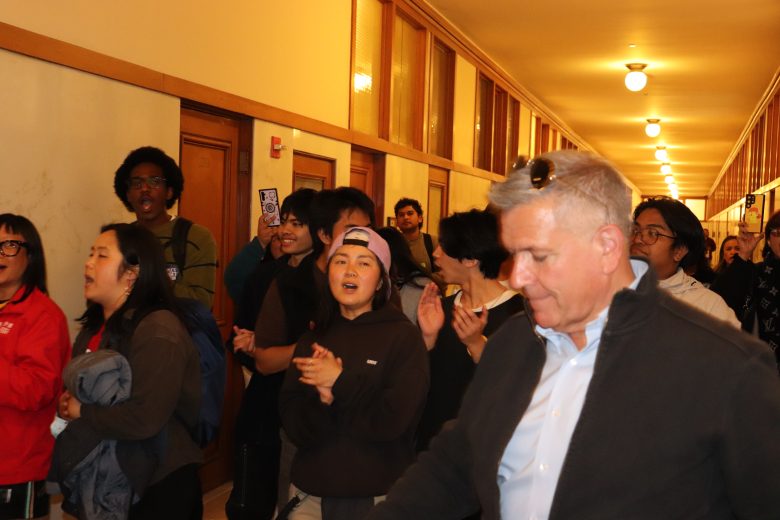
Roars of applause echoed off the chamber walls from the roughly 50-person crowd of advocates and city workers who stayed to watch the supervisors’ vote until the bitter end.
“I’m hearing people say, ‘what’s the big deal?’” said Fielder, “The big deal is, democracy can be negotiated away at 1 a.m. while San Franciscans are asleep. The big deal is, we’re looking more and more like D.C. every single week.”
And those were fighting words.
“I am offended to say that somehow, that this is a budget that is … what the mayor wants,” said Chan, responding to the accusations that the board had simply conceded to Lurie’s proposal. “You can be assured that … this is not everything that Mayor Lurie wants. I would like to think that a great portion of it is what the board wants, too.”
Thanks for the reporting. SF Chronicle says that both Walton and Fielder voted against doing away with the supermajority needed to change the allocations of Prop C funds. Burt your articles say only Walton voted against it. And given what you quoted Jackie Fielder as saying about this being an attack on democracy since it means going against the 61% will of the voters who passed Prop C, it would make sense that she voted against the Mayor’s request. Could you clarify?
$87 million is entirely too much to give people who have NEVER lived in a home or apartment in San Francisco. These folks roll in with their RVs & tents to get the free services. Unacceptable.
87 million for temporary shelter beds. 87 million. Let me say that again 87 million dollars. We throw these numbers out like it’s Monopoly money. We could give 475 working families a $ 200,00 down payment on a house or apartment but we choose to spend it on people who have no income or intention of having an income. Most of whom are not FROM here! Justify that to me
Why are all the stories about the budget about cuts? What about increasing revenue streams? Isn’t a budget income and expense? I understand Lurie probably did not make any, or any meaningful, revenue enhancing proposals. But why not? Most of the City’s revenues come from fees. Fees for what and who pays them? Isn’t it time to go where the money is and tax the billionaires or the 1%?
Tax increases would have to go to the voters anyway, who often vote them down. And the State bars cities and counties from taxing income, capital gains, wealth, estates and so on. Prop 13 limits the taxation of property.
One of the weirdest leftist tics is assuming that the SF government has the untrammeled ability to extract game-changing money from a handful of billionaires who live in Atherton and Portola Valley.
Progressives have largely been reduced to the development arm of the governing coalition, where they run tax measures that only end up further empowering conservative mayors.
Specifically which taxes are you suggesting progressives came up with and voted in?