


Tenderloin residents say that the “urban oasis” model San Francisco city officials now want to develop at the former “triage center” at Sixth and Stevenson streets, an area known as an epicenter of drug activity, has worked before.
Just five blocks away, at Turk and Hyde streets, the model turned a neighborhood once known for drug sales and consumption into a place safe for children and residents.
“At times, we counted up to 50 [people] injecting themselves every day,” said Carmen Vasquez, a 10-year resident of an alley near the “oasis” at 200 Hyde St. that was installed in 2022. She noted in Spanish that the area has changed “muchísimo.”
An “oasis,” in the city’s definition, would be a place for people to sit, socialize and feel safe, under the supervision of trained staff.
The so-called oasis on Hyde Street was part of a larger effort to make a block with plenty of children safer: The corner is bordered by a kids’ park and sits on the “Safe Passage” route to and from the Tenderloin Community School. First, the city renovated and reopened the Turk-Hyde Mini Park in early 2020. In 2021, Urban Alchemy ambassadors began patrolling nearby streets, greeting residents and ushering away negative activity like drug use and fights.
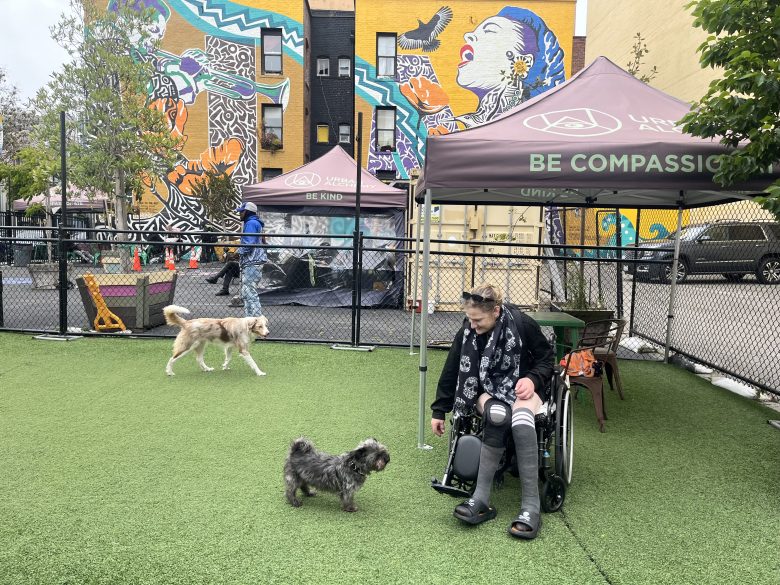
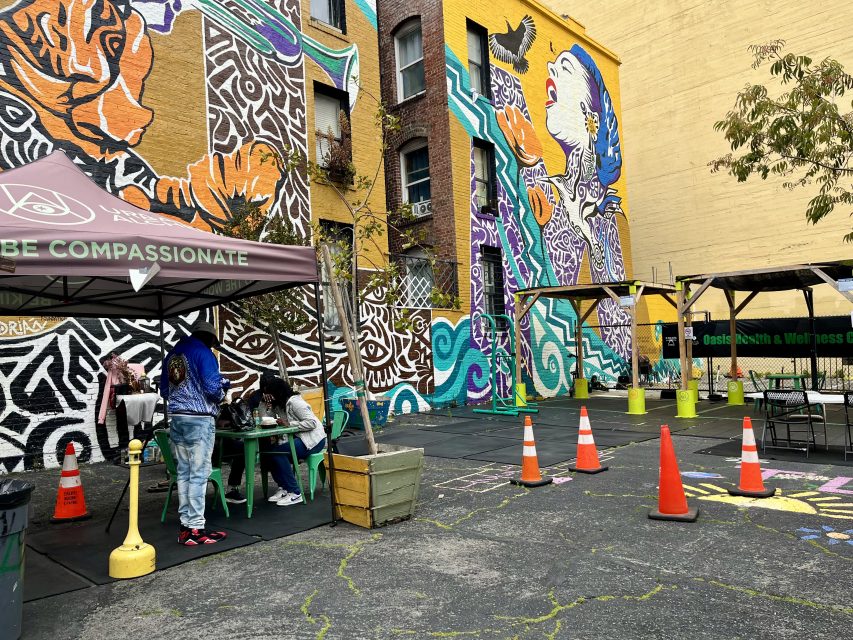
Urban Alchemy then transformed a parking lot across the street from the mini park into the city’s first “oasis.” The intent was to offer an amenity for residents, and the nonprofit staffed the public space with ambassadors, tables and chairs, coffee, tea and water. There’s also a dog run, exercise equipment, and a welcome table staffed by Urban Alchemy ambassadors, who keep an eye inside and post up on the corner.
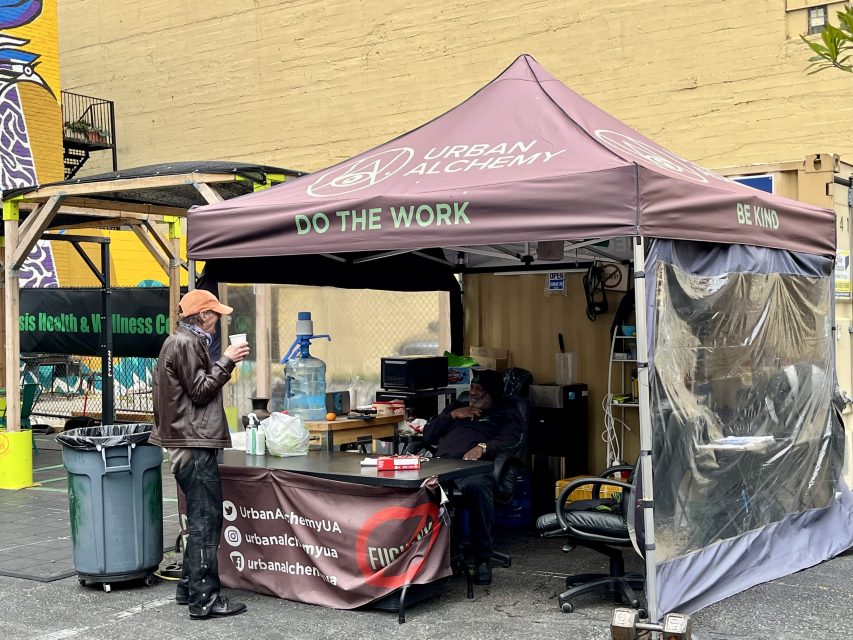
The change has been transformative. Vasquez remembers a time when people would be often found dead in the area. Now, with the arrival of ambassadors and the oasis, kids come around more often to play at the mini park, she said, and adults like herself can come relax at the oasis.
On a recent Tuesday afternoon, a group of friends sat and ate lunch from takeout boxes. One played R&B from a speaker while others watched their dogs zoom around the gated play area.
Jose Salazar, 23, who grew up nearby, agreed with Vasquez. “It got really, really bad during COVID,” he said.
Salazar now works for the Tenderloin Community Benefit District, overseeing and greeting people at the children’s park across the street. He didn’t think the area was ever unsafe, per se, but it was dirty and filled with people camped out, which made it difficult to walk on the sidewalk.
“If they’re not dealing, they’re using. And if they’re not using, they’re already high,” he said.
Even though he grew up two blocks away, he never walked through the area alone as a child, he said.
A ‘safe zone’
The idea isn’t new. Urban Alchemy has implemented a similar concept elsewhere: In Austin, the nonprofit operates a 24-hour area with food, drinks, showers and shade.
Studies have shown that building parks and greening vacant lots can reduce crime. The Turk and Hyde oasis, in the middle of a densely packed urban area, has trees in planters and green astroturf in the dog-play area.
The effort has even won over skeptical residents. Melinda Welsh, an eight-year resident of the neighborhood, said at first she was unsure about Urban Alchemy ambassadors telling people to move along; it felt ostracizing of homeless people.
Over time, she recognized the drug activity made it unsafe for children, and that the ambassadors were helping. Now, the block is cleaner, and she visits the oasis regularly with her dog, Ninja. Welsh has since met new people and fellow “dog enthusiasts” at the park.
On a recent Tuesday, a couple of dogs bounded on the astroturf at any given time; people stopped in to say hi to friends seated at a table, or inspected items on a shelf full of free clothing for those in need.
Crime hasn’t gone away on the corridor, though it mostly occurs late at night, after ambassadors have gone home and the parks have closed. In January 2024, one person was killed and four more injured in a mass shooting at the intersection of Hyde and Turk streets around 2:30 a.m.
In March 2024, a man was fatally stabbed near the same intersection around 8:30 p.m., and in November 2023, a gunfight broke out at the intersection, injuring one and killing another at 4 a.m. Later that night, two more people were shot there.
The daytime hours, however, are now mostly owned by the residents.
“This was like a drug hub … [dealers] just basically disintegrate this whole community,” said Wayne Richardson who, until recently, worked for Urban Alchemy after getting out of a long prison sentence for murder four years ago. Now, he calls the space a “safe zone” welcoming people from all walks of life. “We sit here, we eat, we chill … you’d be surprised who you’ll find here.”
The mayor’s office has not confirmed which nonprofit will staff the Sixth Street location; contracts are still being negotiated.
While Vasquez was enthusiastic about recreating the oasis model across the city, Richardson of Urban Alchemy cautioned that change needs to come with care.
“Who is going to run it?” he asked. Urban Alchemy workers had success, he said, because of their experiences: Many were formerly incarcerated, and they can talk respectfully to those on the streets.
Richardson said he believed many of the issues at Turk and Hyde simply moved to Sixth Street in SoMa with Urban Alchemy’s arrival, and he cautioned against “playing musical chairs” and again moving Sixth Street’s issues somewhere else.
“You gotta do it with finesse, you gotta do it with grace, you gotta respect people,” he said. And you need a plan.