

At 2 a.m. on Thursday morning, San Francisco supervisors finally advanced the city’s two-year budget and unveiled the total money they had clawed back from Mayor Daniel Lurie’s cuts. The “add back” funds amounted to a total of $41.4 million over two years — a fraction of the $15.9 billion budget for the same period, 0.1 percent.
Over the last month, the Board of Supervisors bore the brunt of the public’s response to the budget — but, ultimately, was only left with a Lilliputian fraction of the budget to wrangle.
A total of $26.3 million of that will go toward restoring nonprofit contracts that were slated for cuts as part of a $185 million reduction from Lurie’s original proposal. Specifically, 15 programs will now be maintained, including:
- Workforce development programs ($7.5 million)
- SRO hotel code enforcement ($6 million)
- General civil legal services ($4.2 million)
The remaining $8.6 million covers various services, including LGBTQ+ community programs, and programs for transitional age youth and seniors.

Two-year budget:
$41.4M in “addbacks”
Including:
Workforce development
programs ($7.5 million)
SRO hotel code enforcement
($6 million)
General civil legal services
($4.2 million)
s
$32.2B
Two-year budget:
$41.4M in “addbacks”
Including:
Workforce development
programs ($7.5 million)
SRO hotel code enforcement
($6 million)
General civil legal services
($4.2 million)
s
$32.2B
Chart by Kelly Waldron. Data from Supervisor Chan’s office.
The other $15 million will go toward preventing city worker layoffs. According to the mayor’s office, that money will be enough to retain 57 positions. But that’s not the total job loss: The $160 million or so cuts to nonprofits would likely result in hundreds of layoffs.
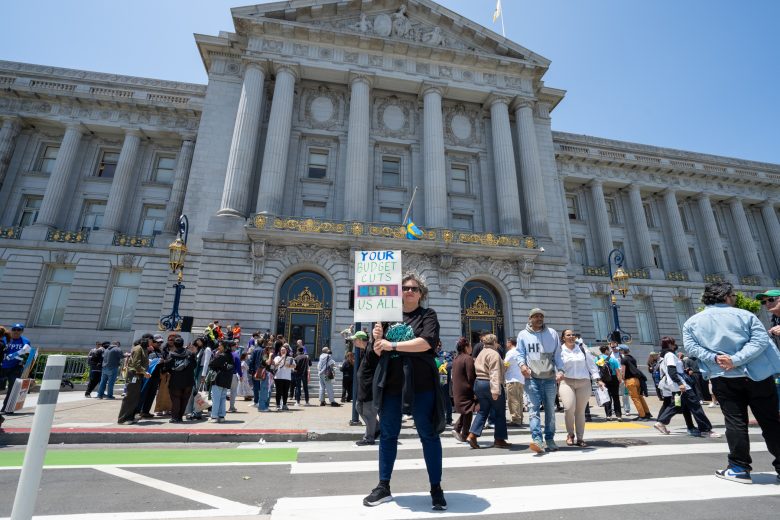
Throughout the month of June, the Board of Supervisors sat through hours of budget presentations from department heads and public comment. Community members came out in droves to protest the proposed nonprofit cuts.
Eleven city workers were arrested after causing civil disobedience and interrupting the board meeting for over an hour on June 17. The following week, one nonprofit worker cut her hair in protest and said “I hope this is the only chop we have to make.” It was not.
“This budget was ultimately balanced on the backs of working people,” said District 10 Supervisor Shamann Walton.
“Everyone made sacrifices in this budget,” said District 1 Supervisor Connie Chan, who served as budget chair. “It’s very difficult.”
Those nonprofits and layoffs make up one slice tackling the city’s overall $800 million deficit, and part of the $260 million in savings from “structural cuts.” The remaining balance is filled through new revenue, readjustments to allocations from voter mandates, reductions in capital spending and leftover funds from the previous budget.

The deficit:
Closing the deficit:
This is essentially the
city’s leftover money
from the prior year
s
$100M from
fund balance
These are changes to
ballot measure
allocations and
reductions in capital
spending
$130 reduced
baseline
commitments
That includes
$185M in cuts
to grants and
contracts and
the elimination
of 470
positions s
$260M in
structural
cuts
$810M
deficit
Most of the
new revenue
comes
from DPH
due to changes
in state
payments and
more patients
s
$320M in
new revenue

The deficit:
Closing the deficit:
This is essentially the
city’s leftover money
from the prior year
s
$100M from
fund balance
These are changes to
ballot measure
allocations and
reductions in capital
spending
$130 reduced
baseline
commitments
That includes
$185M in cuts
to grants and
contracts and
the elimination
of 470
positions s
$260M in
structural
cuts
$810M
deficit
Most of the
new revenue
comes
from DPH
due to changes
in state
payments and
more patients
s
$320M in
new revenue
Chart by Kelly Waldron. Data from the Office of the Mayor.
The full Board of Supervisors will vote on the budget on July 15. The proposal is largely in the same shape it started out as — but with some key programs restored and at least 57 jobs saved.
While the two-year deficit is addressed, the city’s overall deficit is projected to grow in subsequent years, and it is not yet clear how the city may be affected by federal cuts. In anticipation, Lurie’s budget sets aside $400 million in reserves (which represents a fraction of the $2 billion the city currently receives in federal funds).
“What I really see is harder days ahead,” said Chan. “This is a moment where we saved as much as we could. We did not save it all, clearly, we’re all sharing the pain.”
We heard a lot about “auditing city contracts” and “accountability” during the election. Was any auditing done before extending no-bid contracts? If so, what?
Finally running out of other people’s money. It is high time to dismantle the homeless-industrial complex 🙂
Sharing the pain? What pain did Moritz, Larsen, Tan, Altman and the other billionaires and billionaire wannabes suffer? A tax on billionaires or the upper 1% would go along way toward improving services for people who don’t have the yachts and the mansions of our overlords. Will they leave SF? Go ahead. What would the City lose? Some philanthropic donations for pet projects like city-wide surveillance? How much would it take to clean up 16th Street. Tom Steyer made a big deal and funded the “American Indian Cultural Zone” — which like reservations around the country are mired in poverty and addiction. Thanks Tom. Stories and fights on cuts cuts cuts but hardly one word about revenue,
Chan says “ new revenue “, do you believe your own smoke screen when you say you charge for Golden Gate parking and believe all the spots will be filled and paid from 9am to 6pm? You’re lucky if you get half your projected revenue.