

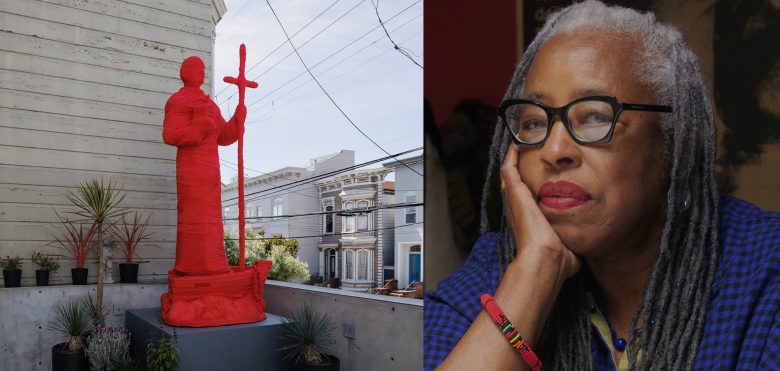

This is just a slice of the near 80-layer super premium birthday cake that is artist Mildred Howard’s story.
Howard, who will turn 80 this year, is among the most celebrated public artists in the Bay Area. She created the lock and keys on Stevenson Street in San Francisco. The wall of saxophones in SFO’s international terminal. The giant frame in Hunter’s Point. The blue glass panels etched with a Quincy Troupe poem on the Fillmore Street overpass. The giant question mark at the entrance to the San Leandro Public Library. The huge notched disk outside Ashby BART station.
All slivers of a thick portfolio that includes works in glass, steel, bronze, photography, video, paper and mixed media, in museum and private collections, in site-specific and permanent installations.
“People should know that Mildred is firmly rooted in representing African American life and culture, from the historic to the contemporary,” said Cheryl Ward, a San Francisco art collector, arts advocate and longtime friend. “Mildred is the center of the African American art world in the Bay Area.”
Most of Howard’s works are powerful but subtle evocations of African American history, including that of her family, who migrated to San Francisco from Texas during World II.
The youngest of 10, she was the only one born in San Francisco. When she was about two, the family moved to South Berkeley. That notched disk at the Ashby BART station? Howard created “Delivered, Mabel’s Promissory Note” (2024) in honor of her mother, activist and union pioneer Mabel “Mama” Howard, who successfully sued to keep BART from destroying Black South Berkeley neighborhoods with above-ground stations.
The statue references metal currency from the Congo, a region that has shown up in Howard’s DNA. West African currency also inspired “Promissory Notes” (2022), a trio of 14-, 16- and 18-foot-tall bronze sculptures resembling ship hulls, harp frames or stylized ears, installed at Southeast Community Center in the Bayview.
Some 20 years ago, when Howard was turned down for the Venice Biennale, she had an epiphany: “I decided, okay, now what can I do? I’m not going to wait to be invited.”
Last September, Howard launched “Collaborating with the Muses Part I,” her own personal “biennale” of overlapping exhibitions and events.
“I wanted to set the groundwork for other artists,” she said, hoping her peers would be inspired to do something similar. “So, I began last year and then there’s this year and then it will end next year with a retrospective at the Oakland Museum.”
“Collaboration with the Muses Part II” commences this month with new installations opening June 19 at 500 Capp St. and in “Black and Gold: Stories Untold,” the Fort Point exhibition about lesser-known chapters of the story of Black people in early California, that opened June 6 and runs through November 2.
Howard’s chosen theme for this year, “Untold Histories/Hidden Truths,” reimagines monuments to lauded historical figures active in the subjugation of enslaved and free Blacks, indigenous people and Asian immigrants.
On Memorial Day, I visited Howard at her home and studio, housed in a former awning factory in West Oakland. There, I saw the works readying to be hauled to San Francisco the next day for installation.
All four monuments are swathed in blood-red jersey. Three of the nine-foot-tall figures depict slave owners: Peter Burnett, the first elected governor of California and the guy who pushed legislation to keep Blacks out of Oregon; William Gwin, a Mississippi Confederate and early California senator who tried to make California a slave state; and Francis Scott Key, the lawyer and national anthem writer who fought abolitionists and helped the owners of runaway slaves.
(A statue of Key stood in Golden Gate Park until it was toppled in 2020 following the murder of George Floyd.)
The fourth figure was Junipero Serra, the Spanish priest who established missions from San Diego to San Francisco, forcing the indigenous people he pressed into labor to abandon their faith and practice Catholicism. Serra was destined for 500 Capp St., not far from Mission Dolores.
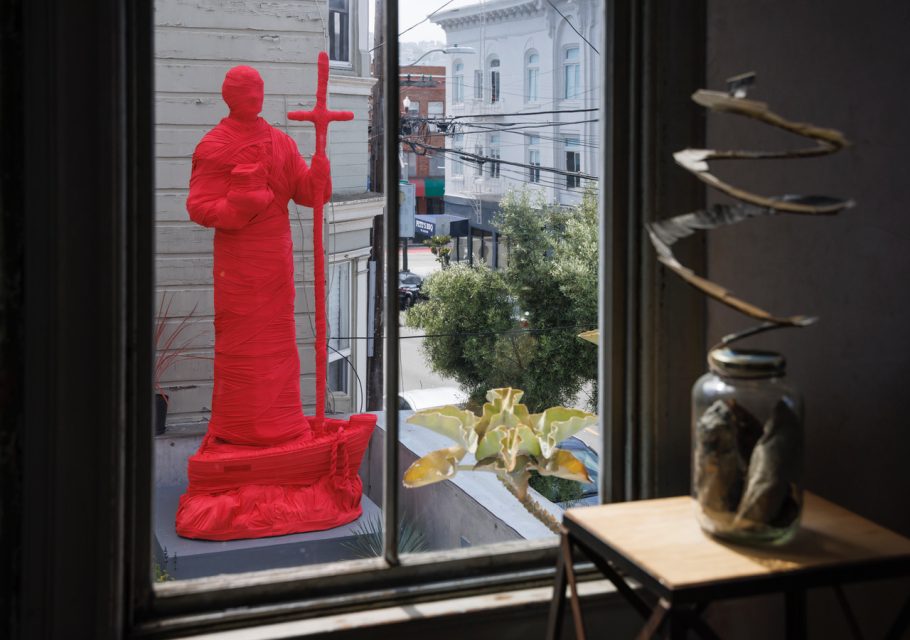
Mildred Howard’s Junipero Serra. Photo by Henrik Kam.
The others would be installed in brick archways at Fort Point, the last remaining Civil War-era fort on the West Coast. There, Howard’s trio of white supremacists would join recent works by Alison Saar, Hank Willis Thomas and Isaac Julien; and commissioned pieces by other Bay Area artists, including Trina Michelle Robinson and Cheryl Derricotte.
There is nothing subtle about the politics of Howard’s new work. But there’s nothing subtle about these times, either.
“One thing serious artists do a lot of is understanding the history that they came from,” said artist and art scholar Dewey Crumpler, an old friend of Howard’s. “Their work is not limited to a reproduction of what has already existed. So they can make work that is responsive to the present.”
While these shows were conceived well before the last presidential election, the subjects — interrogating bloody episodes in American history, challenging triumphalist narratives, recognizing Black achievements and contributions in California — can feel like either a last gasp or a call to action.
For Howard, it’s action. She told me that both of her parents and all of their children were “outspoken.” “I help to pay his [Trump’s] salary. Bring it on. He’s trying to erase anything that is negative about the United States, but he can’t do that. It won’t go away.”
Howard takes me upstairs to her office. While she searches for a file, I spot a copper glove mold from her 1991 sculpture “Ten Little Children Standing in a Line (One Got Shot and Then There Were Nine).” By my feet, there’s a vinyl copy of Miles Davis’s 1961 live album from San Francisco’s Blackhawk. There’s a pretty, brown plaster doll head on a shelf and what looks like a work in progress involving a helmet and chains of red soda can tabs.
Before 11 a.m., Howard and I are at her spacious kitchen island, popping bottles of chilled prosecco. This is how she tells me that her partner of more than 50 years, John Moore, died in January.
She is planning to hold a memorial celebration in the apartment and trying to decide on a reasonably priced sparkling wine to serve 50 guests. We take tasting-room-size sips of the two wines, and agree on the one that’s a bit tart. She tells me she’s making fried fish for the event because John was a pescatarian.
Weeks later, I tell Crumpler that kitchen story. He laughs and says, “That’s her joie de vivre … She let you share in her decision about what to choose to celebrate the most important person in her life. That was pretty warm.”
Other Howard friends tell me that Mildred is a “throw-down” level cook. According to her Instagram, she’s currently #12 on a poll of great home chefs.
Howard’s living room is filled with her friends’ art and her own. In 2019, she curated two shows of John’s work and she shows me albums of his drawings and collages. Two bronze keys and a coffee-table sized lock from the Stevenson Street casting are next to the L-shaped white leather sectional sofa.
“I made that for Harry Bridges, ” she said, referring to the legendary California labor leader. “The lock is open because he helped people be free. He was a good friend of my parents,” she said with a proud smile. Mabel Howard, who painted ships at the Alameda Shipyard, was the first Black woman in the Painters’ Union.
The sofa overlooks a faded but busy section of San Pablo Avenue. Howard says she is sometimes bored “with mess,” but she never runs out of ideas. “I get so much just looking out the window or sitting in my car, watching people pass by. … Everything about this world, or the United States, is right here in front of me. The good, the bad, the in-between.
“In a few minutes we’ll hear this guy walk by with his boom box playing R&B. Mm-hmm. It happens every day. Parents dropping their kids off at the daycare center. People walking from the food bank with grocery carts. I mean, everything you want to know about the United States is right here in this community.”
Mildred, beautiful soul, really lovely article. My next sip of prosecco I’ll think of her and John
❤️
Excellent article! I’m a long time fan of Mildred Howard. Guess I’ll be stopping by her “retrospective” at Capp St Project – sooner vs later; maybe even June 19! [I live in Mission District]. Mildred is a creative maestra. For sure.
Note: I’m also a monthly subscriber to Mission Local.